Key takeaways
- A first set of 50 prompts works if it is built from a structure, not from brainstorming. Pick a framework before you write a single prompt.
- The five frameworks here are buyer journey, persona, the prompt matrix, intent type, and topic-as-variable. Most teams end up blending two or three.
- ChatGPT cites different content for commercial, informational and branded prompts, so a set made of one intent gives you a skewed picture.
- Keep a stable core set for trend tracking and a separate bucket for experiments. Review it quarterly.
- Run at least 30 days of data before you draw conclusions. Single snapshots mislead.
Why the first 50 matter more than the next 500
I have seen a lot of teams open an AI visibility tool, type in 30 prompts that came to mind during a meeting, and then spend three months staring at a dashboard that tells them nothing useful. The problem is rarely the tool. It is the input.
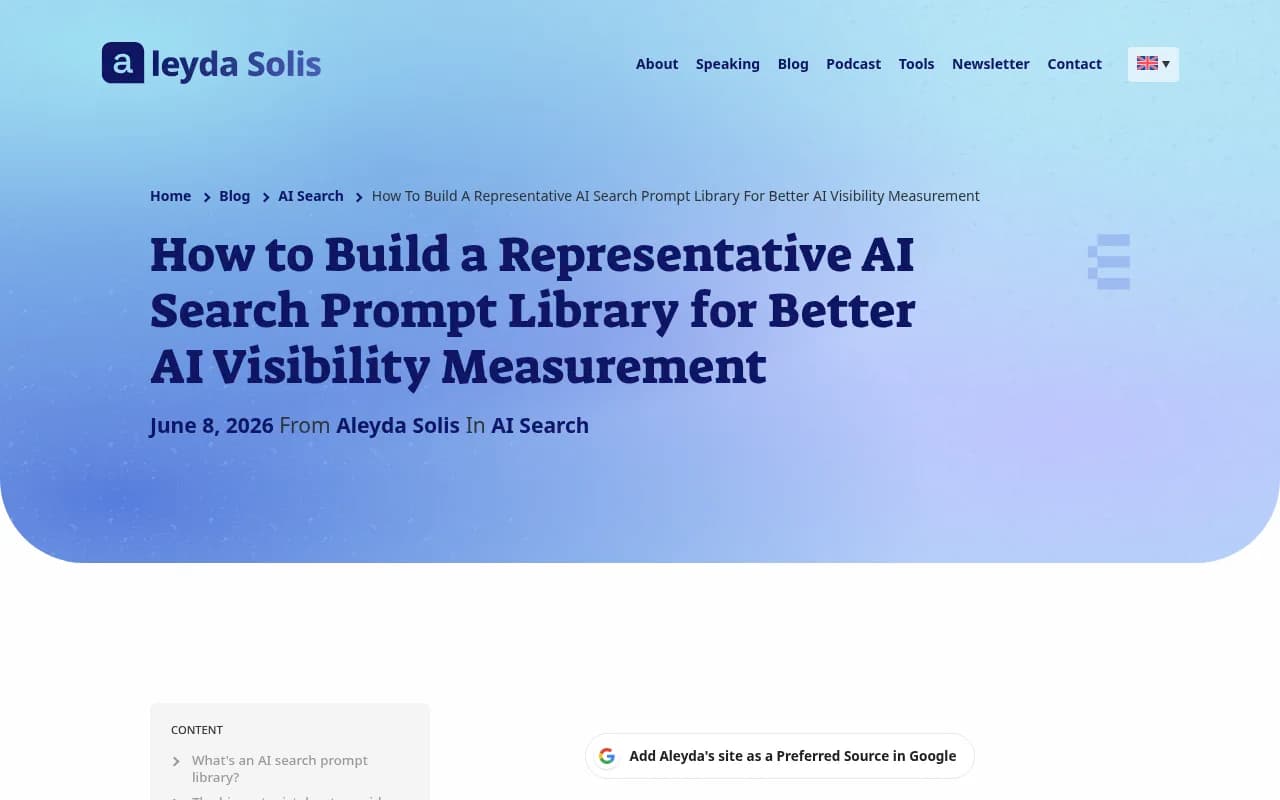
Aleyda Solis puts it well in her AI search prompt library guide: a prompt set that over-represents generic discovery prompts, ignores product lines, misses local competitors or only tracks branded questions can make a dashboard look useful while pointing you at the wrong priorities. The goal is a representative sample of the journeys that matter, not every possible prompt.
Why 50? SE Ranking suggests starting with 20 to 40 prompts, and a persona-based approach of roughly 15 prompts per persona. For a marketing team with two or three personas and a handful of product areas, 50 lands in the sweet spot: big enough to cover real ground, small enough that you can read the results and act on them. A bloated set is hard to analyze and expensive to maintain.
A quick note on terminology. These are not the prompts you type into ChatGPT to write email copy. Guides like monday.com's list of 40 marketing prompts cover that. Here, a tracked prompt is a question your buyers ask an AI assistant, which you monitor to see whether your brand appears, how it is described, and which sources get cited.
Before any framework: answer the business questions
Solis's advice is to start with business questions, not prompts. Write down answers to these before you open a spreadsheet:
- Which products, services, categories or markets matter most right now?
- Which audiences do we need to represent, and do they use different terminology?
- Which countries or languages are strategically important?
- Which competitors belong in the set, by product line or market?
- Which conversion path matters: purchase, demo, signup, booking?
Two hours on this saves weeks of cleaning up later. It also gives you a way to say no to prompts that sound interesting but have no commercial link.
Framework 1: the buyer journey split
This is the simplest place to start, and the one SE Ranking's guide uses. You divide prompts by where the buyer sits in the decision.
SE Ranking's suggested distribution for a 20 to 40 prompt set is 10 to 20 awareness prompts, 20 to 30 consideration prompts, and 5 to 10 brand evaluation prompts, tracked separately from category prompts. Scale that to 50 and you get something like:
- 15 awareness prompts: problem-led questions such as "how do I reduce no-shows for a dental clinic"
- 25 consideration prompts: shortlist and comparison questions such as "best scheduling software for small clinics" or "X vs Y"
- 10 brand evaluation prompts: "is [brand] good for...", pricing, reviews, alternatives to your brand
Why it works: it stops you over-weighting the awareness end, where AI answers are broad and your brand rarely shows up anyway. Where it falls short: it says nothing about who is asking. A CFO and an office manager walk the same journey with very different questions.
Framework 2: the persona stack
Personas fix the weakness of the journey split. SE Ranking quotes an expert who measures prompts around personas, roughly 15 prompts per persona, run about five times a week. Riverside's Erika Varangouli recommends organizing the tracking set by audience personas, use cases, product features and topics, instead of trying to cover every variation.
For your first 50, three personas at around 15 prompts each plus a handful of shared brand prompts is a clean structure. Each persona gets its own vocabulary. The same product might be "time tracking" to a founder and "GPS time tracking for field service teams" to an operations lead. The second one is the kind of narrow, intent-rich prompt SE Ranking points to as a good starting place.
The catch: personas only help if they are distinct. If two of your personas would ask nearly identical questions, merge them. Otherwise you are padding the list.
Framework 3: the prompt matrix
This is the most rigorous option and the one I would use for a multi-product or multi-market business. Solis recommends building a matrix before writing individual prompts, with these columns:
- Product, service line or category
- Audience or persona
- Market and language
- Journey stage
- Prompt type (best tools, alternatives, brand vs competitor, where to buy, how to solve)
- Buyer constraint (budget, integration, compliance, urgency)
- Competitor or alternative set
- Business priority (high, medium, low)
Each row becomes one or more prompts. A sample row: Product A, SMB buyer, US English, discovery, best/shortlist, small team on a budget, direct competitors and free alternatives, high priority.
The matrix shows coverage gaps immediately. If you have six rows for Product A and none for Product B, you see it. For a simple business the matrix is small. For a complicated one it is the only thing that keeps the library from turning random. The downside is time. Plan on a half day to fill it in properly.
Add real buyer constraints
Whichever framework you choose, constraints are what separate useful prompts from generic ones. Solis's example: "Best project management software" is generic. "Best project management software for a 25-person marketing agency that needs client approvals, Slack integration and recurring task templates" is how a real buyer asks. The second one is far more likely to match an actual conversation, and far more likely to reveal who the AI recommends in your niche.
Framework 4: the intent mix
This one comes straight from citation data. Promptwatch Data's content type report (Sep 28 to Oct 4, 2026) shows that ChatGPT leans on different content depending on the kind of prompt:
| Prompt intent | Example | Top cited content types |
|---|---|---|
| Commercial | "best CRM for small businesses" | Product pages 26.0%, landing pages 20.6%, listicles 15.0%, comparisons 7.9% |
| Informational | "how does a CRM work" | Product pages 19.1%, landing pages 13.9%, listicles 13.6%, how-tos 10.7% |
| Branded | "is HubSpot good for startups" | Product pages 23.3%, landing pages 22.8%, reviews 5.6%, FAQ pages 4.8% |
Across all prompts, product pages take 22.4% of citations and landing pages 16.8%, together about 39%. Editorial formats combined make up around 43%.
The practical point: if you only track commercial prompts, you will only see how you perform in one slice of the content mix. Tag every prompt as commercial, informational or branded, and aim for a deliberate split. A reasonable starting ratio for 50 is 25 commercial, 15 informational and 10 branded. Adjust it if your sales cycle is heavily research-driven.
This framework pairs well with the journey split, since commercial roughly maps to consideration, informational to awareness, and branded to evaluation. The difference is that intent tagging is tied to how the AI chooses sources, so it tells you which pages to fix, not just which stage you are weak at.
Framework 5: topics as variables
Helen Pollitt, Director of SEO at Getty Images, argues in SE Ranking's guide that we should track topics, not individual prompts. Treat the topic as a variable that plugs into any prompt structure. Your topic is "content marketing software", and the templates are things like "best [topic] for [persona]", "[topic] alternatives", "[topic] pricing", "how to choose [topic]".
This matters because of how ChatGPT searches. Promptwatch Data's query fanout report found ChatGPT ran about 2 web searches per prompt in early December 2025, easing to about 1.84 by March, then returned at 1.0 per response in April after a gap in the data. Fanout query length fell from around 117 characters to the high 80s, and about 53 characters in April. The takeaway is that your content has to match the short queries the model generates, not the user's literal prompt. Tracking sub-questions like pricing, alternatives and how-tos under each topic covers those fanouts.
A workable build: 8 to 10 topics, each with 5 to 6 templates. That gets you to 50 quickly and keeps the list organized in a way that is easy to explain to a CMO.
Comparing the five frameworks
| Framework | Best for | Effort | Main risk |
|---|---|---|---|
| Buyer journey | Single product, small team | Low | Ignores who is asking |
| Persona stack | B2B with distinct buyers | Medium | Personas that overlap |
| Prompt matrix | Multi-product or multi-market | High | Over-engineering a small business |
| Intent mix | Teams that want to act on citation data | Low | Skips audience and market |
| Topics as variables | Content-led teams, scalable lists | Medium | Template prompts feel artificial |
My own take: no single one is enough. A good first 50 usually combines topics (what you want to be known for), personas (who is asking), and an intent tag on every row. Use the matrix if you operate in more than one market.
Sourcing the actual wording
Frameworks give you structure. Real language gives you realism. Pull phrasing from places buyers already talk:
- Sales call notes and support tickets
- Site search queries and Google Search Console
- Reviews and community threads
- People Also Ask style questions
- Your own website, reverse-engineered into narrow queries
Tools like AnswerThePublic and AlsoAsked are good for the question-style phrasing.
If you want to see which prompts have volume and how hard they are to win, a platform like Promptwatch includes prompt volumes, difficulty scores and query fan-outs, and it suggests prompts from Search Console and People Also Ask data.

Which models to run them on
SE Ranking recommends running prompts across two or three priority models: ChatGPT for its user base, Perplexity for citation-heavy behavior, and Google AI Overviews or AI Mode for ties to traditional search intent. That is a sensible default. Do not try to cover everything on day one. More models multiplies cost and noise.
If you are choosing software, a few options worth a look from the catalog:
| Tool | Angle |
|---|---|
| Promptwatch | Tracking plus content gap analysis, crawler logs and content generation |
| SE Ranking (SE Visible) | AI visibility inside a familiar SEO suite |
| Otterly.AI | Lower-cost prompt tracking |
| Peec AI | Monitoring-focused tracking |
| Profound | Enterprise-level monitoring |



For a broader comparison, the directories at bestgeosoftware.com and ai-rank-tools.com list far more options.
A worked example: assembling 50 prompts
Say you sell scheduling software to clinics. You choose three personas (clinic owner, practice manager, IT lead), five topics, and tag each by intent.
- Fill a small matrix: three personas, two markets (US and UK), priority marked.
- For each topic, write six templates: best-for-persona, alternatives, X vs Y, pricing, how to solve the underlying problem, and an integration question.
- Add real constraints to at least half: practice size, EHR integration, HIPAA.
- Add 8 to 10 branded prompts about your own name, competitor names and "is X good for...".
- Tag each as commercial, informational or branded. Check the ratio. Fix it.
- Label 40 as core and 10 as experimental.
That last step matters. Solis recommends a stable core set for recurring tracking, kept separate from experimental or monitoring prompts, so trends stay comparable.
Running it: what to record and when to change it
For each prompt group, note whether your brand appears, how it is recommended, whether you are cited with a link, which sources the AI used, and which competitors show up. Then work out the likely gap: visibility, representation, source ecosystem, competitor strength, owned content or technical accessibility. Assign an owner to every finding.
A few operating rules:
- Track for at least 30 days before concluding anything. Responses vary between runs.
- Review quarterly. Retire prompts that never surface anything useful and add new ones as campaigns change.
- Log the model and date for each result. A prompt that behaved one way in January can behave differently after a model update.
- Refresh the library when products, competitors or markets change.
If you would rather hand some of the planning off, an agency can help with the whole setup. 1001 SEO Media builds prompt sets as part of its AI search and GEO work, but you can do a good first pass in-house with the steps above.
Common mistakes
- Tracking only branded prompts. You will look great and learn nothing.
- Accepting a tool's default set. Defaults are generic by design.
- Treating a topic list as a prompt list. Topics need templates and constraints.
- Ignoring local language. Translation is not localization; competitors and sources differ by market.
- Changing the set every week. You lose any ability to see trends.
Where to start this week
Pick two frameworks, probably topics plus personas, and write the business questions on one page. Build 50 prompts, tag intent, split core from experimental, and run them on two or three models for 30 days. Then look at the gaps, not the averages. The gaps tell you what to publish next.