Key takeaways
- Google AI Overviews cites roughly 10 sources per answer while ChatGPT's web-search responses average closer to 5, and Microsoft Copilot has swung between under 2 and nearly 17 sources per response in a matter of weeks. A dashboard built for one engine's citation math misreads the others.
- Content format preferences diverge sharply: ChatGPT leaned into product pages (32.8% of July 2026 citations) while AI Overviews favored listicles and how-tos before product pages overtook listicles in late July. The same page performs differently depending on which engine is scoring it.
- Reddit's share of ChatGPT citations fell from about 3.8% to 0.5% in a single day (August 14, 2026), while Google AI Overviews and AI Mode declined gradually over the same window. These platforms simply don't move together.
- Google is merging AI Overviews and AI Mode into one search experience starting in 2026, but they're still separate systems today, with AI Mode overlapping traditional top-10 organic results by less than 50% on some queries.
- Engine coverage in most AI-visibility tools is gated by pricing tier, not marketing copy. Cheap plans often track ChatGPT only; full coverage across 8-9 engines is usually reserved for enterprise pricing.
The assumption that breaks first
Most teams set up brand monitoring for AI search the same way they'd set up a rank tracker: pick a tool, plug in some prompts, watch a dashboard. It feels reasonable. It's also wrong, and it breaks fast once you actually look at the data.
Here's the thing nobody tells you upfront: ChatGPT, Google AI Overviews, Perplexity, and Copilot are not four windows into the same underlying system. They're four different retrieval architectures with different citation budgets, different content preferences, and different failure modes. Treating them as one "AI search" category and expecting a single score to represent your visibility across all of them is like averaging your Google ranking with your Instagram follower count and calling it a "visibility score." It's a number, but it's not telling you anything you can act on.
Different engines, different citation math
Start with the most basic fact: how many sources does each engine actually cite per answer? According to Promptwatch's data on average sources per response, Google AI Overviews cites around 10 sources per answer and holds that average steady over time. Perplexity is even more consistent, sitting almost exactly at 10 with barely a decimal point of daily movement. ChatGPT's web-search-enabled responses cite roughly half that, around 5 sources on average, the smallest inventory of the major engines. Microsoft Copilot is the outlier here, and not in a good way: its average has swung from under 2 sources to nearly 17 within a few weeks before settling low again, which tells you Microsoft is still rebuilding how Copilot attributes sources.
Why does this matter for monitoring? If your dashboard treats "citation slots" as a fixed pool of 10 (the Google-style assumption), it will systematically overrate how hard it is to get cited in ChatGPT, where the pool is half the size, and it will completely misjudge Copilot, where the pool itself is unstable. A tool that normalizes scores across engines using one formula is quietly lying to you about at least one of them.
It gets worse when you factor in that citation counts aren't even stable within a single engine over time. After the GPT-5.3 rollout on March 4, 2026, average citations per ChatGPT response dropped from roughly 6.4 to 4.7-4.9, about 27% fewer citation slots, across every ChatGPT model simultaneously, and it never bounced back a month later, per Promptwatch's tracking of the ChatGPT citation drop. If you saw a visibility dip around that date and assumed your content had a problem, you'd have been chasing the wrong fix. The platform changed under everyone at once.
The content-type trap
Here's where a single dashboard really starts to mislead people: content format preferences are not the same across engines, and they're moving in opposite directions.
In July 2026, ChatGPT Search citations broke down as roughly 32.8% product pages, 9.7% listicles, 5.2% news articles, 4.1% how-tos, 4.1% social posts, and 2.9% comparisons, according to Promptwatch's ChatGPT citation type data. Product pages nearly doubled their share since March, when they sat around 18%.
Google AI Overviews, over the same July window, looked almost inverted: listicles led at 18.0%, product pages at 16.3%, how-tos at 15.1%, news articles at 13.5%, per Promptwatch's AI Overviews citation type data. But by month-end, product pages had actually overtaken listicles on a daily basis (17.9% vs 16.2%), even though listicles still won the full-month average. Video citations in AI Overviews also climbed from about 2.7% in January to over 6.3% by late July, a format most AI-visibility tools barely classify at all.
So if your dashboard applies one "content type" tag to a citation regardless of which engine surfaced it, you're masking a real, measurable divergence. A listicle that's doing well in AI Overviews might be nearly invisible to ChatGPT, which increasingly wants product pages. A single trend line can't show you that; it can only average it into meaninglessness.
Reddit's collapse is the clearest proof these platforms don't move together
If you need one concrete example to hand to a skeptical stakeholder, use this one. On August 14, 2026, reddit.com's share of ChatGPT Search citations fell from a steady 3.8% (holding from July 18 to August 7) down to 0.5%, an 86% relative drop, in a single day. Over that exact same window, Google AI Overviews only drifted from 2.37% to 2.10% share, and Google AI Mode from 2.22% to 1.54%, both gradual, neither anything close to a cliff. That's from Promptwatch's analysis of Reddit citations dropping in ChatGPT, and the timing lines up with a change in how ChatGPT runs its background searches (more on that below).
If you were only watching one aggregated "social citation" number, you'd have seen a modest decline and moved on. Watching ChatGPT and Google separately, you'd have seen a genuine platform event, the kind that might change where you invest content effort for the next quarter.
And Reddit isn't even the platform every engine treats the same way. ChatGPT is what Promptwatch calls a "Reddit specialist," with Reddit accounting for 5.19% of its citations, more than 20 times its next social platform (LinkedIn at 0.23%). AI Overviews and Grok, by contrast, lean on YouTube (4.08% and 4.85% respectively), and Perplexity favors it too (2.67%), per Promptwatch's social media citation data by AI model. Build your social-proof strategy around Reddit because "AI search cites Reddit a lot," and you'll be half right for ChatGPT and mostly wasting effort everywhere else.
The hidden fanout problem
Most visibility dashboards log the final, visible citation in a response. What they don't show is the searching that happens before that citation appears, and that search behavior is where ChatGPT and Google genuinely diverge.
ChatGPT doesn't run one search per prompt. It fans out into multiple sub-searches (Promptwatch's data on ChatGPT query fanouts shows average fanouts per response falling from 2.15 in early December 2025 to about 1.0 by April 2026, alongside average query length shrinking from roughly 117 characters to 53, meaning the queries themselves look more like terse keyword strings now than full sentences). Then, on August 8, 2026, ChatGPT started using the site: operator at scale in these fanouts, jumping from about 0.4% to 17% of all fanout queries overnight, according to Promptwatch's tracking of the ChatGPT site-operator shift. Google's AI Overviews and AI Mode run their own, separate fanout logic internally, breaking a search into sub-queries and ranking sources per sub-query before synthesizing an answer, which is a different mechanism entirely, built for a different retrieval stack.
The practical result: a brand can be present at the retrieval step and never show up in the visible citation, or the reverse. A monitoring tool built around Google's fanout model won't automatically capture what ChatGPT is doing, and vice versa. If your tool only logs the final answer, you're missing the step where a lot of this gets decided.
AI Overviews and AI Mode aren't even the same thing yet
A lot of brand-monitoring setups conflate Google AI Overviews with Google AI Mode, treating them as one Google surface. They're not, not yet anyway. AI Overviews launched broadly in the US in May 2024 and appears automatically inside standard search results, static, no follow-up, triggered selectively for high-confidence queries. AI Mode is a separate, user-selected tab built for multi-step conversational queries with retained context, and it reportedly crossed 1 billion monthly users around Google I/O in May 2026, with query volume said to be doubling every quarter and average queries running about 3x longer than conventional searches, per reporting from Green Flag Digital.
Google announced in May 2026 that the two are merging into one "seamless AI Search experience," but that's a multi-quarter rollout, not a switch that flipped overnight. In the meantime, Semrush's domain-overlap analysis found AI Mode's citations overlap with traditional organic top-10 results by less than 50% on some queries, sometimes closer to 30%. That's a strong argument against inferring AI Mode visibility from your existing rank-tracking data. It's a different result set, and it needs its own monitoring.
What this means for choosing a tool
The practical fallout from all of the above is that engine coverage in AI-visibility tools matters a lot more than most buyers realize, and it's usually gated hard by pricing tier rather than by what a vendor's homepage implies. Profound's cheapest self-serve plan tracks ChatGPT only; you need the Growth tier to add Perplexity and Google AI Overviews, and Enterprise pricing to unlock the full set of nine engines. Otterly.AI's entry tier covers four engines but treats Google AI Mode, Gemini, and Claude as paid add-ons even at higher base plans. Scrunch AI reserves Claude, Gemini, Meta AI, and Grok for Enterprise only. The pattern repeats across nearly every vendor in the category: what you can afford determines what you can actually see.
| Approach | Engines typically covered at entry tier | What it misses |
|---|---|---|
| Single cheap AI-visibility tool (e.g. entry-tier Otterly, Peec) | ChatGPT, Perplexity, AI Overviews | AI Mode, Copilot volatility, crawler-level access, Reddit/YouTube-specific tracking |
| Classic rank tracker only | Google organic | All chat-based AI answers entirely; AI Mode overlaps organic top 10 by under 50% on some queries |
| Single enterprise AI-visibility suite at full tier | Up to 8-9 engines | Still monitoring only; most don't auto-fix content gaps or show crawler-level access logs |
| Multi-tool stack matched to specific engines | Whatever you deliberately configure | Requires more setup, but avoids the blended-score problem entirely |
A few tools worth knowing by name if you're shopping this category. Ahrefs Brand Radar differentiates itself with a "dual-index" methodology built on real People Also Ask query volume rather than fabricated hypothetical prompts, which matters because most competitors invent the prompts they test against.
Profound was named a Representative Vendor in Gartner's inaugural 2026 Market Guide for Answer Engine Visibility Tools and has been pushing into automated remediation with its FactCheck feature.
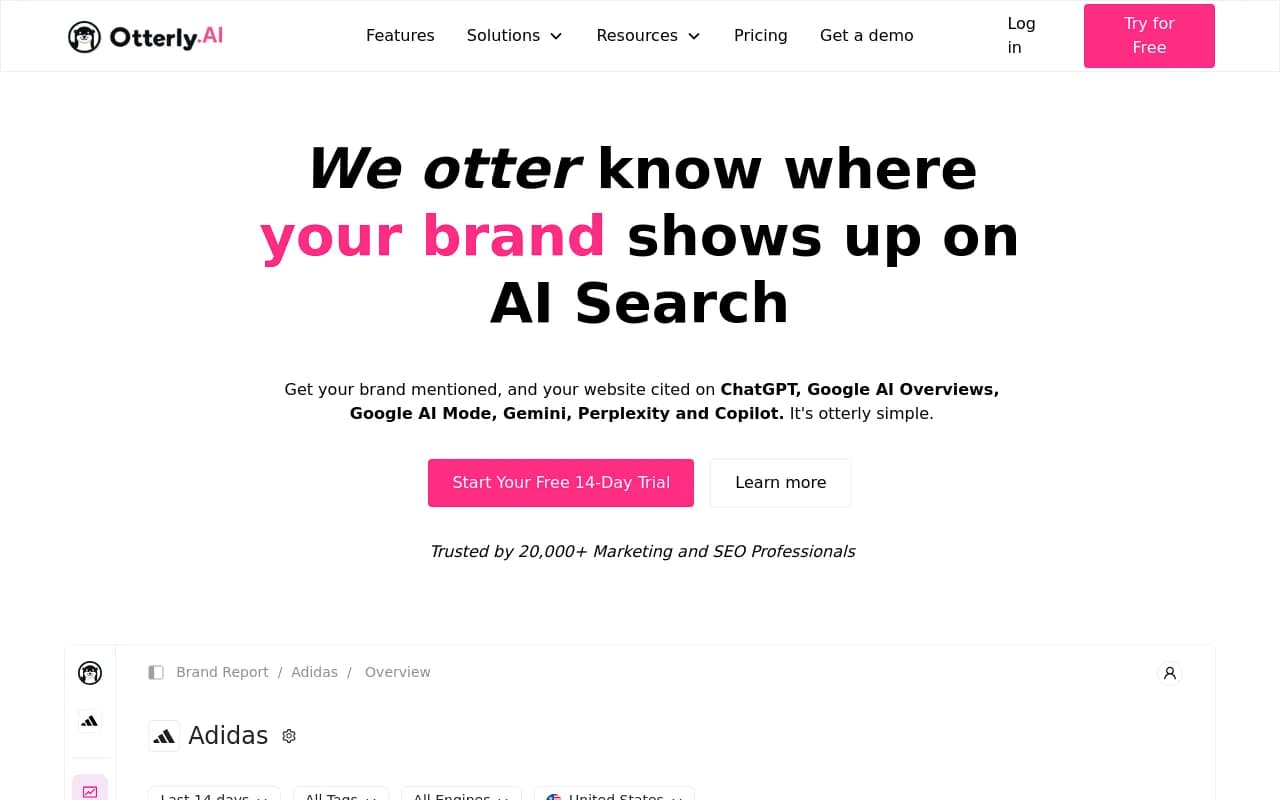
Otterly.AI is a reasonable low-cost entry point if you only need core coverage (ChatGPT, AI Overviews, Perplexity, Copilot) and don't mind paying extra for AI Mode or Claude later.
Scrunch AI sits in a similar mid-market tier, with broader engine access reserved for its higher plans.
If you want a platform designed around the idea that monitoring alone isn't the finish line, Promptwatch tracks ChatGPT, Gemini, Claude, Perplexity, Grok, DeepSeek, Copilot, Mistral, Meta Llama, Google AI Overviews, and Google AI Mode from a single account, and it pairs that with crawler logs (showing when AI bots actually visit your pages and what they read), citation trend data broken into 22 content types, dedicated Reddit and YouTube citation reports, and Content Agents that can draft and publish fixes to your CMS instead of just flagging the gap and leaving you to solve it.

That matters given everything above: if ChatGPT wants product pages and AI Overviews wants how-tos this month, and both can flip again next quarter, you need a tool that shows you the divergence per engine, not one that blends it into a single score you can't act on.
Building a monitoring setup that respects the differences
A few practical habits, based on the data above:
- Track citation share and content type per engine separately, never as a blended average. If a tool only offers a single "visibility score," ask what's inside it before trusting a downward trend.
- Check platform release dates before blaming your content for a dip. The March 2026 GPT-5.3 rollout cut ChatGPT's citation count by roughly a quarter overnight, across the entire platform, for reasons that had nothing to do with any individual brand's SEO.
- Don't assume Reddit or YouTube strategy transfers between engines. ChatGPT over-indexes on Reddit; AI Overviews and Grok lean on YouTube. Build content placement around the engine you actually care about.
- Treat AI Overviews and AI Mode as separate targets until Google's merger is complete. They pull from different result sets today, even if that changes over the next few quarters.
- Match your tool's pricing tier to the engines you actually need visibility into, not the engines the vendor advertises at their top tier. Read the fine print on what's included versus what's a paid add-on.
For a broader look at where the AI-visibility category is heading and which platforms actually go beyond passive tracking, the GEO software directory at bestgeosoftware.com is a useful place to compare options side by side, and surferstack.com covers the wider software landscape if you're weighing AI-visibility tools against your existing SEO stack.
If you'd rather have someone build and run this monitoring and content strategy for you, 1001 SEO Media works on exactly this kind of AI search visibility and GEO work, combining technical audits with content production aimed at getting cited across both AI Overviews and chat-based engines, not just one or the other.