Key takeaways
- Perplexity brand tracking measures whether the engine mentions you, cites your domain, and which competitor URLs take the citation slots. It is not classic rank tracking.
- Perplexity cites almost exactly 10 sources per answer, according to Promptwatch's average sources per response data. That stability makes it a good engine for testing whether your content changes actually move citations.
- Most tools on this list cover Perplexity as one engine among many. The real differences are real-UI data versus API data, whether prices are published, and whether the tool helps you fix gaps or just reports them.
- Vendor listicles disagree on pricing (one says $29 to $189 a month for the top trackers, another says $59 to $499 for a single tool). Check every pricing page yourself before buying.
What Perplexity brand tracking actually measures
If you come from SEO, the word "rank" misleads you here. Google gives you a position in a list. Perplexity writes an answer, attaches sources, and may give you a different answer the next time someone asks the same question.
SparkToro published research in January 2026 showing that ChatGPT and Google AI returned the same list of brands in fewer than 1 in 100 runs. That study was not about Perplexity specifically, but the lesson transfers. One manual check tells you almost nothing. A useful tracker runs many prompts repeatedly and reports rates: how often you are named, how often you are linked, and which domains show up instead of yours.
Three numbers matter:
- Mentions: Perplexity names your brand in the answer text.
- Citations: Perplexity links to your domain as a source.
- Displacement: which competitor URLs sit in the source list when you are missing.
The third one is where most dashboards are thin. Knowing visibility dropped is easy. Knowing which page replaced you is what lets you do something about it.
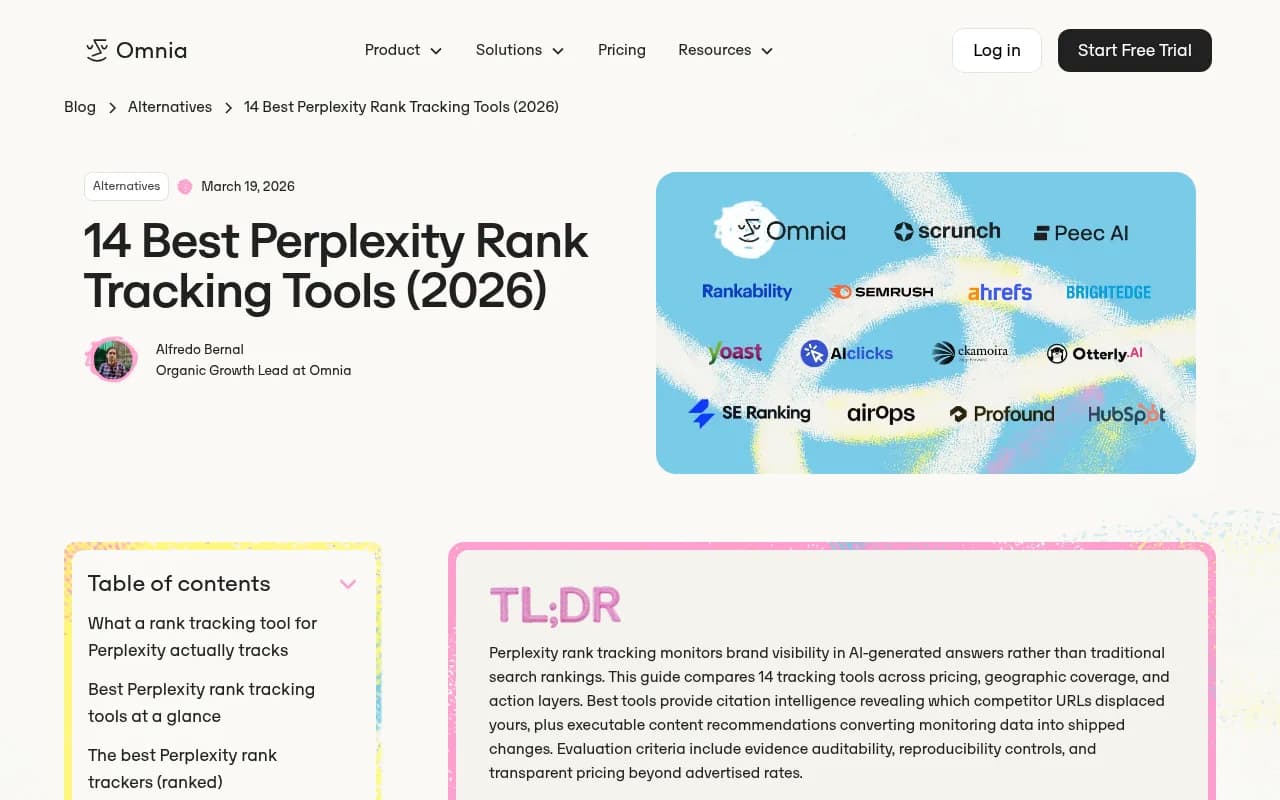
Omnia's explainer is a decent primer on why Perplexity tracking differs from Google tracking. Note that it is vendor-authored, like most guides on this topic. Its estimate that Perplexity handles 1.2 to 1.5 billion queries a month by mid-2026 comes from a third-party source and is an estimate, not a confirmed figure.
Why Perplexity is a good test bench
Promptwatch's data shows Perplexity citing almost exactly 10 sources per answer, day after day, with barely a decimal of movement. ChatGPT averages about 5 sources on web-search answers, and Copilot swung from under 2 to nearly 17 within a few weeks. The report's own conclusion is that Perplexity's steady count makes it a clean place to test GEO changes, because a shift in your pickup reflects your content rather than engine noise.
The mix of sources also differs by engine. In Promptwatch's social media citations report for Sep 28 to Oct 4, 2026, social platforms made up 2.7% of Perplexity's citations. LinkedIn and Reddit tied at 0.86%, YouTube sat at 0.79%, and X peaked at 0.1% on Perplexity. For comparison, ChatGPT got 0.46% of its citations from social and Google AI Overviews got 12.2%. If you only publish on Reddit for Perplexity, you are leaving LinkedIn on the table.
How to choose a Perplexity tracker
Before the list, here is what I would check, in rough order of importance.
- Data source. Does the tool capture what users see in the Perplexity interface, or call an API? The two can differ in answers and citations.
- Evidence. Can you click from a metric back to the actual answer text and cited URLs? If not, you are trusting a number.
- Prompt volume and run frequency. Daily runs over a decent prompt set beat weekly runs over twenty prompts.
- Citation detail. Source URLs, competitor displacement, and ideally per-page citation history.
- Action layer. Does it tell you what to write or fix, or only report?
- Published pricing. Several vendors hide the real cost behind demos, and some gate Perplexity behind higher tiers.
- Geography and language. Some tools cover one country and one language only.
Comparison of the 9 platforms
| Tool | Best for | Perplexity coverage | Action layer | Pricing notes |
|---|---|---|---|---|
| Promptwatch | Teams that want to fix gaps, not just see them | Real UI plus many other engines | Content Agent, Action Board, gap analysis | From $95/mo, free tier |
| Profound | Large enterprises | Check plan gates | Yes | Custom at the top end |
| Semrush | Existing Semrush users | Included per Omnia's comparison | Yes | $99+ per Omnia |
| AIclicks | Growth and content teams | Included | Yes | Reported $59 to $499 |
| Rankability | Agencies wanting tracking plus content | Tracks 11 platforms daily | Content optimization | Verify on vendor page |
| Otterly.AI | Budget-minded monitoring | Yes | Limited | Low entry price |
| ZipTie | Deep analysis of answers | Mentions and citation rates | Reporting focus | Published plans |
| Searchable | Action-oriented analytics | Yes | Yes | Check vendor page |
| Leapd (Alex) | Small teams wanting audits and content | Mentions and citations | Audits and content generation | Check vendor page |
Prices in this table come from vendor-authored listicles that conflict with each other. Treat them as rough signals and confirm on each pricing page.
The 9 platforms
1. Promptwatch
Promptwatch is the one I would put first for teams that care about what happens after the dashboard. It monitors Perplexity through the actual user interface (not just API calls), alongside ChatGPT, Google AI Overviews, Gemini, Copilot and others, in the countries and languages you pick. That matters because user-facing answers and citations can differ from API output.
What separates it from prompt trackers is the loop. You can see which of your pages Perplexity cites, check IP-verified crawler logs for PerplexityBot and Perplexity-User to see whether it can even read your site, and then use content gap analysis, the Action Board and the Content Agent to close the gaps. Published pages are tracked afterward through crawls, citations and AI-referred traffic. Prompt volumes and difficulty scores help you pick which prompts are worth chasing.

Pricing starts at $95 a month on Essential (50 prompts, all AI models), with a free Explore tier limited to ChatGPT. Confirm current numbers at promptwatch.com/pricing. The honest downside: if you only want a cheap weekly mention check, you will pay for depth you do not use.
2. Profound
Profound targets large enterprises and has a strong monitoring feature set, with a higher price point. One of the comparison guides lists it with Perplexity not included in the base plan and coverage limited to one country and one language, so check plan gates carefully before assuming you get what you need.

3. Semrush
If your team already lives in Semrush, adding its AI visibility features is the path of least resistance. The tradeoff is that traditional SEO suites tend to bolt AI tracking onto an existing product, often with fixed prompt sets and thinner AI-specific data than dedicated platforms.
4. AIclicks
AIclicks pitches itself at growth marketers and content teams, with multi-region coverage and Perplexity in the base plan according to Omnia's comparison. It also ranks itself first in its own Perplexity rank tracker roundup, so weigh that accordingly.
5. Rankability
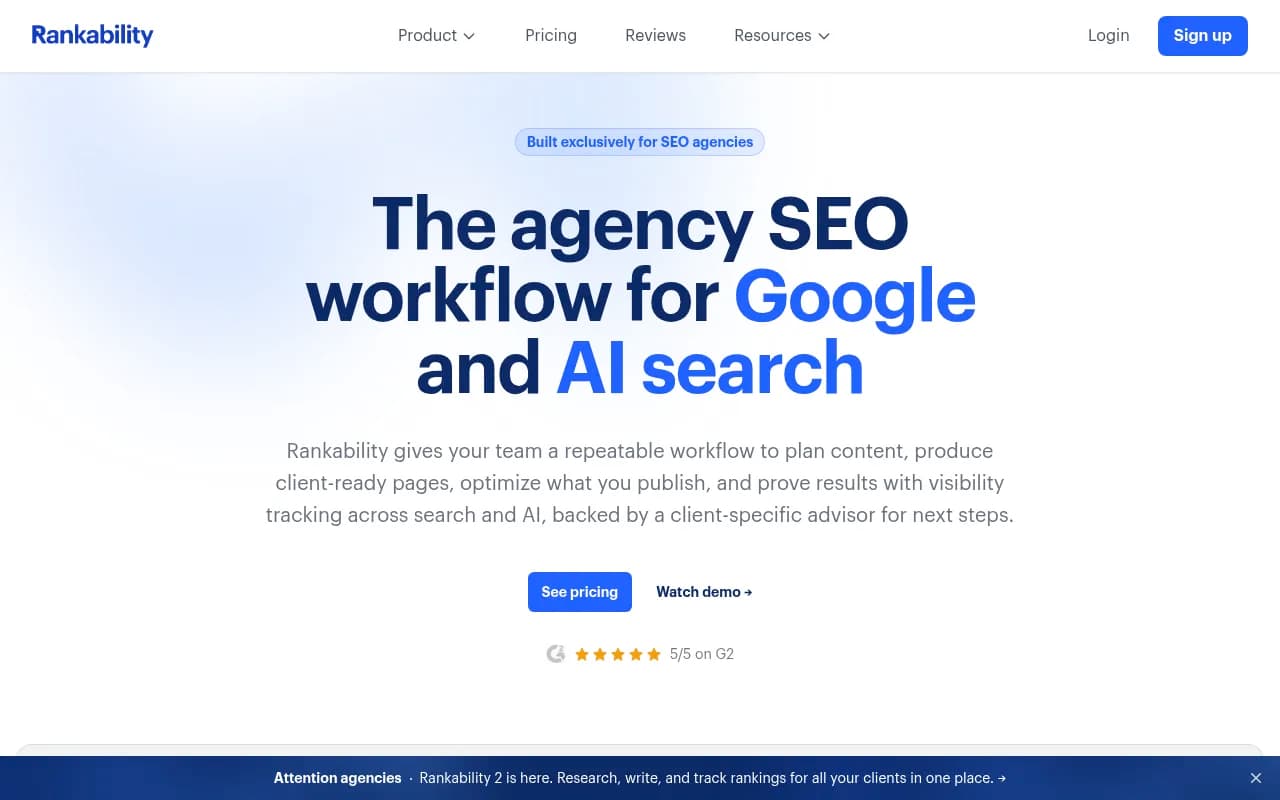
Rankability says it tracks 11 platforms daily, including Perplexity, ChatGPT, Gemini, Claude, Copilot, Grok, DeepSeek and Meta AI. Its pull is for agencies that want tracking and content optimization in one product.
6. Otterly.AI
Otterly.AI is the affordable option for basic monitoring. It tells you whether you are mentioned and cited, but it does not go much further: no crawler logs, no visitor analytics, no content generation. For a small brand that wants a pulse check, that can be enough.

7. ZipTie
ZipTie focuses on deep analysis and reports how often Perplexity mentions and cites you across many prompts, rather than pretending to give a fixed rank. That is the right framing. One caveat: its own guide ranks ZipTie first, though it discloses this openly and says it checked competitors against vendor pages in October 2026.
8. Searchable
Searchable markets action-oriented analytics. Its Perplexity roundup puts the cost of the top ten trackers between $29 and $189 a month, which is far below what some enterprise tools charge, so it is a useful lower-bound reference.
9. Leapd (Alex)
Leapd's Alex tracks whether your brand is cited or mentioned in Perplexity answers, and adds audits and content generation. A reasonable fit for a lean team that wants one tool for tracking and first drafts.

What the vendor guides get wrong (and right)
Every listicle I read for this piece was written by a vendor that ranks itself near the top. ZipTie discloses this plainly, which I respect. Others do not. That does not make the information useless, but it does mean pricing and feature claims should be verified.
What they get right: tracking should be about rates across many prompts, and the best tools show which competitor URL displaced you. What they often skip: whether the data comes from the real interface, and whether the tool helps after you find a gap.
A simple workflow once you pick a tool
- Build a prompt set of 30 to 50 questions buyers ask in your category, split into branded, comparison and category prompts.
- Run a baseline for a week and record mention rate and citation rate separately.
- Open the cited sources for prompts where you are missing. Look at the format of the pages that beat you.
- Check crawler access. If PerplexityBot cannot read your key pages, no content change will help.
- Publish or refresh content, and extend your presence on LinkedIn and Reddit, which tie on Perplexity at 0.86% of citations each.
- Re-measure after a few weeks. Because Perplexity's source count is so stable, movement in your numbers is more likely to be real.
If you are comparing beyond Perplexity, the GEO software directory at bestgeosoftware.com lists more platforms, and Promptwatch Data has the underlying citation research.
Which one should you pick
- You want tracking plus the ability to fix gaps and publish: Promptwatch.
- You already pay for Semrush and want something quick: its AI features.
- You run an agency and want tracking with content optimization: Rankability or Promptwatch's agency plans.
- You want a cheap pulse check: Otterly.AI or Searchable.
- You are a Fortune 500 team with procurement needs: Profound, after checking plan gates, or Promptwatch Enterprise, which is ISO/IEC 27001 certified.
Whichever you choose, run a trial on your own prompts. Tools that look identical in a table often return very different answers for the same query.