Key takeaways
- AI-driven traffic to U.S. retail sites rose 693% year over year during the 2025 holiday season (Adobe data), making AI search a real revenue channel, not a future experiment.
- Most GEO tools only monitor -- they tell you whether you're cited but don't help you fix it. The best tools for e-commerce close that loop with content generation and feed optimization.
- E-commerce brands need product-level tracking, not just domain-level visibility. Whether your SKU appears in a ChatGPT shopping shortlist matters more than whether your homepage is mentioned.
- Promptwatch is the only platform rated "Leader" across all GEO categories in 2026 comparisons, with crawler logs, content agents, and ChatGPT Shopping tracking built in.
- Monitoring-only tools (Otterly.AI, Peec.ai, AthenaHQ) are fine for awareness but leave you stuck when you need to actually improve your rankings.
When a shopper asks ChatGPT "what's the best noise-cancelling headphone under $300," they don't get ten blue links. They get three or four products with names, prices, and a short reason to buy. If your product isn't in that shortlist, you don't exist for that query.
That's the shift that's happened quietly over the past 18 months. AI search stopped being a curiosity and became a commercial channel. Adobe tracked a 693% year-over-year surge in AI-driven traffic to U.S. retail sites during the 2025 holiday season. Gartner estimated traditional search volume would drop roughly 25% by 2026, and that's playing out in real analytics right now.
For e-commerce brands, the implication is uncomfortable: your SEO stack was built for a world that's changing underneath it. Rank trackers measure keyword positions. GEO tools measure something different -- whether AI engines mention you, cite your pages, and recommend your products when shoppers ask.
This guide covers the best GEO tools for e-commerce in 2026, what separates the ones worth paying for from the ones that just show you a dashboard, and how to think about building a stack that actually moves the needle.
What makes GEO different for e-commerce
Generic GEO tools track brand mentions across AI engines. That's useful, but e-commerce has a layer of complexity that most tools weren't designed for.
When someone asks an AI assistant what to buy, the AI isn't just citing your domain -- it's evaluating specific products, comparing prices, checking availability signals, and often pulling from structured data like product feeds. That means visibility in AI shopping answers depends on two things at once:
- Whether AI models have enough quality content about your brand and products to cite confidently
- Whether your product data (GTINs, prices, descriptions, structured markup) is clean enough for AI agents to parse and surface
Most GEO tools handle the first part. Very few handle the second. The best e-commerce GEO setups address both.
There's also the question of what "ranking" even means in this context. In traditional SEO, you rank for a keyword. In AI search, you either appear in an answer or you don't -- and the answer changes based on how the question is phrased, which model is answering, and what persona is asking. That variability makes prompt-level tracking essential.
The tools worth knowing about
Promptwatch -- best for brands that want to find gaps and fix them
Promptwatch is the most complete GEO platform available for e-commerce teams in 2026. The core difference from most competitors is that it's built around an action loop, not just a reporting dashboard.

The sequence works like this: Answer Gap Analysis shows you exactly which prompts your competitors appear in but you don't. You see the specific content your site is missing -- the questions AI models want answered but can't find on your pages. Content Agents then generate articles, comparisons, and briefs grounded in that real prompt data. Then page-level tracking shows you when those new pages get crawled, cited, and which models are picking them up.
For e-commerce specifically, Promptwatch's ChatGPT Shopping tracking is genuinely useful. It monitors when your brand appears in ChatGPT's product recommendations and shopping carousels -- a signal most other tools don't capture at all. The AI Crawler Logs show you which pages AI bots are reading, how often they return, and what errors they're hitting. If ChatGPT's crawler is bouncing off a product category page with a 404, you'll see it.
Prompt Intelligence gives you volume estimates and difficulty scores for each prompt, so you can prioritize the high-traffic, winnable queries rather than spreading effort across everything. The platform covers 10 AI models: ChatGPT, Perplexity, Google AI Overviews, Google AI Mode, Claude, Gemini, Meta/Llama, DeepSeek, Grok, and Copilot.
Pricing starts at $99/month for the Essential plan (1 site, 50 prompts, 5 articles). The Professional plan at $249/month adds crawler logs, state/city tracking, and 15 articles per month. Business is $579/month for 5 sites.
Profound -- best for enterprise teams needing governance
Profound is a strong enterprise pick. It goes deeper on analytics than most tools, with visibility-to-impact reporting that connects AI mentions to business outcomes. It's well-suited for large brands with multiple stakeholders who need governance guardrails and audit trails alongside their visibility data.
The tradeoff is price -- Profound sits at a higher price point than most mid-market tools -- and it doesn't have the content generation capabilities that Promptwatch offers. You get excellent data, but the "what do I do about it" part is still largely on you.
Otterly.AI -- best affordable entry point for smaller brands

Otterly.AI tracks AI visibility across ChatGPT, Google AI Overviews, Gemini, Perplexity, and Copilot. It's one of the more affordable options in the category and has a clean interface that's easy to get started with.
The honest limitation: it's a monitoring tool. You'll see where you're visible and where you're not, but there's no content gap analysis, no content generation, and no crawler logs. For a small brand that just wants to understand its current AI visibility before investing in optimization, it's a reasonable starting point.
Peec.ai -- solid monitoring with clean reporting

Peec.ai covers the major AI engines and gives you share-of-voice data across prompts. The reporting is clean and the setup is straightforward. Like Otterly.AI, it's a monitoring-first tool -- useful for tracking trends over time but not for driving action.
SE Ranking / SE Visible -- best for teams already in the SE Ranking ecosystem
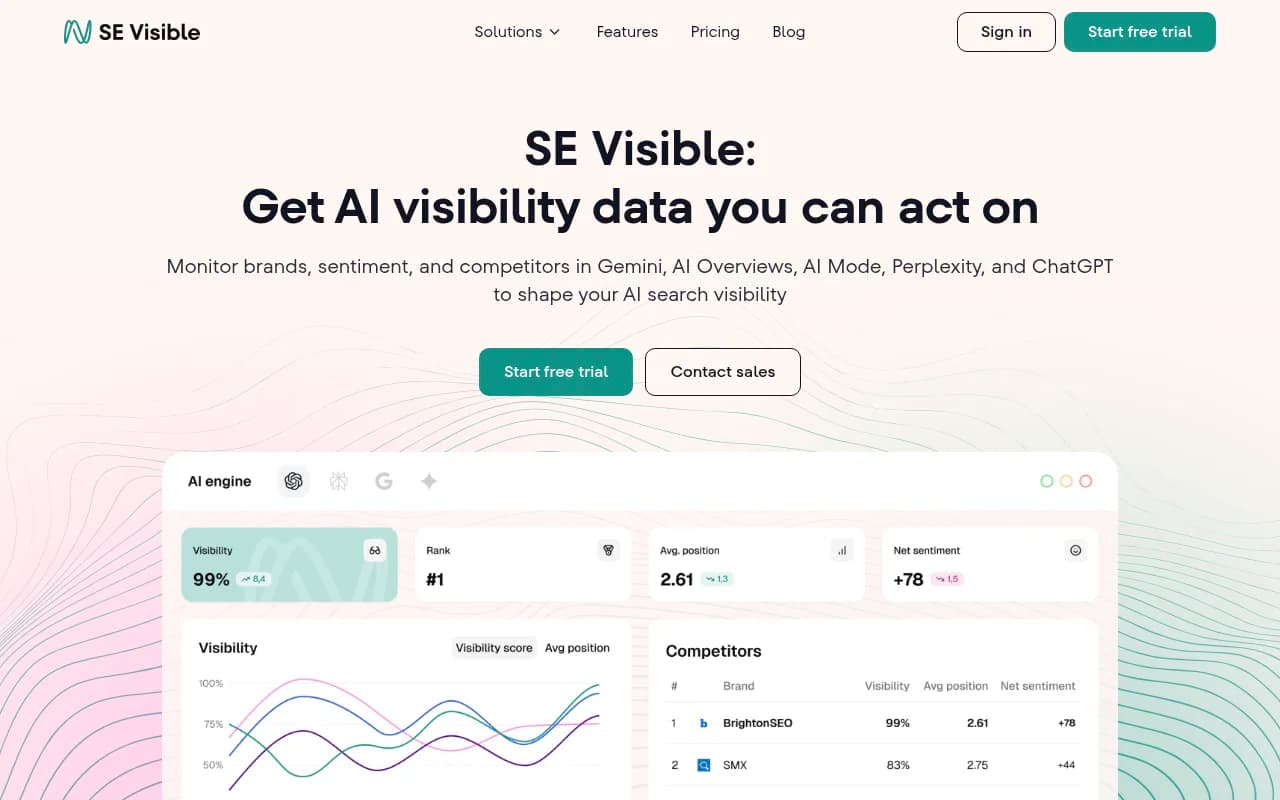
SE Ranking has added AI visibility tracking to its existing SEO platform, and SE Visible is its dedicated GEO reporting layer. If your team already uses SE Ranking for traditional SEO, the integration makes sense -- you get AI visibility data alongside your existing rank tracking without adding another tool.
The coverage isn't as deep as dedicated GEO platforms, and there's no content generation, but the price-to-value ratio is good for teams that want a single platform.
Scrunch -- best for citation auditing and LLM-ready pages
Scrunch focuses on making your content easier for AI assistants to read and cite. It audits your existing pages against what AI models are looking for and helps you create an "agent-facing experience layer" -- essentially a version of your content optimized for LLM parsing rather than human browsing.
For e-commerce brands with large content libraries that haven't been optimized for AI citation, Scrunch's audit approach is useful. It's more of a content optimization tool than a tracking platform.
AthenaHQ -- monitoring-focused with good competitor benchmarking
AthenaHQ tracks visibility across 8+ AI search engines and has solid competitor benchmarking. The interface is clean and the data is reliable. The gap is on the optimization side -- it monitors well but doesn't help you create content or fix what's missing.
Writesonic -- AI search visibility with content creation
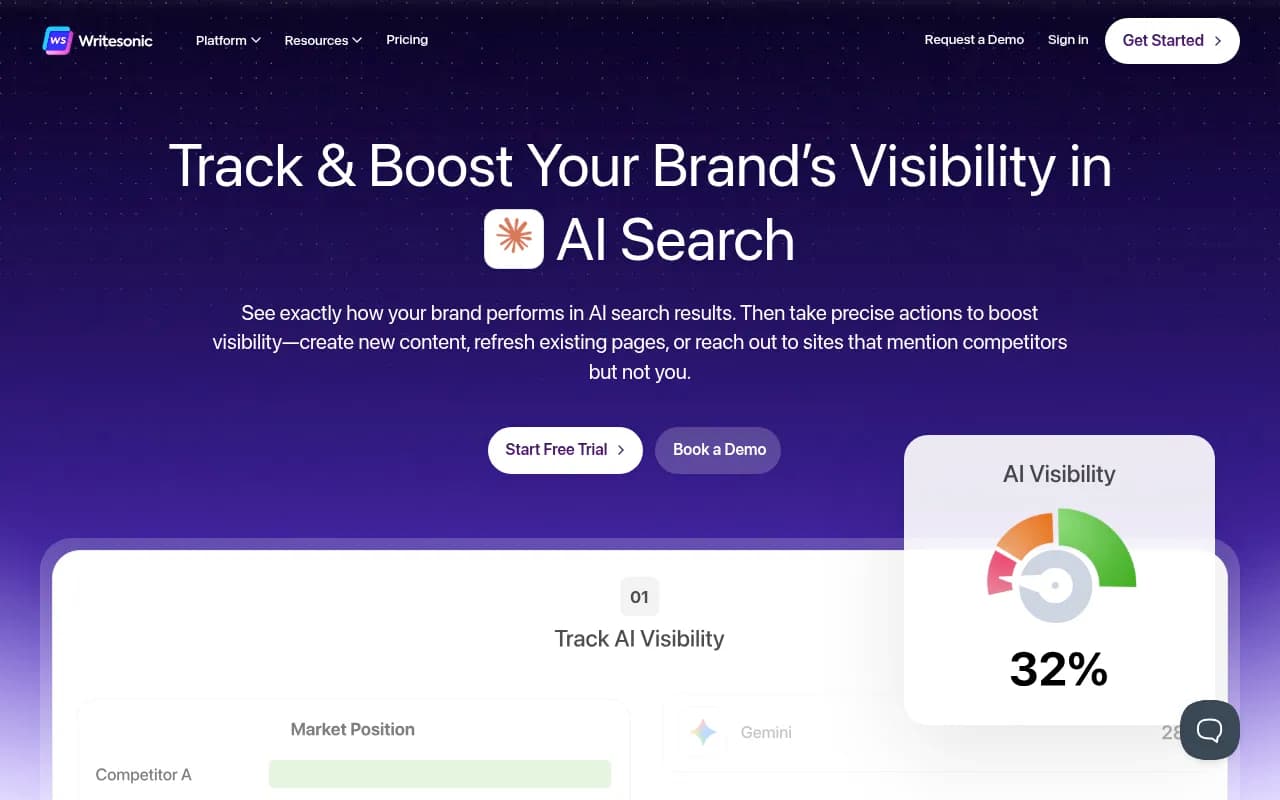
Writesonic has expanded beyond its original AI writing roots to include AI search visibility tracking. It's an interesting option for teams that want content creation and visibility monitoring in one tool, though the GEO tracking features are less mature than dedicated platforms.
Botify -- enterprise technical SEO with AI search visibility
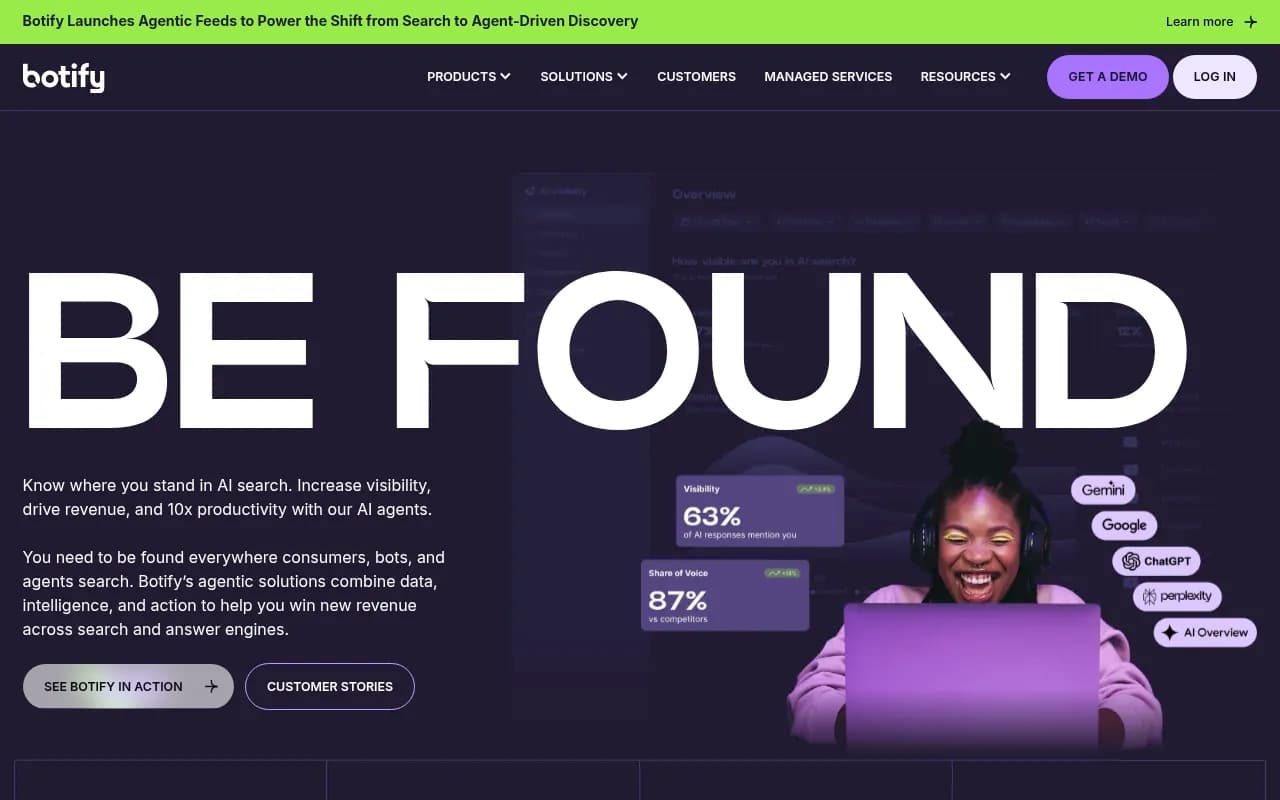
Botify is primarily an enterprise technical SEO platform that has added AI search visibility tracking. If your e-commerce site has serious technical SEO challenges -- crawl budget issues, JavaScript rendering problems, large-scale indexing gaps -- Botify addresses those alongside AI visibility. It's overkill for most mid-market brands but genuinely useful at scale.
Comparison table
| Tool | AI models covered | Content generation | Crawler logs | ChatGPT Shopping | Best for | Starting price |
|---|---|---|---|---|---|---|
| Promptwatch | 10 | Yes (Content Agents) | Yes | Yes | Full optimization loop | $99/mo |
| Profound | 6+ | No | No | No | Enterprise analytics | Custom |
| Otterly.AI | 5 | No | No | No | Affordable monitoring | ~$49/mo |
| Peec.ai | 5+ | No | No | No | Clean share-of-voice reporting | ~$49/mo |
| SE Ranking / SE Visible | 4+ | No | No | No | SE Ranking users | Bundled |
| Scrunch | 4+ | Partial (briefs) | No | No | Citation auditing | Custom |
| AthenaHQ | 8+ | No | No | No | Competitor benchmarking | Custom |
| Writesonic | 5+ | Yes (writing) | No | No | Content + monitoring combo | ~$79/mo |
| Botify | 4+ | No | Yes (technical) | No | Enterprise technical SEO | Custom |
What to actually look for when evaluating a GEO tool for e-commerce
Prompt-level tracking, not just domain-level
Domain-level visibility tells you "your brand was mentioned 47 times this week." That's fine for brand awareness tracking. For e-commerce, you need to know which specific prompts your products appear in -- "best running shoes for flat feet under $150," "waterproof jacket for hiking," etc. Tools that only report at the domain level miss the commercial intent layer entirely.
Product and category tracking
Some tools now track visibility at the product or category level, not just the brand. This matters enormously for e-commerce. Your brand might be cited in AI answers about sustainability, but your hero product might be invisible in "best eco-friendly water bottles" queries. Those are different problems with different fixes.
Coverage of the right AI models
Not all AI models matter equally for e-commerce. ChatGPT and Google AI Overviews drive the most commercial traffic right now. Perplexity is growing fast, particularly for research-heavy purchases. Gemini matters for Google Shopping integration. Make sure the tool you choose covers the models your customers actually use.
The gap between monitoring and optimization
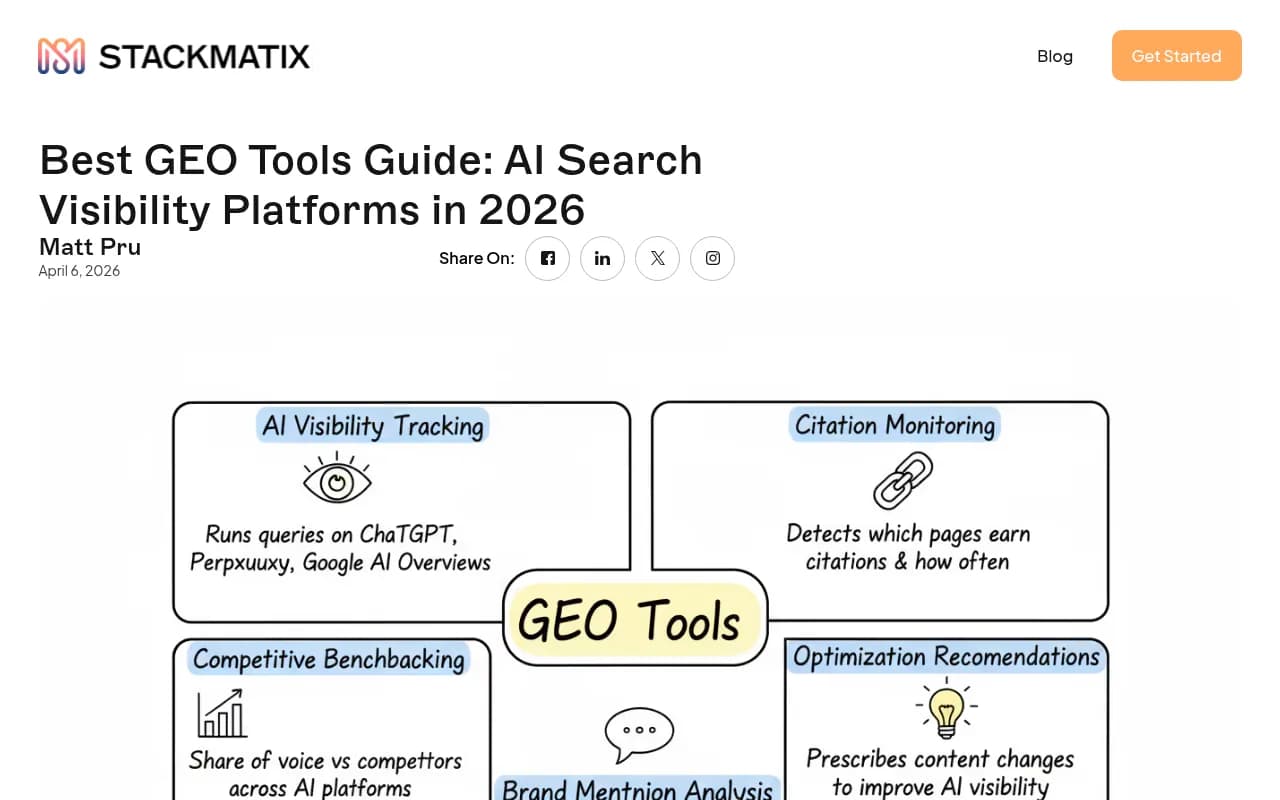
This is the most important distinction in the category. Monitoring tools show you where you're invisible. Optimization platforms help you fix it. Most tools in this space are monitoring tools. If you want to actually improve your AI visibility -- not just measure it -- you need a platform with content gap analysis, content generation, or both.
Crawler and indexing data
AI models can only cite content they've crawled and processed. If your product pages have crawl errors, slow load times, or JavaScript rendering issues that prevent AI bots from reading them, no amount of content optimization will help. Tools that show you AI crawler activity (what's being read, what's being skipped, what errors are occurring) give you a layer of diagnostic data that pure monitoring tools don't.
How to build an e-commerce GEO stack in 2026
You don't need ten tools. Most e-commerce teams are better served by one solid platform that covers monitoring, gap analysis, and content optimization, plus a technical SEO tool if the site has crawlability issues.
A practical starting point:
For small to mid-size e-commerce brands: Start with Promptwatch at the Professional tier. The combination of prompt tracking, Answer Gap Analysis, Content Agents, and ChatGPT Shopping monitoring covers most of what you need. Use Google Search Console alongside it for traditional search data.
For enterprise brands with large catalogs: Promptwatch at Business or Enterprise tier, potentially paired with Botify if you have serious technical crawl issues at scale. Profound is worth evaluating if you need enterprise governance features.
For teams just getting started: Otterly.AI or Peec.ai to establish a baseline of where you currently stand, then graduate to a platform with optimization capabilities once you understand the gaps.
The content side of GEO for e-commerce
Tracking visibility is only half the job. The other half is creating content that AI models actually want to cite.
AI engines tend to cite content that directly answers specific questions, uses clear and structured language, demonstrates expertise on a topic, and is regularly updated. For e-commerce, this means:
- Product comparison pages that answer "X vs Y" queries directly
- Category guides that explain how to choose between product types
- FAQ content that matches the exact phrasing shoppers use in AI queries
- Structured data (schema markup) that helps AI agents parse product details
The brands winning in AI search right now aren't necessarily the ones with the biggest budgets. They're the ones who've mapped their content against the specific prompts their customers are asking, found the gaps, and filled them systematically.
That's a workflow that used to require a lot of manual research. Platforms like Promptwatch have automated much of it -- the Answer Gap Analysis surfaces the missing content, and Content Agents generate the first draft. The editorial judgment still needs to be human, but the research and drafting layer is now much faster.
A note on Google AI Overviews specifically
Google AI Overviews deserve separate attention for e-commerce because they sit at the intersection of traditional SEO and AI search. Unlike ChatGPT or Perplexity, Google AI Overviews pull heavily from pages that already rank well in traditional Google search. That means your existing SEO work isn't wasted -- it's a foundation.
But there are nuances. AI Overviews tend to favor pages with clear, direct answers near the top of the content. They cite specific claims, not general brand authority. And they're more likely to appear for informational and comparison queries than for pure transactional ones.
For e-commerce, the highest-value AI Overview opportunities are usually category-level comparison queries ("best X for Y use case") and product-type guides ("how to choose a X"). These are the pages worth investing in first.
The bottom line
AI search is a commercial channel now, not a future trend. E-commerce brands that treat GEO as a monitoring exercise -- checking dashboards, watching numbers -- will fall behind the ones that use it as an optimization discipline.
The tools exist to do this properly. The question is whether you're using them to understand your visibility or to actually improve it. Most of the market is still at the "understand" stage. The brands pulling ahead are the ones that have closed the loop between gap analysis, content creation, and citation tracking.
Pick a platform that does all three, start with your highest-value product categories, and build from there.