Key takeaways
- People now ask ChatGPT, Gemini, Perplexity and Google AI Overviews to compare loans, savings accounts and credit cards. If your institution isn't named in those answers, a competitor or an aggregator is.
- Product pages and landing pages earn about 39% of ChatGPT citations, and commercial prompts like "best credit union for auto loans" lean even harder on them. Your rate pages matter more than your blog.
- A good GEO tool for a bank does three things: tracks the engines buyers use, shows which pages and third-party sources get cited, and tells you what to fix. Dashboards that stop at a score leave your small team with the work.
- Compliance changes the buying criteria. Look for security certifications, audit logs, fact checking of what AI says about your rates, and local targeting for branch markets.
- Tools built for credit unions specifically are few. Most teams will pick a general GEO platform and adapt it.
Why banks and credit unions need GEO now
Search for a financial product used to mean ten blue links and a click to your site. Now a member types "best credit union for auto loans near me" into ChatGPT and gets a short list with reasons. Google AI Overviews does the same on the results page. You were either on that list or you weren't.
Finance is a tricky category for this. It's a YMYL (your money or your life) topic, so AI engines lean on sources they treat as trustworthy and tend to cross-check multiple domains. Promptwatch Data found that almost half of ChatGPT responses cite 10 or more unique domains (Sep 28 to Oct 4, 2026). That means a single answer about savings rates may pull from your site, a review site, a comparison roundup and a regulator page. You need presence across several of those, not just your own domain.
There's also a quieter problem. AI engines state facts about your rates, fees and eligibility with total confidence, and sometimes they're wrong. A stale APY quoted in a ChatGPT answer is a compliance headache as well as a marketing one.
The same pressure shows up in member behavior. J.D. Power's 2026 U.S. Retail Banking Satisfaction Study, as summarized by Perspective AI, found 20% of retail bank customers moved money away from their primary bank in the past three months, up from 17% a year earlier. If people are already comparison shopping for a better savings rate, AI answers are where a lot of that comparing happens.
What the data says about what AI cites
No published report covers banking citations specifically, so I'm leaning on cross-industry data and being upfront about that. Promptwatch's content type report (Sep 28 to Oct 4, 2026) breaks down what ChatGPT cites:
| Content type | Share of ChatGPT citations |
|---|---|
| Product pages | 22.4% |
| Landing pages | 16.8% |
| Listicles | 13.6% |
| How-tos | 8.7% |
| Documentation | 7.5% |
| Articles | 6.1% |
| Comparisons | 5.9% |
| News | 5.7% |
| FAQ pages | 3.3% |
| Reviews | 1.7% |
For commercial prompts, the ones closest to how people shop for financial products, product pages climb to 26.0%, landing pages to 20.6% and listicles to 15.0%. Comparisons rise to 7.9%. Those four types make up almost 70% of commercial citations.
For a credit union, the practical reading is plain. Your auto loan, checking and savings pages need complete, factual rates, terms and eligibility. You also want to appear in the "best of" roundups that ChatGPT cites. For branded prompts like "is X Credit Union good?", reviews, FAQ pages and press releases matter more, so collect reviews on sites people trust and publish a real FAQ.
Two more findings worth knowing. Promptwatch's content half-life report shows landing pages and docs stay cited longest while news loses half its pages within 36 days, so evergreen product content beats rate-change press posts. And on social, ChatGPT got only 0.46% of its citations from social platforms while Google AI Overviews got 12.2% in the week of Sep 28 to Oct 4, 2026 (social media citations report). Reddit and YouTube presence matters for AI Overviews far more than for ChatGPT.
The closest regulated-industry analogy is healthcare: Promptwatch's healthcare citation report shows government and public health sites earning almost half of citations. Expect something similar for finance, where regulators and established institutions get preferential treatment.
What to look for in a GEO tool for a financial institution
A generic checklist is not enough here. These are the criteria that actually separate tools for banks and credit unions.
Coverage of real AI interfaces
Answers in the actual ChatGPT or Google AI Overviews interface can differ from what an API returns. Ask vendors how they collect data. Your members use the consumer apps.
Location and market targeting
Credit unions are often defined by field of membership: a county, an employer group, a state. "Near me" prompts matter. A tool that can run prompts as if asked from a specific city or exact coordinates is worth more to you than a national dashboard.
Explaining the why, not just the score
A visibility score tells you that you're absent. You need to know which pages get cited, which third-party sources AI trusts instead, and whether AI crawlers can even read your site. Many bank websites sit behind aggressive bot protection, which can quietly block AI crawlers.
Accuracy of what AI says about you
Rates, fees, membership eligibility and branch details change. You want to see the claims AI makes about your institution and flag the wrong ones. This is a compliance-adjacent feature, so it's worth more here than in most industries.
Security and procurement fit
Bank vendor reviews ask about certifications, data residency, role-based access and audit trails. Check these before you fall in love with a demo.
Lean-team execution
Most credit union marketing teams are two to five people. A tool that produces a to-do list or drafts content is more useful than another dashboard to babysit.
The best GEO tools for banks and credit unions
Promptwatch
Promptwatch is the platform I'd start with for a financial institution that wants to act, not just monitor. It tracks ChatGPT, Gemini, Perplexity, Claude, Google AI Overviews, Google AI Mode, Copilot and others through the real interfaces, in the countries and languages you pick. 1001 SEO Media uses it for client work too.

Three things matter for finance specifically. Brand Narrative pulls out the individual claims AI makes about you ("low rates on auto loans", "hard to join") and groups them by theme, and Fact Check lets you mark a claim inaccurate and finds the pages on your site that state it, so you can see where AI learned the wrong thing. Local GEO/SEO targeting pins a monitor to exact coordinates with a radius from 20 m to 5 km, which suits branch-based institutions. And IP-verified AI crawler logs show whether GPTBot, ClaudeBot and others can read your rate pages or hit errors, which separates an access problem from a content problem.
On the action side, the Action Board prioritizes what to fix, and the Content Agent plans, writes and publishes to WordPress, Webflow or Framer with a review inbox, so compliance can approve before anything goes live. The company is ISO/IEC 27001 certified and GDPR compliant, which helps in vendor reviews. Business is the first plan with the Content Agent, Fact Check, state and city tracking and local targeting, at $579/mo; Professional is $245/mo and Essential $95/mo. Confirm current pricing at promptwatch.com/pricing. A 7-day free trial and a free AI visibility report are the low-risk ways to start.
If you're comparing platforms head to head, see Promptwatch vs Profound and the 2026 comparison of GEO platforms.
Profound
Profound is an enterprise-focused monitoring platform and is a common shortlist name for larger banks with dedicated budgets. It has solid tracking depth. The trade-offs are higher pricing, and no agentic execution or Reddit tracking in the way Promptwatch offers.

Gumshoe
Geear's September 2026 roundup of GEO tools for credit unions leads with Gumshoe. I haven't verified its pricing or feature set, so treat it as a candidate to evaluate directly rather than a recommendation. Geear's guide is worth reading for the credit union angle.
HubSpot AEO tooling
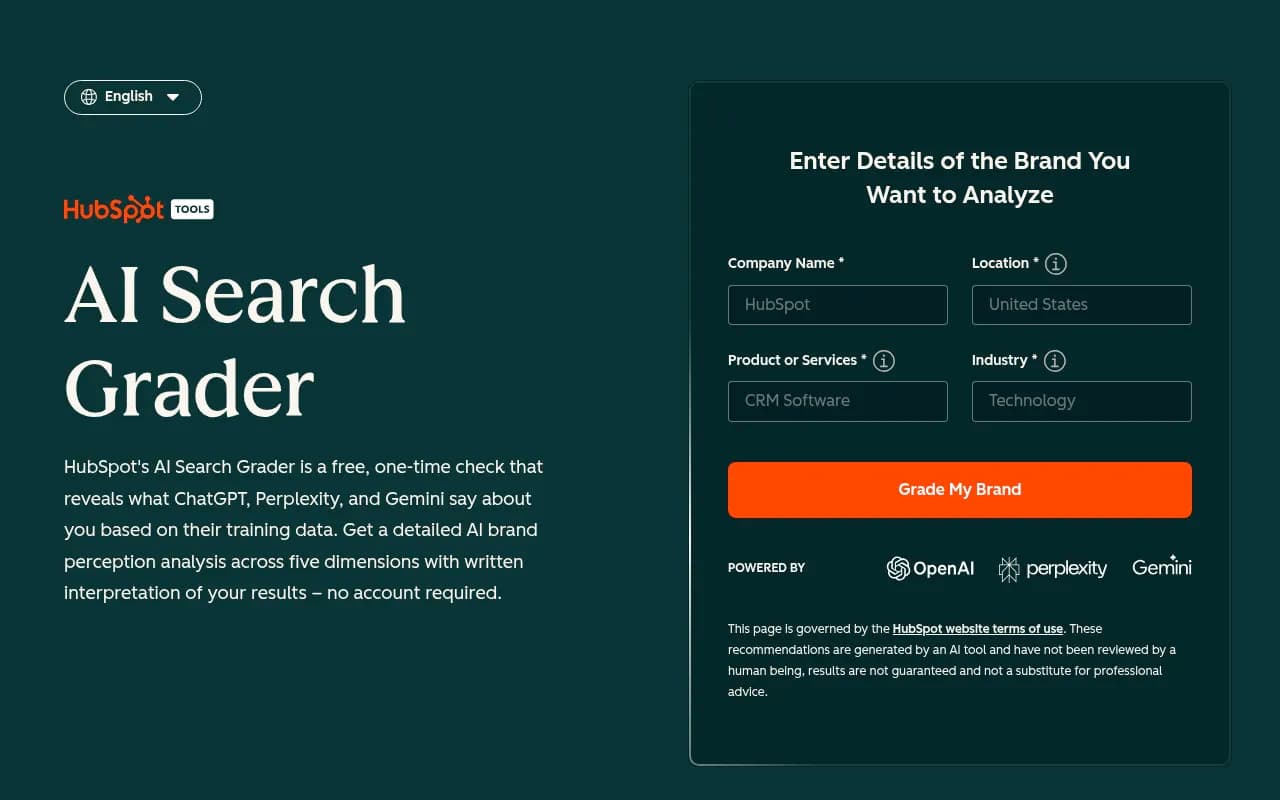
Geear also points to HubSpot's AEO tool for tying AI visibility to CRM data you already collect. If your marketing team lives in HubSpot, that connection is attractive: you can see how AI-driven visits turn into leads. The limitation is depth. HubSpot's approach is a suite add-on, so expect less AI-specific data than a dedicated platform. The free HubSpot AI Search Grader is a one-time diagnostic.
Semrush and Ahrefs Brand Radar
If your SEO team already pays for a traditional suite, the AI tracking bolted onto Semrush or Ahrefs Brand Radar is a reasonable first look. They use fixed prompt sets and offer shallower AI-specific data, with no crawler logs.
Enterprise SEO platforms: BrightEdge, Conductor and seoClarity
Large banks often already have one of these. All three have added AI search visibility. They make sense when you want AI tracking under the same contract and reporting as your existing SEO program.
Otterly.AI and Peec AI
Lower-priced prompt trackers suited to a small credit union that wants a monitoring baseline. They answer "were we mentioned?" and not much beyond that. No crawler logs, visitor analytics or content generation.


Local listing and reputation tools: Yext, Birdeye, Reputation.com
These aren't GEO platforms, but for branch-based institutions they feed what AI says about your locations. Consistent listings and reviews influence the review and directory sources AI pulls from.
Side-by-side comparison
| Tool | Type | Fit for banks and credit unions | Main limitation |
|---|---|---|---|
| Promptwatch | End-to-end AI visibility and action | Brand Narrative, Fact Check, local targeting, crawler logs, Content Agent with review inbox | Content Agent starts on Business plan |
| Profound | Enterprise monitoring | Larger banks with budget | Higher price, no agentic execution |
| Gumshoe | GEO tracking | Named in credit union roundup | Pricing and features unverified |
| HubSpot AEO | Suite add-on | Teams already on HubSpot CRM | Shallower AI data |
| Semrush / Ahrefs | SEO suites | Teams already on the suite | Fixed prompt sets, no crawler logs |
| BrightEdge / Conductor / seoClarity | Enterprise SEO | Existing enterprise SEO contracts | AI is one module of a larger platform |
| Otterly.AI / Peec AI | Prompt trackers | Small teams starting out | Monitoring only |
| Yext / Birdeye | Listings and reviews | Branch-heavy institutions | Not AI visibility tools |
For wider browsing, the GEO software directory at bestgeosoftware.com lists more options by category.
Customer experience tools are a different category
Some roundups for banks mix GEO tools with CX software like Qualtrics, Medallia, MemberXP and Allegiance Engage. Those measure satisfaction and attrition through surveys. They're useful, but they don't tell you whether ChatGPT recommends you. Keep the two budgets separate. The Perspective AI comparison covers that space if you need it.
How to run a GEO program at a bank or credit union
Tooling is half of it. Here's a sequence that works for a small team.
1. Build a prompt list from real member questions
Start with 30 to 50 prompts across three intents: commercial ("best credit union for auto loans in Ohio"), informational ("how does a credit union differ from a bank") and branded ("is Example Credit Union good?"). Add your actual branch markets. Pull ideas from Search Console queries and your member service logs. Promptwatch's query fan-out generator shows the sub-searches an AI engine runs for a prompt.
2. Check that AI crawlers can read your site
Before writing anything, confirm access. Bank sites often sit behind WAFs and bot managers. Run the free Agentic Readiness Check or look at crawler logs through Promptwatch's AI crawler logs. If rate pages return errors to AI bots, nothing else you do will matter.
3. Fix product and landing pages first
Given the citation data above, make each product page complete: current rates, fees, eligibility, membership requirements and a short FAQ. Keep it factual. Pricing and rate tables in plain HTML are easier for AI to read than PDFs or rate calculators that need JavaScript.
4. Get into the roundups and review sources
Listicles are 13.6% of ChatGPT citations overall and 15.0% for commercial prompts. Find which "best credit unions" or "best savings accounts" articles get cited for your prompts and pursue inclusion. Trustpilot and G2-style review sites are cited at low rates but matter for branded questions.
5. Audit what AI says and correct it
Read the claims. If ChatGPT says you require employer membership when you've opened eligibility, find the page that teaches it that. Fix the source, then re-check.
6. Build compliance into the workflow
AI-generated content in finance needs review. Whichever tool you pick, use a human approval step and keep the audit trail. Promptwatch's review inbox and organization audit log (Business and above) are examples of what to look for.
7. Measure traffic, not just mentions
Visibility without visits is vanity. Track AI-referred sessions and conversions. Note that ChatGPT stopped sending a referrer on October 8, 2026, so tagging links with utm_source=chatgpt.com matters. Promptwatch's guide on attributing AI traffic explains the options.
Should you hire an agency instead?
If you have no SEO headcount, maybe. Geear, ZAG Interactive, Bluelinks, iPullRank and Siege Media all offer AEO and GEO services aimed at credit unions according to Bluelinks' roundup, and ZAG publishes practical SEO tips for bank and credit union sites. 1001 SEO Media also does GEO and technical SEO work with no long-term contracts. Whatever you choose, ask who does the work and how they report on AI citations, not just rankings.
Which tool should you pick?
- Small credit union, one marketer, tight budget: start with a free visibility report, then a low-cost tracker or Promptwatch Essential. Spend your time fixing product pages.
- Mid-size credit union or community bank with branches: Promptwatch Professional or Business for local targeting, Fact Check and crawler logs.
- Regional bank with an existing enterprise SEO contract: look at your platform's AI module first, then compare against a dedicated tool.
- Agency serving several institutions: agency plans start at $199/mo with unlimited projects. See Promptwatch for agencies.
Pricing changes, so verify everything on the vendors' own sites before buying. The AI directories at ai-rank-tools.com can help you shortlist rank trackers.
The real test of any GEO tool is simple. Six weeks after you start, can you point to a rate page that got fixed, a roundup you got into, and a change in what AI says about you? If the answer is only "we have a dashboard", pick a different tool.