Key takeaways
- A headline visibility score tells you almost nothing until you know where the data came from: real AI interfaces or API calls, how many prompts, how often, and in which markets.
- Most vendor "methodology" content in 2026 is either a capability page or a buyer's guide written by a vendor with its own product in the ranking. Treat it as shortlist evidence, not proof.
- The AI platforms change underneath everyone. A trustworthy methodology page explains how the vendor detects and annotates abrupt shifts, such as ChatGPT's citation drop after GPT-5.3 or the August 2026 collapse of Reddit citations.
- Citation numbers are only comparable when platform, web-search filter, prompt type, and date window match.
- Use the ten-question checklist near the end in every vendor call, and ask for a trial on your own prompts.
Why methodology matters more than the dashboard
Enterprise GEO buying has a strange feature: every dashboard looks convincing. You get a visibility number, a share of voice chart, a list of cited domains. The numbers move, the charts are tidy, and nothing on the screen tells you whether the underlying sample was 200 responses or 200,000.
That is the problem a methodology page is supposed to solve. It should let a skeptical analyst reconstruct, roughly, how a number was produced. In practice, I find most of them don't get there. Some describe features. Some describe a philosophy. A few describe the actual pipeline.
This guide looks at what the public evidence shows, what a good page includes, and how to pressure-test a vendor in a call. One caveat up front: I only reviewed a limited set of public pages for this piece, and I did not verify every vendor's methodology directly. Where I cite a vendor's claim, treat it as self-reported.
What the public evidence looks like right now
Three types of content show up when you search for how enterprise GEO platforms validate their data.
Vendor-written buyer's guides
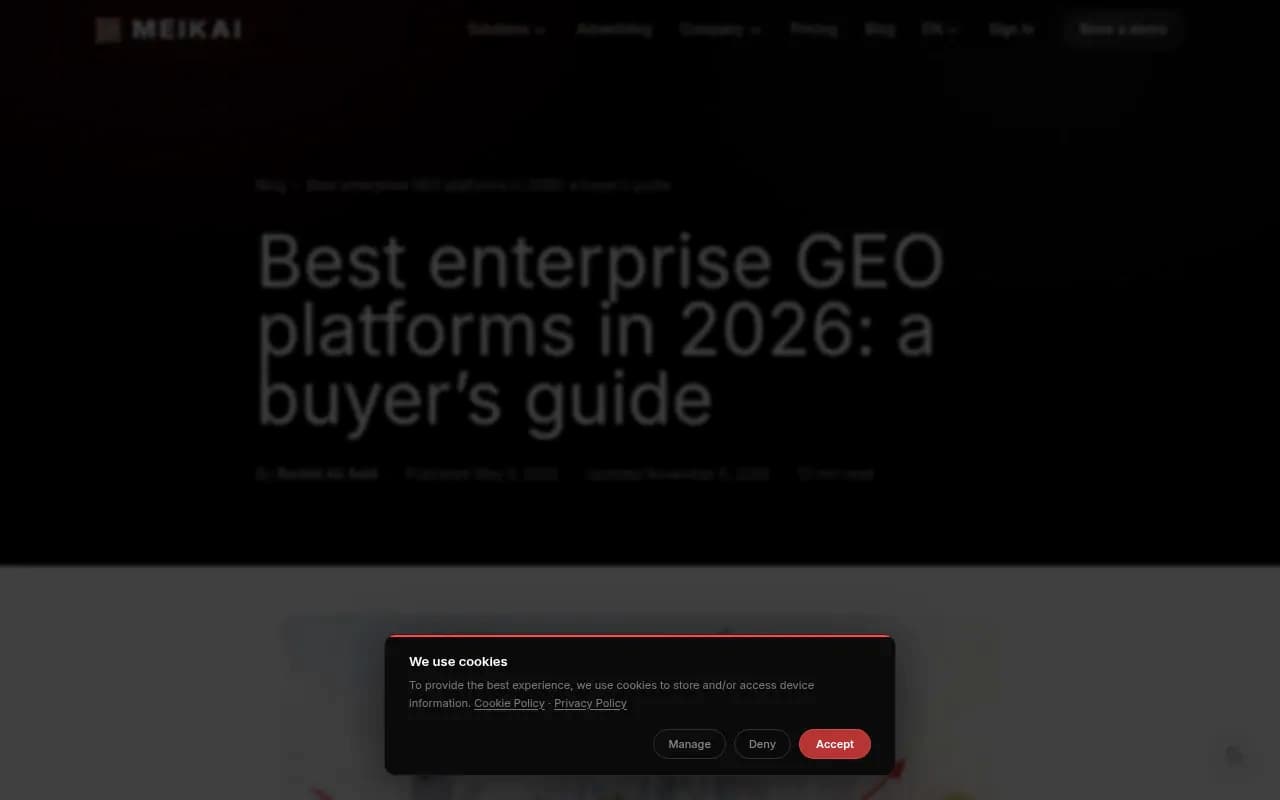
Meikai's 2026 enterprise GEO buyer's guide is a useful example because it is unusually candid about its own limits. It states that public capability pages "cannot establish data quality, implementation fit or how well a platform will work inside your organization." It discloses that it was written from vendor materials published by 28 July 2026, with pricing updated in September and one product description updated on 6 November. It also argues that a single visibility score is the least useful thing any of these products produces.
I agree with that last point, and the dating discipline is good practice. But the guide also names its own product the strongest fit, citing 120+ active brands, daily data freshness, API and MCP access, and a production panel of more than 1.5 billion question-and-answer messages. Those are self-reported figures. They are not independently audited, and a large message count says nothing by itself about whether prompts are representative.
The lesson: a disclosure paragraph is a start. It does not replace evidence you can test.
Dedicated methodology posts
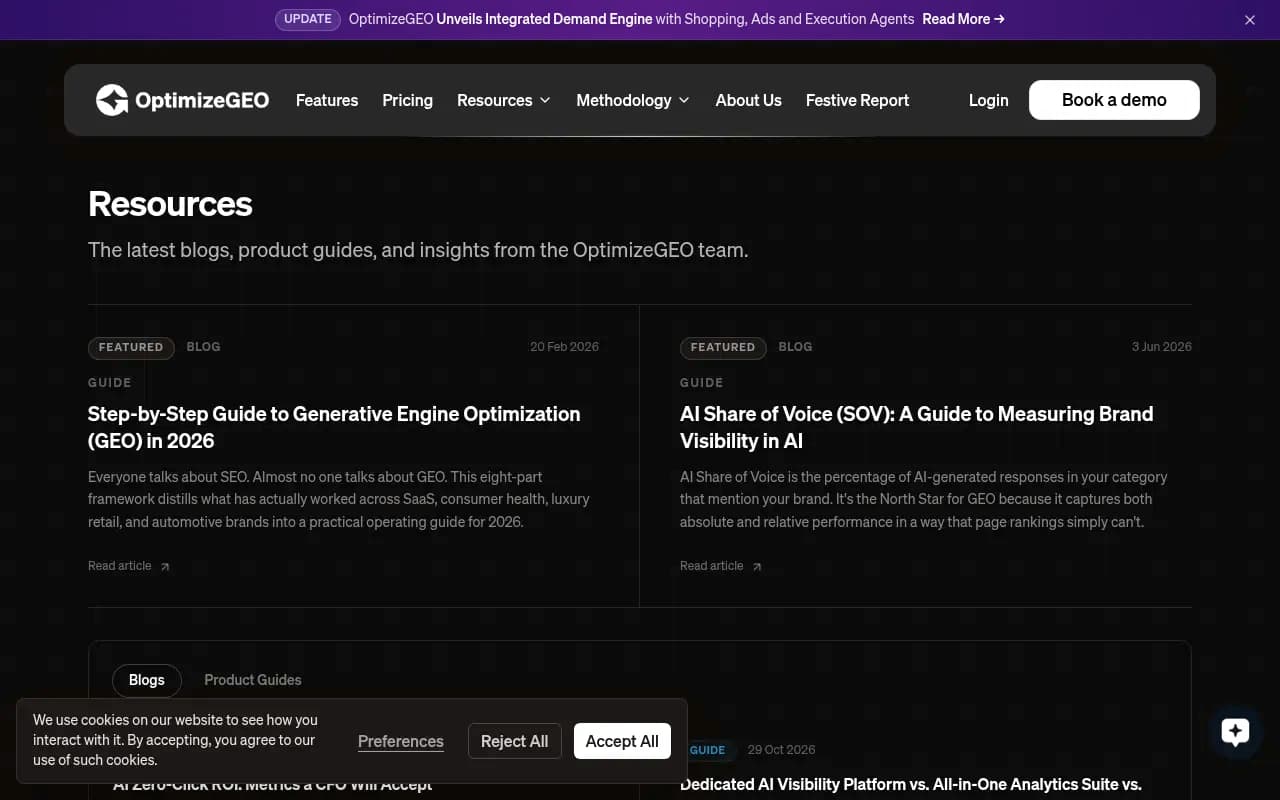
OptimizeGEO's resources hub lists a post dated 27 Oct 2026 titled "How We Calculate, Audit, and Refresh Our GEO Analytics." The title promises the right three things: calculation, auditing, and refresh cadence. I did not retrieve the full text for this comparison, so I can't tell you whether it delivers sample sizes and validation steps or stays at the level of principle. Check it yourself against the criteria below. The same hub lists posts on multi-client permissions and CFO-ready ROI metrics, which suggests the vendor is writing to procurement concerns, not just practitioners.
Vendors with nothing public
For several well-known platforms, including Profound, Peec, Scrunch, AthenaHQ, Otterly, and Bluefish, I did not find a methodology page to evaluate in the material I reviewed. That does not mean one doesn't exist. It means a buyer should not assume it does, and should ask for the documentation in writing.
What a credible methodology page should contain
I'd score any page against these eight items. Missing two or three is normal. Missing most of them means you are buying a number on trust.
| Element | What good looks like | Red flag |
|---|---|---|
| Collection source | States whether responses come from real user interfaces or model APIs, per platform | "We query AI engines" with no detail |
| Sample size | Prompts per monitor, runs per prompt, responses per period | Only a total across all customers |
| Prompt design | How prompts are built, weighted by volume, and split by type (organic, brand, comparison) | Hand-picked prompts with no rationale |
| Location and language | Country, language, and city handling per monitor | One global score |
| Refresh cadence | Daily or faster, and what happens on missed runs | "Regularly updated" |
| Metric definitions | Formula for visibility, share of voice, position, sentiment | Unexplained 0-100 score |
| Change detection | How model updates and data gaps are flagged | Silent jumps in trend lines |
| Export and audit | Raw responses and citations exportable | Aggregates only |
The collection question: real interfaces versus APIs
This is the single biggest divider, and it is the one vendors are least eager to discuss. User-facing answers, citations, and shopping recommendations can differ from what a model returns through its API. If a vendor tracks ChatGPT through the API, you are measuring something close to what the model believes, not what a person sees when they use ChatGPT Search.
API data is not worthless. It tells you what a model knows from training. But for citations and recommendations in live search, the interface is the product your customers use.
Promptwatch is a useful reference point here because its methodology is public. Its Promptwatch Data reports state that data comes from the actual user interfaces of ChatGPT, Gemini, Perplexity, Claude, Google AI Overviews and others, from a dataset of 26B+ analysed citations, prompts, and responses, updated continuously with public versions aggregated and non-identifiable. It also tracks API models separately, to show what models answer from training data. There is a longer explanation in its Academy guide on how Promptwatch collects data.

Whatever vendor you pick, ask this: for each platform, is the data from a real UI session or an API call? Get the answer per platform, not as a blanket statement.
Why a single prompt tells you nothing
Promptwatch's report on unique domains per ChatGPT response (Sep 28 to Oct 4, 2026, responses with at least one citation) shows why sample design matters. Across that window, 47.6% of responses cited 10 or more domains and 66.1% cited at least 8. Only 6% cited three or fewer, and 1% cited a single domain.
The split by prompt type is what a methodology page should reflect:
| Prompt type | Cite 10+ domains | Notable detail |
|---|---|---|
| Organic (no brand named) | 52.5% | 71.8% cite 8+ |
| Brand-specific | 21.3% | Most common count is 5 domains (14.9%) |
| Competitor comparison | 49.1% | Only 0.35% cite a single domain |
If a vendor blends these prompt types into one score, the source mix is muddied. Brand prompts pull from a narrow set of sources. Organic prompts pull from a wide one. A vendor that reports results by prompt type is showing it understands this. One that doesn't is probably averaging apples and oranges.
Citation rates are only comparable under the same conditions
Promptwatch's average sources per response report makes a point that every buyer should internalize. ChatGPT averaged about 5 citations per web-search answer in that dataset, but the figure only counts responses where web search was triggered and it drifts with model and retrieval updates. AI Overviews cites about 10 sources, steadily. Perplexity cites almost exactly 10 every day, which makes it a stable test bench. Copilot swung from under 2 to nearly 17 sources per response within weeks, then settled low.
Two vendors can both report a "citation rate" for ChatGPT and get different numbers for entirely legitimate reasons: different web-search filters, different date windows, different prompt sets. So when comparing vendors during a trial, demand the same prompts, same country, same dates, and ask each to state its web-search trigger filter.
Fanouts: the part most dashboards skip
ChatGPT doesn't answer a prompt by running that one prompt. It runs follow-up searches. Promptwatch's ChatGPT query fanouts report measured about 2.15 fanout queries per response in early December 2025, about 1.84 by early March 2026, and 1.0 per response in April after a data gap. Average query length fell from about 117 characters to the high 80s, then to about 53 in April.
Those are big swings in a short period. A vendor whose methodology ignores fanouts is tracking the prompt, not what the model searched for. Ask how fanouts are captured, and how often the capture method is re-validated. For background, see the Academy explainer on query fan-outs.
Detecting platform shifts
This is where I think methodology pages separate serious vendors from the rest. AI platforms change abruptly, and a vendor's trend lines will jump when they do. A credible page explains how those jumps are detected and annotated. Recent examples from Promptwatch Data:
- Average citations per ChatGPT response dropped across GPT-5.3, GPT-5.4, and GPT-5-Mini around the March 4, 2026 rollout (report).
- On August 8, 2026, ChatGPT Search began using the site: operator at scale, going from about 0.4% to about 17% of fanout queries overnight (report).
- On August 14, 2026, reddit.com's share of ChatGPT citations fell from roughly 4% to 0.5% (report).
If your dashboard shows Reddit visibility collapsing in mid-August and the vendor can't tell you whether that was your brand or the platform, the number is not decision-grade. Ask to see how they separate a real change in your visibility from a change in the model.
Crawler data is the other half of the proof
Citation tracking shows outcomes. Crawler logs show access. An enterprise buyer should ask whether a vendor can verify that AI bots actually read the pages it recommends fixing. IP-verified logs, checked against each operator's published ranges, filter out spoofed bots. Promptwatch publishes weekly AI crawler traffic data built from IP-verified requests, and its crawler logs feature is the productized version. Most monitoring-only competitors don't offer this, which means they cannot tell an access problem from a content problem.
Comparing the kinds of evidence vendors publish
| Evidence type | Example | What it proves | What it doesn't |
|---|---|---|---|
| Vendor-written buyer's guide | Meikai's enterprise guide | Criteria and disclosure habits | Data quality, since the vendor ranks itself |
| Methodology post | OptimizeGEO's calculate/audit/refresh post | Intent to document the process | Depends on the content; I did not verify it |
| Open research reports | Promptwatch Data | Collection source, windows, definitions, sample caveats | Your brand's results, which need a trial |
| Capability pages | Most vendor sites | Feature existence | Anything about accuracy |
The open research model is the strongest signal I found, because a vendor that publishes dated, windowed findings is exposing its data to scrutiny. Anyone can compare those numbers against their own observations.
Ten questions to ask every vendor
- For each AI platform, do you collect from the real interface or the API?
- How many prompts and runs per prompt sit behind each reported number?
- How do you handle country, language, and city, and are they fixed per monitor?
- Are results split by prompt type: organic, brand, comparison?
- How do you capture query fanouts?
- What is your web-search trigger filter for citation metrics?
- How do you detect and annotate model updates and data gaps?
- Can I export raw responses and citations, not just aggregates?
- How do you verify AI crawler activity?
- Can I run a trial on my own prompts and compare against a second vendor?
How to run a fair bake-off
Pick 50 to 100 prompts across your three prompt types. Run them in the same country and week on two or three shortlisted platforms. Compare raw responses, not scores. Look for disagreements on whether your brand was mentioned and which sources were cited, then ask each vendor to explain the differences. The vendor that can walk you through a discrepancy is the one with a real pipeline.
For a wider view of the category, the GEO software directory lists platforms side by side. Promptwatch also keeps a 2026 comparison of GEO platforms, though as the publisher it has an obvious interest in the result, so check its claims the same way you would anyone's. Promptwatch offers a 7-day free trial on monthly plans, confirmed at promptwatch.com/pricing, and a free AI visibility report if you want a quick first look before a bake-off.
A note on who publishes this
This guide is published by 1001 SEO Media, an SEO and GEO agency that uses Promptwatch as its AI visibility platform. That is a relationship you should factor in. It is also why the advice above is framed around tests you can run yourself instead of conclusions you need to take on faith.
Bottom line
Most enterprise GEO methodology content in 2026 is thinner than the dashboards it supports. The good signs are specific: dated findings, named collection sources, prompt-type breakdowns, and explanations for platform shifts. Ask for them in writing, test on your own prompts, and don't sign anything that depends on a score you can't trace back to raw responses.