Key takeaways
- Generic AI writing has a name now: Merriam-Webster named "slop" its 2025 word of the year, and the tell isn't bad grammar, it's predictable sentence rhythm and buzzword density.
- Claude tends to score better on "burstiness" (sentence-length variation) than GPT models in independent testing, though no model matches human variability out of the box.
- The tool matters less than the workflow. Feeding a model real writing samples and explicit banned-word lists does more to de-genericize output than switching apps.
- Sudowrite still wins for fiction voice control, Writer.com wins for enterprise brand consistency at scale, and Jasper has pivoted hard toward AI-search visibility, not just copy.
- 52% of readers stop reading the moment they suspect AI wrote something, according to a Bynder study, so "undetectable" output isn't a vanity metric, it's a retention metric.
Why most AI writing sounds the same
Here's the uncomfortable truth: it's not really about the tool. Every major AI writing app in 2026, from ChatGPT to Jasper to Rytr, is built on a small handful of underlying language models. When you strip away the UI, a lot of them are producing text with the same statistical fingerprints.
Researchers call one of those fingerprints "burstiness," which just means how much sentence length varies across a piece of writing. Human writing swings between short punchy sentences and long, winding ones. AI models tend to settle into a groove of medium-length sentences and stay there. In one 200-sample comparison, human academic writing had a sentence-length standard deviation of 8.2 words. Claude's output came in at 5.3, better than most competitors, but still nowhere near human variability.
Then there's the vocabulary. If you've read more than a few AI-generated blog posts, you've probably developed an allergy to words like "delve," "leverage," "foster," "unlock," and "landscape." Add in the structural tics, the three-sentence paragraph, the rule-of-three list, the hedge-everything phrasing ("it could be argued that"), and you get writing that reads clean but feels hollow. Simon Willison's definition of AI slop, surfaced in a survey by researcher Leon Furze that collected roughly 450 votes, sums it up well: "slop is something that takes more human effort to consume than it took to produce."
That matters commercially, not just aesthetically. A Bynder study found 52% of consumers stop reading the moment they suspect a text is AI-generated. Klaviyo data puts full consumer trust in AI-generated brand content at just 13%. Readers aren't being paranoid, they're pattern-matching, the same way you'd spot a form letter.
Worth noting: Google has repeatedly said it does not penalize content simply for being AI-written, and that it doesn't rely on AI detectors to judge quality. The company's public stance is that it evaluates helpfulness, not production method. So the pressure to avoid "generic" AI writing isn't coming from a search algorithm penalty, it's coming from readers who bounce the moment something feels synthetic.
What actually reduces the genericness (it's not always the tool)
Before ranking tools, it's worth being honest about something the marketing pages won't tell you: the single highest-leverage fix isn't switching apps, it's how you prompt whatever app you're using.
- Paste in actual writing samples from your brand or your own past work, rather than describing your tone abstractly ("friendly but professional"). Models imitate examples far better than they follow adjectives.
- Set explicit negative constraints. A banned-word list works better than a vague instruction to "sound natural." Ban "delve," "leverage," "unlock," "in today's fast-paced world," the em-dash, and the "not just X but Y" construction.
- Always do a human pass after the AI pass. Even a five-minute edit adding one specific example or personal opinion breaks the uniformity that makes AI text feel mass-produced.
- Don't over-engineer the banned-word list. Practitioners who've tested this at scale report that overly long lists of forbidden words actually degrade output quality. Tune the list to the five or six patterns that bother your specific readers, not every AI cliché in existence.
Interestingly, in Furze's slop survey, just over half of roughly 188 respondents blamed the author's workflow for slop, not the technology itself. Only 8% called it an unavoidable side effect of AI. The tool sets a ceiling on quality. The workflow decides whether you hit it.
The tools, ranked by how well they avoid generic output
| Tool | Best for | Price (2026) | Genericness risk | Why |
|---|---|---|---|---|
| Claude | Long-form brand voice, editing | $20/mo (Pro) | Low | Custom "Styles" hold tone consistently across long docs; testers report less post-editing needed |
| ChatGPT | Brainstorming, breadth | $20/mo (Plus) | Medium | Strong for ideas and research, but default prose has recognizable tells without custom GPTs |
| Sudowrite | Fiction prose, scene drafting | $19-59/mo | Low (fiction only) | Muse model trained specifically on fiction, not marketing copy patterns |
| Writer.com | Enterprise brand consistency at scale | $29-39/user/mo | Low at scale | Shared "Voice profiles" and terminology lists keep dozens of writers consistent |
| Jasper | Marketing copy + AI search visibility | $59-69/mo (Pro) | Medium | Jasper IQ centralizes brand voice, but output still needs a human pass |
| Rytr | Budget general-purpose writing | $9/mo | Medium-high | Cheap and capable, but less control over brand voice or knowledge base |
Claude: the current favorite for not sounding like a robot
Across multiple independent write-ups in 2026, the practitioner consensus is fairly consistent: ChatGPT is better for brainstorming and breadth, Claude is better at holding a voice steady across a long document without drifting back into default AI phrasing. Claude's "Styles" feature lets you lock in a persistent tone, and testers report needing less cleanup afterward compared to ChatGPT's custom instructions.
A workflow pattern that keeps showing up in tester reports: use ChatGPT first for breadth, brainstorming, and research, then run the actual draft through Claude for tone-matching and polish. It's not scientific, it's anecdotal across several Medium and Substack comparisons, but it lines up with what the burstiness data suggests, Claude's sentence-length variation is closer to human than most competitors, even if it's still short of the target.
Sudowrite: still the specialist for fiction voice
Sudowrite is a different animal from the general-purpose tools because its Muse model is trained specifically on fiction prose rather than marketing copy or blog content. That specialization shows up in output that doesn't carry the corporate-blog fingerprints readers are trained to spot.
The catch is the credit system. Independent testing found a single 2,400-word chapter can burn around 40,000 credits on mid-tier models, more on Muse or Claude Opus, and a full novel draft typically eats 600,000 to 1,500,000 credits. Pricing runs from a $19/month Hobby tier (widely flagged by reviewers as a trap, since it gives a quarter of the Pro tier's credits for two-thirds the price) up to a $44-59/month Max tier that's the only one with credit rollover. If you write fiction seriously, it's worth the learning curve. If you're writing marketing copy, it's the wrong tool entirely.
Writer.com: brand consistency when a whole team is writing
Most "avoid generic AI writing" advice assumes one person prompting one model. Writer.com solves a different problem: keeping dozens of writers at a large company sounding like the same brand, not forty slightly different flavors of AI-generic. Its shared "Voice profiles" and terminology lists are explicitly marketed as the fix for "everyone's content sounds the same," and in March 2026 the company added over 200 enterprise-specific "Skills" on top of that. It's priced for teams, $29-39 per user per month, with enterprise pricing custom, and it doesn't really compete with solo-creator tools like Jasper or Copy.ai. If you're a single blogger, skip it. If you manage content across a marketing org, it's worth a look.
Jasper: less a writing tool now, more a visibility platform
Jasper's positioning has shifted noticeably in 2026. Its own marketing now leads with "get cited by AI," framing the product around AI-search visibility rather than pure copywriting. Under the hood, Jasper IQ centralizes brand voice, audience data, and company knowledge, which is a real attempt at solving the genericness problem at the input level rather than just the output level. Pro runs $59-69/month with expanded tone-of-voice slots and campaign limits over the Creator tier.
If you're already thinking about how your content shows up in ChatGPT or AI Overviews and not just Google's ten blue links, that's a meaningfully different category of problem than "does this paragraph sound generic." Tools like Promptwatch are built specifically to answer the visibility side of that question, tracking where your content actually gets cited across ChatGPT, Gemini, Perplexity, and Google's AI surfaces, and generating GEO-optimized content through automated agents rather than just flagging buzzwords.

Rytr: fine for volume, not for voice
Rytr remains the budget pick at $9/month, and it's genuinely useful if you need a lot of short-form copy fast and don't have strong brand-voice requirements. But reviewers are consistent that you have less control over tone and knowledge base compared to pricier tools, which means a higher chance the output lands in that generic middle ground unless you're doing heavy editing yourself.
A practical checklist for de-genericizing whatever you write
Before you publish anything AI-assisted, run it through this:
- Read a paragraph out loud. Would you actually say that sentence to a colleague? If not, rewrite it.
- Scan for the usual suspects: delve, leverage, foster, unlock, landscape, tapestry, testament, pivotal, seamless, robust.
- Count how many paragraphs follow the same three-sentence, medium-length structure. If it's most of them, break the rhythm on purpose, add a fragment, start a sentence with "But."
- Add one detail only you would know, a specific number, a real anecdote, an opinion you'd actually defend in an argument.
- Check sentence-length variation. If every sentence is roughly the same length, manually shorten some and lengthen others.
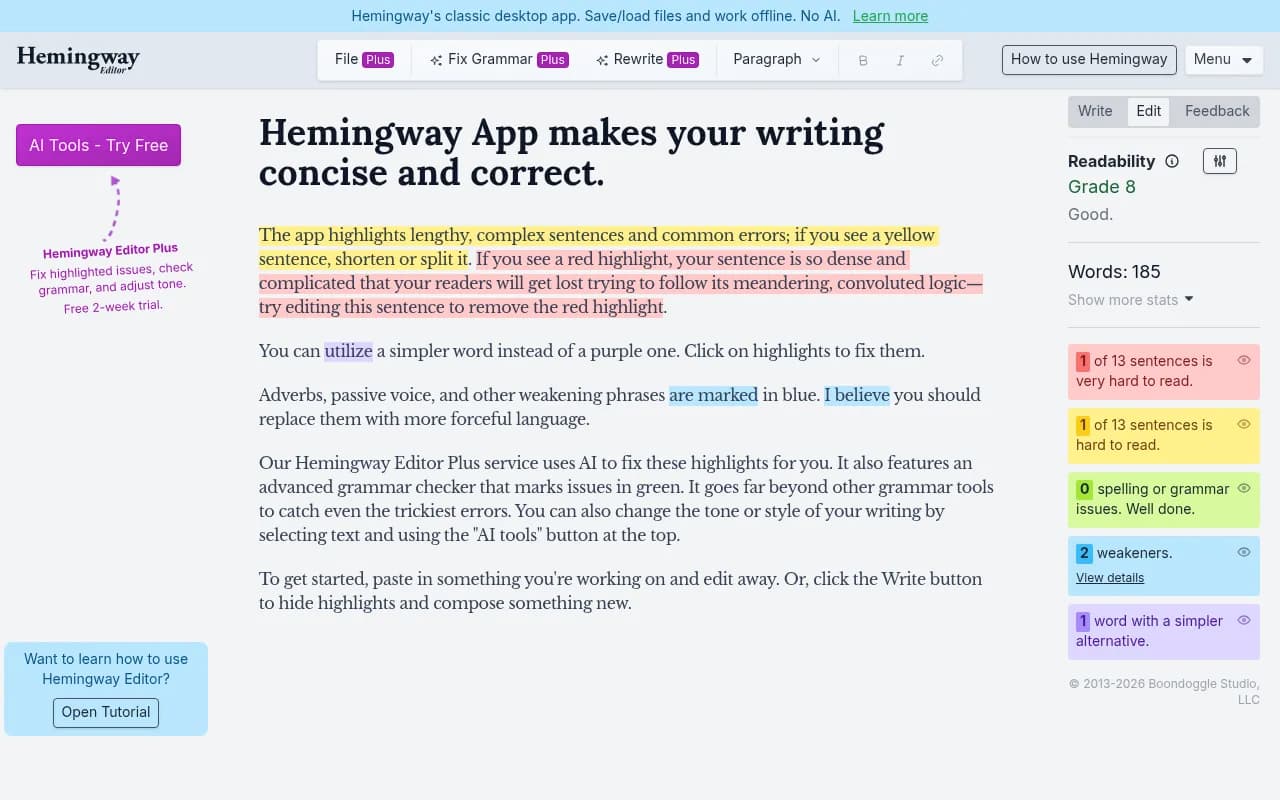
None of this requires expensive software. A grammar and readability pass with something like Grammarly or the free Hemingway App catches some structural repetition too, though neither is designed specifically to flag AI clichés the way a manual pass will.
Where this is heading
The gap between "AI-assisted" and "obviously AI-generated" is closing, but not because the models got dramatically better at sounding human by default. It's closing because the people getting good results have stopped treating prompting as a one-line instruction and started treating it as an editing relationship, feeding real examples, banning specific words, and always doing a final human pass. Pick a tool that fits your actual use case, fiction, brand copy, or enterprise scale, and spend less time hunting for the mythical tool that writes perfectly human text on the first try. It doesn't exist yet. The workflow is the product.