Key takeaways
- A 2026 benchmark from Zen Media found that no individual law firm made the top 20 most visible names across ChatGPT, Gemini, Perplexity and Grok. Directories like Avvo, Martindale-Hubbell and Super Lawyers took the mentions.
- For a law firm, AI visibility means the firm's own site plus the directories, bar listings and review profiles AI systems pull from. A good platform has to show you all of that, not just whether your name appeared.
- Monitoring-only tools tell you that you are invisible. Platforms that also show crawler activity, citations and content gaps, and help you act on them, are worth the money for firms that want leads rather than screenshots.
- Nobody can guarantee a ranking in an LLM. Treat any vendor promising one as a red flag.
- Budget-friendly trackers are fine for a solo practice or a first test. Multi-office firms and agencies need country, state and city tracking, reporting and exports.
Why law firms need to care about AI visibility
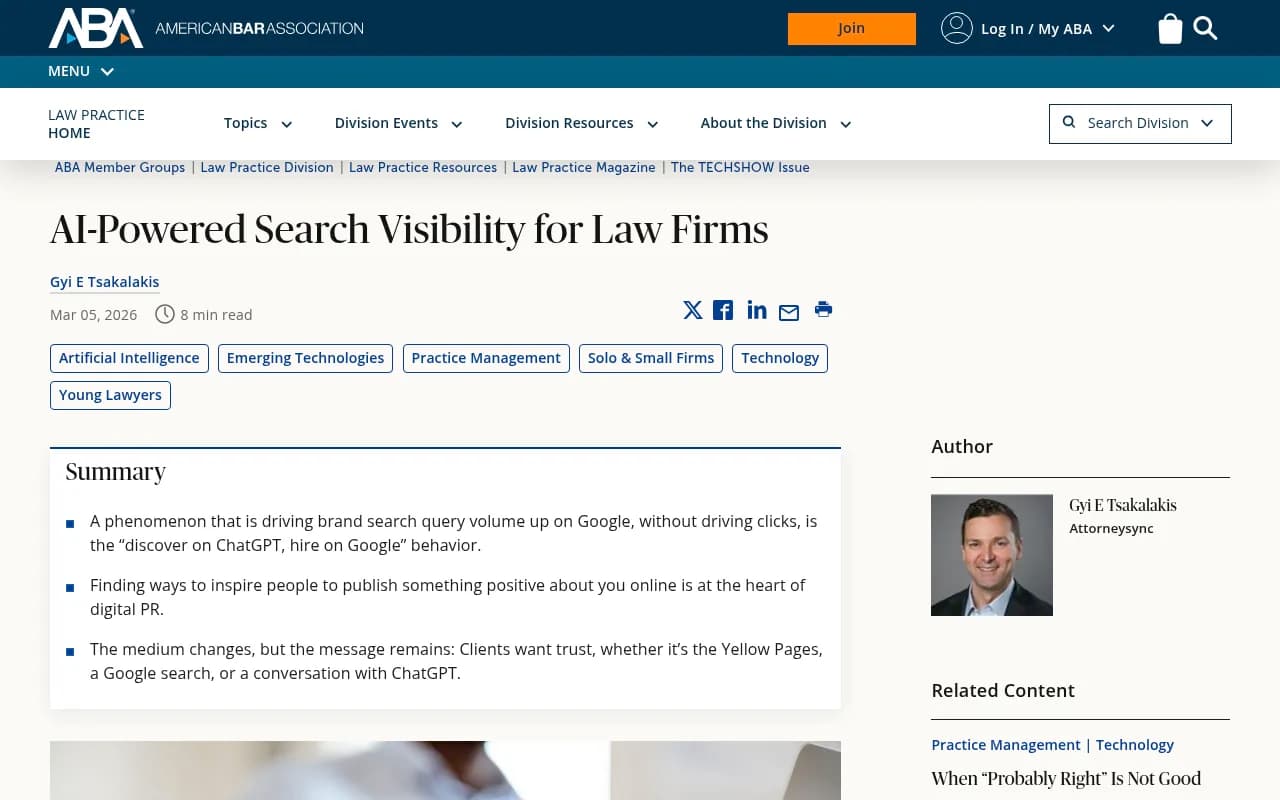
People used to ask a friend or search Google for a divorce lawyer. Now plenty of them ask ChatGPT, then check the shortlist on Google before they call. A piece in the American Bar Association's Law Practice magazine describes this as the "discover on ChatGPT, hire on Google" pattern: brand searches rise, but the clicks that prove it never show up in your analytics.
That is a measurement problem as much as a marketing one. If a prospect asks "who is the best personal injury lawyer near me" and your firm is not named, you never learn about the lost consultation. A visibility platform is the only way to see those answers at scale.
One caution from the same ABA piece is worth repeating. The author notes that these systems are highly variable and personalized, that LLM "ranking" data is unreliable, and that guarantees are red flags. I agree. Use a platform to find patterns across hundreds of prompts, not to chase a single number every morning.
What the data says about legal AI answers
The most useful legal-specific data point is the Zen Media benchmark, published through GlobeNewswire on October 1, 2026. It analyzed 1,000 legal consumer questions across Perplexity, ChatGPT, Gemini and Grok, which produced 4,000 responses.
| Company | Type | Share of responses naming it |
|---|---|---|
| Avvo | Legal directory and rating platform | 45% |
| Martindale-Hubbell | Directory and peer rating | 32% |
| Super Lawyers | Attorney recognition | 24% |
| FindLaw | Legal directory | 15% |
| LegalZoom | Online legal services | 13% |
Directories and rating platforms made up 45% of all company mentions. Among answers that cited sources, state bar associations appeared in 92%, Avvo in 85% and Martindale-Hubbell in 78%. Google Reviews showed up in 45%. This is third-party research from a communications agency, so treat the exact figures as directional. The pattern, though, matches what you would expect: AI answers lean on structured, trusted third-party sources.
Promptwatch Data points the same way on content format. In Promptwatch's ChatGPT citation share by content type report (Sep 28 to Oct 4, 2026), product pages took 22.4% of ChatGPT citations and landing pages 16.8%. For commercial prompts like "best X for Y", product pages reached 26.0% and listicles 15.0%. For branded prompts, reviews were 5.6%, more than three times their share across all prompts. My own mapping for law firms (the report does not say this): practice-area pages are your product pages, and directory and review profiles are your reviews.
There is also a platform point. Promptwatch's social citations data for the same week shows social platforms at just 0.46% of ChatGPT citations but 12.2% for Google AI Overviews, with YouTube at 4.28% there. A firm with a strong video presence matters more for Google than for ChatGPT.
What to look for in a platform for a law practice
Most AI visibility tools were built for SaaS companies. Law firms have different needs, and a few criteria matter more than the usual feature checklist.
- Local and regional tracking. Legal search is local. "Best immigration lawyer in Tampa" is not the same prompt as the national version. You want country tracking at minimum, and state or city tracking if you operate in specific markets.
- Coverage of the engines clients actually use. According to Triple Digital's guide, ChatGPT leads among consumers researching lawyers, while Google AI Overviews and Gemini matter because they sit inside Google search. Tracking should also cover Copilot and Perplexity.
- Citation and source visibility. Since directories and bar listings drive so many answers, you need to see which third-party pages AI cites, not just whether your firm name appears.
- Real interface data rather than only API calls. What a user sees in ChatGPT can differ from API output.
- Crawler and traffic data. Does AI even reach your site? Do visits from AI turn into consultation requests?
- Something to do with the findings. A report that says "you are invisible" is the start of the work.
- Reporting a managing partner will read. Scheduled PDFs and exports save hours.
One more thing specific to this industry: lawyer advertising rules vary by state. Be careful with any tool that auto-publishes content, and have an attorney review anything that makes claims about results or specialization before it goes live. I did not research state-by-state rules here, so check yours.
The best AI visibility platforms for law firms in 2026
Promptwatch
Promptwatch is the one I would put first for firms that want to change their results, not just watch them. It tracks the real interfaces of ChatGPT, Google AI Overviews, Google AI Mode, Gemini, Perplexity and Copilot, plus API models like Claude, DeepSeek and Mistral. Country tracking is on every paid plan, and state and city tracking starts on the Business plan, which matters for a firm with offices in several metros.

The parts that suit law firms:
- IP-verified AI crawler logs show whether GPTBot, ClaudeBot, PerplexityBot and others actually read your practice-area pages, and whether they hit errors.
- Citation analytics show which pages get cited and where third-party sources like directories and review sites land in the source list.
- Content gap analysis and the Action Board turn missing coverage into a prioritized to-do list.
- The Content Agent can draft and publish to WordPress, Webflow or Framer, with a review inbox so an attorney can approve everything first. I would keep that review step on for any legal content.
- Visitor analytics tie AI platforms to real traffic and conversions.
Pricing, as listed at promptwatch.com/pricing (confirm there): a free Explore tier, Essential at $95 per month for 50 prompts, Professional at $245 per month for 150 prompts, and Business at $579 per month for 350 prompts. Agencies serving legal clients can look at the Kick-off, Growth and Scale plans from $199 per month, which include unlimited projects and white-label reporting.
Honest downside: it is a full platform, and a solo attorney with one practice area may not need all of it. Start with the free tier or a monthly Essential trial.
Profound
Profound is an enterprise-oriented monitoring platform with strong reporting. It suits large firms with a dedicated marketing team and budget for a premium tool. The trade-off is price, and it is less oriented toward executing content fixes.

Scrunch
Scrunch monitors and optimizes how AI assistants like ChatGPT and Claude describe a brand, and it has some focus on making sites readable to AI. Worth a look if technical accessibility is your main worry.

Otterly.AI and Peec AI
Both are affordable prompt trackers. They answer "was my firm mentioned?" competently. They do not give you crawler logs or content generation, so you will need other tools for the fixing part. For a small firm that wants a first baseline, that may be enough.


Semrush and Ahrefs Brand Radar
If your marketing team already lives in one of these suites, the AI add-ons are convenient. The depth on AI-specific data is shallower than the dedicated platforms, and prompt sets tend to be fixed.

AthenaHQ and Qwairy
Monitoring-focused GEO tools covering a good number of AI engines. Reasonable for agencies that want a lightweight dashboard for clients.
Local listing and review tools
Since directories and reviews drive so many legal answers, tools that manage listings are a useful companion, not a replacement. Yext, BrightLocal, Birdeye and Moz Local help keep your name, address and practice areas consistent across directories, which Zen Media's benchmark recommends writing identically everywhere.
Comparison table
| Platform | Real-UI tracking | Crawler logs | Content actions | Local tracking | Best for |
|---|---|---|---|---|---|
| Promptwatch | Yes, 6+ engines | Yes, IP-verified | Content Agent, Action Board | Country on all paid plans, state/city from Business | Firms and agencies that want to improve, not just monitor |
| Profound | Yes | Limited | Limited | Varies by plan | Large firms with enterprise budgets |
| Scrunch | Yes | Partial | Some | Varies | Technical AI-readiness focus |
| Otterly.AI | Basic | No | No | Limited | Solo and small firms testing the waters |
| Peec AI | Basic | No | No | Limited | Simple monitoring |
| Semrush / Ahrefs | Fixed prompt sets | No | SEO suite tools | Limited | Teams already in those suites |
| AthenaHQ / Qwairy | Yes | No | Limited | Varies | Lightweight agency dashboards |
Feature claims for competitors reflect general positioning, so confirm current details on each vendor's site before buying.
How to choose by firm size
Solo practitioner or small firm
You probably do not need a big platform yet. Run the free Promptwatch AI Visibility Report or a low-cost tracker, track 20 to 50 prompts that reflect how clients describe their problem, and fix your Google Business Profile, bar listing and directory profiles first. That is where the Zen Media data says AI looks.
Mid-size regional firm
You have several practice areas and maybe several offices. Local tracking matters, so a Professional or Business-tier platform with city or state coverage earns its keep. Pair it with a listing manager.
Large or multi-state firm
Expect a shortlist of Promptwatch, Profound and a suite add-on. Ask about SSO, audit logs, white-label reporting and who reviews published content. Compliance review is a process question, not a software feature.
Legal marketing agencies
Agency plans with unlimited projects and client portals fit better than per-seat pricing. If you do not want to run this in-house at all, a specialist team like 1001 SEO Media works on technical SEO, content, digital PR and generative engine optimization with 100% white-hat methods, and uses Promptwatch for AI visibility measurement.
Prompts worth tracking
Bad prompt sets produce useless dashboards. Build yours from real client language, not firm jargon.
- Problem prompts: "I was rear-ended and the other driver has no insurance, what should I do?"
- Selection prompts: "how do I choose between a solo attorney and a large firm for a DUI?"
- Local prompts: "best estate planning attorney in Austin"
- Comparison prompts: "Avvo vs Martindale-Hubbell for finding a lawyer"
- Branded prompts: "is [your firm] any good"
Zen Media's benchmark found that AI answers kept returning to free consultations (68% of responses), trial experience (65%) and local court knowledge (62%). Those are good themes to confirm your pages actually state, factually.
A practical rollout plan
- Baseline. Track 30 to 50 prompts across ChatGPT, AI Overviews, Gemini and Perplexity for two weeks before changing anything.
- Audit the sources. Look at which directories and bar pages are cited for your practice areas. Claim and complete those profiles, using identical name, address and practice areas.
- Check crawler access. Make sure robots.txt and your CDN are not blocking AI bots from practice-area pages.
- Fix the pages. Give each practice area its own page naming case types, counties, courts and any board certification.
- Add FAQ and how-to content. Promptwatch's content-type data suggests branded prompts pull FAQ pages and how-to formats often.
- Segment analytics. Set up your analytics to separate AI-referred traffic so you can see consultations from it.
- Review monthly. Judge trends, not daily swings.
What I would not trust
Anyone selling a guaranteed AI ranking. Anyone who says they reverse-engineered ChatGPT. A tool that auto-publishes attorney-voice content with no human review. The ABA article makes the first two points well, and the third is just common sense given advertising rules.
If you want to compare more tools beyond this list, the GEO software directory at bestgeosoftware.com and the AI rank tracking directory at ai-rank-tools.com both catalog dozens of options.
Bottom line
If your firm is not named by AI, the cause is probably not your homepage. The Zen Media benchmark suggests the sources AI trusts are directories, bar listings and review sites, so start there. Pick a platform that shows you the sources and the crawler activity, and then helps you act. For most firms that want results, that points to Promptwatch. For a solo lawyer who only needs a baseline, a cheaper tracker is fine. Either way, set your baseline this month, before your competitors do.