Key takeaways
- No AI visibility vendor has direct access to OpenAI, Google, or Anthropic query logs. Every "prompt volume" number on the market is a modeled estimate, not a count, and Conductor estimates panel-based tools may sample well under 1% of ChatGPT's actual daily volume.
- The two dominant estimation methods are opt-in consumer panels (Profound, Evertune) and People Also Ask-based proxies (DataForSEO, which several smaller tools resell). They measure different things and shouldn't be compared head to head.
- Peec AI's decision to show a 1-5 prompt volume scale instead of a fake-precise number is arguably the most honest approach on the market right now.
- Trust relative rankings and trend lines within a single tool, not absolute numbers, and never compare one vendor's "4,820 prompts/month" against another's figure for the same topic.
- Platform search behavior itself keeps shifting underneath these models. ChatGPT's fanout query count nearly doubled overnight on August 8, 2026, which means any volume model trained on last quarter's behavior is already stale.
Why "prompt volume" is such a slippery number
Here's the uncomfortable truth nobody selling this data likes to lead with: nobody outside OpenAI, Google, and Anthropic actually knows how many people are asking a given question in ChatGPT or Gemini. Sam Altman confirmed ChatGPT processes roughly 2.5 billion prompts a day as of mid-2025, and OpenAI reported around 900 million weekly active users by February 2026. That's the real denominator. Every vendor selling you a "prompt volume" metric is working from a sample of that ocean, and the sample sizes are small. Conductor's analysis pegs panel-based tools at sampling as little as 0.15% of total volume.
That doesn't make the metric useless. It makes it directional. Think of it less like Google's Keyword Planner search volume, which draws on Google's own click and impression logs, and more like a survey extrapolated to a population. The relative ranking between two topics inside the same tool tends to hold up. The absolute number rarely does.
There's also a structural problem that's easy to miss: one prompt from a user doesn't equal one query to a search index anymore. Promptwatch's fanout data shows ChatGPT triggered an average of 1.84 search queries per response back in March 2026, dropped briefly to a flat 1.0 in April after a data gap, then jumped to 1.83 overnight on August 8 when ChatGPT started using the site: operator at scale, an almost 46x jump in that operator's usage share in a single day. If a platform's underlying search behavior can swing that much in one release, a prompt-volume model calibrated on last quarter's data is already out of date by the time you act on it. That's a genuinely useful lens for reading any of these numbers, and you can dig into the full breakdown of ChatGPT's query fan-out patterns and the site-operator jump if you want the daily chart.
The two dominant methodologies, and what each one actually measures
Opt-in consumer panels
Profound was first to ship a dedicated prompt-volume product, back in December 2024, and it remains the most cited example of this approach. The pitch is real sentences from real people: double opt-in panels contribute actual prompts, which Profound then clusters and models to correct for demographic and geographic skew. Evertune runs a similar play with what it calls EverPanel, described as drawing on 25 million internet users and 150 million-plus real conversations.
The strength here is authenticity. You're looking at language people genuinely typed, not a guess. The weakness is exactly what Conductor flags: panels are opt-in, skew toward tech-savvy desktop users, and cover a tiny fraction of total AI usage. A number built from a biased sample of a small slice of traffic is still a guess, just a more expensive one.
People Also Ask-based proxies
The other camp doesn't touch AI assistants at all. DataForSEO's ai_search_volume API infers prompt demand from Google's People Also Ask question data, essentially a proxy for a proxy. It's cheap, scalable (up to 1,000 keywords per API call), and stable, but it has documented quirks, like scoring grammatical variants ('tie' vs 'ties') identically, and it never actually observes what an AI model does with the query.
A growing number of smaller AI visibility tools quietly build on top of this same data source rather than running their own panels, which is worth asking about directly when you're evaluating a vendor.
Topic clustering instead of keyword matching
SISTRIX's Prompt Research module illustrates a third approach worth knowing about even outside its home German market: instead of counting individual prompts, it clusters over 62 million observed queries into more than 1.4 million topic groups. Its own example is instructive: the German keyword "Gasgrill" (gas grill) pulls 86,500 Google searches a month, but the equivalent AI prompt is a full sentence, something like "I'm looking for a compact gas grill with a side burner for the rooftop terrace, budget 500 euros." Keyword-to-prompt mapping breaks down at that level of specificity, so topic clustering is the more honest unit of measurement.
Platform-by-platform comparison
| Platform | Methodology | Stated accuracy claims | Pricing entry point | Where it's honest about limits |
|---|---|---|---|---|
| Profound | Double opt-in consumer panels, 1.5B+ real prompts | "Real-World Foundation," no synthetic estimates claimed | Free trial (10 prompts, ChatGPT only); Enterprise custom | States panel basis clearly, doesn't publish sample size vs total AI volume |
| Evertune | EverPanel, 25M users, 150M+ conversations | Notes 80%+ of prompts are unique phrasings, hence topic clustering | $800/mo Pro | Transparent about clustering rationale |
| AthenaHQ | Query Volume Estimation Model, ensemble ML on 50+ sources | Claims 95%+ accuracy "validated against real-world data," 85% on trend forecasts | Self-serve, credit-based | Accuracy claims are vendor-published and not independently verified |
| Cognizo | "Billions of real-world signals" (methodology not fully disclosed) | No specific accuracy percentage published | $499/mo Growth | Limited public methodology detail |
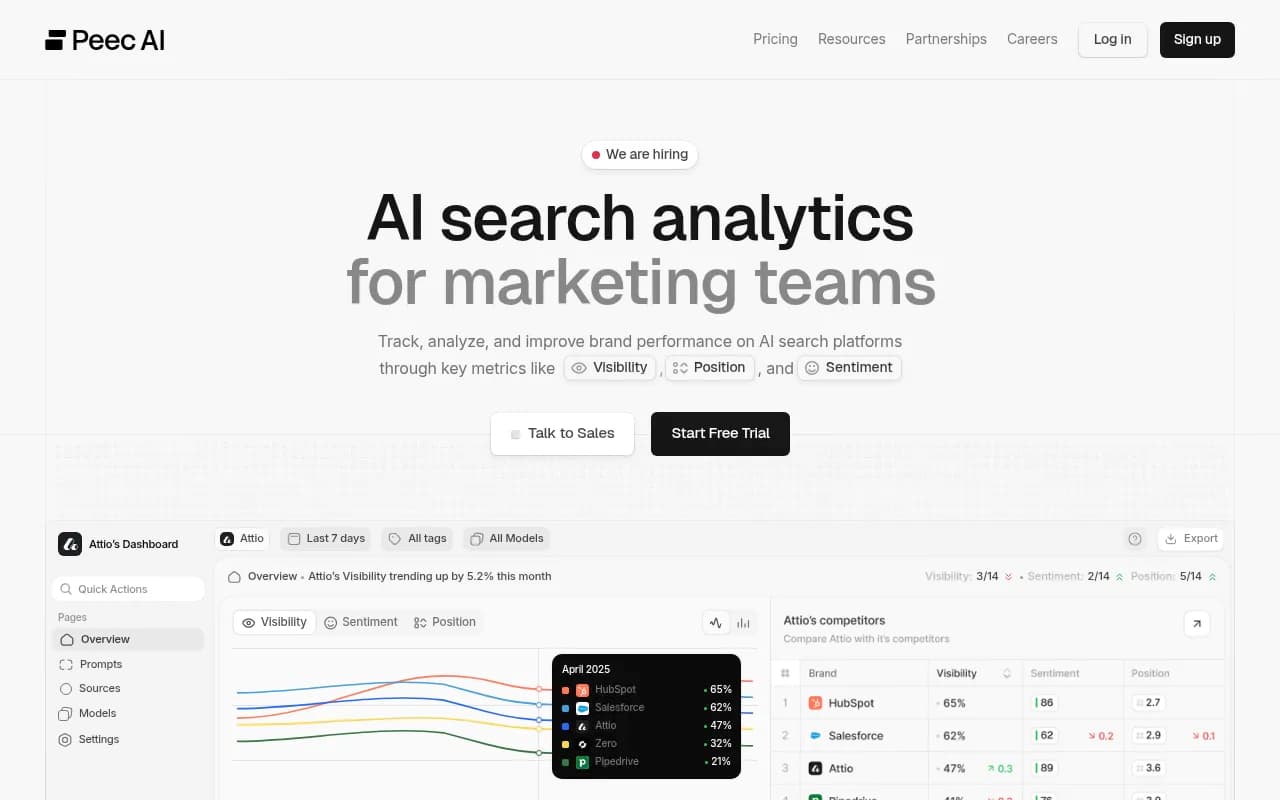
| Peec AI | Simplified 1-5 volume scale rather than absolute number | Deliberately avoids false precision | $95/mo Starter | Most transparent about the limits of the metric itself |
| SISTRIX | 62M+ queries clustered into 1.4M+ topics | Focused on topic-level, not prompt-level, precision | Bundled with SISTRIX AI/Chatbots module | Explicitly explains why individual prompt counting fails |
DataForSEO (ai_search_volume) | PAA-based proxy, never touches an AI model directly | No accuracy claim, framed as an estimate | API-based, per-call pricing | States plainly it's a proxy, not a real AI observation |
What actually separates a good prompt-volume tool from a bad one
After working through vendor documentation and third-party breakdowns, three things consistently distinguish a trustworthy platform from a pseudo-precise one.
Methodology transparency matters more than the number itself. A vendor that tells you "this comes from an opt-in panel of roughly X users, refreshed weekly, with known geographic bias" is giving you something you can sanity-check. A vendor that just shows you "4,820 prompts/month" with no explanation of where that came from is asking you to trust a black box.
Historical trend data beats a single snapshot. A number without a trend line tells you almost nothing. Whether a topic's volume is climbing or falling over the past six months is far more actionable than knowing it's "4,820" this month, especially given how fast underlying AI search behavior moves.
Competitive benchmarking on the same prompt set closes the loop. If you can see your volume and a named competitor's volume side by side, calculated with the same methodology, at least the comparison is internally consistent, even if the absolute numbers are fuzzy.
A validation checklist before you trust any vendor's number
A few sanity checks will save you from building a content strategy on a fantasy number:
- Compare rank order, not absolute numbers, across two or three tools covering the same topic. If they broadly agree on which topics matter most, that's a good sign even if the raw counts differ wildly.
- Cross-check against related Google keyword volume. A wild mismatch (huge prompt volume claimed for a topic with near-zero search demand) is a red flag.
- Manually run your top prioritized prompts through ChatGPT, Gemini, and Perplexity yourself. Does the AI engage meaningfully with the topic, or does it barely register?
- Compare against how real buyers phrase things in sales calls, support tickets, or community posts. If your sales team has never heard a prospect ask the question your dashboard says is high-volume, dig deeper.
- Re-run the same prompts weekly and watch citation stability. Volatile citations on a supposedly "high volume, low competition" topic suggest the underlying data is noisier than advertised.
- Never compare one vendor's absolute number against another vendor's absolute number for the "same" topic. Different panels, different models, different scales. It's not a valid comparison, full stop.
Where citation data fits into the accuracy question
Prompt volume tells you what people are asking. It doesn't tell you whether your brand ever shows up in the answer, or how much citation inventory even exists per platform. That second number varies a lot by engine: Promptwatch's average sources per response data shows ChatGPT cites roughly 5 sources per web-search-triggered response, while Google AI Overviews and Perplexity both sit around 10, and Microsoft Copilot swings wildly, from under 2 to nearly 17 sources within a matter of weeks. A prompt with huge modeled volume but only 5 citation slots per response, split across every competitor in your category, is a much tougher opportunity than the raw volume number suggests.
This is really the case for treating prompt volume as one input among several rather than the whole strategy. Promptwatch approaches this by pairing prompt volume and difficulty scoring with query fan-out visibility, citation-type breakdowns across 22 content types, and crawler logs that show which of your pages AI systems actually read before citing (or not citing) you. That combination matters because it answers a follow-up question most prompt-volume tools can't: even if the volume estimate is directionally right, what do you do about it? Promptwatch's Content Agents and Unified Actions turn the gap analysis into a prioritized to-do list and draft the content to close it, rather than leaving you with a dashboard and a shrug.

Other tools worth knowing in this space
A few other platforms show up repeatedly in this conversation and are worth a look depending on what you need:
AthenaHQ's Prompt Value formula (search volume times intent score times competition factor times bid price estimate) is an interesting attempt to go beyond raw volume, though its 95%+ accuracy claim comes from the vendor itself with no independent verification found.
How to actually choose
If you're a solo marketer or small team just trying to understand your prompt universe, Peec AI's honesty about using a 1-5 scale instead of fake precision is refreshing, and its $95/mo Starter tier is accessible. If you're running AEO for a portfolio of enterprise clients and need panel depth plus multi-region coverage, Profound's scale is hard to match, though the useful data increasingly sits behind its custom-priced Enterprise tier. If your German-language market matters and you want topic-level clustering instead of noisy prompt-level guessing, SISTRIX's approach is genuinely different from everyone else on this list.
But if the real goal isn't just knowing the volume number, it's knowing what to do next with limited time and a content team that can't chase every modeled estimate, that's where a platform combining prompt intelligence with crawler-level visibility data and automated content execution earns its keep. You can browse a broader set of options in the GEO software directory at bestgeosoftware.com or the AI rank tracking tools directory at ai-rank-tools.com if you want to compare more platforms side by side before you commit budget.
Whatever you pick, hold every number loosely. The estimate you get today is built on AI search behavior that could change again before your next quarterly review, and the vendors that admit that upfront are usually the ones worth trusting.