Key takeaways
- Model Context Protocol (MCP) is now a standard way for AI agents to connect to external tools and data sources -- supported by Anthropic, OpenAI, and Google.
- Most AI visibility and GEO platforms don't yet offer native MCP servers, but the ones that do (or integrate via MCP-compatible middleware) unlock powerful automation possibilities.
- The most practical path today is connecting AI visibility tools to your agent stack via MCP gateways like Workato or automation platforms like n8n and Zapier.
- Monitoring-only visibility tools have limited value in an agentic workflow -- you want platforms that can both surface insights and trigger content actions.
- Promptwatch is one of the few AI visibility platforms with an API and Looker Studio integration that makes it viable as a data source in agent pipelines.
Why MCP suddenly matters for AI visibility
A year ago, connecting an AI agent to an external tool meant writing custom API wrappers, managing auth, and hoping nothing broke when the API changed. Model Context Protocol changed that calculus. MCP is an open standard -- originally proposed by Anthropic, now adopted by OpenAI and Google -- that lets AI agents discover and call tools in a standardized way. Think of it like USB-C for AI integrations: one protocol, many compatible devices.
For marketers and SEO teams, this matters because AI agents are no longer just chatbots. They're autonomous workflows that can research competitors, identify content gaps, draft articles, and publish -- all without a human clicking through dashboards. If your AI visibility platform can plug into that workflow via MCP, you've turned a passive reporting tool into an active participant in your content operations.
The question is: which AI visibility platforms are actually ready for this?
The honest answer in mid-2026: most aren't, at least not natively. But the gap is closing fast, and there are practical workarounds that work well today.
What MCP support actually means for a visibility tool
Before evaluating specific tools, it's worth being precise about what "MCP support" means in this context. There are three levels:
Native MCP server: The platform ships its own MCP server that AI agents can connect to directly. Your agent can call tools like get_brand_visibility_score, list_citation_gaps, or fetch_competitor_prompts without any middleware.
API + MCP gateway: The platform has a well-documented API, and you connect it to your agent stack via an MCP gateway (like Workato or a self-hosted MCP server). More setup required, but it works.
No programmatic access: Dashboard-only tools with no API. These are dead ends for agentic workflows -- you can't automate anything.
Most AI visibility tools today fall into the second or third category. A handful are building toward the first.
The MCP infrastructure layer: what's powering agent integrations
To understand where visibility tools fit, you need to understand the infrastructure they'd connect through.
MCP gateways and orchestration platforms
MCP gateways act as a control plane between your AI agents and the external tools they call. Instead of each agent maintaining direct connections to dozens of APIs, the gateway handles auth, routing, rate limiting, and logging centrally.
Workato is one of the most mature options here -- it offers enterprise MCP servers that connect AI agents to 1,400+ apps, including marketing and analytics tools. If your AI visibility platform has an API, Workato can wrap it in an MCP-compatible interface.
n8n takes a more developer-friendly approach. It's open-source, self-hostable, and has strong support for building custom MCP tool definitions. For teams that want full control over their agent pipelines, n8n is a serious option.
Zapier is the most accessible entry point. It connects 8,000+ apps and has been adding AI agent capabilities throughout 2026. It's not as powerful as Workato for complex orchestration, but for simpler "trigger an action when visibility drops" workflows, it's hard to beat for speed of setup.
The key insight: even if your AI visibility platform doesn't have a native MCP server, you can often bridge it through one of these gateways -- as long as it has an API.
AI visibility platforms and their MCP/API readiness
Here's how the major AI visibility and GEO platforms stack up when it comes to programmatic access and agent integration potential.
| Platform | Native MCP server | Public API | Automation-friendly | Best for |
|---|---|---|---|---|
| Promptwatch | No (API + integrations) | Yes | Yes (API, GSC, Looker Studio) | Full GEO workflow automation |
| Profound | No | Limited | Partial | Enterprise monitoring |
| Otterly.AI | No | No | No | Manual monitoring |
| AthenaHQ | No | No | No | Monitoring dashboards |
| Workato | Yes (MCP gateway) | Yes | Yes | Enterprise agent orchestration |
| n8n | Yes (custom MCP) | Yes | Yes | Developer-built agent pipelines |
| Zapier | Partial | Yes | Yes | Simple trigger-action workflows |
| SE Ranking | No | Yes | Partial | SEO + AI visibility combined |
| Semrush | No | Yes | Partial | Traditional SEO with AI monitoring |
The table makes something clear: if you want a visibility platform that slots into an agentic workflow today, you're mostly building the bridge yourself using the platform's API plus a gateway. That's not a dealbreaker -- it's just the current state of the market.
Promptwatch: the most agent-ready AI visibility platform right now
Promptwatch doesn't have a native MCP server yet, but it's the most practical choice for teams building agentic AI visibility workflows. Here's why.

The platform has a public API and a Looker Studio integration, which means you can pull visibility data -- citation counts, prompt performance, competitor heatmaps, crawler logs -- into any system that can make an HTTP request. Combine that with Workato or n8n as your MCP gateway, and you have a fully automated pipeline:
- Agent queries Promptwatch API for answer gaps (prompts where competitors rank but you don't)
- Agent uses that data to brief and generate content via Promptwatch's built-in AI writing agent
- Agent monitors new content performance through page-level citation tracking
- Traffic attribution (via code snippet or server log analysis) closes the loop to revenue
This is the kind of workflow that monitoring-only tools like Otterly.AI or Peec.ai simply can't support -- they don't generate content, and many don't have APIs at all. You'd be stuck exporting CSVs and doing the rest manually.
Promptwatch also tracks AI crawler activity in real time -- which pages ChatGPT, Claude, and Perplexity are reading, how often, and what errors they hit. That data is genuinely useful in an agentic context: an agent could detect that a high-value page is returning crawl errors and trigger a fix automatically.
Other visibility tools worth knowing about
Profound
Profound has strong enterprise features and a solid monitoring foundation. It's used by large brands and agencies. The limitation for agentic workflows is that its API access is restricted on lower tiers, and it doesn't have content generation capabilities -- so an agent using Profound can surface gaps but can't act on them within the same platform.
Otterly.AI
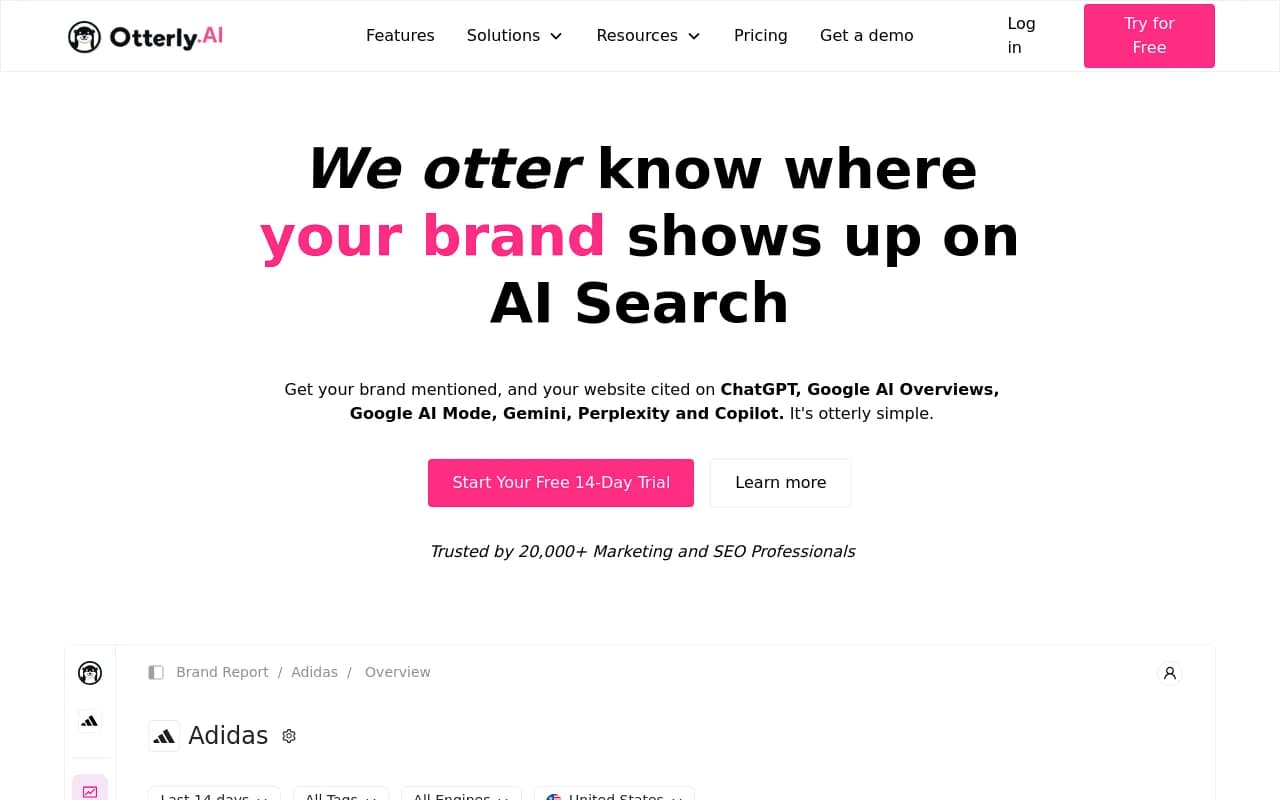
Otterly is a lightweight, affordable monitoring tool. Good for teams that just want to track brand mentions across ChatGPT and Perplexity without a big investment. But there's no API, no content tools, and no crawler data -- which makes it a non-starter for agent integration.
SE Ranking
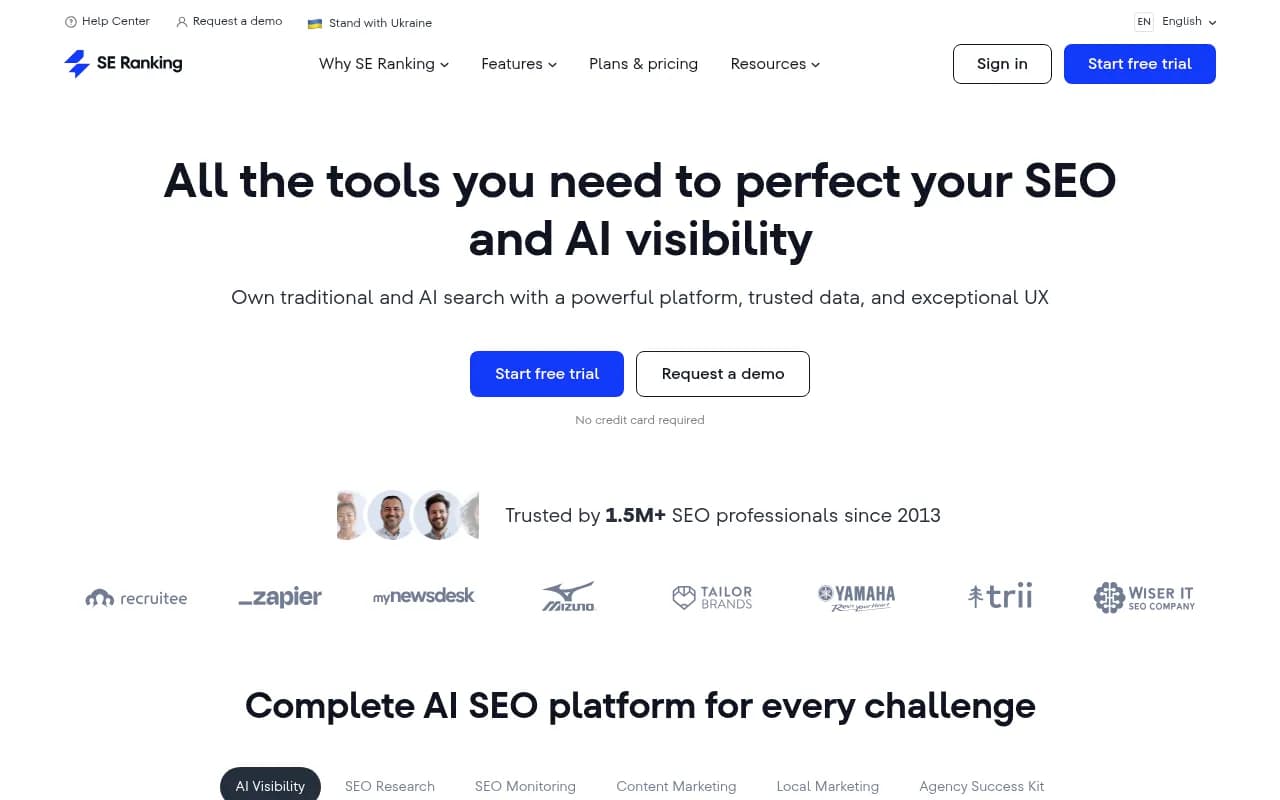
SE Ranking has been expanding its AI visibility features and does have a public API, which makes it more agent-friendly than most. It's a reasonable choice if you're already in the SE Ranking ecosystem and want to pull visibility data into a broader automation workflow.
Semrush
Semrush has an API and a huge integration ecosystem. Its AI visibility features are more limited -- fixed prompts, no AI traffic attribution -- but if you're building a comprehensive SEO + AI visibility agent pipeline, Semrush's API coverage for traditional SEO data is hard to match.
Scrunch AI
Scrunch focuses on monitoring and optimizing how AI assistants represent your brand. It has some optimization features beyond pure monitoring, though it doesn't go as far as Promptwatch's content generation capabilities. Worth evaluating if you're in the enterprise space.
Building an agent workflow with AI visibility data: a practical approach
If you want to actually connect an AI visibility platform to your agent stack today, here's a realistic architecture:
Step 1: Choose a visibility platform with an API
Promptwatch is the strongest choice because it combines monitoring, gap analysis, and content generation in one platform with API access. If you're already committed to another tool, check whether it has a documented API before investing in the integration.
Step 2: Set up an MCP gateway
For enterprise teams, Workato is the most robust option -- it handles auth, rate limiting, and observability out of the box. For developer teams, n8n gives you more flexibility and keeps everything self-hosted. For simpler use cases, Zapier gets you moving in an afternoon.
Step 3: Define your agent tools
This is where you translate the visibility platform's API endpoints into MCP tool definitions your agent can call. Common tools to define:
get_answer_gaps(competitor, topic)-- returns prompts where a competitor ranks but you don'tget_citation_sources(prompt)-- returns which pages and domains AI models cite for a given queryget_crawler_activity(page_url)-- returns recent AI crawler visits and any errorstrigger_content_generation(topic, persona, competitor_data)-- kicks off a content brief
Step 4: Build the agent loop
The most useful agent pattern for AI visibility is a monitoring-and-response loop:
- Check visibility scores daily (or on a schedule)
- Flag any significant drops or new competitor gains
- Identify the specific prompts driving the change
- Generate a content brief or article targeting those prompts
- Track whether the new content gets cited
This is exactly the workflow Promptwatch is designed to support -- and with an MCP gateway in the middle, you can run it with minimal human intervention.
What to watch for in the second half of 2026
The MCP ecosystem is moving fast. A few things to keep an eye on:
Native MCP servers from GEO platforms are coming. Several vendors have mentioned MCP support on their roadmaps. The first platforms to ship native MCP servers will have a significant advantage for teams building agentic marketing stacks.
Agent-to-agent workflows are becoming real. Right now, most teams have a single agent calling external tools. The next wave is multi-agent systems where a research agent feeds data to a content agent, which feeds to a publishing agent. AI visibility data becomes much more valuable in that context -- it's the signal that tells the whole system what to prioritize.
ChatGPT's own agent capabilities (via the Responses API and tool use) are making it easier to build visibility-aware content workflows directly inside OpenAI's ecosystem. If Promptwatch or a competitor ships an official ChatGPT plugin or MCP server, that changes the integration story significantly.
For now, the practical advice is: pick a visibility platform with a real API, connect it through a gateway like Workato or n8n, and start building. The teams that figure out agentic GEO workflows in 2026 will have a meaningful head start when native MCP support becomes standard.
Which platform should you actually use?
If you're building an agentic AI visibility workflow and need to pick one platform to anchor it around, Promptwatch is the clearest choice. It's the only platform that covers the full loop -- finding gaps, generating content, tracking results, and attributing traffic -- with API access that makes automation possible.
For teams that want lighter-weight monitoring without the content generation layer, Otterly.AI or SE Ranking are reasonable starting points, with the understanding that you'll hit a ceiling when you want to automate actions rather than just read data.
And if you're serious about the infrastructure layer, Workato's enterprise MCP servers are worth evaluating as the connective tissue between your visibility platform and your agent stack.
The bottom line: MCP support in AI visibility tools is still early, but the path to building agentic GEO workflows exists today. You just need to assemble the right pieces.