Key takeaways
- There is no published, reliable number for how long models take to "catch up" after a rebrand, merger or crisis. Anyone quoting an exact timeline is guessing. What you can do is measure the lag for your own brand.
- Two separate systems lag differently: the model's trained memory (slow, outside your control) and live retrieval with citations (fast, and where most of your leverage is).
- Promptwatch Data shows landing pages and docs stay cited in ChatGPT for months, while news pages lose half their citations in about 36 days. Old pages with the old name can keep haunting you. Crisis coverage fades faster.
- The practical plan: fix your own pages, redirect and index the new domain, let AI crawlers in, correct third-party sources, then monitor weekly until the wrong claims disappear.
The honest answer to "how long?"
I went looking for a clean study that says "models take X weeks to reflect a rebrand." It does not exist, at least not one I can cite. Promptwatch has not published a report on that exact question either. So this guide does not pretend. Instead it explains why the lag happens, which parts of it you can shorten, and which first-party data tells us how long different kinds of pages stay in AI answers.
Here is the short version. AI answers come from two places, and they update on completely different clocks.
| Source of the answer | How it updates | Your leverage |
|---|---|---|
| Model memory (training data) | Only when a new model version is trained and released | Low. You wait, and you make sure the web says the right thing by then |
| Live search and retrieval (ChatGPT Search, AI Overviews, Perplexity, Copilot) | Whenever pages are crawled, indexed and selected for citation | High. Days to weeks if your pages are reachable and clear |
| Third-party pages AI cites (news, Wikipedia-style references, reviews, Reddit) | Whenever those publishers update or you get them to | Medium. Needs outreach |
Most brands panic about the first row and ignore the other two. That is backwards. You cannot edit a trained model, but you can change what a retrieval-based answer finds this week.
Why models keep saying the old name
Training data is a snapshot
A model's built-in knowledge reflects whatever the web said up to its training cutoff. If you rebranded after that cutoff, the model genuinely does not know. Even if you rebranded before it, the old name usually appears in far more documents than the new one, because it had years of coverage and the new name has weeks. Volume wins. The model picks the statistically common answer.
This is why a merger is often worse than a rename. Two brands with long histories get blended, and the model may describe the acquired company as independent, or attribute old products to the wrong parent. I have seen this pattern in answers repeatedly: confident, fluent, and a year out of date.
Retrieval inherits the old web
When an assistant searches live, it cites what it finds. If your old domain still ranks, your old About page still says the old name, and a dozen directory listings were never updated, retrieval hands the model stale sources. The answer is wrong because the sources are wrong.
There is a new wrinkle here. Promptwatch Data found that on August 8, 2026, ChatGPT Search started using the site: operator at scale. Site-scoped fanout queries jumped from 0.37% to 16.8% of all fanout queries overnight, and the average number of fanout queries per response rose from about 1.08 to about 1.83. For a rebranded company, that means your own domain is now a direct retrieval surface. If the new domain is not crawlable and indexed, those site: searches have nothing to find. If the old domain is still the better-indexed one, that is what gets retrieved.
What Promptwatch Data says about how long pages stay cited
The closest first-party evidence on timing is the half-life of content in ChatGPT report. Promptwatch followed every classified page ChatGPT cited on July 6, 2026, for 90 days, and recorded how many were still cited later. A content type's half-life is where its line drops to 50%.
The report does not cover rebrands. What follows is my inference from it, not a claim the report makes.
| Content type | Still cited after 30 days | Still cited after 60 days | Half-life notes |
|---|---|---|---|
| Landing pages | 78% | 69% | Likely near or beyond 90 days |
| Docs | 76% | 67% | Likely near or beyond 90 days |
| Comparisons | 72% | 63% | Likely near or beyond 90 days |
| Listicles | n/a | 60% | Likely near or beyond 90 days |
| Product pages, reviews, how-tos | n/a | 55% | 74 to 77 days |
| News | n/a | 41% | About 36 days |
The report notes that the final-week drop is partly an artifact of the window ending, so treat the long half-lives as "at least this long."
What this means for you:
- Old landing pages, docs and pricing pages that still use the old name or old facts can keep getting cited for months. These are exactly the pages with the longest staying power. If they are wrong, they stay wrong for a long time.
- The flip side is good news. The new pages you publish are also long-lived. Get them right once and they keep working.
- Crisis coverage is the short-lived kind of content. News pages lost half their citations within 36 days in this dataset, and almost a quarter were never cited again after day 0. If the negative story is a news cycle, its pull on AI answers may fade in a matter of weeks. If it lives on evergreen pages like an explainer, a Wikipedia-style summary or a long review thread, expect it to last longer.
The report's own advice is to treat landing pages, docs and pricing pages as long-term citation assets and keep prices, features and positioning accurate on them. After a rebrand, that is the whole job in one sentence.
A realistic expectation by scenario
I will be explicit that these are working estimates from how the systems behave, not measured benchmarks. Your numbers will differ. Track your own.
Rebrand or domain change
Live-search surfaces can start using the new name once the new pages are crawled and indexed, which can take days to a few weeks depending on your site. Old pages that keep ranking will keep polluting answers until they are redirected or updated. Trained memory is the slow part: expect the old name to surface in non-search answers until a newer model version absorbs enough of the new web. Plan on months, not weeks, for full consistency.
Merger or acquisition
This is the messiest case. Entity confusion lasts the longest because there are two histories to reconcile, and third-party sources (analyst write-ups, directories, review sites, press) need individual updates. Your owned pages are fast. The ecosystem around you is slow.
PR crisis
The model-memory risk is smaller for a recent crisis because the event may postdate the cutoff, but retrieval will happily surface fresh coverage. Based on the news half-life data, citation of the coverage itself should decay faster than anything on your own site. The danger is the lasting claim: a line like "known for data breaches" that gets repeated across forums and summaries and then shows up in sentiment. That is a reputation problem, not a freshness problem, and it needs a content answer, not patience.
Step-by-step: shortening the lag
1. Baseline before you announce
If you can, capture what AI says now. Run the same set of prompts across ChatGPT, Gemini, Perplexity, Google AI Overviews and Claude: "What is [brand]?", "Who owns [brand]?", "Is [brand] the same as [old name]?", "What does [brand] do?" Save the answers and the cited sources. You need a before picture to know what is moving.
Tools in this space include Promptwatch, which collects answers from the real interfaces of AI platforms by country and language and lets you track individual claims AI makes about a brand over time.

Other options for tracking mentions across assistants include Otterly.AI, Profound and Peec AI. If you want to compare more of them, the GEO software directory at bestgeosoftware.com lists dozens.



2. Fix the pages that live longest
Start with the page types the half-life data says persist: landing pages, docs, pricing pages, comparison pages. Update every one that carries the old name, old ownership, old product names or outdated facts. Be explicit on the page. A sentence like "Acme Cloud, formerly known as Orbit Software, is a subsidiary of ..." is boring to a human and extremely useful to a retrieval system, because it ties both names together in one citable passage.
Add a plain FAQ: "Is X the same company as Y?" Answer in two sentences. AI engines love a direct answer they can lift.
3. Migrate cleanly
If the domain changed, use permanent 301 redirects page to page, not a blanket redirect to the homepage. Update your sitemap, canonical tags and internal links. Submit the new sitemap through Google Search Console and Bing Webmaster Tools. Then check the new domain is actually reachable, because a robots.txt or CDN rule copied over from a staging site is a classic way to lose weeks.
The Screaming Frog crawler is a quick way to find leftover references to the old name across a site.
4. Let AI crawlers in and verify it
Promptwatch's AI crawler traffic report shows OpenAI accounted for 79.8% of verified AI crawler requests in the week of Aug 31 to Sep 6, 2026, down from 94.8% in Jun 8 to 14, with Anthropic, Google, Perplexity and Mistral making up the rest. Its advice applies directly after a migration: check robots.txt, CDN and WAF rules for every provider, compare your own crawler logs with that mix, and confirm the new domain is not blocked. A provider that is large in the benchmark but near zero in your logs probably cannot reach you.
Promptwatch's AI crawler logs give IP-verified visibility into which bots read which pages and where they hit errors, which is how you tell an access problem from a content problem. If you want to check basics for free, the Agentic Readiness Check and the robots.txt generator for AI are good starting points.
5. Correct the third-party sources AI cites
Your own site is only part of the picture. List every external page that AI answers cite about you: news articles, directories, review profiles, partner pages, Wikipedia-style references, Reddit threads, LinkedIn pages. Then work down the list.
- Update profiles you control (Google Business Profile, LinkedIn, Crunchbase-style listings, app stores, review sites).
- Ask partners and press to update the name or ownership line. A short factual note with a link to the announcement works better than a long email.
- Do not chase every old article. News pages decay on their own, per the half-life data. Focus on evergreen pages that keep getting cited.
The citation share by content type report is a useful reminder of where the weight sits: product pages were the most cited type at 22.4% of ChatGPT citations in the week of Sep 28 to Oct 4, 2026, followed by landing pages and listicles. Those are the formats to prioritize.
6. Publish content that answers the confusing questions
Before the web catches up, give it something to catch. Write the explainer: what changed, why, what stays the same, what customers need to do. Write comparison pages if the merger changes your positioning. Ground it in facts and dates.
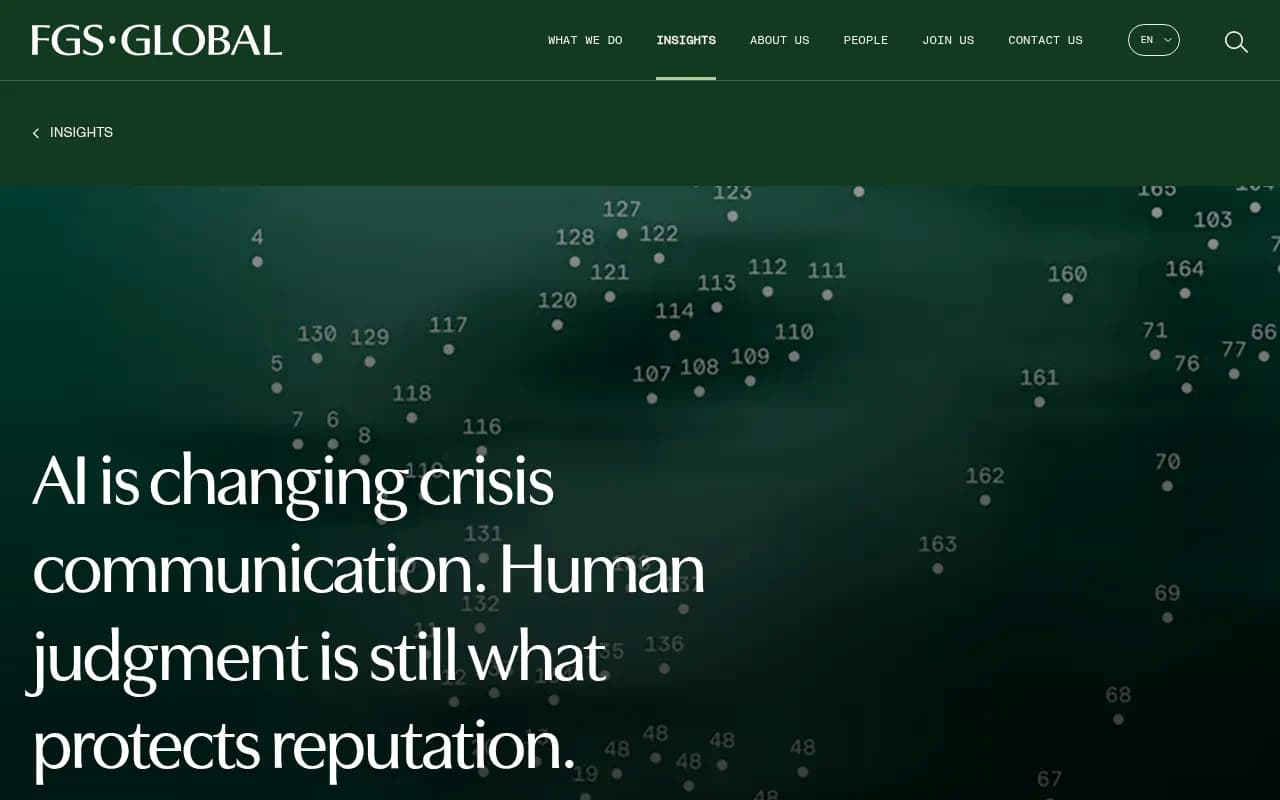
For crisis response, the same logic applies with more care. Publish a clear, factual account on your own domain and keep it updated. FGS Global makes a point in its July 2026 piece on crisis communication that AI can draft statements quickly, but a human has to decide whether to send them. I agree, and I would add one thing: a hastily generated statement that contradicts your own earlier pages is exactly what retrieval systems will quote back at you.
If you want help writing and publishing pages that target the specific prompts where you are misdescribed, Promptwatch's Content Agents can plan and publish against visibility gaps to WordPress, Webflow or Framer. Check pricing to see which plans include them.
7. Monitor weekly, not once
The site: operator shift is a good argument for continuous monitoring. Promptwatch Data notes that search behaviour changed platform-wide in one day, which means a one-off audit goes stale. Run your baseline prompts on a schedule and watch four things:
- Does the new name appear at all (share of responses)?
- Does the old name still appear, and with which sources?
- Which claims are wrong, and which pages are they learned from?
- Is sentiment recovering after a crisis, or flat?
A claim-level view helps here. Promptwatch's Brand Narrative breaks responses into individual claims and themes, and its Fact Check feature (Business plan and above) lets you mark a claim inaccurate and find pages on your own site that state it. For simpler needs, the free AI visibility report gives a quick snapshot.
For broader brand-mention monitoring beyond AI, tools like Brand24 and Meltwater cover news and social listening, which is useful in a crisis because AI answers lean on what the press and forums say.
Tools for each job
| Job | What to use | Notes |
|---|---|---|
| Track AI answers, citations and sentiment | Promptwatch, Otterly.AI, Profound, Peec AI | Promptwatch also covers crawler logs, content creation and traffic attribution |
| Verify AI bots can reach the new domain | Promptwatch crawler logs, Screaming Frog, robots.txt checks | Check every provider, not just OpenAI |
| Get new URLs indexed | Google Search Console, Bing Webmaster Tools | Submit sitemaps, inspect key URLs |
| Monitor press and social fallout | Brand24, Meltwater | Complements AI monitoring |
| Structured data for entity clarity | Schema App, Yoast SEO | Mark up Organization, parentOrganization and sameAs |
Entity signals that help models connect old and new
A few small technical moves do more than they look like they should:
- Organization schema with the legal name, alternateName (the old name), parentOrganization where relevant, and sameAs links to official profiles.
- Consistent naming everywhere: footer, About page, social bios, press boilerplate, app store listings, invoices.
- A short, quotable "formerly known as" line on the homepage and About page for at least a year.
- A press page with the announcement, dated, and a stable URL.
None of these force a model to update. They make it easy for retrieval to resolve the ambiguity in your favour.
What not to do
- Do not delete old pages and leave 404s. You lose the link equity and give AI nothing to connect old to new.
- Do not rely on one big press release. News decays fastest in the data, so a spike of coverage is a short burst, not a durable fix.
- Do not game it with mass-produced posts that mention the new name. They do not fix evergreen sources, and they can lock in inconsistent facts.
- Do not treat a single answer as a verdict. AI responses vary between runs and models, so judge by share across many prompts over time.
A simple timeline to plan against
Again, working assumptions rather than benchmarks:
| Window | What you are doing | What to expect |
|---|---|---|
| Before launch | Baseline prompts, audit old pages and third-party listings | A record of current answers |
| Launch week | Redirects, updated pages, sitemap submission, crawler access checks | Retrieval can start finding new pages as they are indexed |
| Weeks 2 to 6 | Outreach to partners and publishers, publish explainer content | Live-search answers improve; stale news fades on its own |
| Months 2 to 6 | Weekly monitoring, fix remaining wrong claims by source | Old name appears less in retrieval-based answers |
| After the next model releases | Re-run the baseline | Trained-memory answers improve only if the web by then is consistent |
If your answers are still wrong at the six-month mark, the cause is usually a specific source, not a vague slowness. Find the cited page, fix or replace it, and recheck.
Do you need an agency for this?
For a small rebrand, a good in-house marketer with the checklist above is enough. For a merger with dozens of domains, or a crisis where wording matters legally and reputationally, outside help pays off. 1001 SEO Media works on technical SEO, digital PR and generative engine optimization together, which is the combination a post-merger cleanup needs. They use Promptwatch for AI visibility tracking.
Bottom line
Models do not catch up on a schedule you can look up. Trained memory moves with the next release. Retrieval moves as fast as your pages get crawled, indexed and trusted. Promptwatch Data shows landing pages and docs staying cited for months and news fading in about five weeks, so the wrong facts on your evergreen pages are the biggest risk and the loudest crisis coverage is often the shortest-lived. Fix the long-lived pages first, make sure AI crawlers can reach the new domain, correct the external sources that keep getting cited, and measure weekly. For more background on how citations behave, browse Promptwatch Data.