Key takeaways
- Tracking whether AI Overviews mentioned your brand at all is the least useful metric you can measure. It tells you nothing about why, how often, or what happens next.
- The real checklist covers citation source, content type cited, position and framing, sentiment, competitor co-mentions, prompt coverage, click-through, crawler behavior, and decay over time.
- Product pages overtook listicles as the most-cited format in AI Overviews in late July 2026, according to Promptwatch's citation type tracking, so what gets cited changes by content type, not just by domain.
- Manual spot-checks catch maybe a handful of prompts a week. A platform like Promptwatch is built to run this checklist continuously, across hundreds of prompts and multiple AI engines at once.
- Set up crawler log tracking now. It's the one data source almost nobody checks, and it's the only one that shows you what AI actually read before it decided to cite (or skip) you.
Every brand monitoring conversation I see starts the same way: someone asks ChatGPT or Google AI Overviews "best [category] tools" and screenshots whatever comes back. If their brand shows up, they call it a win. If it doesn't, they panic. That's about as useful as checking your website traffic once a month by refreshing the homepage and counting how many people you personally see load it.
AI Overviews and AI Mode answers are dynamic. The same prompt returns different citations depending on the day, the user's location, prior search history, and which sources Google's crawlers happened to index recently. A single "were we mentioned" check is a snapshot of a moving target. If you want actual signal, you need to track a wider set of variables, consistently, over time.
Here's the checklist I'd actually use.
1. Mention vs citation (they're not the same thing)
A mention is your brand named in the generated text with no link. A citation is your brand named and linked to a specific URL. Adobe's own breakdown of AI search brand tracking draws this exact distinction, and it matters because citations are what drive traffic while mentions mostly just shape perception.
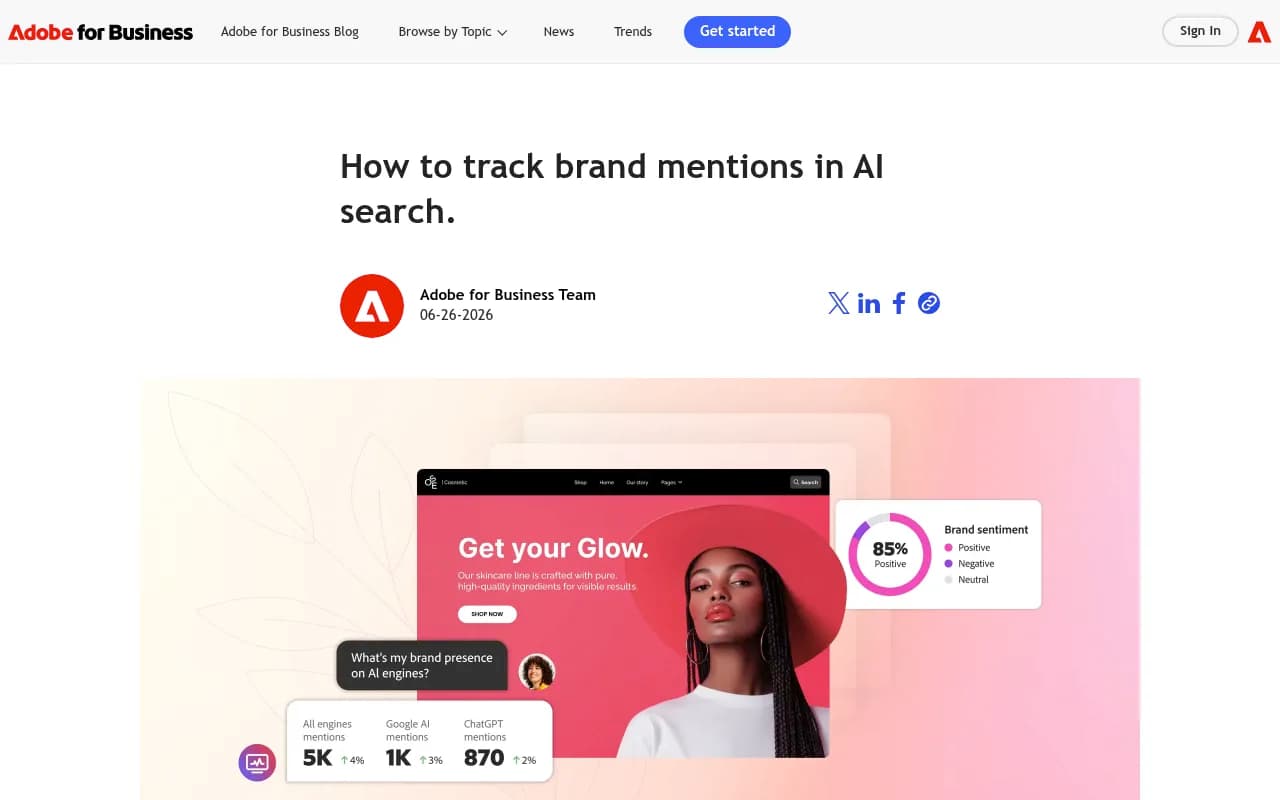
Track both separately. A brand that gets mentioned a lot but rarely linked has a different problem (weak content depth, no clear canonical page to cite) than a brand that's invisible entirely.
2. Which specific URL got cited
Knowing your domain got cited is step one. Knowing which page is the actionable part. Is it your homepage (bad sign, means AI Overviews couldn't find anything more specific), a comparison page, a pricing page, or a three-year-old blog post you forgot existed? Page-level tracking tells you what's actually working so you can build more of it, instead of guessing.
3. Content type of the citation
AI Overviews doesn't cite everything equally. Promptwatch's monthly breakdown of AI Overviews citation types found product pages overtook listicles as the most-cited format in late July 2026. If your competitor's product page keeps getting cited and your listicle-style comparison page doesn't, that's a content-format problem, not a brand-awareness problem. Track the citation type per response: product page, listicle, how-to, news, comparison, forum post, and so on.
4. Position and framing within the answer
Being cited third in a five-source answer that opens with "the most established option is X" is not the same outcome as being buried in a footnote after four paragraphs about a competitor. Note where you land in the response structure and whether the surrounding language is favorable, neutral, or dismissive. This is closer to share-of-voice tracking than a binary presence check.
5. Sentiment of the mention
A Quora thread on this exact topic makes a point worth repeating: it's essential to track if your brand is mentioned, but tracking the tone matters just as much. AI Overviews can mention you accurately and still frame you as "a budget option" or "less feature-rich than X." Sentiment scoring over time tells you whether that framing is improving or calcifying.
6. Competitor co-occurrence
Which competitors show up alongside you, and in what order? If you're always cited third behind the same two competitors across dozens of prompts, that's a pattern worth acting on, not a coincidence. Share-of-voice comparisons against named competitors turn a vague "we should rank higher" into a specific target list.
7. Prompt coverage and gaps
Don't just monitor the five prompts you already know you rank for. Map the full universe of prompts a buyer might type at each stage, awareness, comparison, and decision, and track which ones surface you at all. The gaps are usually more informative than the wins. A brand monitoring guide from Qoulomb lists prompt coverage as one of the core metrics teams should track, alongside citation frequency and referral traffic.
8. Prompt volume and difficulty
Not all prompts are worth chasing equally. Some get searched constantly; others are long-tail and rarely triggered. Prioritize the content and outreach work around prompts with real volume and where you're currently losing, not prompts that sound important but nobody actually asks.
9. Referral traffic and conversions from AI surfaces
A Quora answer on this topic makes a fair point: the chat interface itself is private, but you can see when someone clicks through. Check your analytics for referrer strings like chatgpt.com, perplexity.ai, or gemini.google.com, and watch for spikes that correlate with new citations. Mentions without traffic are a vanity metric. Traffic and downstream conversions are the actual business case.
10. AI crawler behavior on your site
This is the metric almost nobody checks, and it's the most diagnostic one on this list. Before Google's AI Overviews or ChatGPT can cite you, their crawlers have to visit and successfully parse your page. Server log analysis (via Cloudflare, CloudFront, or a similar CDN) shows you exactly which bots hit which URLs, how often, and whether they hit errors. If GoogleOther or a citation-specific crawler is visiting a page repeatedly but it never gets cited, something on that page is failing to earn the citation, which is a very different fix than "we need more content."
11. Citation decay over time
A page that gets cited heavily for two weeks and then drops off a cliff is telling you something: either the content went stale, a competitor published something fresher, or the underlying prompt shifted. Track ramp-up, peak, and decay per cited page instead of treating a single good week as a permanent win.
12. Cross-platform consistency
Google AI Overviews, AI Mode, ChatGPT Search, and Perplexity don't cite the same sources the same way. A brand can be well-represented in AI Overviews and nearly invisible in ChatGPT, or vice versa. Track each platform separately rather than assuming a win on one surface generalizes to all of them.
Putting it together: a simple tracking table
| What to track | Why it matters | Where to find it |
|---|---|---|
| Mention vs citation | Citations drive traffic, mentions shape perception only | Manual prompt testing or an AI visibility platform |
| Specific URL cited | Shows what content actually works | Page-level citation reports |
| Content type cited | Tells you what format to build more of | Citation type breakdowns |
| Position and framing | Distinguishes a strong endorsement from a footnote | Manual review or sentiment tooling |
| Sentiment | Flags framing problems accuracy checks miss | Sentiment analysis features |
| Competitor co-occurrence | Turns vague ranking anxiety into a target list | Share-of-voice / competitor heatmaps |
| Prompt coverage and gaps | Reveals where you're invisible, not just where you win | Prompt tracking across a full prompt set |
| Prompt volume and difficulty | Prioritizes effort toward prompts worth chasing | Prompt intelligence with volume/difficulty scoring |
| Referral traffic and conversions | Connects mentions to actual revenue | Web analytics, referrer segmentation |
| Crawler behavior | Explains why you are or aren't getting cited | Server log analysis / crawler log tools |
| Citation decay | Prevents overreacting to one good week | Citation trend tracking over time |
| Cross-platform consistency | Wins on one engine don't guarantee wins on another | Multi-model tracking |
How to actually run this checklist
Doing all twelve manually, every week, across dozens of prompts and multiple AI engines, isn't realistic for most teams. This is where dedicated tooling earns its keep. Free options like Google Alerts or the HubSpot AI Search Grader (a one-time diagnostic) are fine for a quick gut check, but they don't do prompt-level tracking, crawler logs, or decay analysis.
On the free end, tools like HubSpot AI Search Grader give a one-time snapshot.
HubSpot AI Search Grader
For ongoing coverage, purpose-built AI visibility platforms handle prompt tracking, citation trends, and sentiment as a matter of course. Otterly.AI and Peec AI are reasonable entry points if you just want basic prompt-level presence tracking.


If you want the full checklist covered in one place, that's the gap Promptwatch is built to close. It tracks citation trends across 22 content types and 20 source types with ramp-up, peak, and decay per page, runs AI crawler log analysis (Agent Analytics) showing exactly which bots read your pages and whether they hit errors, measures actual referral traffic and conversions from AI platforms rather than just mentions, and covers prompt volume, difficulty, and coverage gaps across ChatGPT, Gemini, Perplexity, Claude, and Google AI Overviews and AI Mode simultaneously. It also runs sentiment analysis and competitor share-of-voice heatmaps, so items 4 through 6 on this list aren't manual spreadsheet work.

The distinction that matters here: most tools in this space answer "were we mentioned." Promptwatch is built to answer "why weren't we cited, and what do we fix," then generates and can publish the fix directly to your CMS through its Content Agents. That's a materially different job than a mention alert.
For social listening that spans beyond AI answers into forums, news, and review sites, Brand24 and Meltwater still have a role, especially since Reddit threads and forum posts increasingly get pulled into AI Overviews and ChatGPT citations themselves.
A note on cadence
Weekly is a reasonable minimum for prompt tracking; AI Overviews responses shift often enough that monthly checks miss real movement. Crawler log review can run on a lighter cadence, maybe biweekly, since crawl patterns change more slowly than the citations themselves. Sentiment and competitor share-of-voice are worth a monthly rollup so you can see trend lines rather than day-to-day noise.
If you're building this out for a client roster rather than a single brand, the reporting side matters as much as the tracking side. Look for white-label dashboards or scheduled PDF exports so you're not manually screenshotting AI answers for a monthly client call. Most of the platforms mentioned above, including Promptwatch, ship this natively for agency plans.
If you'd rather explore the full category before picking a tool, the GEO software directory at bestgeosoftware.com breaks down platforms by feature set, and ai-rank-tools.com focuses specifically on prompt and rank tracking if that's the piece you're missing right now.
One last thing worth saying plainly: a "yes we were mentioned" answer feels good in a Slack channel but doesn't tell your team what to do Monday morning. The twelve items above do. Pick three or four to start with, crawler logs and referral traffic are the highest-leverage pair, and build out from there.