Key takeaways
- ChatGPT, Claude, and Gemini pull from different citation pools, retrieve information differently, and don't even cite the same number of sources per answer, so "AI visibility" is never a single score.
- ChatGPT leans heavily on Reddit for social citations (5.19% of its citations vs. Claude and Gemini's far lower share), while Gemini's answers are grounded directly in Google's own index through a first-party tool called Grounding with Google Search.
- Even the same prompt on the same tool can produce different results run to run, because of query fan-out variation and genuine model non-determinism, not just "randomness."
- A single check of any AI tool tells you almost nothing. You need repeated, logged prompts across all three engines before you can trust the pattern you're seeing.
- Tools like Promptwatch exist specifically to automate this cross-engine tracking instead of doing it by hand in a spreadsheet.
Why the same brand gets three different answers
A marketer asks ChatGPT "best project management software for small teams," gets one list. Asks Gemini the identical question, gets a different list. Asks Claude, gets a third. Same words, same intent, three outcomes. This isn't a bug. It's the predictable result of three companies building retrieval systems that don't share an architecture, a citation policy, or even a definition of what counts as a good source.
I've seen people treat this like a mystery to be solved with better prompting. It's not a prompting problem. It's a plumbing problem. Each engine has its own pipes, and the water comes out looking different no matter how carefully you turn the tap.
The citation slot problem
Here's a fact that explains a surprising amount of the divergence: these engines don't even cite the same number of sources per answer. Promptwatch's analysis of average sources per response found ChatGPT cites around 5 sources per web-search-triggered response, while Google AI Overviews cites close to 10, roughly double. Perplexity sits at almost exactly 10 sources with very little day-to-day movement. Microsoft Copilot has swung wildly, from under 2 to nearly 17 sources within a matter of weeks (Promptwatch Data).
Think about what that means competitively. If ChatGPT only has 5 citation slots to fill, getting into that answer is a fight for one of five seats. Google's roughly 10-slot inventory is, in Promptwatch's words, "the more forgiving engine to break into." Your brand can be perfectly visible in Gemini or AI Overviews and simply not make the cut in ChatGPT, not because ChatGPT dislikes you, but because there were fewer seats at the table and five other pages got there first.
Different engines trust different sources
ChatGPT is what Promptwatch's social media citation research calls a "Reddit specialist." In its data, 5.19% of ChatGPT's citations point to Reddit, more than 20 times its next-best social source, LinkedIn, at 0.23%. Google AI Overviews and Grok instead lean on YouTube, at 4.08% and 4.85% of citations respectively, with Perplexity also favoring YouTube at 2.67% (Promptwatch Data). Grok is the most socially diverse of the bunch, giving meaningful weight to Facebook and Instagram, platforms the other three barely touch.
So if your brand has a thriving Reddit community but no YouTube presence, you might look fantastic in ChatGPT and nearly invisible in an engine that leans on video. That's not an accident of the algorithm punishing you. It's a direct consequence of where each engine goes looking for confirmation.
This pattern shows up at the domain level too. In ChatGPT Search's June 2026 data, Reddit alone accounted for 3.71% of all citations, over six times the #2 domain, Wikipedia, at 0.56%. But that share isn't stable: it had been 6.11% in May, a roughly 40% drop in a single month (Promptwatch Data). Then on August 14, 2026, Reddit's ChatGPT citation share fell off a cliff, from about 4% to roughly 0.5% in a single day, while AI Overviews and AI Mode saw a more gradual decline over the same period (Promptwatch Data). If you were optimizing for Reddit visibility in ChatGPT and didn't notice that shift, your dashboard would have quietly gone stale overnight.
Gemini plays by Google's rules
Gemini isn't a general-purpose retrieval engine bolted onto a chatbot. Google's own developer documentation describes "Grounding with Google Search" as a first-party tool built directly into the Gemini API across its current model family, letting it cite sources beyond the model's training cutoff by querying Google's live index (Google AI for Developers). That means a brand's Gemini visibility tracks closely with its actual Google search presence. If you rank well organically, Gemini has an easier time finding and citing you. If your organic footprint is thin, Gemini's answers about you will likely be thin too, regardless of how well you're doing on Reddit or in ChatGPT.
Claude is the odd one out, mostly because its retrieval footprint is still small but growing fast. Promptwatch's crawler data shows Claude's citation crawler traffic went from about 0.04% of tracked AI citation crawler traffic in mid-December 2025 to a peak of 1.73% daily share on April 12, 2026, more than a hundredfold increase in four months, with the inflection point in late March 2026 (Promptwatch Data). Even at that peak, Claude sits around 1% of tracked crawler traffic overall, well behind ChatGPT and Google's crawlers. That's a useful reality check: Claude's citation behavior matters less today, but the trend line says check back in six months, and make sure your robots.txt or CDN rules aren't accidentally blocking Anthropic's bots the way an old, forgotten rule sometimes does.
Content format bias adds another layer
On top of source bias, engines have shifting preferences for content type. In July 2026, ChatGPT Search's citations broke down as roughly 32.8% product pages (up from about 18% in March, nearly doubling in four months), 9.7% listicles, 5.2% news, 4.1% how-to content, 4.1% social posts, and 2.9% comparisons (Promptwatch Data). Google AI Overviews saw a similar shift, with product pages overtaking listicles as the most-cited format in late July 2026 (Promptwatch Data). Both engines are converging on citing the commercial page itself rather than a third-party writeup about it. If your GEO strategy still leans on getting mentioned in listicles, that's worth revisiting.
The same tool gives different answers to the same question
Here's the part that trips people up even after they've accepted that engines differ from each other: a single engine will give you different results on consecutive runs of the identical prompt. Two separate mechanisms cause this.
First, ChatGPT doesn't run one search per prompt, it fans a prompt out into multiple separate sub-queries, each hitting different pages. Promptwatch's fan-out research shows the average number of fanouts per response actually dropped over time, from 2.15 in early December 2025 to 1.84 by March, then to about 1.0 in April 2026 (Promptwatch Data). Average query length also shrank, from around 117 characters in December to roughly 53 characters by April, more than half the original length. That means ChatGPT increasingly searches with short keyword fragments rather than full sentences, which changes which page titles and headings actually match. Then on August 8, 2026, ChatGPT started using the site: search operator at scale, jumping from about 0.4% to 17% of all fan-out queries overnight (Promptwatch Data). A change like that can rewrite which of your pages get pulled into an answer without you touching a single word of your content.
Second, and this is the part that's easy to miss: large language models aren't fully deterministic even when developers set them to be. A widely cited arXiv analysis of "non-determinism in deterministic LLM settings" traces this to floating-point rounding under parallel GPU computation and, notably, to Mixture-of-Experts architectures, where the same prompt batched alongside different concurrent requests can produce different token routing and therefore different output (arXiv). A Stack Overflow thread on GPT-4 specifically attributes its inconsistency at temperature=0 to this sparse MoE routing behavior. So when a Reddit or Quora commenter tells you "run the prompt more than once," that's not superstition. It's a direct consequence of how these models are built.
Building a monitoring process that actually works
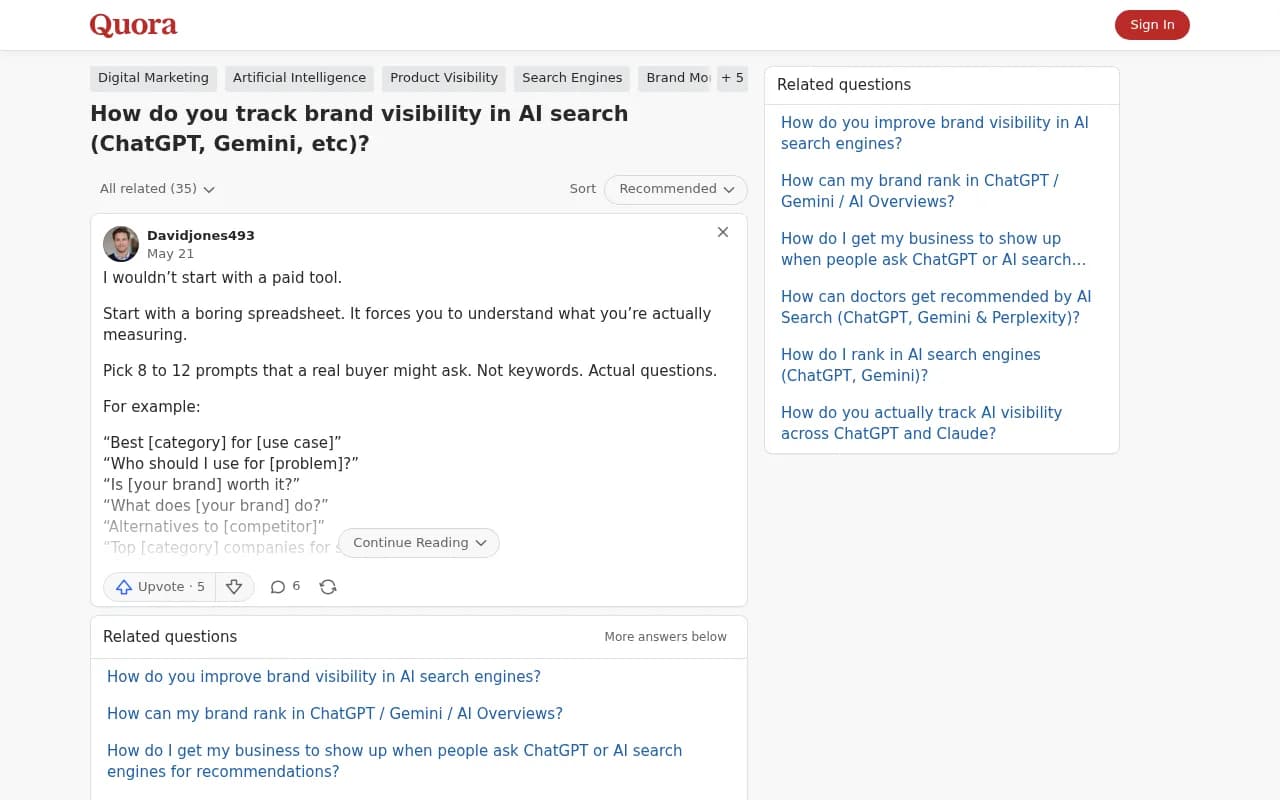
The advice that keeps surfacing from people who've done this manually, on Quora and Reddit threads about AI brand tracking, is consistent: don't treat AI visibility like a single ranking. One Quora contributor put it directly: start with a spreadsheet before you buy a tool, pick 8 to 12 prompts a real buyer would actually ask, freeze that list so you're comparing apples to apples month over month, and log four things for each answer: whether you appeared, where in the answer, what it said about you, and which sources it cited.
A Reddit thread on r/digital_marketing makes the same point from a different angle: run each prompt across ChatGPT, Perplexity, and Gemini separately, because they pull from different sources, and treating them as a single channel hides exactly where you're losing ground. That matches everything above about differing citation pools, differing source preferences, and differing retrieval architecture.
A practical checklist:
- Freeze a list of 8-12 buyer-intent prompts and don't change the wording month to month.
- Run each prompt at least three times per engine, per check, since single runs are close to meaningless given fan-out variance and model non-determinism.
- Log not just "mentioned or not" but where in the answer, what was said, and which sources were cited, since the cited sources tell you exactly which third-party pages are shaping the AI's confidence in your brand.
- Track ChatGPT, Claude, and Gemini as separate lines in your report, never averaged into one score.
- Revisit your source list monthly. Citation share moves fast, Reddit's ChatGPT share alone dropped 40% in a single month before falling off a cliff a few months later.
Where manual tracking breaks down
The spreadsheet method works fine at small scale, and it's genuinely worth doing at least once so you understand what you're measuring. Where it falls apart is volume and consistency. Running 10 prompts across 3 engines, 3 times each, once a month, is 90 manual checks. Do that with 50 prompts and you're at 450. Add crawler log analysis, content gap mapping, and sentiment tracking, and a spreadsheet stops being a monitoring system and becomes a part-time job.
This is the gap that dedicated AI visibility platforms fill. Some, like Otterly.AI and Peec.ai, are essentially automated versions of the spreadsheet: they run your prompts on a schedule and log whether you appeared.
| Tool type | What it tracks | What it's missing |
|---|---|---|
| Manual spreadsheet | Whatever you log by hand | Scale, consistency, crawler data |
| Basic prompt trackers (Otterly.AI, Peec.ai) | Mentions across a fixed prompt set | Crawler logs, content generation, traffic attribution |
| Enterprise monitors (Profound, Scrunch) | Deep prompt-level and citation data | Reddit/YouTube-specific tracking, shopping/ads radar, agentic content execution |
| Traditional SEO suites with AI bolt-ons (Semrush, Ahrefs Brand Radar) | Fixed prompt sets tied to existing SEO data | Shallow AI-specific depth, no AI crawler logs |
| Promptwatch | Prompt tracking, citation trends, crawler logs, visitor analytics, Reddit/YouTube, content gap analysis, automated content generation | N/A - most complete stack in current comparisons |
The distinction that matters most, once you've accepted that ChatGPT, Claude, and Gemini genuinely diverge, is whether a tool just tells you "you weren't mentioned" or whether it tells you why and helps fix it. Promptwatch's crawler log feature (Agent Analytics) shows exactly when ChatGPTBot, ClaudeBot, PerplexityBot, and 400+ other crawlers visited your pages, what they read, and whether they hit errors, which explains the mechanical "why" behind a visibility gap rather than just reporting the gap itself. It also runs dedicated Reddit and YouTube citation reports, directly relevant given how differently ChatGPT, Gemini, and Grok weight those two platforms.

For teams that want a lighter starting point, HubSpot's AI Search Grader offers a free one-time diagnostic, and Amplitude's free AI visibility analysis is worth a look if you just want a first snapshot before committing to a paid tool.
HubSpot AI Search Grader

If you want to browse the broader category of dedicated GEO and AI visibility software before choosing, the directory at bestgeosoftware.com covers a wider set of options side by side, and ai-rank-tools.com focuses specifically on rank-tracking style tools if that's the narrower feature you need.
Putting it together
The honest answer to "why does my brand look different in ChatGPT versus Claude versus Gemini" is that these systems were never designed to agree. They cite a different number of sources, trust different platforms, favor different content formats, and even disagree with themselves from one run to the next because of how the underlying models are architected. None of that is a reason to give up on monitoring. It's a reason to monitor each engine on its own terms, log more than a single check, and pay attention to the sources being cited, since those third-party pages are more actionable than any single visibility score you'll get back.
If your organization is building this into a broader content and SEO strategy rather than a one-off audit, that's the kind of work an agency like 1001 SEO Media handles for clients who want technical SEO, content production, and AI search optimization run as a coordinated program instead of three disconnected efforts.