Key takeaways
- Adobe LLM Optimizer is now Adobe Brand Visibility. Adobe announced the rename on June 17, 2026, folding in Semrush's AI prompt database (nearly 300 million prompts, per Adobe). It makes the most sense if you already run Adobe Experience Cloud.
- Brandlight is an enterprise AI visibility platform with a strong services layer: a dedicated AEO team, content agents, publisher outreach and an AI Ads module. Pricing is not published.
- Promptwatch is the one of the three built as a closed loop: monitor, trace, act, measure. It tracks real AI interfaces, logs AI crawler visits, writes and publishes content, and shows the traffic that results. Pricing is public.
- The deciding questions for a large org are less about dashboards and more about how data is collected, who does the fixing, how you prove revenue impact, and how procurement and security reviews go.
- Whichever you shortlist, run the same 50 to 100 prompts through each in a trial and compare the output against what you see by hand.
Why enterprise GEO is a different buying decision
A 10-person startup can pick an AI visibility tracker on price and move on. A large marketing org cannot. You have multiple brands, several markets and languages, a legal team, a security review, an agency or two, and a CMO who wants a number that ties to revenue.
That changes what matters. A pretty visibility chart is table stakes. The harder questions are these:
- Is the data measured from what real users see, or modeled?
- Can the platform tell you why you are invisible, not just that you are?
- Who does the work to fix it: your team, the vendor's team, or software agents?
- Can you connect AI answers to traffic and conversions?
- Will it pass procurement, and how long does that take?
The three products below answer those differently. If you want a wider scan of the category first, the GEO software directory at bestgeosoftware.com lists most of the alternatives.
The three platforms at a glance
| Adobe Brand Visibility (ex LLM Optimizer) | Brandlight | Promptwatch | |
|---|---|---|---|
| Origin | Adobe Experience Cloud product line, plus Semrush data after the acquisition | Dedicated AI visibility vendor | Dedicated GEO platform, ISO/IEC 27001 certified |
| Data approach | Adobe's documentation describes a statistical approximation of answers to selected prompts (per Profound's reading); Semrush prompt database adds demand data | Visibility score per engine and category, competitive benchmarking | Collected from the real interfaces of ChatGPT, AI Overviews, AI Mode, Gemini, Perplexity, Copilot and more, per country and language |
| Acting on gaps | Opportunities dashboard, Optimize at Edge for AI-friendly page renders | Page-level edits ranked by impact, writing agent, human AEO team | Action Board, Content Agent, content refresh, CMS publishing to WordPress, Webflow and Framer |
| AI crawler logs | Not confirmed in our research | Technical health fixes (crawl, schema) | IP-verified crawler logs on Professional and above |
| Attribution | Investment impact reporting | Leadership overview across a portfolio | Visitor analytics, crawl-to-citation path, Search Console and Bing data |
| Pricing | Sales-led, not published | Sales-led, not published | Public: Essential $95/mo, Professional $245/mo, Business $579/mo, agency and Enterprise tiers |
| Best for | Teams already standardized on Adobe | Brands that want a vendor team to do much of the work | Teams that want data, execution and measurement in one product |
Adobe Brand Visibility (formerly Adobe LLM Optimizer)
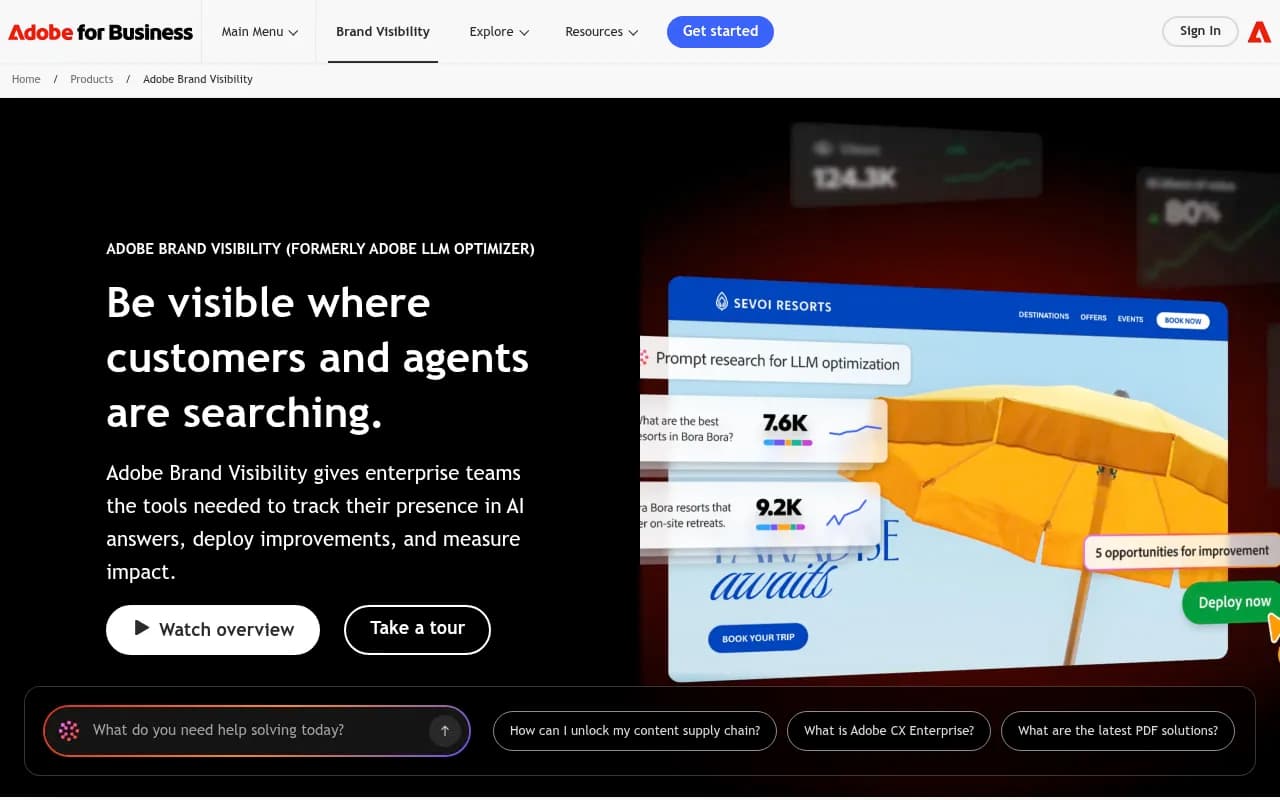
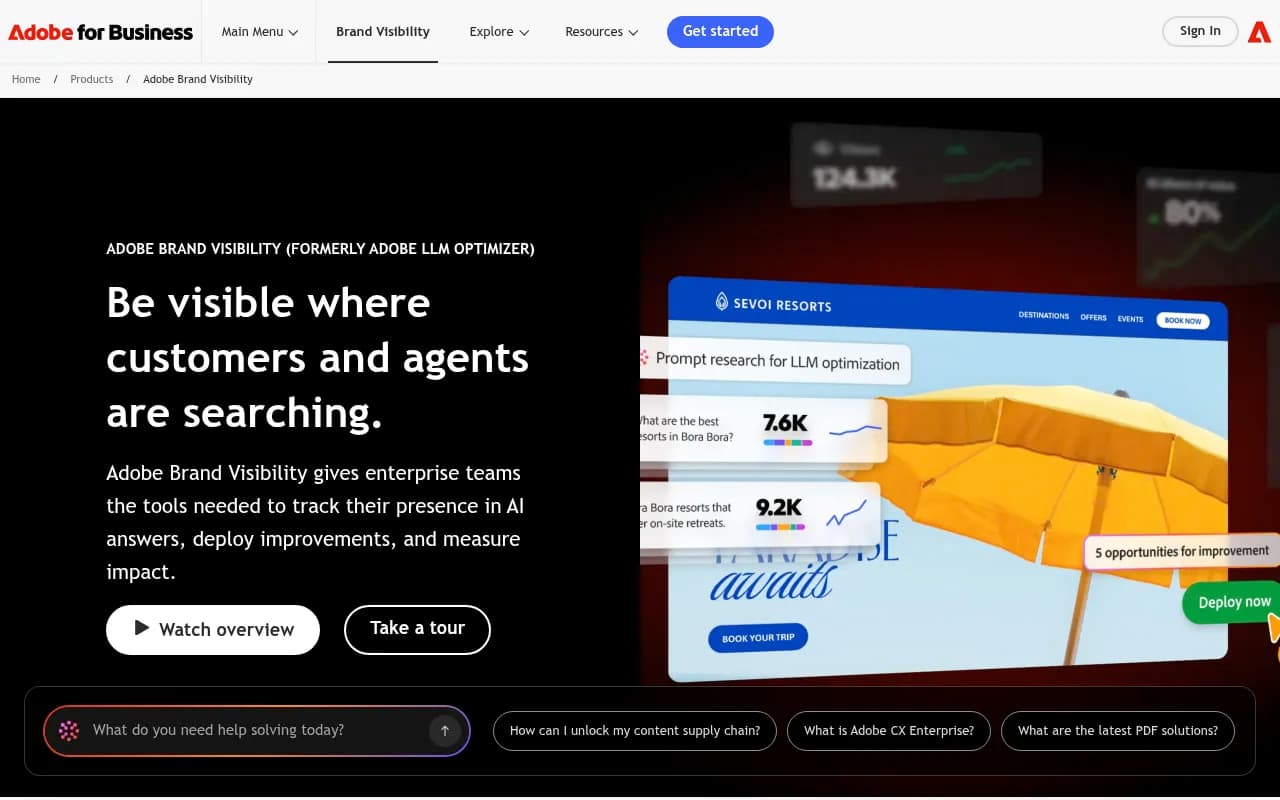
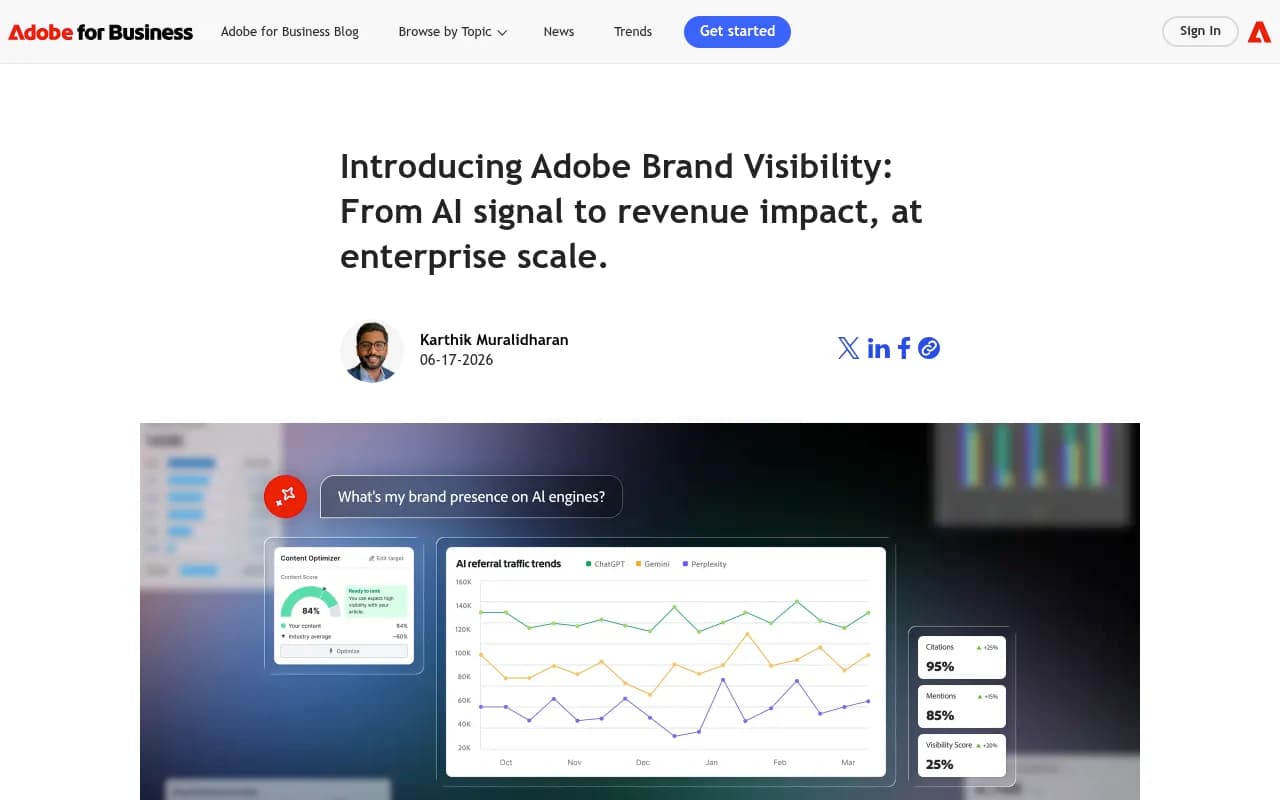
The naming is confusing, so let's settle it. Adobe LLM Optimizer has been generally available since October 2025. On June 17, 2026, Adobe announced Adobe Brand Visibility, which combines LLM Optimizer with the AI search database from Semrush, the SEO company Adobe acquired earlier this year. Adobe's own docs say LLM Optimizer "has evolved into Adobe Brand Visibility." Third-party write-ups note that the product you can actually buy today is still LLM Optimizer, with Brand Visibility as the broader front door. Check with your Adobe rep what is live in your contract.
What you get
Adobe's product page organizes the offer into three areas: AI-driven brand performance, brand optimization for AI search, and AI visibility investment impact. The Semrush layer is the interesting addition. Adobe says it gives access to nearly 300 million AI search prompts, so you can see which specific prompts competitors win and you do not. Digital Applied puts the figure at 289 million.
There is also an Optimize at Edge component, which renders AI-friendly versions of pages for AI crawlers. For a big site where engineering tickets take months, deploying a fix at the edge is a real advantage.
Where it fits
If your content already lives in Adobe Experience Manager, your analytics in Adobe Analytics and your campaigns in Marketo, buying GEO from the same vendor reduces integration and procurement work. That is a legitimate reason and I would not dismiss it. Adobe also has an unusually large data asset through Semrush.
Where to push
A competitor, Profound, argues that Adobe's approach is "modeled estimates" rather than measured visibility, and that Adobe's own documentation describes the method as a statistical approximation. Profound also concedes that for a rough, directional read across a large portfolio at low cost, that can be useful. Treat all of this as a rival's claim, not a verdict. But it is a fair thing to test: ask Adobe exactly how a visibility number is produced, and compare it against responses you capture manually.
Also confirm the following in a demo, because our research could not verify them:
- Pricing and contract structure
- Depth of AI crawler log analysis
- Which engines are covered natively
- How content gets written and published, beyond edge rendering
Brandlight
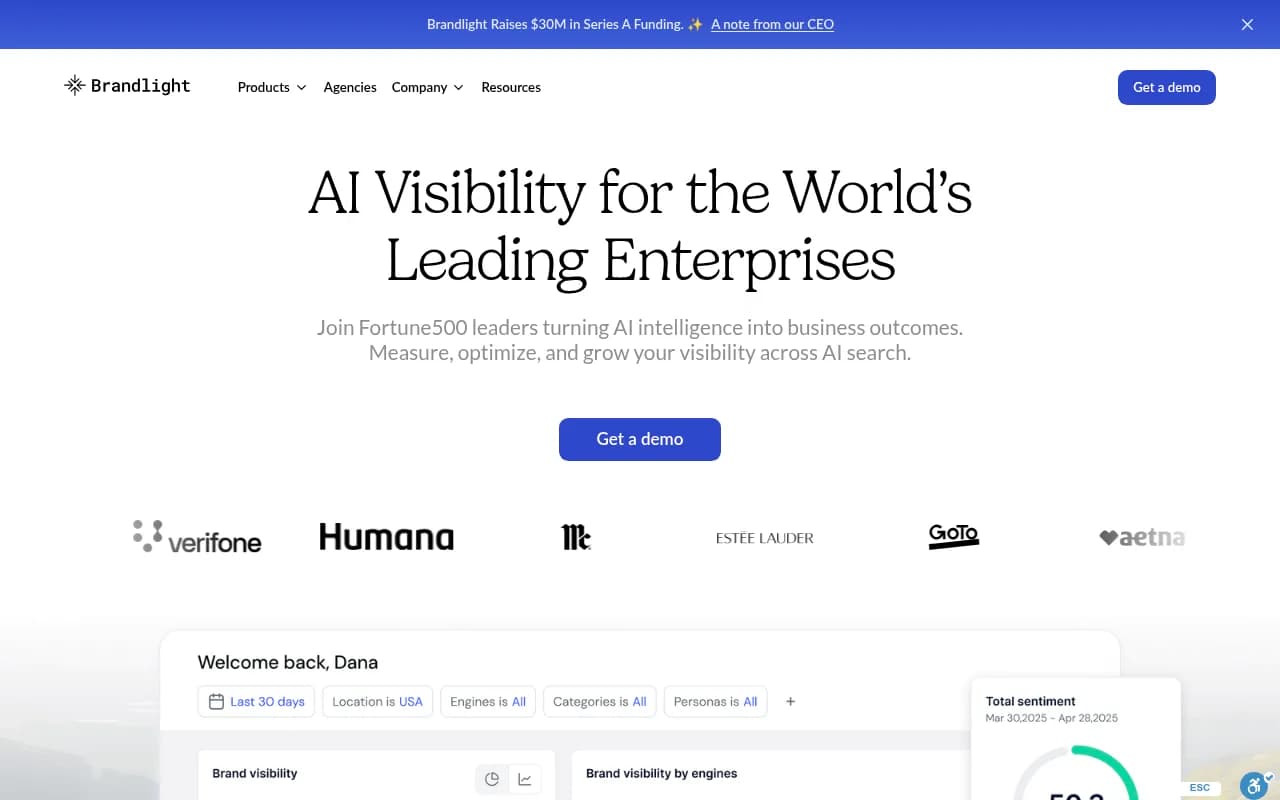
Brandlight positions itself as an enterprise AI visibility platform. Its homepage lists a long module set: prompt tracking across markets, technical health (crawl and schema fixes), content agents that draft answer pages, shopping and product page visibility, publisher and PR outreach to outlets AI trusts, an AI Ads manager, social and creator citations, and a portfolio-level leadership overview.
What stands out
The content optimization product goes down to the wording of individual pages, ranks edits by estimated impact, and has a one-click "send to writing agent" flow. It also comes with a dedicated AEO team that works through fixes alongside the customer. That services layer is the main differentiator. If your marketing org is stretched thin and wants someone else to own the grind, it is attractive.
The PR outreach module is a smart idea too. AI engines lean heavily on third-party sources, so getting named on trusted publisher pages matters as much as your own site.
Brandlight's site shows testimonials from Kimberly-Clark, Samsung, Mediaocean, You.com and Xebia, and a self-reported 4.9/5 G2 rating from roughly 240 reviews. A rival's blog names Volkswagen, LG, TD Bank and Estee Lauder as customers and mentions a $30M Series A, but that is lower-confidence since it comes from a competitor.
Where to push
- Pricing is not published and onboarding is built around strategists. A rival vendor's blog cites third-party reviews suggesting entry plans around $199/mo and enterprise contracts of $4K to $15K/mo. That is unverified, so treat it as a rough estimate at best.
- The homepage claims "#1 AEO platform globally" with no source. Ask for evidence.
- Engine coverage differs between sources (ChatGPT, Gemini, Perplexity, Copilot and Grok per one; Claude, ChatGPT, Gemini and Grok per the homepage logos). Confirm the exact list and whether data comes from real interfaces or APIs.
- A services-heavy model can mean the know-how sits with the vendor, not your team. Decide whether that is a feature or a dependency.
Promptwatch
Promptwatch is an end-to-end AI visibility and GEO platform. The loop is the point: it monitors what AI says about you, traces where answers come from, acts on the gaps, and measures the result on your own site.

Monitor and trace
Promptwatch collects responses from the real interfaces of ChatGPT, Google AI Overviews, Google AI Mode, Gemini, Perplexity, Microsoft Copilot, Amazon Alexa and Meta AI, in each country and language you set, and tracks API models such as Claude, DeepSeek, Mistral and Grok alongside. User-facing answers and citations can differ from API output, which is why interface data matters. Metrics include Visibility Score, Share of Voice, Position and Sentiment, and Brand Narrative pulls out the individual claims AI makes about you and competitors, grouped by theme like Pricing or Support. For a regulated enterprise, Fact Check (Business and above) lets you flag a claim as inaccurate and find the pages on your own site that teach AI the wrong thing.
Tracing covers which of your pages get cited, which Reddit threads, YouTube videos and LinkedIn posts AI relies on, and Offsite Mentions where third parties name you without a link. Brandlight bundles PR outreach; Promptwatch shows you the opportunity list and the citation data behind it.
Act
The Action Board is a prioritized GEO to-do list, and a weekly Discovery agent suggests evidence-backed actions. The Content Agent (Business and Enterprise) plans, writes and publishes pages against your visibility gaps, to WordPress, Webflow or Framer, with a review inbox or fully hands-off. Content Refresh gives diff-style updates to existing pages. Agentic AI Search Optimization is the fully managed version, included with Business.
Measure
AI crawler logs are IP-verified, so you can tell an access problem (bots cannot read the page) from a content problem (bots read it but never cite it). Visitor analytics then show AI-referred traffic and conversions. Crisp reported 2x higher conversion rates from AI traffic than traditional channels, and TreeHouse (Pararius) reached about 25% of organic conversions from AI search, per their case studies.
Enterprise fit
Promptwatch is ISO/IEC 27001 certified and GDPR compliant, with data handled by an EU-based company. Enterprise adds SSO, audit logs, a white-label dashboard and client portal, and a dedicated success manager. A hosted MCP server and REST API let you pull data into your own BI stack. Local GEO targeting at exact coordinates helps multi-location brands.
Pricing
Promptwatch publishes prices, which is rare at this tier. Business is $579/mo (5 projects, 350 prompts, Content Agent, hourly tracking option, Fact Check, Ads Radar, audit log). Professional is $245/mo and Essential $95/mo. Enterprise is custom. Confirm current numbers at promptwatch.com/pricing. The honest caveat: a very large portfolio of brands will land on Enterprise, where pricing is a conversation like the others.
Head-to-head on what large orgs actually care about
Data you can trust
Ask each vendor the same thing: show me ten raw AI responses for ten of my prompts, with the citations, and let me compare against what I see in the browser. Promptwatch's collection method is documented in its Academy. For Adobe, probe the modeled-versus-measured question directly. For Brandlight, ask which engines are real interface captures.
Also check that tracking is per engine. According to Promptwatch Data on average sources per response (published Sep 2025, so possibly dated), ChatGPT cited about 5 sources per web-search answer while Google AI Overviews and Perplexity cited about 10. Blending engines into one score hides that.
Diagnosis, not just scores
Knowing what kind of page gets cited helps you prioritize. Promptwatch's citation share by content type data (Sep 28 to Oct 4, 2026) found product pages are the most cited type in ChatGPT at 22.4%, with landing pages at 16.8%. For commercial prompts, product pages hit 26.0%. A platform that cannot show you which of your pages are cited, and which content types are winning, leaves you guessing. Content also decays: the half-life report found news loses half its cited pages within about 36 days, while landing pages and docs last longer. That argues for refresh workflows, not one-off publishing.
Execution capacity
| Need | Adobe | Brandlight | Promptwatch |
|---|---|---|---|
| Fix technical blockers | Optimize at Edge | Technical health module, AEO team | Weekly site audit, crawler logs, Action Board |
| Write content | Not confirmed | Content agents, writing agent | Content Agent, on-demand content creation |
| Publish | Via Adobe stack (verify) | Verify | WordPress, Webflow, Framer, REST API, MCP |
| Off-site influence | Verify | Publisher/PR outreach | Offsite Mentions, Reddit, YouTube, LinkedIn tracking |
| Human help | Adobe services and partners | Dedicated AEO team | Managed optimization, success manager on Enterprise |
Attribution
This is where CMOs get stuck. Adobe has an obvious path via its analytics products. Brandlight offers a leadership overview. Promptwatch has its own visitor analytics, plus a setting to count visits tagged utm_source=chatgpt.com, because ChatGPT stopped sending a referrer on October 8, 2026. Whatever you choose, make sure AI-referred sessions land in your existing analytics too. The attributing AI traffic guide covers the setup.
Procurement and security
Adobe wins on familiarity: you may already have a master agreement. Promptwatch brings ISO/IEC 27001 and GDPR. Ask Brandlight for its current certifications. Request SSO, audit logs and role-based access from all three.
Which one should you pick?
- Choose Adobe Brand Visibility if your stack is Adobe-first, you want one vendor and one contract, and a directional read at portfolio scale is enough to start. Validate the methodology before signing.
- Choose Brandlight if you want a vendor team deeply involved, value PR outreach to trusted publishers, and are comfortable with sales-led pricing.
- Choose Promptwatch if you want measured interface data, crawler-level diagnosis, content that gets written and published from the same system, and revenue impact you can check. It is also the easiest of the three to price before you talk to anyone.
There is a fair argument for running two. Some enterprises use an incumbent suite for broad portfolio reporting and a specialist platform for the markets and brands where execution matters most. Other enterprise options worth a look are listed in the AI rank tracking directory, including Profound and Bluefish.
A 30-day evaluation plan
- Build a prompt set of 50 to 100 prompts covering branded, competitor comparison and commercial queries, across two or three markets.
- Run the same set through each vendor and capture 10 responses by hand as ground truth.
- Ask each vendor to explain, per prompt, why you lose and what the fix is.
- Ship three fixes from each platform's recommendations and watch whether the pages get crawled and cited.
- Check what the vendor can show about traffic and conversions from those pages.
- Send the security questionnaire in week one, not week four.
To start with something free, Promptwatch's AI visibility report gives a no-login baseline of how ChatGPT, Gemini and Perplexity describe your brand, or you can start the 7-day free trial on a paid plan. If you want an outside team to run the program, 1001 SEO Media, which publishes this site, works with Promptwatch for GEO and AI visibility.
Bottom line
Adobe sells convenience and scale of data, Brandlight sells hands-on service, and Promptwatch sells a loop that goes from measurement to published fix to measured traffic. For most large marketing orgs the real test is simple: after 30 days, which tool has changed something on your site that AI now cites?