Key takeaways
- Scrunch AI tracks brand visibility across LLMs but doesn't surface the external sources (Reddit, YouTube, forums) that influence what AI models say about you
- Most alternatives are monitoring-only dashboards -- only a handful close the loop by helping you create content that gets cited
- Promptwatch is the only platform in this comparison rated as a "Leader" across all GEO categories, with native Reddit and YouTube tracking plus a built-in content generation engine
- If you're choosing based on source intelligence alone, look for tools that show citation origins, not just citation counts
- The real differentiator in 2026 isn't how many AI engines a tool monitors -- it's whether it helps you understand why AI says what it says and what to do about it
Here's something most AI visibility tools won't tell you: ChatGPT doesn't form opinions about your brand in a vacuum. When someone asks "what's the best project management software for remote teams?" and ChatGPT answers, it's drawing on training data and real-time sources -- Reddit threads, YouTube reviews, forum discussions, comparison articles. The AI is essentially synthesizing what the internet says about you.
That's the gap Scrunch AI leaves open. It can tell you whether you appear in AI responses. It can't tell you why you don't, or which Reddit thread is actively hurting your chances.
This guide covers six alternatives that go beyond basic monitoring to track the external sources shaping AI search results -- and in some cases, help you actually influence them.
Why Reddit and YouTube matter for AI visibility
Before getting into tools, it's worth understanding the mechanism. AI models like ChatGPT, Perplexity, and Claude pull from a mix of sources when generating responses. Reddit consistently appears as a high-weight source -- partly because of its volume, partly because AI models treat community discussion as authentic social proof. YouTube descriptions, transcripts, and comment sections carry similar weight.
A competitor getting recommended over you in Perplexity might not be winning because of better SEO. They might be winning because three Reddit threads from r/SaaS rank their product favorably, and a YouTube review with 40,000 views uses exactly the language AI models associate with your category.
Tracking your AI visibility score without understanding these source dynamics is like checking your blood pressure without knowing what's causing it to spike.
The problem with Scrunch specifically
Scrunch AI covers a solid range of AI engines -- ChatGPT, Perplexity, Claude, Gemini, and others. The core issue practitioners keep running into is that it's diagnostic without being prescriptive.
One documented frustration: Scrunch doesn't share prompt volume data, and its prompt trend feature doesn't give you enough signal to prioritize which gaps to fix first. Another: pricing escalates fast when you add team members ($25/user on top of base pricing that starts at $300/month), which makes it expensive for agencies managing multiple clients.
But the biggest gap for 2026 is source intelligence. Scrunch shows you citation counts. It doesn't show you which Reddit threads, YouTube videos, or third-party articles are feeding those citations -- which means you can't systematically influence the inputs that shape AI responses.
6 alternatives worth considering
1. Promptwatch
Promptwatch is the most complete option here if you want to understand and act on what's influencing your AI visibility. It tracks Reddit discussions and YouTube content that directly affect AI recommendations -- a channel most competitors ignore entirely.
The source analysis goes deep: you can see exactly which pages, Reddit threads, YouTube videos, and domains AI models cite in their responses. That's the intelligence layer most tools skip. Instead of just knowing you're not being cited, you know what is being cited instead of you, and why.
What separates Promptwatch from monitoring-only tools is the action loop. Answer Gap Analysis shows which prompts competitors appear for that you don't. The built-in AI writing agent then generates articles, listicles, and comparisons grounded in real citation data -- 880M+ citations analyzed -- to fill those gaps. Page-level tracking closes the loop by showing which new content gets picked up by which AI models.
It also has AI Crawler Logs, which show in real time when ChatGPT, Claude, or Perplexity crawls your site, which pages they read, and any errors they hit. Most competitors don't have this at all.
Pricing starts at $99/month (Essential: 1 site, 50 prompts), with Professional at $249/month adding crawler logs and city-level tracking, and Business at $579/month for 5 sites and 30 articles per month.

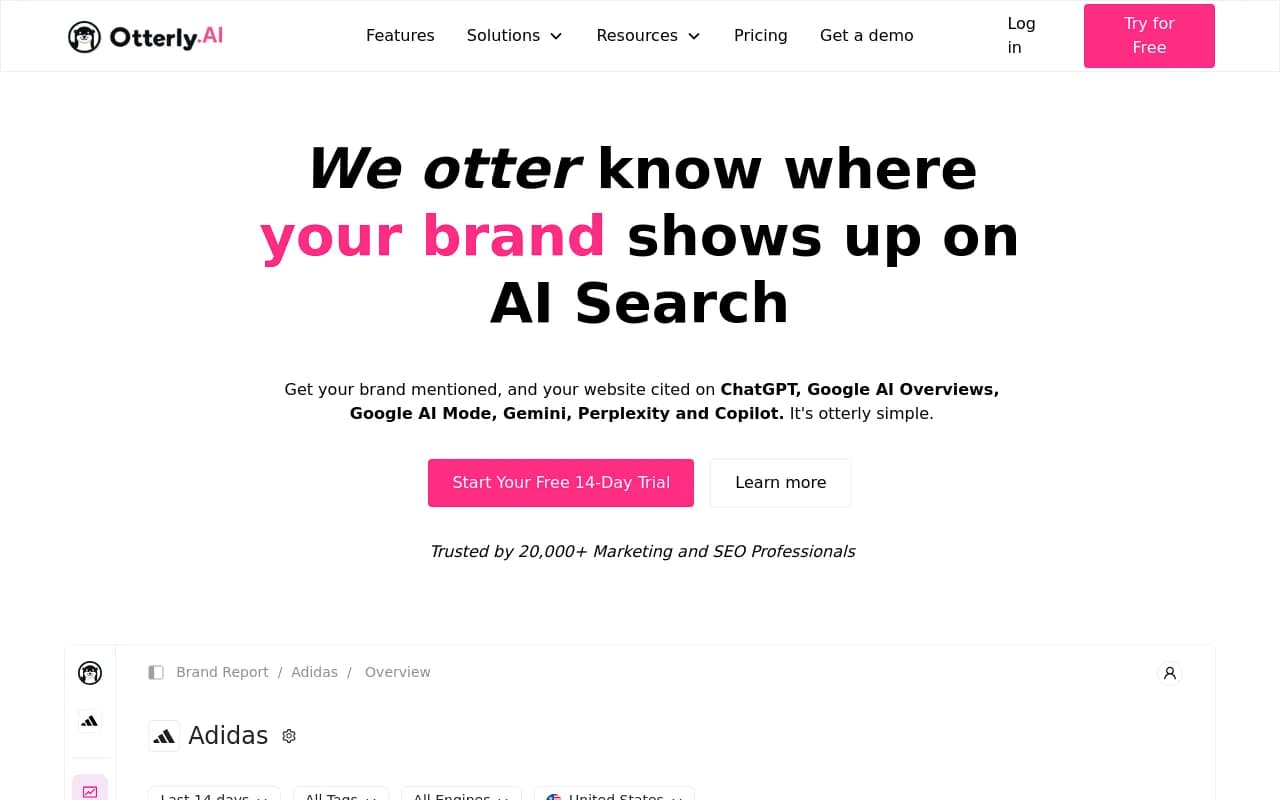
2. Otterly.AI
Otterly.AI is a solid entry point for teams that want clean AI visibility tracking without a steep learning curve. It covers the major AI engines and gives you brand mention tracking across LLM responses.
It doesn't have Reddit or YouTube source tracking built in, but it's honest about what it is: a monitoring dashboard that's easy to set up and read. For smaller teams that just need to know where they stand before investing in a more complex platform, it works.
The limitation is the same one that affects most monitoring-only tools -- you see the data, but the next step is on you.
3. Peec AI
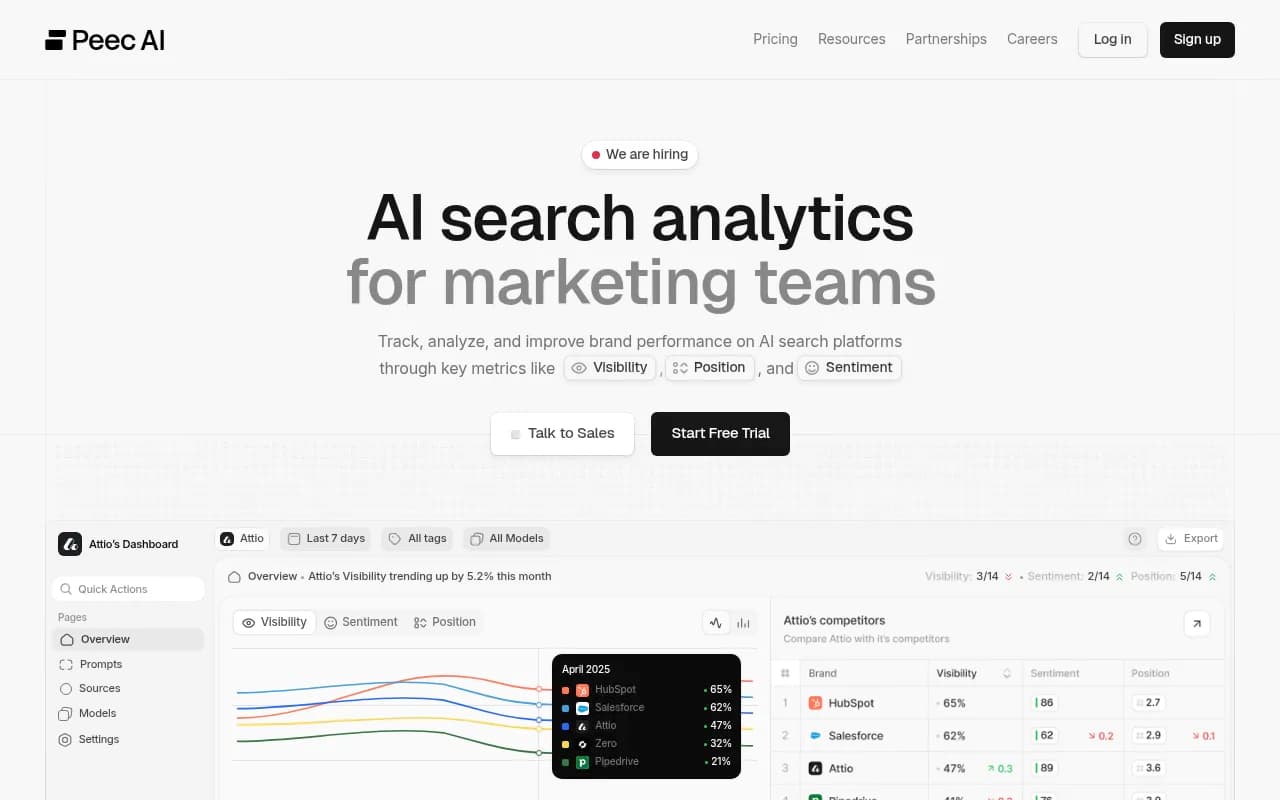
Peec AI takes a dashboard-first approach to AI visibility. It's clean, fast to onboard, and covers the main LLM platforms. The interface is genuinely easier to navigate than most enterprise-grade alternatives.
Like Otterly, it's primarily a monitoring tool. There's no source intelligence layer that shows you which external content is influencing AI responses, and no content generation to help you fix gaps. But if your primary need is a quick read on brand visibility across AI engines without a lot of setup friction, it's a reasonable option.
4. Profound
Profound targets enterprise teams and has a stronger feature set than most monitoring-only tools. It covers AI visibility tracking with more governance features -- useful for large organizations that need audit trails and team permissions.
The source tracking is more developed than Scrunch's, though it still doesn't match the Reddit/YouTube depth of Promptwatch. Pricing is higher, which makes it a harder sell for mid-market teams. If you're a large brand with compliance requirements and a budget to match, it's worth a demo.
5. AthenaHQ
AthenaHQ positions itself as a GEO strategy platform built on AI visibility data. It covers 8+ AI search engines and gives you competitive benchmarking across them. The interface is built around helping teams understand where they're losing visibility and to whom.
The gap is on the execution side -- AthenaHQ is monitoring-focused and doesn't have a content generation layer. You'll get good data on what's happening, but the "what to do about it" question still requires a separate workflow.

6. Airefs
Airefs is the most affordable option in this roundup, starting at $24/month. It describes itself as a full-stack AEO platform with a ChatGPT-first methodology and Reddit monitoring -- which puts it in a different category from most budget tools that skip source tracking entirely.
The Reddit monitoring is a genuine differentiator at this price point. It won't have the depth of Promptwatch's source intelligence, but for a startup or solo marketer who wants to start understanding which community discussions are influencing AI responses, it's a practical starting point.
How these tools compare
| Tool | Reddit/YouTube tracking | Content generation | AI engines covered | Starting price | Best for |
|---|---|---|---|---|---|
| Promptwatch | Yes (native) | Yes (built-in AI writer) | 10+ | $99/mo | Teams that want to find gaps and fix them |
| Otterly.AI | No | No | Major LLMs | ~$49/mo | Simple monitoring for small teams |
| Peec AI | No | No | Major LLMs | ~$49/mo | Dashboard-first visibility tracking |
| Profound | Partial | No | 10+ | $200+/mo | Enterprise with governance needs |
| AthenaHQ | No | No | 8+ | Custom | GEO strategy without execution |
| Airefs | Yes (Reddit) | No | ChatGPT-first | $24/mo | Budget-conscious teams starting with AEO |
What to actually look for when evaluating these tools
Source transparency. Can the tool show you which Reddit threads, YouTube videos, or third-party articles AI models are citing? A citation count tells you you're losing. Source transparency tells you why.
Prompt volume data. Knowing you're invisible for a prompt is only useful if you know how many people are asking it. Without volume estimates, you can't prioritize. Scrunch's lack of prompt volume data is one of the most cited frustrations -- make sure any alternative you evaluate has this.
The action layer. Monitoring is table stakes in 2026. The question is what happens after you see the gap. Does the tool help you create content to fill it? Does it show you which pages to optimize? Or does it hand you a dashboard and wish you luck?
AI crawler visibility. Some tools now show you when AI crawlers visit your site and which pages they read. This is genuinely new intelligence -- if a crawler keeps hitting your homepage but never your product pages, that's a structural problem you can fix.
Multi-model coverage. AI search isn't just ChatGPT. Perplexity, Google AI Overviews, Claude, Gemini, Grok, DeepSeek -- each has different citation patterns. A tool that only monitors one or two models gives you an incomplete picture.
The source intelligence gap most tools ignore
Here's the practical problem: if a Reddit thread from two years ago is actively shaping how AI models describe your product category, and you don't know it exists, you can't do anything about it. You might publish ten new blog posts and see zero improvement in AI visibility because the underlying source driving AI responses hasn't changed.
This is why Reddit and YouTube tracking isn't a nice-to-have feature -- it's the difference between understanding your AI visibility and just measuring it.
The tools that surface this layer (Promptwatch at the comprehensive end, Airefs at the budget end) give you something the monitoring-only platforms don't: a map of the terrain you're actually competing on.
Which tool fits which situation
If you're a marketing team that needs to understand and act on AI visibility gaps, Promptwatch is the most complete option. The combination of source intelligence (Reddit, YouTube, citation origins), Answer Gap Analysis, and built-in content generation means you're not stitching together three separate tools to close the loop.
If you're an enterprise with compliance requirements and a larger budget, Profound is worth evaluating alongside Promptwatch.
If you're a startup or solo marketer with a tight budget who wants to start tracking Reddit's influence on AI responses, Airefs gives you a real entry point at $24/month.
If you just need a clean monitoring dashboard and source intelligence isn't a priority yet, Otterly.AI or Peec AI are easy to get started with.
The one thing I'd avoid: picking a tool purely on the number of AI engines it monitors. Coverage breadth matters less than what you can do with the data. A tool that monitors 15 AI engines but can't tell you why you're invisible -- or help you fix it -- is just a more expensive version of the same problem.