GrowthOS Review 2026
GrowthOS tracks brand presence across ChatGPT, Claude, Gemini, Perplexity and Copilot, treating AI visibility the way you treat SEO rankings. It offers a free AI visibility report so teams can benchmark where they stand before committing to a paid GEO monitoring workflow.
Key takeaways
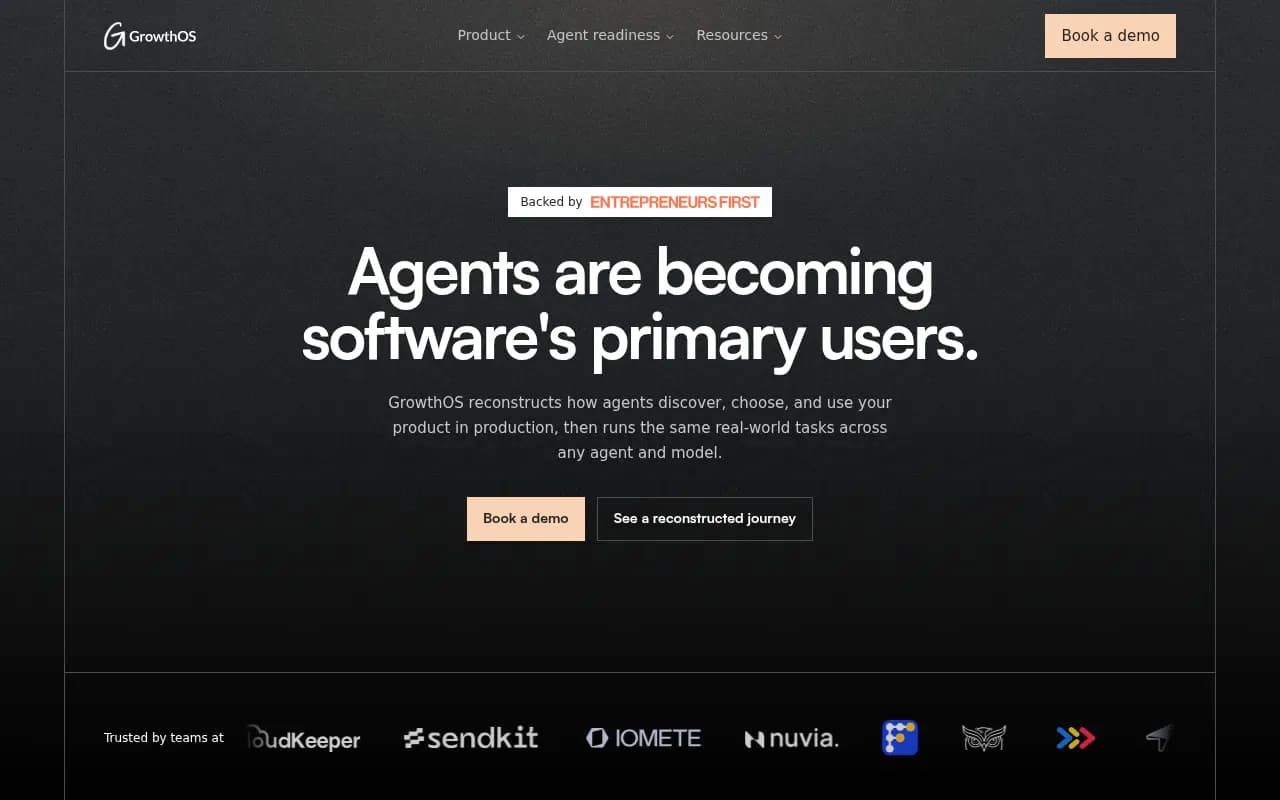
- GrowthOS is not an AI visibility or brand monitoring tool, despite what older directory descriptions suggest. It's agent journey reconstruction software: it rebuilds how AI agents (not humans) discover, evaluate, and use your product in production, then replays those journeys as controlled Evals across agents and models.
- It's extremely early-stage. No public pricing, no self-serve signup, no third-party reviews, and two of its integration categories (product logs, workflow destinations) are still listed as "Planned." You engage by booking a demo or talking to a founder.
- The core value proposition is genuinely novel: the Agent Task Completion Rate (ATCR) metric and the four-layer framework (Discovery, Access, Usability, Transaction) address a real gap for API-first and SDK-first companies whose "users" are increasingly AI agents.
- It does not compete with GEO platforms like Promptwatch on brand visibility, citations, or content optimization. If you need to know whether ChatGPT cites your brand, GrowthOS is the wrong tool. If you need to know whether an AI agent can successfully create an API key in your product, it's one of the few tools even attempting to answer that.
- Best suited for developer-platform B2B SaaS companies (API security, data infrastructure, SDKs, MCP servers) with the engineering bandwidth to instrument their product surfaces. Not suited for e-commerce brands, local businesses, or marketing teams.
What GrowthOS actually does
The premise is simple and a little unsettling: agents are becoming software's primary users. When an AI agent tries to activate your SDK, it might browse your docs, hit an auth barrier, recover through your API reference, and send its first event. Your existing analytics split that journey across five different tools and never show you the whole task. GrowthOS joins the evidence into a journey graph.
What I appreciate here is the epistemic honesty. Every connection in the reconstructed journey carries a confidence level (exact, strong, probable, ambiguous, unresolved) plus supporting evidence and unresolved alternatives. The company explicitly refuses to force uncertain data into a clean narrative, and their methodology page discloses limitations rather than hiding them: reconstruction quality depends on how much product-owned evidence your surfaces expose, and network or timing clues alone never prove identity. That's rare. Most analytics vendors oversell certainty.
The second engine, Evals, takes a real production journey and turns it into a controlled, repeatable test. You hold the success criterion steady while comparing agents, models, interfaces, documentation versions, and product treatments. The output table is refreshingly concrete: completion, friction (avoidable recovery work), latency, token usage, retries, and named failure modes like "auth scope unresolved." This is the loop that makes the product more than a passive dashboard: production tells you what to test, Evals tell you what to change, and you verify the change back in production.
ATCR: the metric worth knowing about
Agent Task Completion Rate is GrowthOS's flagship number: completed reconstructed production tasks divided by eligible reconstructed production tasks. The company is careful, almost pedantically so, to keep it separate from Eval pass rate and evidence confidence. The three numbers never collapse into one composite score, which is the right call even if it makes the pitch harder to digest.
If your product has an API, SDK, or MCP server, ATCR answers a question nobody else is measuring: what fraction of agent-initiated tasks actually complete end to end? A developer-tool company could plausibly find that agents get stuck at auth 40% of the time and never know it from human-oriented funnels.
Strengths
- A genuinely new category. Journey reconstruction plus controlled agent Evals is not something I've seen packaged this way. The closest analogues are observability tools and LLM eval frameworks, neither of which reconstruct production agent behavior across docs, auth, API, and SDK surfaces.
- Methodological transparency. The pipeline (Collect, Bound, Link, Constrain, Reconstruct, Classify) is documented publicly, along with what it cannot do. For a product making claims about inference and confidence, publishing your limits builds trust.
- Real failure-mode specificity. The Eval output names blockers like "auth scope unresolved" and quantifies friction, not just pass/fail. That's actionable for docs and DX teams.
- Serious founding team for the problem space. All three co-founders (Sidhant Goyal, Vivek Mittal, Harsh Raj) came through YC-company engineering roles (Artisan AI, Atlys) and the company is backed by Entrepreneur First's S26 cohort.
Limitations
- No self-serve anything. The site states plainly: "There is no self-serve product tour on this site." Every engagement starts with a demo or a founder call. For teams that want to poke at a tool before talking to sales, this is a hard stop.
- No public pricing. The /pricing URL redirects to a contact form. Expect bespoke, negotiated pricing consistent with an early enterprise sell.
- Instrumentation burden. Python and TypeScript SDKs are available for backend, browser, and edge events, but product-log connectors and workflow destinations are still "Planned." You're doing real integration work to get value, scoped individually with the GrowthOS team.
- No independent validation. Nothing on G2, Capterra, or Gartner for this specific product (a Gartner "GrowthOS" listing is actually an unrelated Mutinex marketing-mix tool, a name collision worth knowing about). The logo wall shows early customers like Akto, Cloudkeeper, and Iomete, all dev-tooling startups, but there are no published case studies with numbers yet.
- Tiny public footprint. The blog went live with 12 articles in the first 11 days of September 2026. The founder's X account has under 100 followers. This is a bet on a team and a thesis, not a proven platform.
Who it's for
The sweet spot is a developer-platform B2B SaaS company with an API, SDK, or MCP server where a meaningful share of "usage" is agent-initiated: API security vendors, data infrastructure companies, integration platforms. You need engineering capacity to instrument your surfaces and a tolerance for an early-stage vendor.
Who should skip it: marketing teams tracking brand mentions in AI answers (that's a GEO platform's job), e-commerce brands, and anyone who needs a self-serve trial before buying.
How it relates to AI visibility tools
There's a category confusion worth clearing up, because older descriptions of GrowthOS (including the one in some directories) frame it as "AI visibility and brand presence tracking across ChatGPT, Claude, Gemini, Perplexity and Copilot." The live product is not that. GrowthOS measures whether agents can complete tasks inside your product. It does not track whether ChatGPT cites your brand, prompt volumes, citation share, or AI-driven traffic.
If your problem is brand visibility in AI answers, you want a GEO platform. Promptwatch, for example, tracks citations across ChatGPT, Claude, Gemini, Perplexity, Grok, and Google AI Overviews, shows which of your pages get cited, measures actual AI-driven traffic and conversions, and runs content gap analysis to fix gaps automatically. GrowthOS has none of that, and doesn't claim to.
The two could actually be complementary for a developer platform: a GEO tool tells you whether agents discover you, and GrowthOS tells you whether they can then complete the activation journey. But they solve different problems, and buyers should not confuse them.

Bottom line
GrowthOS is an early, ambitious bet on a real shift: if agents become primary software users, someone has to measure whether they succeed. The journey reconstruction engine, the Evals loop, and the ATCR metric are thoughtfully designed, and the company's honesty about its own limitations is a good sign. But it's a demo-only, unpriced, pre-validation product from a three-person founding team, and you'd be an early adopter in every sense.
For developer platforms with agent-heavy usage and the engineering bandwidth to instrument properly, a founder call is probably worth 30 minutes. For everyone else, especially teams focused on brand visibility in AI search rather than agent task completion, a mature GEO platform like Promptwatch is the more practical starting point.
Tags:
Frequently asked questions
Is GrowthOS an AI visibility or brand monitoring tool?
What is ATCR (Agent Task Completion Rate)?
Does GrowthOS have public pricing or a free trial?
What integrations does GrowthOS support?
Who should use GrowthOS?
Is GrowthOS a proven, mature product?
Similar and alternative tools to GrowthOS