Key takeaways
- Wikipedia appears in roughly 27% of AI citations across ChatGPT, Gemini, and Perplexity. No other single source comes close. For Google it's one signal among hundreds. For AI models it's close to ground truth.
- Most brands can't get a page. English Wikipedia rejects 68% of Articles for Creation submissions, and business topics have the lowest approval rates of any category: 16% for companies, 6% for startups.
- Notability comes from independent press coverage you didn't commission. Press releases, sponsored posts, and founder interviews don't count, and no amount of polished writing fixes missing coverage.
- If the page is about your brand, you have a conflict of interest. You must disclose it and submit through Articles for Creation. Direct self-editing gets you blocked and your brand flagged on a public noticeboard.
- Since March 2026, Wikipedia's editor community has banned AI-generated articles. Write the draft yourself or hire a specialist. Don't hand it to ChatGPT.
Why Wikipedia matters more for ChatGPT than for Google
Think about what Wikipedia does for you in Google today. Someone searches your brand name, your website ranks first, and the Wikipedia page, if you have one, sits somewhere on page one. Most people click your site. The page mostly fills your knowledge panel and signals legitimacy. Useful, but peripheral.
AI flipped that relationship. The Wikimedia Foundation has said that every large language model released so far was trained on Wikipedia content, and that Wikipedia is almost always the largest single source of training data in those datasets. Read that in brand terms: the model formed its understanding of your company partly from your Wikipedia page, or from its absence, before any user ever typed a question about you. Rankings can be climbed month by month. A prior belief about your brand was formed at training time, and it's much harder to move.
Then there's the retrieval layer. When ChatGPT or Perplexity searches the web mid-conversation, Wikipedia is one of the domains they reach for most. And a Pew Research study from July 2025 found that people click traditional search results less when an AI summary appears, which means the summary itself, not your website, is increasingly the first thing a buyer reads about you.
The numbers, with an honest caveat
Different studies measure this differently, and the numbers swing depending on method and month:
- GrowthOS puts Wikipedia at nearly 27% of citations across ChatGPT, Gemini, and Perplexity combined, the dominant reference source by a wide margin.
- Profound's citation analysis found Wikipedia accounts for 47.9% of ChatGPT's top-10 source share, but just 0.6% of Google AI Overviews citations, where Reddit and LinkedIn both outrank it.
- Semrush tracked ChatGPT's Wikipedia citations falling from roughly 55% of prompt responses to under 20% in mid-September 2025. Their team attributes the drop to ChatGPT deliberately avoiding over-citing certain domains, not to Wikipedia losing relevance.
- 5WPR's 2026 research found Wikipedia is the most-cited source in AI answers at the same time human pageviews fell 8% year over year. People read it less. Machines read it more.
The numbers disagree with each other because methodologies differ. The direction is consistent though: Wikipedia is the heaviest single source for ChatGPT, matters less for Perplexity, and barely registers in Google AI Overviews, which is roughly the opposite of what most marketers assume.
| Platform | How it uses Wikipedia | Wikipedia's rough share |
|---|---|---|
| ChatGPT | Absorbed during training, also pulled in live search | 47.9% of top-10 source share (Profound), volatile month to month |
| Gemini | Through Google's Knowledge Graph, which leans heavily on Wikipedia | Feeds entity data more than visible citations |
| Perplexity | Direct retrieval with visible attribution links | Under 1% of citations; Reddit dominates at ~46.5% of top sources |
| Google AI Overviews | Through the Knowledge Graph | 0.6% of citations (Profound) |
One more thing worth sitting with. The agency ToTheWeb reported watching an AI tool cite a Wikipedia page that didn't exist for a client's branded search. The model expected a page to be there. It wasn't, so it invented one. That's the level of confidence AI systems place in Wikipedia, and it cuts both ways: an accurate page makes AI describe you accurately, while a missing page means AI describes you from whatever else it can find, which is usually competitors, analyst pages, and your own press releases.
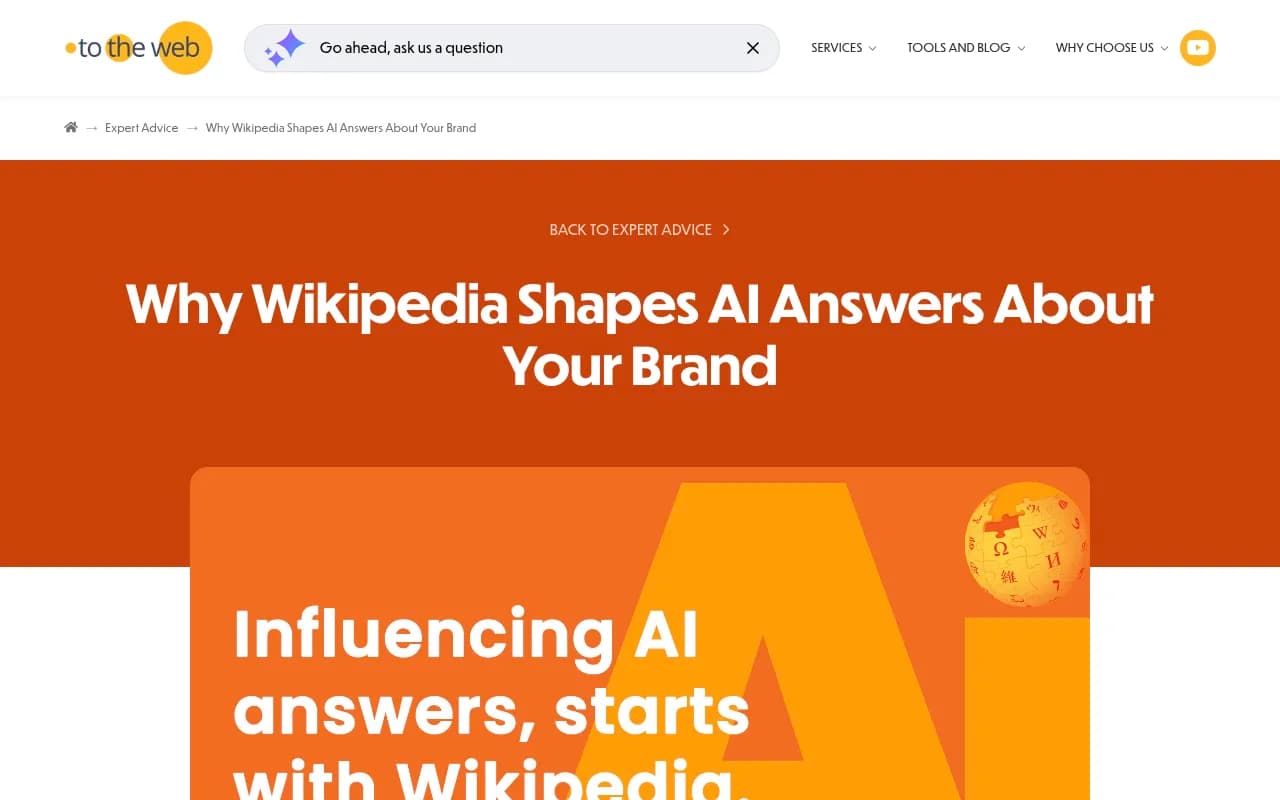
Wikimedia CH, the Swiss chapter, reported 50% growth in hits from AI systems reading Wikipedia. The page's job has quietly changed. You're not writing it for a prospect browsing an encyclopedia. You're writing it so the machines that summarize you to the market get you right.
The notability bar, and why most brands fail
Here's the part most guides soft-pedal. Most of you reading this cannot get a Wikipedia page, and it has nothing to do with how good your company is.
Lumino audited 1,009 English Wikipedia Articles for Creation submissions across two sample periods in 2025. The overall rejection rate was 68%. Notability was the stated reason for 57% of declines. The category breakdown is brutal for anyone in business: arts and culture drafts get approved 48% of the time, companies 16%, business executives 12%, and startups just 6%. If you're a funded startup hoping for a page, your approval odds are roughly one in sixteen.
Reviews take about 30 days either way, and nearly 40% of all reviews were handled by just 11 prolific editors. That's a structural bottleneck, not a service level agreement you can negotiate with.
Wikipedia's guideline for organizations, WP:NCORP, is stricter than the general notability guideline, and the policy page says plainly that only a small percentage of organizations in the world qualify. Size doesn't matter. Revenue doesn't matter. Being famous in your industry doesn't matter. What matters is whether independent, reliable sources have covered you in depth, and whether they did it without you asking or paying.
What counts as notability (and what doesn't)
Three tests get applied to every source you'd cite. Significant means the source discusses your company in depth, not a passing mention in a roundup. Independent means you didn't write it, commission it, supply the material for it, or pay for it. Reliable means the outlet has editorial control and a reputation for fact-checking.
| Counts toward notability | Doesn't count |
|---|---|
| Independent feature or investigative articles | Press releases and wire syndication |
| National or major trade press with editorial standards | Your own site, blog, and social channels |
| Books and academic sources covering the company | Founder interviews and Q&As |
| Independent analyst reports | Routine funding and hiring announcements |
| Sustained coverage over multiple years | Paid placements and sponsored posts |
The funding round trap deserves a callout, because it surprises almost every founder. Coverage of your Series B is usually treated as a routine announcement, because dozens of companies raise every week and the coverage follows a template. A TechCrunch funding post is not your ticket in. What reviewers look for is a journalist deciding your company is a story worth telling in depth, on their own initiative.
If you don't have that coverage yet, that's the real project, and it's a PR project, not a Wikipedia project. This is where digital PR work comes in. Agencies like 1001 SEO Media run digital PR campaigns specifically to earn independent coverage in outlets that pass Wikipedia's reliability tests, and that coverage does double duty, because the same articles are what AI models cite when they describe your category.
To audit what coverage already exists, media monitoring tools beat manual Googling. Meltwater and BuzzSumo can pull every news mention of your brand across thousands of outlets, which turns the notability spreadsheet into a one-afternoon job instead of a week of searching.
How to do it right: the actual process
Assuming your notability audit passes, here's the sequence that doesn't get you blocked.
- Run the audit first. Build a spreadsheet of every piece of coverage, with columns for outlet independence, depth of coverage, and editorial standards. Be brutal about it. If you can't find at least three genuinely independent sources with real depth, stop here and go work on coverage instead.
- Get your facts consistent everywhere. Your Wikidata entry, Crunchbase profile, LinkedIn company page, and your own About page should all state the same founding date, the same founder names, the same headcount range. Reviewers cross-check these, and so do AI models.
- Disclose your conflict of interest. If you're affiliated with the brand or being paid, Wikimedia's Terms of Use require you to say who's paying and for what. No confidentiality, no exceptions. You disclose with the paid template on your user page and the connected contributor template on the article's talk page, using a registered account. Undisclosed paid editing is the one thing that turns a routine rejection into a permanent black mark.
- Draft through Articles for Creation. Neutral tone, no marketing language, every claim cited to an independent source. Describe your product the way a skeptical journalist would, not the way your homepage does.
- Submit and wait about a month. Average review time is 30 days for approvals and 32 for declines. Expect a decline on the first pass even for decent drafts. Read the reviewer's stated reasons, fix them, resubmit. Do not argue on the talk page. Reviewers decline hundreds of drafts, and they remember editors who fight.
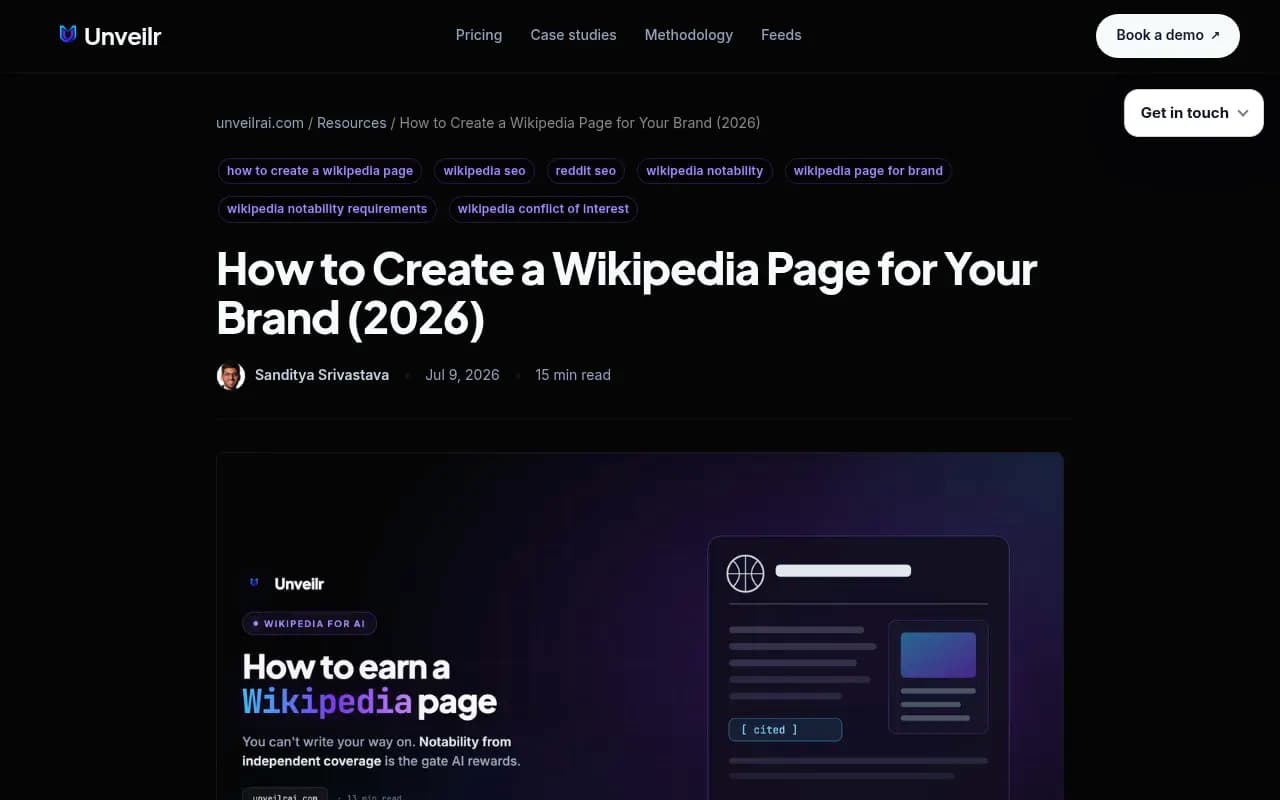
- Write it yourself, in the literal sense. In March 2026, Wikipedia's editor community banned AI-generated new articles and rewrites outright. Lumino found 16% of submitted drafts were already being flagged for AI or LLM concerns before the ban. Reviewers can spot generated text, and a flag for it poisons every future attempt you make.
Why gaming the system backfires
Every few months a story breaks about a company caught editing its own Wikipedia page through undisclosed accounts. The edit history is public and permanent, the conflict of interest noticeboard is public, and journalists read both. A block on your account is recoverable. A news article titled "Company caught secretly editing Wikipedia" is not.
So a few honest warnings.
No vendor can guarantee publication. Anyone promising a guaranteed Wikipedia page is either lying or planning to violate policy in ways that will eventually surface. The legitimate market is real but modest: baseline page creation services run around $1,500, full agency engagements start around $2,000, and reputable firms like Beutler Ink describe a six-month process and claim 90%+ success rates on edit requests, not instant pages. Their own guidance says fixing a client-written draft often takes longer than starting from scratch.
And understand what you're signing up for. A Wikipedia page is the only brand asset you'll ever create that you don't control after it exists. Competitors can propose edits. Critics can propose edits. If your company has a scandal in its future, it will be on that page within hours, with citations. You trade control for credibility, and once the page exists there's no take-backs button.
No page? The alternative paths that still shape AI answers
Here's where it gets interesting for the majority of brands that will never clear the notability bar. AI platforms don't all read the same sources. The Digital Bloom's citation study found only 11% of websites cited by ChatGPT are also cited by Perplexity. Presence on one platform guarantees almost nothing on the others, which means there are several ways to shape what AI says about you without a Wikipedia article.
| Source | What it influences | Notes |
|---|---|---|
| Wikidata | Google's Knowledge Graph, entity disambiguation | Far lower bar than a full article; an item just needs to be identifiable from a serious public source |
| Perplexity above all, ChatGPT moderately | ~46.5% of Perplexity's top citations; authentic participation only | |
| Trade press and analyst reports | All platforms | The same sources Wikipedia values, minus the notability gatekeeping |
| Crunchbase and LinkedIn | Entity data and company facts | Keep them complete and consistent |
| G2, Capterra, review platforms | Product recommendation prompts | Structured, frequently retrieved |
| YouTube | Several models cite transcripts | Underused by most brands |
Wikidata deserves special mention, because it's the shortcut most brands ignore. It's the structured database that feeds Wikipedia and the Knowledge Graph. You can create and maintain a Wikidata entry for your company with verifiable references, and it directly improves how AI systems resolve who you are and what you do.
Reddit deserves a warning instead of an invitation. Perplexity leans on it heavily, and brands that show up with marketing copy get shredded in the comments, which then becomes the source AI cites. Participate like a human or don't participate.
How to know what AI actually says about you
Start manual. Ask ChatGPT, Perplexity, and Gemini about your brand directly, then ask category questions like "best [your category] for [your use case]" and watch which sources get cited. Perplexity makes this easy because it shows its citations.
Perplexity
Manual checks are anecdotes, though. What you need is a system, because AI answers change weekly and you won't remember to check every prompt that matters. This is where an AI visibility platform earns its keep. Promptwatch tracks how your brand appears across ChatGPT, Claude, Gemini, Perplexity, Grok, and Google AI Overviews, shows which sources get cited in answers about your category, and flags sentiment shifts over time, so you can see whether your Wikipedia content is actually surfacing and what it's doing to how AI describes you.

A realistic plan for the next six months
Month one: run the notability audit and the manual AI checks. Months two through four: if the audit came up short, close the gap with digital PR aimed at outlets that pass Wikipedia's reliability tests. Month five: draft through Articles for Creation, disclosed, human-written. Month six and after: monitor what the AI platforms say, and keep the page's facts current through talk page requests rather than direct edits.
And if the audit told you the honest truth, that the coverage isn't there and won't be soon, redirect the effort. Wikidata, trade press, review platforms, and genuine Reddit presence will move what AI says about you faster than a rejected draft ever will. The brands that do best here are the ones that earn coverage solid enough to survive review by a volunteer editor who has seen ten thousand marketing attempts.