Key takeaways
- Scrunch, Profound, and Promptwatch all track brand visibility in AI search engines -- but their depth, scope, and price points differ significantly.
- Profound is an enterprise-grade platform with strong prompt intelligence, built for large teams with dedicated analysts and bigger budgets.
- Scrunch is positioned as an enterprise tool but has limited public pricing transparency and fewer optimization capabilities.
- Promptwatch is the only one of the three that closes the full loop: it finds gaps, generates content to fix them, and tracks whether that content is getting cited.
- If your goal is to actually improve your AI visibility (not just monitor it), Promptwatch is the most complete option at a price most marketing teams can justify.
AI search is eating traditional search traffic. ChatGPT now handles over 900 million weekly queries. Perplexity is becoming a default research tool for a growing slice of B2B buyers. Google AI Overviews appear on the majority of search results pages. And when those AI engines answer questions about your category, they either mention your brand or they don't.
That's why AI visibility platforms exist. But the category is crowded, and the tools vary wildly in what they actually do. Three names come up constantly in 2026 evaluations: Scrunch, Profound, and Promptwatch.
This guide is a direct comparison. I'll break down what each platform does well, where it falls short, and which one is actually worth paying for depending on your situation.
What these platforms actually do (and what they don't)
Before getting into the specifics, it's worth being clear about the core job these tools are supposed to do.
At the most basic level, an AI visibility platform queries AI models (ChatGPT, Perplexity, Claude, Gemini, etc.) with prompts relevant to your business, then checks whether your brand appears in the responses. That's the foundation.
But monitoring alone doesn't move the needle. The real question is: what happens after you see the data? Can you figure out why you're not appearing? Can you create content to fix it? Can you track whether that content is actually getting cited?
That's where the three platforms diverge sharply.
Scrunch: enterprise positioning, limited optimization
Scrunch launched in 2024 and markets itself as an enterprise-grade AI visibility platform. It tracks how your brand appears across AI answer engines and gives you competitive benchmarking data.
The core offering is solid for monitoring. You can track brand mentions across multiple AI models, see how competitors are performing, and get sentiment analysis on how AI engines describe your brand.
Where Scrunch runs into trouble is on the optimization side. It's primarily a monitoring dashboard -- it shows you what's happening but doesn't give you much to work with in terms of fixing it. There's no built-in content generation, no answer gap analysis that tells you which specific prompts you're losing, and no crawler log data to understand how AI engines are actually reading your site.
Pricing is also opaque. Scrunch doesn't publish clear pricing tiers, which makes it hard to evaluate for smaller teams or agencies without going through a sales conversation. That enterprise-first positioning means the tool is likely priced accordingly.
Who Scrunch works for: enterprise teams that primarily need executive-level reporting on AI visibility and have separate resources to act on the data.
Profound: strong intelligence, high price point
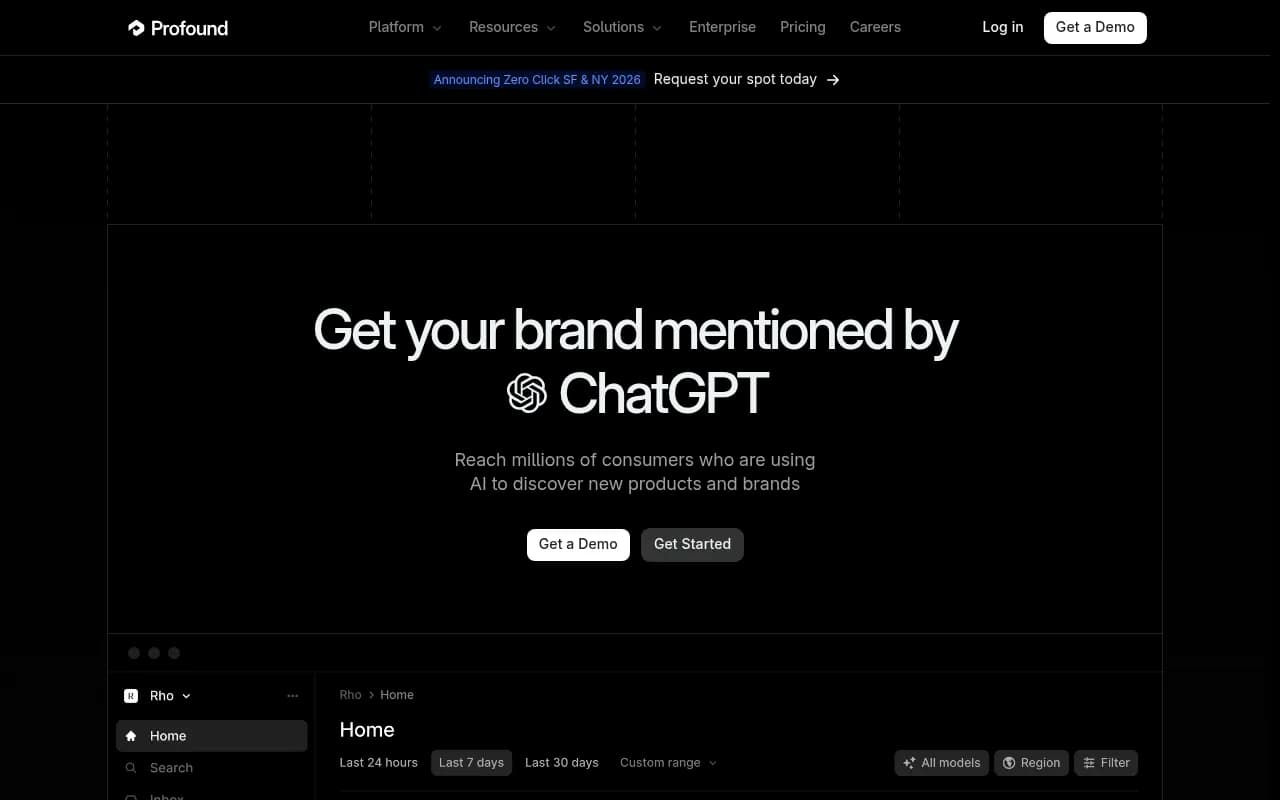
Profound is arguably the most feature-rich monitoring platform in this comparison. It has deep prompt intelligence, solid model coverage, and a well-designed interface for enterprise teams.
What Profound does well:
- Prompt volume estimates and difficulty scoring
- Competitive benchmarking across AI models
- Structured data on which sources AI engines are citing
- Enterprise security and compliance features
The platform is genuinely impressive if you have a team of dedicated analysts who can interpret the data and translate it into action. Profound gives you a lot to work with.
The problems are price and actionability. Profound is positioned firmly at the enterprise end of the market, with pricing that reflects it. For most mid-market marketing teams, the cost is hard to justify when the platform still requires significant internal resources to act on what it surfaces.
There's also no built-in content generation. Profound tells you where you're invisible -- it doesn't help you fix it. That gap matters more than it sounds. If your team is already stretched, a monitoring dashboard that surfaces problems without solving them can become another thing you check and feel bad about.
Who Profound works for: enterprise organizations with dedicated SEO or content analysts, larger budgets, and the internal capacity to translate visibility data into content and optimization work.
Promptwatch: the full loop
Promptwatch takes a different approach. Where Scrunch and Profound are primarily monitoring tools, Promptwatch is built around a three-step cycle: find the gaps, create content to fill them, and track whether it's working.

That distinction sounds simple but it changes everything about how the tool actually gets used.
Finding the gaps
Promptwatch's Answer Gap Analysis shows you exactly which prompts competitors are appearing for that you're not. Not just "you're missing from 40% of prompts" -- it shows you the specific questions and topics where AI models want an answer but can't find one on your site. That's actionable in a way that most monitoring dashboards aren't.
The platform also includes prompt volume estimates and difficulty scores, so you can prioritize which gaps are actually worth closing. High-volume, winnable prompts first. That's a sensible way to allocate content resources.
Creating content that gets cited
This is where Promptwatch separates itself most clearly. The built-in AI writing agent generates articles, listicles, and comparison pages grounded in real citation data -- over 880 million citations analyzed. The content isn't generic SEO filler. It's engineered around what AI models actually cite, which sources they trust, and what angles they respond to.
For teams that don't have the bandwidth to commission and brief a separate content operation, this is significant. You can go from "we're invisible for this prompt" to "we have a published article targeting it" without leaving the platform.
Tracking the results
Page-level tracking shows exactly which of your pages are being cited, by which AI models, and how often. Traffic attribution connects that visibility to actual sessions and revenue -- via a code snippet, Google Search Console integration, or server log analysis.
That closed loop -- gap analysis to content creation to citation tracking to traffic attribution -- is what makes Promptwatch an optimization platform rather than a monitoring tool.
Other capabilities worth noting
Promptwatch also includes AI crawler logs, which show you in real time which AI crawlers (ChatGPT, Claude, Perplexity, etc.) are hitting your site, which pages they're reading, and what errors they're encountering. Most competitors don't have this at all.
Reddit and YouTube tracking surfaces the discussions that directly influence AI recommendations -- a channel that most platforms ignore entirely. ChatGPT Shopping tracking monitors when your brand appears in product recommendation carousels. Multi-language and multi-region support lets you monitor AI responses in any language, from any country.
The platform covers 10 AI models: ChatGPT, Perplexity, Google AI Overviews, Google AI Mode, Claude, Gemini, Meta/Llama, DeepSeek, Grok, Mistral, and Copilot.
Side-by-side comparison
| Feature | Scrunch | Profound | Promptwatch |
|---|---|---|---|
| Brand mention tracking | Yes | Yes | Yes |
| Competitive benchmarking | Yes | Yes | Yes |
| Prompt volume / difficulty scores | Limited | Yes | Yes |
| Answer gap analysis | No | Partial | Yes |
| Built-in content generation | No | No | Yes |
| AI crawler logs | No | No | Yes |
| Reddit / YouTube tracking | No | No | Yes |
| ChatGPT Shopping tracking | No | No | Yes |
| Traffic attribution | No | No | Yes |
| Page-level citation tracking | No | Partial | Yes |
| Multi-language / multi-region | Limited | Yes | Yes |
| Transparent public pricing | No | No | Yes |
| AI models covered | ~5 | ~6 | 10 |
| Best for | Enterprise reporting | Enterprise analysis | Optimization + execution |
Pricing: what you actually pay
This is where the comparison gets concrete.
Promptwatch publishes its pricing clearly:
- Essential: $99/month (1 site, 50 prompts, 5 articles)
- Professional: $249/month (2 sites, 150 prompts, 15 articles, crawler logs, city-level tracking)
- Business: $579/month (5 sites, 350 prompts, 30 articles)
- Agency/Enterprise: custom pricing
A free trial is available. Annual billing comes with a discount.
Profound and Scrunch don't publish pricing. Both require a sales conversation, which typically signals enterprise-level pricing (think $1,000+/month as a starting point). That's not necessarily wrong for the right buyer, but it makes evaluation harder and rules both platforms out for most SMBs and mid-market teams.
Who should use which platform
The honest answer depends on what you need the tool to actually do.
If you're an enterprise marketing team with a dedicated analyst, a large budget, and a need for deep prompt intelligence and compliance features, Profound is worth evaluating. It's genuinely powerful for teams that can use it.
If you're primarily looking for executive-level AI visibility reporting and already have a separate content operation, Scrunch might fit. But the lack of pricing transparency and limited optimization capabilities are real drawbacks.
If you need to actually improve your AI visibility -- not just measure it -- Promptwatch is the most complete option. The combination of gap analysis, content generation, and citation tracking in one platform means you can act on what you're seeing without stitching together multiple tools or waiting for a content agency to execute.
For agencies managing multiple clients, Promptwatch's agency pricing and multi-site support make it a practical choice. The Looker Studio integration and API also make it easy to build client reporting on top of the platform's data.
The monitoring-only trap
One thing worth saying directly: a lot of teams buy an AI visibility platform, see the data, and then... don't do much with it. The dashboard shows them they're invisible for 60% of relevant prompts. They share it in a Slack channel. Someone says "we should fix this." Nothing changes.
That's not a knock on the people -- it's a structural problem with monitoring-only tools. When the platform shows you a problem but doesn't help you solve it, the gap between insight and action is wide enough that it often doesn't get crossed.
Promptwatch's built-in content generation is a direct response to that problem. It's not a perfect solution -- you still need someone to review and publish the content -- but it dramatically shortens the distance between "we're invisible here" and "we published something to fix it."
That's the practical difference between an optimization platform and a monitoring dashboard. In 2026, with AI search growing fast and the window to establish visibility narrowing, that difference matters.
Bottom line
Scrunch, Profound, and Promptwatch are all legitimate tools, but they serve different buyers.
Profound is the right call for enterprise teams with analyst resources and compliance requirements. Scrunch fits if you need reporting-level visibility data and have separate execution capacity. Promptwatch is the right call if you want to actually move the needle -- find what's missing, create content to fix it, and track whether it's working.
For most marketing teams in 2026, that third option is the one that justifies the budget.