Key takeaways
- Promptwatch has transparent, self-serve pricing starting at $99/mo. Brandlight has no public pricing at all -- you talk to sales and likely start with a paid pilot.
- Promptwatch auto-publishes AI-optimized content to your CMS through Content Agents. Brandlight routes drafts through a multi-agent workflow but stops short of auto-publishing, keeping a human/legal reviewer in the loop.
- Brandlight is built exclusively for Fortune 500-scale enterprises and says so directly on its own site. Promptwatch scales from a free single-project tier up through agency and enterprise plans.
- Brandlight has a stronger average G2 rating (4.9/5 from 207 reviews) but a documented steep learning curve. Promptwatch's rating sits around 4.5-4.7/5 from a much smaller review pool, with some reviewers flagging UI bugs.
- Promptwatch lists 11 integrations on G2 (including Vercel, Cursor, Search Console); Brandlight lists 3 (ChatGPT, GA360, Semrush).
- If budget and speed matter, Promptwatch wins on accessibility. If you need a dedicated forward-deployed team and multi-market brand governance, Brandlight's enterprise model is built for that specific job.
Overview

Promptwatch is an AI search visibility and GEO platform that tracks how brands show up across ChatGPT, Gemini, Claude, Perplexity, Grok, Copilot, and Google's AI surfaces, then goes further than most competitors by actually doing something about the gaps it finds. Content Agents write and publish GEO-optimized articles, Agent Analytics logs which AI crawlers hit which pages, and Unified Actions turns all of that into a prioritized to-do list. It's used by 1,840+ brands including Duolingo, Yelp, and Typeform, and by agencies like Monks and WPP.
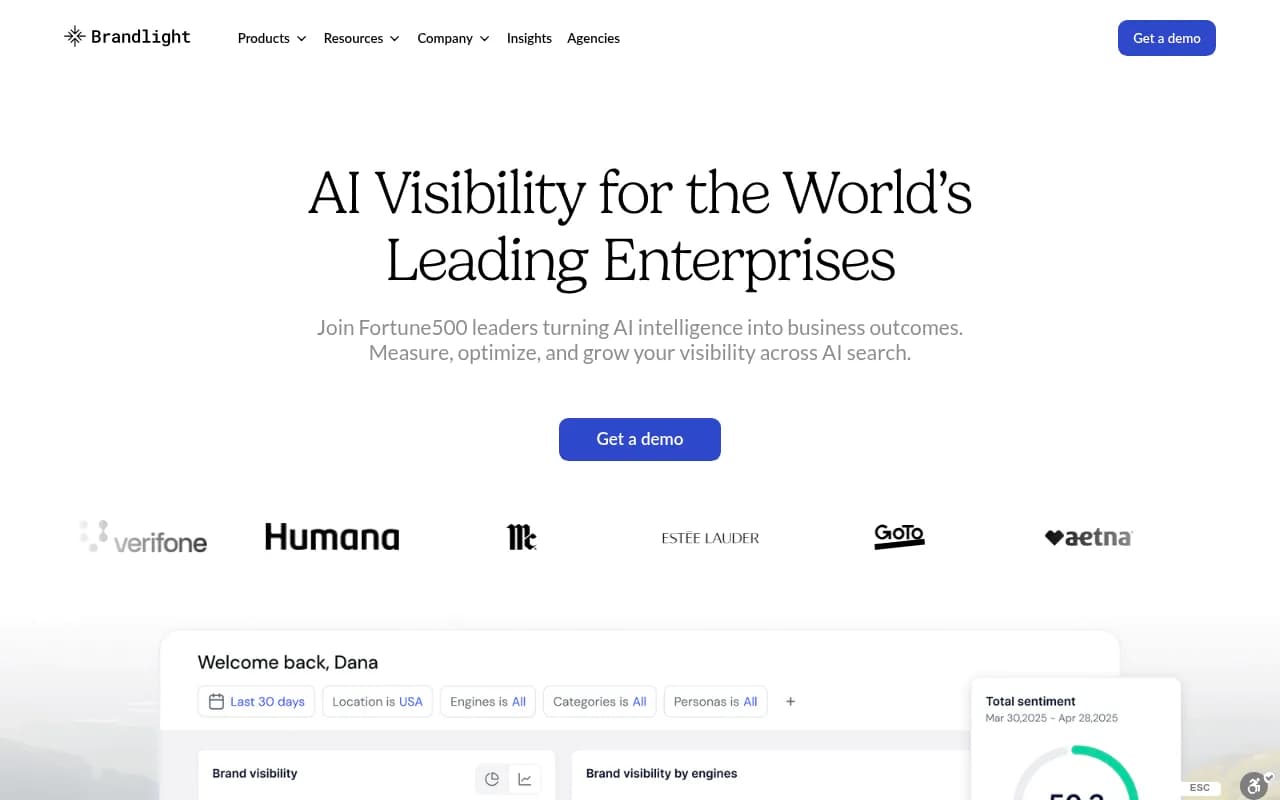
Brandlight is an enterprise AI visibility platform built for Fortune 500 marketing teams -- customers include Verifone, Humana, Estee Lauder, and Aetna. Its pitch is a "See, Shape, Act, Transform" loop: measure visibility, get prescriptive fixes tied to explainable source data, execute through a content workflow, and track the business impact. It's sales-led with no public pricing and no self-serve signup, positioned deliberately against smaller tools.
Side-by-side comparison
| Feature | Promptwatch | Brandlight |
|---|---|---|
| Starting price | $99/mo (Essential, published) | No public pricing; sales call required |
| Free trial | Yes, 7 days, plus a free Explore tier | No; typically starts with a paid 3-month pilot |
| AI engines tracked | ChatGPT, Gemini, Claude, Perplexity, Grok, DeepSeek, Copilot, Mistral, Meta Llama, Google AI Overviews/AI Mode | ChatGPT, Google AI Overviews, AI Mode, Gemini, Perplexity, Copilot, Claude (adapted by market) |
| AI crawler log tracking | Yes, Agent Analytics with citation-rate-per-page data | Not published as a distinct feature |
| Content generation | Content Agents auto-write and auto-publish to Webflow, Framer, WordPress | Multi-agent draft workflow (strategist, writer, editor, validator) routed to CMS for human/legal review, no auto-publish |
| Reddit / YouTube citation tracking | Yes, dedicated reports | Not published |
| ChatGPT Shopping / Ads Radar | Yes | Not published |
| Conversational analyst (chat interface) | Agent Chat, also in Slack | Not published |
| Integrations (per G2) | 11: ChatGPT, Claude, Cursor, Data Studio, Gemini, Google Analytics, Search Console, Perplexity, Vercel | 3: ChatGPT, GA360, Semrush |
| Target buyer | Solo operators to enterprise, agencies | Fortune 500 only, explicitly excludes SMBs |
| G2 rating | 4.5-4.7/5 (~17 reviews) | 4.9/5 (207 reviews) |
| Security / data handling | Standard SaaS | Closed-network processing, SOC 2-oriented positioning |
Pricing and access
Pricing
This is the starkest difference between the two tools. Promptwatch publishes every tier on its website. Brandlight publishes nothing -- its /pricing and /plans URLs both 404, and every engagement starts with a demo call.
| Plan | Promptwatch | Brandlight |
|---|---|---|
| Free | Explore: 10 prompts, ChatGPT only | None |
| Entry paid | Essential: $99/mo (1 site, 50 prompts, 6,000 responses, 5 AEO articles) | Unpublished; third-party estimates put entry around $199/mo |
| Mid-tier | Professional: $249/mo (2 sites, 150 prompts, 18,000 responses, 15 AEO articles) | Unpublished |
| Top tier | Business: $579/mo (5 sites, 350 prompts, 42,000 responses, 30 AEO articles) | Enterprise contracts reportedly in the $4K-$15K/mo range (unverified) |
| Trial | 7 days, self-serve | Paid 3-month pilot, sales-managed |
| Agency plans | $199-$799/mo, unlimited projects/prompts | Not offered as a distinct tier |
Brandlight raised a $30M Series A to push into AI ad visibility, and total funding is reported around $35.75M, smaller than Bluefish's $68M and well below Profound's $155M+. That funding gap doesn't tell you much about product quality, but it does explain why Brandlight leans so hard on white-glove enterprise sales rather than a self-serve funnel -- it's chasing fewer, bigger deals.
Verdict: If you can't get a number without booking a call, budget planning is harder. Promptwatch's transparency is a real advantage for anyone who isn't already committed to an enterprise procurement process.
Coverage of AI platforms
Both tools track the major AI answer engines that matter in 2026: ChatGPT, Gemini, Perplexity, Copilot, Claude, and Google's AI Overviews and AI Mode. Promptwatch adds Grok, DeepSeek, Mistral, and Meta Llama, plus tracking for AI coding assistants like Claude Code and OpenCode -- useful if your audience includes developers. Brandlight adapts its engine list by market (for example substituting Claude where Copilot access is restricted), which makes sense for a platform serving multinational brands but means the exact list varies by deployment.
One detail worth flagging: third-party guides note that Promptwatch gives full multi-platform visibility from its very first paid plan, while some competitors in this space gate full coverage behind higher tiers. That's a meaningful difference if you're trying to understand cross-platform citation share without upgrading twice.
Verdict: Roughly equivalent breadth, but Promptwatch's coverage is documented plan-by-plan; Brandlight's isn't, since there's nothing to compare it against publicly.
Going from insight to action
This is where the two products diverge philosophically. Brandlight's "See, Shape, Act, Transform" framework explicitly tries to move past a monitoring dashboard into prescriptive recommendations -- fix this page, write this content, partner with this publisher -- and it backs those recommendations with source-level data rather than a single opaque score. Its content pipeline runs drafts through a strategist, writer, editor, and validator, then hands them to a CMS for human and legal review. Brandlight does not auto-publish; there's always a human gate.
Promptwatch's Content Agents go one step further: they can auto-publish GEO-optimized articles directly to Webflow, Framer, or WordPress on a schedule, informed by real prompt-volume and citation-gap data (Promptwatch's content briefs will literally show something like