Key Takeaways
- Promptwatch and Cognism solve completely different problems -- Promptwatch tracks how your brand appears in AI search engines (ChatGPT, Claude, Perplexity), while Cognism provides verified B2B contact data and sales intelligence for outbound prospecting
- Pricing structures differ dramatically: Promptwatch starts at $99/mo with transparent self-serve plans, while Cognism requires custom quotes starting around $960/user/year with annual contracts
- Promptwatch is built for marketing teams optimizing AI visibility and content strategy; Cognism targets sales teams who need phone numbers, emails, and intent signals to book meetings
- Neither tool replaces the other -- they operate in separate categories (AI search optimization vs sales intelligence), though both aim to drive revenue through different channels
- If you're deciding between these two, you're likely confused about what problem you're solving. Promptwatch = "How do I get ChatGPT to recommend my brand?" Cognism = "How do I find and call the VP of Sales at Company X?"
- Most companies using either tool would benefit from the other for different use cases -- Promptwatch for inbound AI traffic, Cognism for outbound prospecting
Overview
This comparison covers two tools that operate in entirely different spaces but occasionally get lumped together in "revenue intelligence" conversations. Let's clear that up.
Promptwatch overview

Promptwatch is an AI search visibility platform used by 7,000+ brands including Booking.com, Center Parcs, and Typeform. It tracks how your brand appears in AI models like ChatGPT, Claude, Gemini, Perplexity, Grok, DeepSeek, and Google AI Overviews. The platform monitors 10 AI engines, analyzes 1.1 billion+ citations, and helps you understand which prompts trigger mentions of your brand versus competitors.
What makes Promptwatch different from monitoring-only dashboards: it includes content gap analysis (shows exactly what content you're missing that competitors have), an AI writing agent that generates articles grounded in citation data, and crawler logs that reveal how AI bots are indexing your site. The action loop is find gaps → generate content → track results. Most competitors stop at step one.
Core use case: Marketing teams who want to rank in AI search results and drive traffic from ChatGPT, Perplexity, and other AI platforms.
Cognism overview
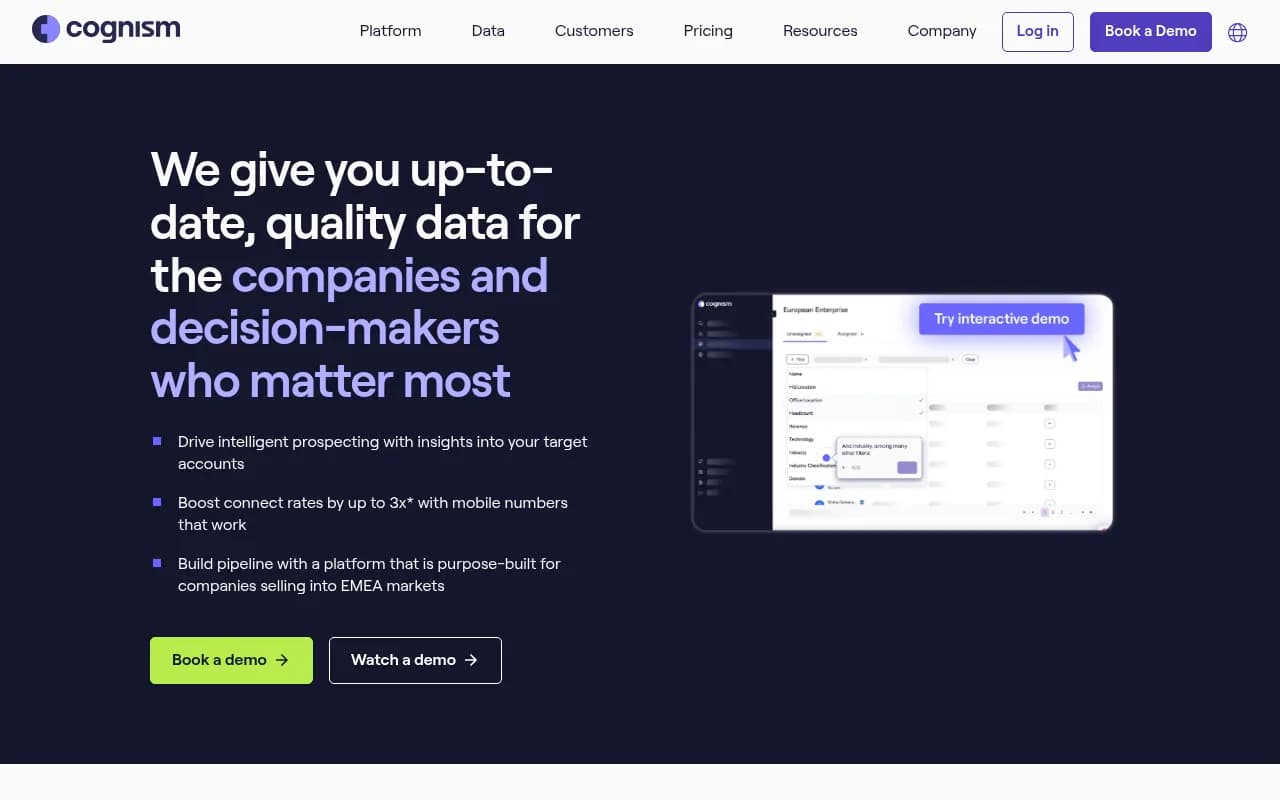
Cognism is a B2B sales intelligence platform trusted by 4,000+ companies including IBM, Thomson Reuters, and Asana. It provides verified contact data (emails, mobile numbers, direct dials), firmographic information, intent signals, and compliance-ready prospecting capabilities. The platform is particularly strong in EMEA markets and claims to boost connect rates by up to 3x with mobile numbers that actually work.
Cognism's data includes company insights, decision-maker profiles, technographic data, and buying intent signals. It integrates with CRMs like Salesforce and HubSpot, plus sales engagement tools like Outreach and SalesLoft. The platform emphasizes data quality and GDPR compliance, which matters for companies selling into Europe.
Core use case: Sales teams who need accurate contact information and account intelligence to fill their pipeline with qualified leads.
Side-by-Side Comparison
| Feature | Promptwatch | Cognism |
|---|---|---|
| Primary use case | AI search visibility tracking & optimization | B2B sales intelligence & contact data |
| Target user | Marketing teams, SEO teams, content strategists | Sales teams, SDRs, BDRs, account executives |
| Core data | AI citations, prompt volumes, visibility scores, crawler logs | Verified emails, mobile numbers, company data, intent signals |
| AI models tracked | 10 models (ChatGPT, Claude, Gemini, Perplexity, Grok, DeepSeek, Copilot, Mistral, Meta AI, Google AI Overviews) | Not applicable |
| Contact database | Not applicable | 400M+ profiles with verified mobile numbers |
| Content generation | ✓ Built-in AI writing agent | ✗ Not a content tool |
| Pricing transparency | ✓ Public pricing from $99/mo | ✗ Custom quotes only |
| Free trial | ✓ 7-day trial | ✓ Demo available, trial terms vary |
| Starting price | $99/mo (Essential plan) | ~$960/user/year (Essentials, annual contract) |
| Integrations | Looker Studio, API, GSC | Salesforce, HubSpot, Outreach, SalesLoft, 50+ tools |
| GDPR compliance focus | Standard compliance | ✓ Strong emphasis, EMEA-focused |
| Best for | Inbound AI traffic optimization | Outbound prospecting and pipeline generation |
Head-to-head feature deep-dive
Core functionality
Promptwatch monitors how AI search engines respond to specific prompts. You define a list of prompts (e.g. "best CRM for startups"), and Promptwatch tracks whether your brand gets mentioned, where you rank in the response, which competitors appear, and what sources AI models cite. It shows citation sources (corporate pages, news articles, Reddit threads, YouTube videos), traffic estimates for each source, and position changes over time.
Cognism provides a searchable database of B2B contacts and companies. You filter by job title, company size, industry, location, tech stack, and intent signals, then export verified contact information. The platform's "Diamond Data" feature offers mobile numbers with high accuracy, which is rare in sales intelligence tools. Cognism also surfaces buying intent signals based on web activity and technographic changes.
Verdict: These tools don't compete. Promptwatch answers "Is ChatGPT recommending my product?" Cognism answers "Who should I call at this company?"
Data quality and coverage
Promptwatch's data comes from real AI model responses -- it queries ChatGPT, Claude, Perplexity, and others with your tracked prompts, then parses the responses to extract citations, rankings, and mentions. The platform has processed 1.1 billion+ citations and tracks crawler activity from AI bots hitting your website. Prompt volume estimates and difficulty scores help prioritize which prompts to target.
Cognism claims 400M+ profiles with 87% phone accuracy and 98% email accuracy. The platform emphasizes data freshness with regular updates and human verification for premium "Diamond Data" mobile numbers. Coverage is strongest in EMEA, though it supports global prospecting. Intent data comes from partnerships with providers like Bombora.
Verdict: Both platforms emphasize data quality, but they're measuring completely different things. Promptwatch's accuracy depends on AI model responses (which it captures directly), while Cognism's accuracy depends on contact verification processes.
User interface and workflow
Promptwatch's interface centers on prompt tracking dashboards. You see visibility scores, citation breakdowns, competitor heatmaps, and page-level tracking. The Answer Gap Analysis feature highlights prompts where competitors rank but you don't, showing exactly what content you're missing. Crawler logs reveal which pages AI bots are reading and any errors they encounter. The AI writing agent generates articles based on gap analysis and citation data.
Cognism's interface is built around search and list building. You create filtered searches, save prospects to lists, and export to your CRM or sales engagement platform. The Chrome extension lets you prospect directly from LinkedIn or company websites. Intent signals and technographic data appear in prospect profiles to help prioritize outreach.
Verdict: Promptwatch feels like an analytics dashboard with optimization tools. Cognism feels like a prospecting database with CRM integration. Both are well-designed for their respective use cases.
Content and optimization capabilities
Promptwatch includes a built-in AI writing agent that generates articles, listicles, and comparison pages grounded in citation data from 880M+ analyzed citations. The content is engineered to get cited by AI models based on what they're already citing from competitors. You can also use Answer Gap Analysis to manually identify content opportunities, then create content yourself or with your team.
Cognism doesn't generate content. It's a data tool, not a content tool. Some users might export Cognism data to personalize outbound emails, but that's a stretch to call it a "content capability."
Verdict: Promptwatch wins by default -- content optimization is core to its value proposition. Cognism isn't trying to compete here.
Integrations and API
Promptwatch integrates with Google Search Console for traffic attribution, Looker Studio for custom reporting, and provides an API for custom workflows. You can also install a code snippet or use server log analysis to track AI-driven traffic to your website.
Cognism integrates with 50+ tools including Salesforce, HubSpot, Outreach, SalesLoft, Salesloft, Gong, and most major CRMs and sales engagement platforms. The Chrome extension works with LinkedIn Sales Navigator. API access is available for enterprise customers.
Verdict: Cognism has more integrations because sales teams use more tools. Promptwatch's integrations are focused on analytics and attribution, which makes sense for a marketing tool.
Pricing structure
Promptwatch uses transparent self-serve pricing:
- Essential: $99/mo (1 site, 50 prompts, 5 AI-generated articles)
- Professional: $249/mo (2 sites, 150 prompts, 15 articles, crawler logs, state/city tracking)
- Business: $579/mo (5 sites, 350 prompts, 30 articles)
- Agency/Enterprise: Custom pricing
All plans include a 7-day free trial. Annual billing offers discounts.
Cognism uses custom pricing with annual contracts:
- Essentials: ~$960/user/year (basic contact data)
- Professional: ~$1,800-$3,000/user/year (includes mobile numbers, intent data)
- Business: ~$6,000+/user/year (advanced features, higher data limits)
- Enterprise and Agency plans available
Pricing varies based on user count, data needs, and contract terms. No public pricing -- you have to book a demo.
Verdict: Promptwatch is more accessible for small teams and self-serve buyers. Cognism's pricing model is standard for enterprise sales intelligence tools but requires a bigger commitment.
Support and onboarding
Promptwatch offers email support, documentation, and video tutorials. Professional and Business plans include priority support. The platform is relatively straightforward -- you add prompts, connect your site, and start tracking. The learning curve is low for marketers familiar with SEO or analytics tools.
Cognism provides dedicated customer success managers, onboarding sessions, and training for Professional and higher tiers. The platform is more complex because it integrates with multiple sales tools and requires workflow setup. Support is generally well-reviewed, though response times vary by plan.
Verdict: Cognism offers more hands-on support because the tool requires more setup. Promptwatch is simpler to get started with but still provides solid support for paid plans.
Compliance and data privacy
Promptwatch handles standard data privacy compliance. It tracks publicly available AI responses and website crawler activity. No personal data collection beyond standard analytics.
Cognism emphasizes GDPR compliance heavily, especially for EMEA customers. The platform includes "Do Not Contact" lists, consent management, and data processing agreements. This is critical for sales teams prospecting in Europe where data privacy regulations are strict.
Verdict: Cognism's compliance features are more robust because sales intelligence tools handle personal contact data. Promptwatch doesn't need the same level of compliance infrastructure.
Pricing comparison
| Plan | Promptwatch | Cognism |
|---|---|---|
| Entry tier | $99/mo (Essential: 1 site, 50 prompts, 5 articles) | ~$960/user/year (Essentials: basic contact data, annual contract) |
| Mid tier | $249/mo (Professional: 2 sites, 150 prompts, 15 articles, crawler logs) | ~$1,800-$3,000/user/year (Professional: mobile numbers, intent data) |
| High tier | $579/mo (Business: 5 sites, 350 prompts, 30 articles) | ~$6,000+/user/year (Business: advanced features, higher limits) |
| Enterprise | Custom pricing | Custom pricing |
| Free trial | 7-day trial | Demo available, trial terms vary |
| Billing | Monthly or annual (annual discounts available) | Annual contracts standard |
| Pricing transparency | Public pricing on website | Custom quotes only |
Note: Cognism pricing is per user, so a 5-person sales team would pay $4,800-$15,000+/year depending on the plan. Promptwatch pricing is per account (not per user), so a 5-person marketing team pays the same $99-$579/mo regardless of team size.
Pros and cons
Promptwatch pros
- Transparent pricing with low entry point ($99/mo)
- Tracks 10 AI models including ChatGPT, Claude, Perplexity, Gemini
- Built-in content generation based on citation data
- Crawler logs show exactly how AI bots index your site
- Answer Gap Analysis pinpoints missing content opportunities
- Per-account pricing (not per user) makes it affordable for teams
- 7-day free trial with no credit card required
Promptwatch cons
- Relatively new category -- some companies don't yet prioritize AI search visibility
- Prompt limits on lower tiers may require upgrades for comprehensive tracking
- Content generation quality depends on your input and the data available
- Less useful if your target audience doesn't use AI search tools yet
Cognism pros
- 400M+ profiles with strong EMEA coverage
- High accuracy on mobile numbers (87%) and emails (98%)
- Deep CRM and sales tool integrations (50+ platforms)
- Intent signals help prioritize accounts showing buying behavior
- Strong GDPR compliance features for European prospecting
- Chrome extension works directly in LinkedIn and company websites
Cognism cons
- No public pricing -- requires demo and custom quote
- Annual contracts standard, less flexibility than monthly billing
- Pricing per user gets expensive for larger sales teams
- Primarily focused on EMEA, though global coverage exists
- Doesn't help with content, SEO, or inbound marketing
- Steeper learning curve and setup time compared to simpler tools
Who should pick which tool
Choose Promptwatch if you:
- Run marketing, SEO, or content teams focused on inbound traffic
- Want to understand and improve how AI search engines recommend your brand
- Need to track visibility across ChatGPT, Claude, Perplexity, and other AI models
- Are looking for content gap analysis and AI-powered content generation
- Prefer transparent pricing and self-serve onboarding
- Care about AI crawler activity and indexing on your website
- Want to drive traffic from AI platforms to your site
Choose Cognism if you:
- Run sales, SDR, or BDR teams focused on outbound prospecting
- Need verified contact data (emails, mobile numbers) for decision-makers
- Sell into EMEA markets where GDPR compliance matters
- Want intent signals and technographic data to prioritize accounts
- Already use a CRM and sales engagement platform that integrates with Cognism
- Have budget for annual contracts and per-user pricing
- Care more about booking meetings than inbound traffic
Use both if you:
- Want to cover both inbound (AI search) and outbound (cold outreach) channels
- Have separate marketing and sales teams with different needs
- Are building a comprehensive revenue engine that combines content marketing and direct sales
- Can justify the combined investment (Promptwatch for marketing, Cognism for sales)
Final verdict
Promptwatch and Cognism don't compete -- they solve different problems for different teams. Promptwatch helps marketing teams get visible in AI search results and drive inbound traffic. Cognism helps sales teams find and contact prospects for outbound pipeline generation.
If you're choosing between them, you're probably asking the wrong question. The real question is: "Do I need to optimize for AI search visibility (Promptwatch) or do I need verified contact data for outbound prospecting (Cognism)?"
For most B2B companies, the answer is both -- but at different stages or for different teams. Marketing uses Promptwatch to drive inbound interest and brand awareness through AI platforms. Sales uses Cognism to directly reach decision-makers and book meetings.
If you can only pick one right now, choose based on your biggest revenue gap. If you're invisible in AI search and missing inbound opportunities, start with Promptwatch. If your pipeline is empty and you need to fill it with outbound, start with Cognism. Neither tool will solve the other's problem.