Arvow Review 2026
Generates and publishes SEO articles automatically, with backlink and AI-citation features for site owners and marketers.
Key takeaways
- Arvow is an end-to-end SEO automation platform: keyword research, article writing, images, internal and external links, CMS publishing and scheduled AutoBlog runs in one account.
- Strongest for agencies and site owners who need volume across many sites. Plans run $39, $69 and $249 a month on yearly billing, based on promo prices shown at the time of research.
- Its LLM brand tracker (Business plan and up) covers mentions and sentiment, but it is a side feature. It lacks the AI crawler logs, visitor analytics, prompt volumes and difficulty scores, query fan-outs, Reddit/YouTube/LinkedIn citation tracking, and content gap analysis that Promptwatch offers.
- Trustpilot sentiment is poor (about 50 reviews). Complaints cover refunds, integration problems, robotic output and unrelated backlinks. Those reviews are self-selected, but they are worth reading before paying.
- No free trial was found, so budget for a paid commitment and test one site first.
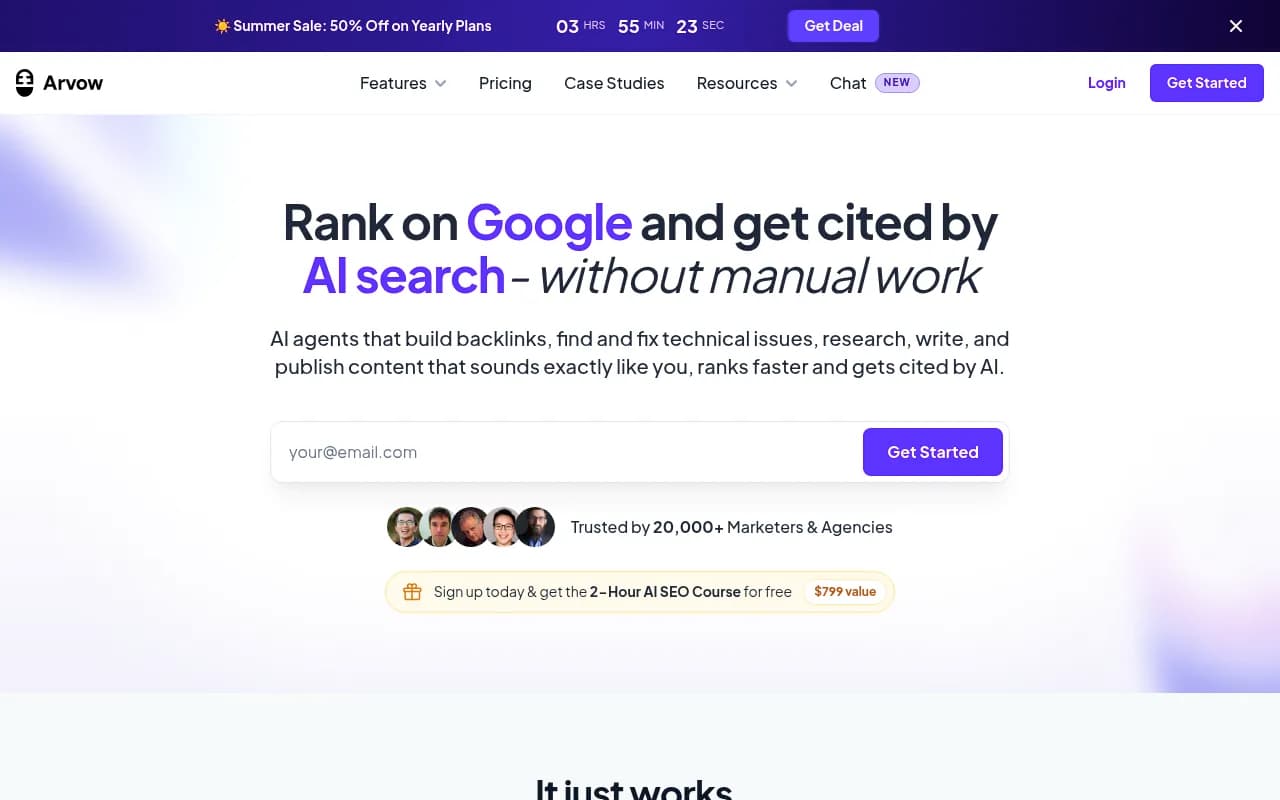
Arvow is an AI SEO platform that started life as a blog-writing tool and has grown into something broader. The homepage now pitches agents that build backlinks, find and fix on-page technical issues, research topics, write articles in your voice and publish them. It claims 20,000+ marketers and agencies as users, a figure I could not verify independently. A co-founder, Vasco Monteiro, appears in the case studies, and one reviewer on Trustpilot says the product was previously called journalistAI, though that claim is unverified.
The audience is clear from the copy. Agency owners running 10 to 40 client blogs, affiliate site builders, local service businesses and solo founders who would rather not write every post. The pitch is simple: pick a keyword or feed, let Arvow produce a formatted article with images and links, and push it to WordPress, Shopify, Webflow and other platforms on a schedule.
The recent additions are more interesting than the writer itself. AI Chat, MCP access, an LLM visibility tracker and Google Maps automation show that the team is trying to cover everything around content, not just generation. Whether the breadth holds up is the real question, and the answer is mixed.
Key features
AutoBlog. This is the core automation. You point it at a source such as an RSS feed, a keyword list, YouTube videos or news events, then choose manual runs or a schedule with a set frequency. Articles are generated and posted to your connected site, either as drafts or live. One case study on the site has a French agency turning English videos into French blog posts, which is a practical use. The claim that pages get indexed 10x faster is marketing; the real mechanism is that Arvow submits each published URL to Google Search Console once you connect your Google account.
AI SEO Writer. Articles are generated in 150+ languages and include a feature image, in-article images, internal and external links, tables, bullet lists and embedded YouTube videos. Structure is customizable, so you can force an FAQ at the end or an intro at the start. Business plans add custom content templates, and a reviewer called that feature incredible. Articles are advertised as taking about 30 seconds. The sample article on the homepage (a plumbing piece for a Tampa company) shows the typical output: heavy on headers, short bullets, a key takeaways block, FAQ and a call to action. It is clean, but it reads like generic AI content, and you will want to edit anything where expertise matters.
Knowledge Bases. Business and above let you upload your own material so articles reflect your facts and perspective. This is how Arvow answers the E-E-A-T question. It matters more than any other setting, because the main failure mode of AI blog tools is content with nothing unique in it. If you skip this step, you get what every other generator produces.
AI SEO Editor. For existing posts, you can rewrite sections with custom prompts, add internal and external links, regenerate images and work in keywords. Every article can be refined before publishing, or sent as a draft so a human checks it in the CMS. Agencies should treat this as mandatory, not optional.
SEO Agent and Site Optimizer. Agents scan your site for issues and deploy fixes: schema markup, meta titles and descriptions, internal linking improvements, image alt text and canonical URLs. Automatic deployment is the risky part. One Trustpilot reviewer claims the software broke their websites, and another saw changes that never appeared live. Start on a staging site or a low-stakes domain and verify what gets changed.
Automatic backlinks. Business and Ultimate include a backlink exchange where AI matches sites by niche, Domain Rating and topical relevance and places contextual links weekly. It removes outreach work, which is attractive. It also carries the most risk. Reviewers report unrelated backlinks, one advises monitoring Search Console and disavowing bad ones, and another says the promised 1 to 3 backlinks per day did not arrive in six days. Exchange-style networks are a gray area for Google's spam policies, so go in cautious. One agency owner on the site says it works and that it avoids being flagged as an exchange, but that is a single testimonial.
LLM brand tracker. Business and above track brand mentions across several LLMs, sentiment, unlimited prompts and mention opportunities. This is useful for a first look at whether ChatGPT or Perplexity names you. It is a lightweight feature next to the content tools, which I cover in the limitations below.
Local SEO automation. Bulk generate and schedule Google Business Profile posts and auto-reply to Google Maps reviews. Handy for local agencies, and a feature most pure writing tools do not have.
AI Chat and MCP. The chat agent loads project context, researches keywords and competitors, reviews Search Console and backlinks, creates content, manages AutoBlog and publishes. MCP access and an API (Solo and up) let developers connect Arvow to other agents and workflows. Zapier is supported too, and the company recommends having a developer help with API setups.
Who is it for
The sweet spot is the small SEO agency with 5 to 40 clients that sells monthly blog content and is drowning in drafting time. Testimonials from agency owners describe cutting a 2,500-word piece from about a week of research and writing down to an hour of review. The Ultimate plan adds white-label SEO reports, unlimited sub-accounts, live Slack chat and 1-on-1 coaching, which is aimed squarely at this buyer.
It also suits affiliate site builders and local businesses: a roofing company wanting weekly posts, an ecommerce owner who wants products supported by informational content, a clinic publishing health articles. In these cases, volume matters more than literary quality, and the Google Business Profile tools are a bonus. Solo founders with a Webflow or WordPress blog who publish nothing at the moment will see the biggest relative gain.
Who should skip it? Brands in regulated or expert-driven fields (medical, legal, finance) where every sentence needs a subject-matter expert. Publishers whose reputation depends on distinctive voice. Teams that need a free trial or strict refund protection, since Trustpilot reviewers describe no trial and a no-refund policy. And anyone whose primary goal is measuring and improving AI search visibility, rather than producing articles. That is a different job, and I come back to it below.
Integrations and ecosystem
Arvow publishes directly to WordPress, Shopify, Ghost, Wix, Webflow and Blogger, according to its FAQ, with a full list on its integrations page. Zapier opens up thousands of other apps, and webhooks are available from the Business plan. Google Search Console connects for submitting new URLs. The API is open on Solo and above, plus MCP access for agent workflows.
The quality of those connections varies by report. One reviewer could not get WordPress to connect, and another said AutoBlog did not work with Webflow. Others, such as Toll Publishing, say WordPress integration was very easy. I would test your specific CMS on the first day, while you can still ask for help.
Exports are not a headline feature. Content lives in your CMS after publishing, so lock-in is low. White-label SEO reports on Ultimate cover client reporting. There is no browser extension or mobile app mentioned in the research.
Pricing and value
Pricing is credit-based. The promo prices below appear to be yearly billing, with list prices crossed out; confirm current numbers at arvow.com/pricing, since I could not verify monthly billing.
- Solo: $39/mo (list $69), 1,000 credits. AI Chat, MCP, AutoBlog, Site Optimizer, internal and external linking, 150+ languages, images, YouTube videos, auto keyword research and API access.
- Business: $69/mo (list $169), 3,000 credits. Everything in Solo plus automatic backlinks, LLM brand visibility, Local SEO booster, AI SEO Editor, custom templates, 1 sub-account, knowledge bases, auto-translate, custom images and webhooks.
- Ultimate: $249/mo (list $449), 9,000 credits. Everything in Business plus white-label reports, unlimited sub-accounts, Slack live chat and 1-on-1 coaching.
There is no free trial according to Trustpilot reviewers, who also report strict refunds. New visitors do get a free 2-hour AI SEO course on signup. Compared with Surfer, Jasper or Semrush's content tools, the per-article cost is low, and the bundling of linking, publishing and backlinks is something those tools do not do. Value depends on a few things: how many credits an article burns, whether the output needs heavy editing, and whether the backlinks help or hurt. For an agency, $69 a month is hard to argue with if the output is usable. For a solo site owner, $39 on Solo is a fair gamble only if you review what ships.
Strengths and limitations
What it does well
- Workflow breadth. Keyword research to scheduled publishing in one account is rare at this price.
- Speed and consistency. Several agency owners describe publishing consistently on a schedule, which is the main reason to automate at all.
- Languages and templates. 150+ languages and custom templates help non-English markets, and the Norwegian and French case studies show it in use.
- Responsive support, per several users. Multiple testimonials mention the founder or team answering quickly. Trustpilot paints a different picture, so treat this as uneven.
- Local SEO extras. Google Business Profile posts and review replies are a useful add-on for local agencies.
Where it falls short
- Trust signals are weak. Trustpilot rates it Poor across about 50 reviews, with reports of $129 and $1,250 charges and no refunds, a charge after cancelling, output flagged by AI detectors, robotic tone and a plan-gating dispute over API access. Reviews are unverified and self-selected, and some accuse YouTube affiliates of misleading promotion. Still, the pattern is worth weighing.
- Case studies are screenshots. Traffic claims like 0 to 5,800 in 30 days come from the vendor's own page, with no method or controls. Content quality and niche matter far more than the tool.
- AI visibility is shallow. The LLM tracker is a feature, not a platform. Compared with Promptwatch, Arvow does not show IP-verified AI crawler logs, AI traffic and conversion attribution, Search Console and Bing data side by side with AI data, prompt volumes and difficulty, query fan-outs, Reddit, YouTube and LinkedIn citation reports, ChatGPT Shopping and Ads Radar, page-level citation tracking, or a content gap analysis grounded in what AI actually cites. Promptwatch also tracks 15+ engines using real interfaces, including coding agents like Codex and Claude Code. Arvow's tracker finds mentions; it does not diagnose why you are missing.
If you want a sense of what gets cited, Promptwatch Data shows product pages were ChatGPT's most cited content type at 22.4% of citations from Sep 28 to Oct 4, 2026, and its content half-life report shows news pages lost half their citations within 36 days, while landing pages and docs lasted longest. Generic blog volume is not an obvious winner in those numbers.
Bottom line
Arvow makes sense for agencies and site owners who want to cut drafting time and publishing busywork, and who will review output, use the knowledge base and treat backlinks and auto-fixes with suspicion. Pay yearly only after a month of testing on one site, and screenshot your terms.
If your goal is to win in ChatGPT, Perplexity and Google AI Overviews, and to prove it with data, Promptwatch is the stronger choice. It does not only report mentions: it shows why you are or are not cited, writes and publishes content through its Content Agent to WordPress, Webflow and Framer, then tracks whether each page gets crawled, cited and clicked.

For more options in this category, the directory at bestgeosoftware.com lists GEO platforms side by side. Best use case for Arvow in one sentence: a small agency scaling scheduled blog output across many client sites, with a human editor checking every post.
Frequently asked questions
What is Arvow?
How much does Arvow cost?
Does Arvow have a free trial?
Which platforms does Arvow publish to?
Is Arvow good for tracking AI search visibility?
Is Arvow content safe for Google rankings?
Similar and alternative tools to Arvow