Key takeaways
- Klue is the closest like-for-like alternative to Crayon -- similar price range, strong battlecard tooling, and now includes a native win-loss program. Best for mid-market and enterprise CI teams who want one platform for both.
- Kompyte (owned by Semrush) is the most automation-heavy option. If your team is drowning in manual research, Kompyte's AI filtering and CRM-native battlecards are worth a look.
- Similarweb is the right pick if you need digital traffic and market benchmarking alongside competitive tracking -- it does things Crayon simply doesn't.
- AlphaSense targets a completely different buyer: finance, strategy, and consulting teams who need deep document research rather than sales battlecards.
- Competitors App and Battlecard by Northr are the budget-friendly options -- genuinely useful for smaller teams who can't justify five-figure annual contracts.
- Contify and PageCrawl.io round out the list for enterprise breadth and lightweight web monitoring respectively.
Crayon is a well-regarded competitive intelligence platform. The case studies on its homepage are real -- a 22% increase in competitive win rate at Salsify, $6M in influenced revenue at Cognism. For teams with a dedicated CI analyst and a sales org that actually uses battlecards, it delivers.
But Crayon has a real problem: it's expensive, opaque about pricing, and often overkill. Mid-market companies routinely report mid-five-figure annual contracts before they've even unlocked all the modules. There's no free tier, no self-serve trial, and getting a number out of their sales team takes time. For a lot of buyers -- especially those just starting a CI program or working with a lean team -- that's a dealbreaker.
There are also specific gaps. Crayon is primarily a monitoring and enablement platform. It tracks what competitors are doing and helps sales reps respond. But it doesn't tell you much about digital traffic patterns, financial signals, or what's happening in analyst and investor research. If your competitive intelligence needs stretch beyond GTM enablement, you'll hit walls.
Here are the best alternatives worth considering in 2026.
Klue
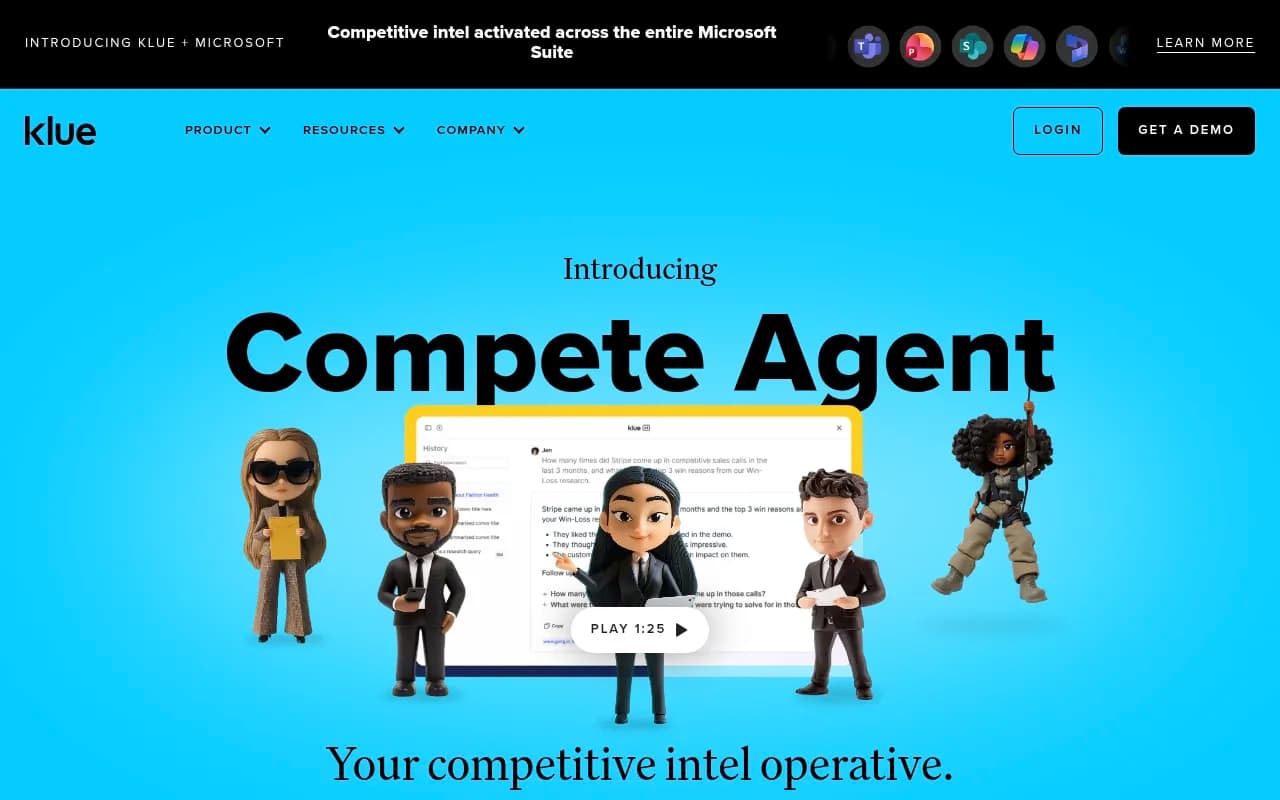
Klue is the most direct Crayon competitor. Both platforms do roughly the same thing: aggregate competitor signals from across the web, help CI teams curate and analyze that data, and push battlecards and insights to sales reps. If you're evaluating one, you should be evaluating the other.
Where Klue has pulled ahead recently is win-loss. They've built a native win-loss program directly into the platform -- structured buyer interviews, analysis, and reporting -- rather than treating it as a separate product or integration. For teams that want competitive intelligence and win-loss data in one place, that's a meaningful advantage over Crayon, which relies on third-party integrations for win-loss.
Klue also launched "Compete Agent" in 2026, an AI agent designed to reduce the manual curation work that eats into CI analysts' time. The pitch is that it surfaces deal-relevant intelligence directly to sellers without requiring a human to review and package everything first. It's a smart direction -- the biggest complaint about CI platforms generally is that insights don't reach reps at the right moment.
On the downside, Klue's pricing is in the same ballpark as Crayon ($30K-50K+ annually for mid-market teams), so you're not saving money by switching. The win-loss program is also priced separately, which can push total cost higher. Some users find Klue's interface more complex to set up initially compared to Crayon.
Pricing: Custom, estimated $30K-50K+ annually. Win-loss add-on priced separately.
Best for: Mid-market and enterprise teams who want competitive intelligence and win-loss analysis from a single platform, and are willing to pay Crayon-level prices for it.
Similarweb
Similarweb does something Crayon doesn't: it tells you how much traffic your competitors are getting, where it's coming from, and how that's changed over time. That's a fundamentally different kind of intelligence -- more quantitative, more about market share and channel performance than about messaging and positioning.
If you're trying to understand whether a competitor's new product launch actually drove traffic, or whether their SEO investment is paying off, Similarweb answers those questions. Crayon can tell you they launched a new product; Similarweb can tell you whether anyone cared.
Similarweb has also moved into AI search visibility with their AEO Suite, which tracks brand presence in AI-generated answers. It's not as deep as dedicated platforms in that space, but it signals where the product is heading.
The trade-off is that Similarweb isn't really a sales enablement tool. There are no battlecards, no rep-facing alerts, no CRM integrations designed to help a sales rep handle a competitive objection in a live deal. It's an analyst and marketing tool, not a sales tool.
Pricing: Free tier available. Paid plans start around $200-300/month (Starter), scaling to $1,000+/month for enterprise.
Best for: Marketing and strategy teams who need traffic benchmarking, channel analysis, and market sizing alongside competitive monitoring. Not a replacement for Crayon if sales enablement is the primary use case.
Kompyte
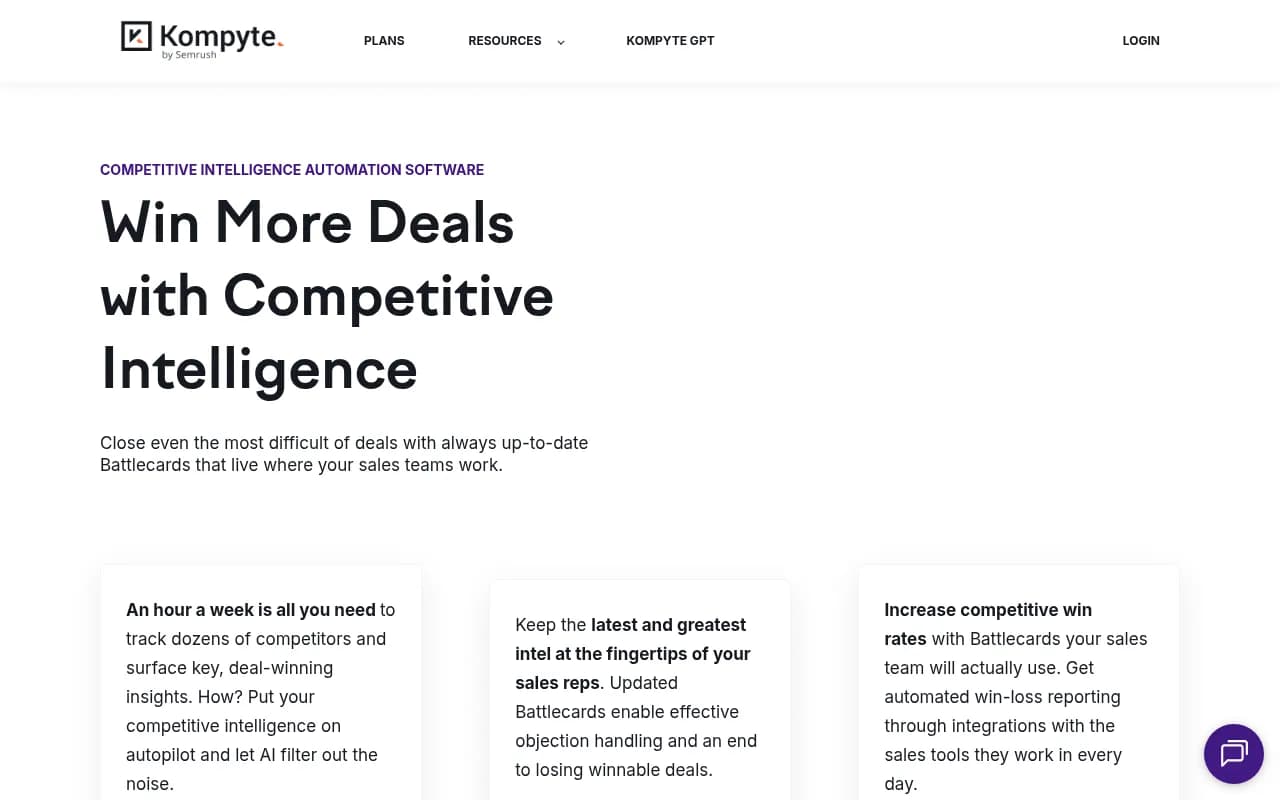
Kompyte was acquired by Semrush a few years ago, which is either reassuring (stable, well-resourced) or concerning (will it get absorbed into a broader product suite?) depending on your perspective. For now, it operates as a standalone competitive intelligence platform with a clear focus on automation.
The core pitch is that Kompyte reduces the time spent on CI from days to about an hour a week. It tracks competitors across websites, reviews, ads, social, job postings, and content, then uses AI to filter out the noise and surface what actually matters. The AI Daily Summaries feature is genuinely useful -- instead of wading through hundreds of raw signals, you get a curated digest.
Battlecards in Kompyte are designed to live inside the sales tools reps already use. CRM integrations (Salesforce, HubSpot) mean battlecards surface in context during active deals rather than sitting in a separate platform that reps have to remember to visit. That's a real workflow advantage.
Compared to Crayon, Kompyte tends to be more automation-forward and less analyst-forward. If you have a small CI team (or no dedicated CI person at all), Kompyte's automation is appealing. If you have a seasoned CI analyst who wants granular control over curation and narrative, Crayon or Klue might feel more flexible.
Pricing: Custom, enterprise quote-based. No free tier. Dedicated CSM included on all plans.
Best for: Teams that want heavy automation and CRM-native battlecard delivery, especially if they're running lean on CI headcount.
AlphaSense
AlphaSense is a different category of tool entirely. It's not a sales battlecard platform -- it's a research platform for strategy, finance, and consulting teams who need to search across 500M+ documents including broker research, expert transcripts, SEC filings, earnings calls, and private company data.
If your competitive intelligence work involves understanding a competitor's financial position, reading analyst commentary on their strategy, or synthesizing expert network interviews alongside public filings, AlphaSense is genuinely powerful. The AI search across structured financial documents is fast and cited -- you can find a specific claim and trace it back to the source document.
But if you're a product marketer trying to build battlecards for a sales team, AlphaSense is the wrong tool. It doesn't monitor competitor websites, track messaging changes, or push alerts to sales reps. The use cases barely overlap with Crayon.
Pricing: Free trial available. Paid plans from approximately $3,000/seat/year (enterprise pricing, not publicly listed).
Best for: Strategy, finance, investment, and consulting teams who need deep document research and financial intelligence. Not a Crayon replacement for GTM teams.
Contify
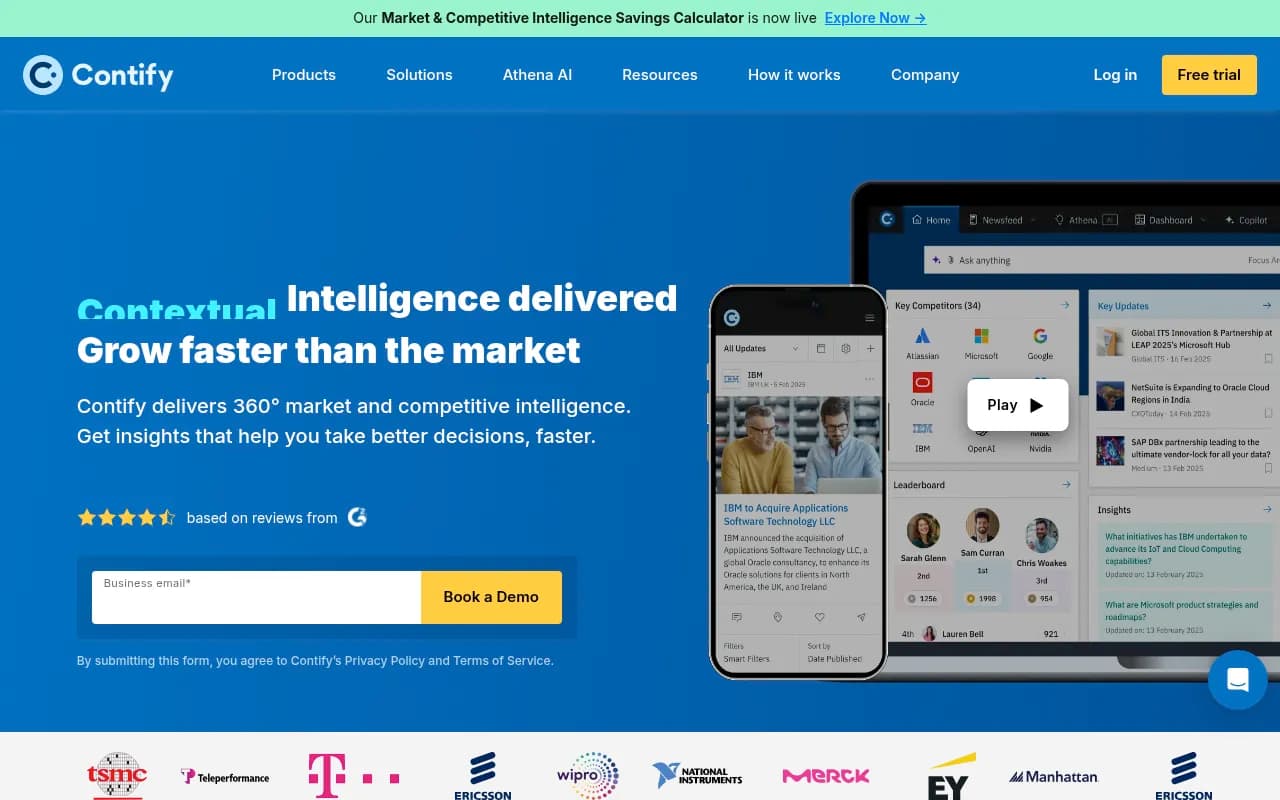
Contify is the enterprise option that doesn't get enough attention in comparison lists. It monitors over 1 million sources, auto-generates battlecards, and serves teams across strategy, product, marketing, and sales -- a broader scope than Crayon's primary GTM focus.
The customer list (Cisco, EY, BCG, Accenture, Ericsson) suggests it's well-suited to large organizations with complex competitive landscapes across multiple business units. Contify's strength is breadth: it can track competitors, industry trends, regulatory changes, and market signals in one place, which is useful when your "competitive intelligence" program is really a broader market intelligence function.
The downside is that Contify can feel like it's trying to do too much. Teams with a narrow, specific use case (e.g., "we need battlecards for our sales team") may find Crayon or Klue more focused and easier to adopt. Contify's value compounds when you have multiple stakeholders with different intelligence needs.
Pricing: 7-day free trial. Custom/enterprise pricing (not publicly listed).
Best for: Large enterprises running a formal market intelligence function that spans strategy, product, and sales -- not just a CI program for one team.
Competitors App

Competitors App is the most accessible option on this list. At $19.90/competitor/month with a free trial, it's priced for marketing teams and agencies who need competitive monitoring without an enterprise budget or a procurement process.
It covers a surprisingly wide range of channels: website changes, trial emails and newsletters, social media, SEO keyword rankings, ads, reviews, traffic estimates, and PR mentions. The email monitoring feature is particularly useful -- getting a copy of every email a competitor sends (onboarding sequences, promotional campaigns, feature announcements) is intelligence that most platforms miss entirely.
What Competitors App doesn't do is sales enablement. There are no battlecards, no CRM integrations, no rep-facing alerts. It's a monitoring and alerting tool for marketers, not a platform for running a CI program that feeds a sales team. The AI features are also lighter than Crayon's -- you get summaries and review analysis, but not the kind of deep competitive narrative generation that Crayon's AI produces.
For a solo marketer or a small team that just wants to know what competitors are doing without spending $40K/year, it's genuinely good value.
Pricing: Free trial + from $19.90/competitor/month.
Best for: Small marketing teams, agencies, and startups who need competitive monitoring on a budget and don't need sales battlecard functionality.
Valona Intelligence

Valona Intelligence positions itself as a competitive and market intelligence platform for mid-market and enterprise teams, aggregating news, signals, and competitor data into structured insights. The focus is on helping strategy, product, and marketing teams act faster on market signals rather than purely on sales enablement.
It sits in a similar space to Contify -- broader market intelligence rather than pure GTM competitive enablement. Teams that need to track industry trends, regulatory developments, and competitor moves across a complex market landscape may find it a better fit than Crayon's more sales-focused approach.
Pricing is custom and quote-based, so you'll need to engage their sales team to get numbers. That's a friction point for teams trying to do a quick evaluation.
Pricing: Custom pricing, no published tiers.
Best for: Strategy and product teams at mid-market and enterprise companies who need structured market intelligence beyond sales battlecards.
Battlecard by Northr
Battlecard by Northr is the most interesting budget option on this list, and it's doing something genuinely different. Rather than monitoring competitor signals over time, it generates AI-powered battlecards, objection handlers, and sales simulations for any competitor in about 60 seconds.
The sales simulation feature is the standout. Reps can practice competitive conversations against an AI buyer before a real call -- getting coached on what to say and when. That's a training use case that Crayon and Klue don't really address.
The obvious limitation is freshness. Battlecard by Northr generates content based on what its AI knows about a competitor, not from ongoing monitoring of that competitor's website, pricing page, or review profile. For fast-moving markets where competitors change their messaging frequently, that's a real gap. Crayon and Klue are continuously monitoring; Battlecard by Northr is more of a point-in-time generation tool.
That said, for early-stage companies, small sales teams, or anyone who needs something working today without a months-long implementation, it's a compelling starting point.
Pricing: Free tier available. Paid plans from $49/month (Starter), $99/month (Pro), $149/month (Team).
Best for: Small sales teams and startups who need battlecards and objection handling practice quickly, without the budget or timeline for an enterprise CI platform.
PageCrawl.io
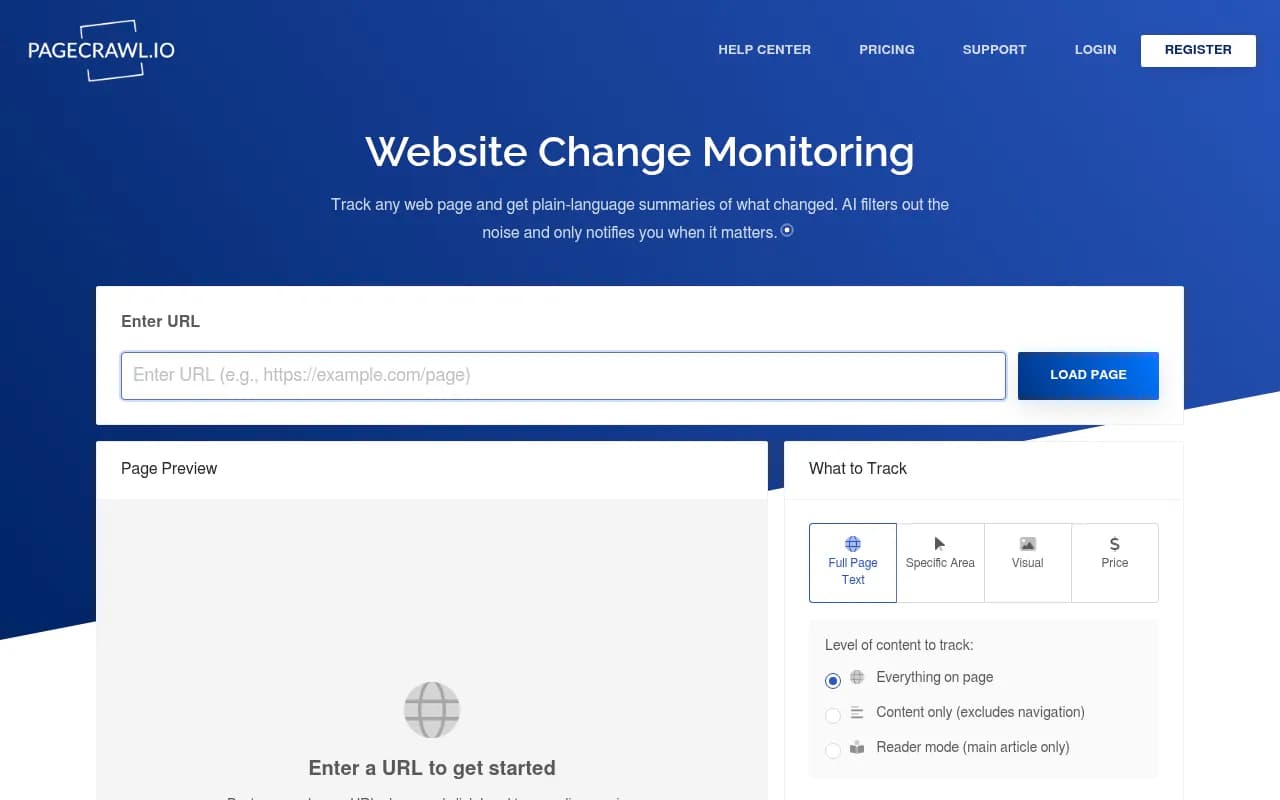
PageCrawl.io is the most narrowly focused tool on this list -- it monitors specific web pages for changes and uses AI to summarize what changed and score it by importance. That's it.
For competitive intelligence purposes, it's useful for tracking specific competitor pages: pricing pages, product pages, job listings, or anything else you want to watch closely. The AI noise filtering is genuinely good -- you set an importance threshold and only get notified when something meaningful changes, rather than being alerted every time a footer link updates.
What it doesn't do is aggregate signals across sources, generate battlecards, or push insights to sales teams. It's a monitoring utility, not a CI platform. Think of it as a component you might use alongside a broader CI workflow rather than a replacement for Crayon.
The pricing is very accessible -- free for up to 6 pages, paid plans from $6.67/month billed annually. For teams that just want to watch a handful of competitor pages closely, it's hard to argue with that.
Pricing: Free tier (6 pages). Paid from $6.67/month (billed annually).
Best for: Teams that need lightweight, precise monitoring of specific competitor pages without a full CI platform. Works well as a supplement to other tools.
Which alternative should you pick?
Here's the honest summary:
If you're replacing Crayon because of price and you need the same core functionality, Klue is the most direct swap -- similar capabilities, similar price, with the added benefit of native win-loss. If you want more automation and less analyst work, Kompyte is worth evaluating.
If you're replacing Crayon because your needs are different -- more market analysis, less sales enablement -- Similarweb covers digital performance and traffic benchmarking, while AlphaSense goes deep on financial and strategic research. Contify is the right call for large enterprises running a multi-team intelligence function.
If budget is the real constraint, Competitors App gives you solid monitoring across channels for a fraction of the cost. Battlecard by Northr is the fastest path to something a sales team can actually use today. And PageCrawl.io is a useful utility for watching specific pages closely.
The one thing all of these tools share with Crayon: they're primarily monitoring and tracking platforms. They tell you what competitors are doing in traditional channels. If you're also thinking about how your brand appears in AI search results -- ChatGPT, Perplexity, Claude, Google AI Overviews -- that's a separate and increasingly important question that none of these tools address well. Promptwatch is built specifically for that problem, tracking AI visibility across 10 models and helping you create content that actually gets cited.

For most teams, the right answer is a combination: a CI platform for traditional competitive monitoring, and a dedicated AI visibility tool for the channel that's growing fastest.