Summary: Which Content Harmony alternative is right for you?
- Promptwatch: Best for brands prioritizing AI search visibility (ChatGPT, Claude, Perplexity) alongside traditional SEO. The only platform that tracks AI citations, generates content optimized for AI models, and shows you exactly what's missing from your site.
- Surfer SEO: Best for teams that want AI writing + real-time on-page optimization in one workflow. Strong SERP analysis but limited AI search tracking.
- Clearscope: Best for enterprise teams focused on content strategy and topical authority. Excellent intent analysis but higher price point.
- Frase: Best budget option for solo creators and small teams. Combines research, writing, and optimization at $39/mo but lacks advanced AI visibility features.
- MarketMuse: Best for content strategists who need inventory-wide analysis and personalized difficulty scoring. Premium pricing reflects depth of strategy features.
Content Harmony built its reputation on turning hours of manual research into fast, comprehensive content briefs. But the search landscape shifted. AI models like ChatGPT and Perplexity now answer millions of queries that used to send traffic to websites. A tool that only optimizes for Google misses half the picture.
That's the core tension: do you need a brief generator, a content optimizer, or a platform that helps you show up in both traditional search and AI responses? The answer determines which alternative fits.
Promptwatch

Promptwatch isn't a direct Content Harmony replacement -- it solves a different problem that most content teams don't realize they have yet. While Content Harmony helps you create briefs for Google, Promptwatch tracks and optimizes your visibility across ChatGPT, Claude, Perplexity, Gemini, and other AI models that are increasingly where your audience searches.
The core difference: Promptwatch doesn't just monitor where you're invisible in AI search -- it helps you fix it. The platform analyzes 880M+ citations to show you exactly which prompts competitors rank for but you don't (Answer Gap Analysis), then generates content engineered to get cited by AI models. You're not guessing what to write -- you're creating articles grounded in real citation data, prompt volumes, and competitor analysis.
Key capabilities Content Harmony lacks:
- Real-time AI crawler logs showing when ChatGPT, Claude, and Perplexity crawl your site, which pages they read, and errors they encounter
- Page-level tracking of which content gets cited by which AI models, with traffic attribution via code snippet, GSC integration, or server logs
- Reddit and YouTube insights surfacing discussions that directly influence AI recommendations
- ChatGPT Shopping tracking for product recommendations and shopping carousels
- Prompt Intelligence with volume estimates, difficulty scores, and query fan-outs showing how prompts branch into sub-queries
The workflow: find content gaps (what AI models want but can't find on your site), generate optimized content with the built-in AI writing agent, track visibility improvements across 10 AI models. This action loop -- find, create, measure -- is what makes Promptwatch an optimization platform instead of just another dashboard.
Pricing starts at $99/mo (Essential: 1 site, 50 prompts, 5 articles), $249/mo (Professional: 2 sites, 150 prompts, 15 articles, crawler logs), $579/mo (Business: 5 sites, 350 prompts, 30 articles). Free trial available.
Best for: Marketing teams and agencies that want to dominate both traditional SEO and AI search. If your audience uses ChatGPT or Perplexity to research your category, you need visibility there -- not just Google.
Trade-off: Promptwatch focuses on AI search visibility and content generation for AI models. If you only care about traditional Google rankings and need detailed SERP-based content briefs, stick with Content Harmony or one of the alternatives below.
Surfer SEO
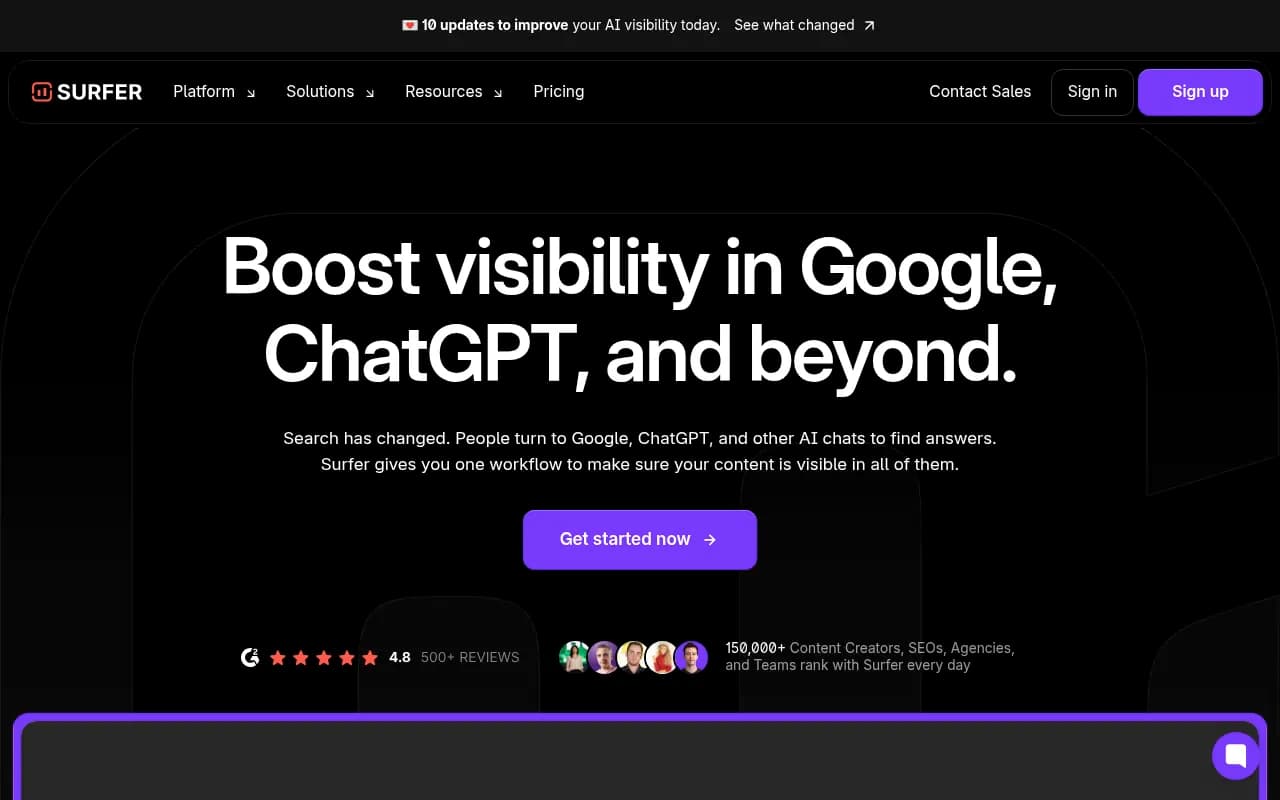
Surfer SEO combines AI content writing with real-time on-page optimization recommendations. The workflow mirrors Content Harmony's brief-first approach but adds a built-in editor that scores your content as you write. Surfer analyzes the top 10 SERP results for your target keyword, extracts common topics and terms, then suggests what to include.
What Surfer does well: the Content Editor gives you a live optimization score based on word count, keyword density, heading structure, and semantic terms. Writers see exactly what's missing without switching tools. The Outline Builder auto-generates section structures from SERP analysis. For teams that want writing and optimization in one interface, Surfer delivers.
Where it falls short compared to Content Harmony: Surfer's briefs feel more mechanical. Content Harmony's workflow was built by agency operators who understood the nuance of intent analysis and competitor structure mapping. Surfer optimizes for keywords and topics but doesn't guide you through the strategic thinking -- why this angle matters, what questions readers actually have, how to differentiate from competitors.
Surfer added AI search tracking in 2026 but it's basic compared to dedicated platforms like Promptwatch. You can see if your content appears in AI Overviews but there's no citation tracking, no crawler logs, no content generation optimized for AI models.
Pricing: $99/mo (Essential: 30 articles, 1 user), $219/mo (Advanced: 100 articles, 3 users), $399/mo (Max: 300 articles, 10 users, 30 AI articles). 7-day money-back guarantee.
Best for: Teams that want AI writing + optimization in one tool and don't need deep strategic guidance. If you're comfortable building your own content strategy and just need execution help, Surfer works.
Trade-off: Less strategic depth than Content Harmony. The briefs tell you what to include but not always why. AI search tracking is surface-level.
Clearscope
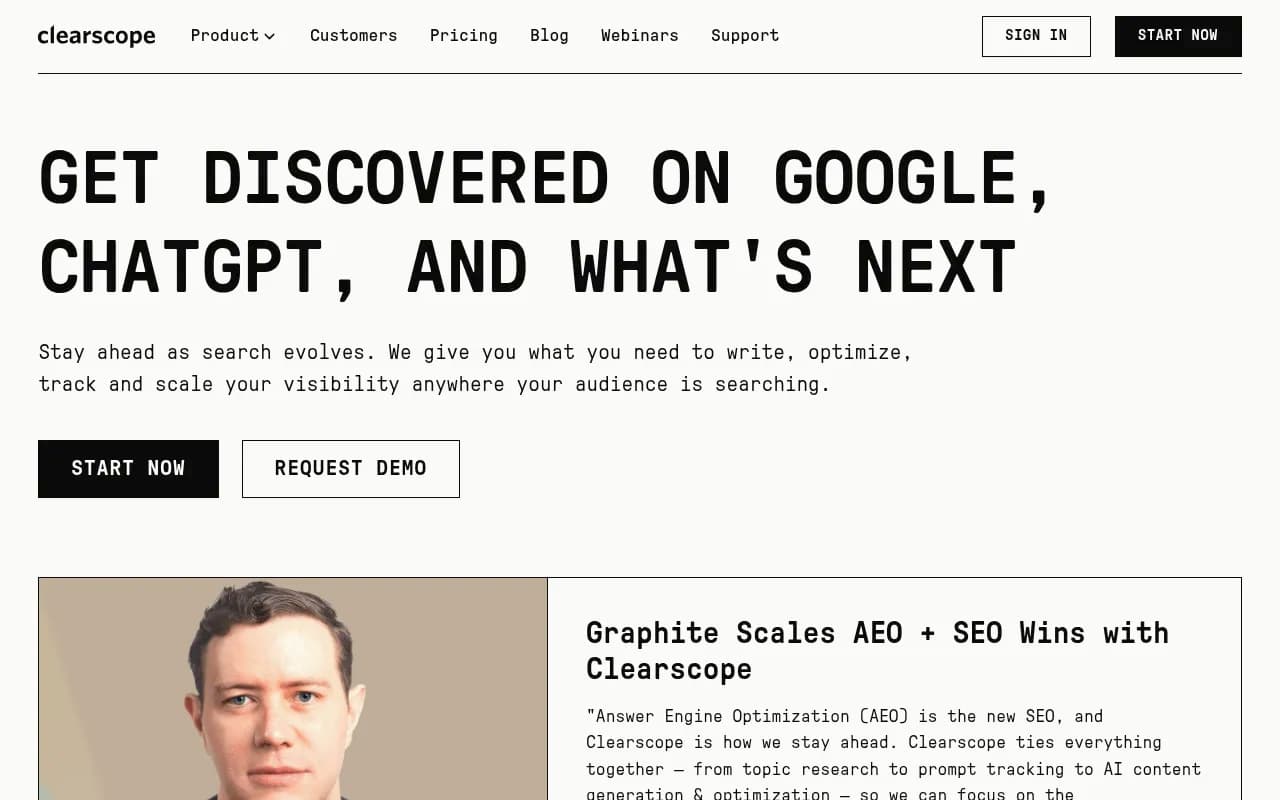
Clearscope positions itself as the discoverability platform for the new era of search. It combines traditional SEO optimization with AI search tracking (Google, ChatGPT, Gemini) and content generation. The core strength: Clearscope's intent analysis is exceptional. It doesn't just list keywords -- it explains the "why" behind searches and helps you create content that feels like the perfect answer.
The workflow: Topic Explorations give you a holistic view of any subject, showing high-impact opportunities and content clusters before you write. The optimization editor scores your content and suggests improvements based on top-ranking pages. Clearscope added AI visibility tracking in 2026, showing which sources LLMs use to compile answers.
What sets Clearscope apart from Content Harmony: deeper strategic thinking. Content Harmony excels at fast, comprehensive briefs. Clearscope takes longer but helps you understand the entire topic landscape and build authority across clusters, not just individual articles.
The downside: price. Clearscope starts at $189/mo (Essentials) and quickly scales to $399/mo (Business) or custom Enterprise pricing. For agencies and enterprise teams, the investment makes sense. For smaller teams or solo creators, it's steep compared to Content Harmony's credit model.
Clearscope's AI search features are newer and less mature than Promptwatch's. You can track visibility in ChatGPT and Gemini but there's no crawler log analysis, no Reddit/YouTube insights, no content gap analysis showing exactly what AI models want but can't find on your site.
Best for: Enterprise content teams and agencies that need deep strategic insights and can justify premium pricing. If you're building long-term topical authority and want the best intent analysis available, Clearscope delivers.
Trade-off: Expensive. AI search tracking is basic compared to dedicated platforms. Slower workflow than Content Harmony's rapid brief generation.
Frase
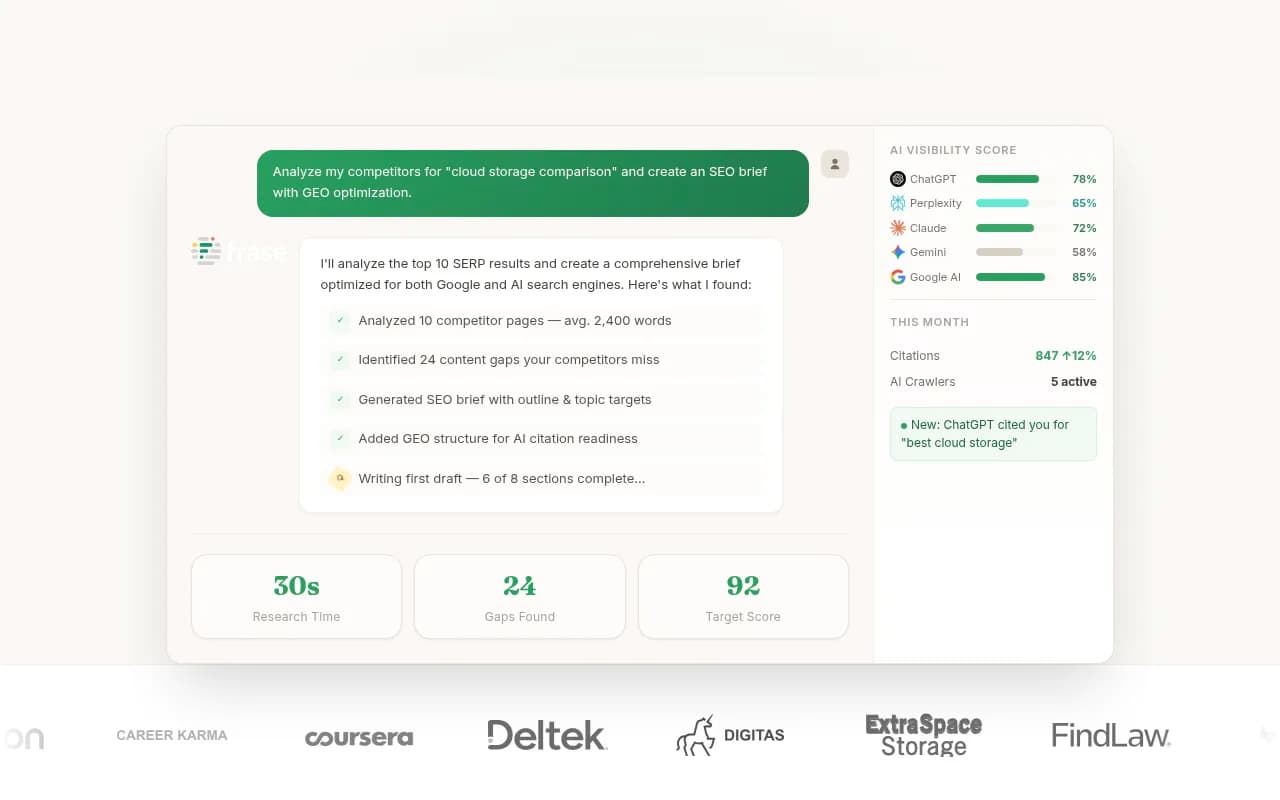
Frase markets itself as the "agentic SEO & GEO platform" -- one AI agent with 80+ skills that researches your market, creates optimized content, and tracks visibility across Google, ChatGPT, and Perplexity. The pitch: Frase tells you exactly what to do next.
The reality: Frase is a solid budget alternative to Content Harmony. It combines research, brief generation, AI writing, and optimization in one interface. The SERP analysis is fast -- Frase pulls top 10 results, identifies content gaps, and generates an outline in under a minute. The AI writer produces decent first drafts that need editing but save time.
What Frase does better than Content Harmony: price. At $39/mo (Solo: 1 user, 10 articles), Frase is accessible to solo creators and small teams. Content Harmony's credit model starts at $99/mo for ~10 workflows, which is comparable, but Frase includes unlimited research queries on all plans.
Where Frase falls short: the "agentic" claims are marketing fluff. Frase doesn't autonomously manage your SEO strategy -- it's a collection of tools you still have to use manually. The AI search tracking (added in 2026) is basic: you can see if your content appears in ChatGPT or Perplexity responses but there's no citation analysis, no crawler logs, no content gap identification.
The optimization editor is functional but less polished than Surfer or Clearscope. You get a score and keyword suggestions but not the depth of semantic analysis or intent guidance that Content Harmony provided.
Best for: Solo creators, freelancers, and small teams on a budget. If you need research + writing + optimization for under $50/mo and don't require advanced AI search features, Frase is the value pick.
Trade-off: Less strategic depth than Content Harmony. AI search tracking is surface-level. The "agentic" positioning oversells what the platform actually does.
SE Ranking

SE Ranking is a full-suite SEO platform that added AI visibility tracking (SE Visible) in 2026. It's not a direct Content Harmony competitor -- SE Ranking covers rank tracking, backlink analysis, site audits, and more -- but the AI Search add-on ($71.20/mo) provides strategic insights for AI search performance.
The AI visibility features: track how your brand appears in ChatGPT, Perplexity, and other AI models. See which prompts trigger mentions, monitor competitor visibility, and get recommendations for improvement. The interface is clean and the strategic view is clearer than most monitoring-only tools.
What SE Ranking lacks compared to Content Harmony: content brief generation. SE Ranking helps you track and analyze but doesn't build the detailed briefs that Content Harmony was known for. You'd need to combine SE Ranking with a writing tool like Surfer or Frase to replicate the full workflow.
The advantage: if you need a complete SEO platform and want AI search tracking as part of the package, SE Ranking delivers. The Core plan ($103.20/mo) includes rank tracking, site audits, backlink checker, and keyword research. Add the AI Search module for $71.20/mo and you have visibility across traditional and AI search.
Best for: Teams that want an all-in-one SEO platform with AI visibility tracking. If you're already using SE Ranking or need rank tracking + site audits + AI monitoring, the bundled approach makes sense.
Trade-off: No content brief generation or optimization editor. You're tracking and analyzing, not creating. AI search features are monitoring-focused, not action-oriented like Promptwatch.
SEMrush Writing Assistant
SEMrush Writing Assistant is the content optimization layer of the SEMrush platform. It provides real-time SEO recommendations, readability scores, tone analysis, and plagiarism checking while you write. The tool integrates with Google Docs, WordPress, and Microsoft Word, so you can optimize content wherever you draft it.
The workflow: analyze your target keyword in SEMrush, get a list of related terms and topics, then use the Writing Assistant to score your content as you write. The recommendations are based on top-ranking competitors for your keyword. You see which terms to include, how to structure headings, and whether your readability and tone match your audience.
What SEMrush does well: integration. If you're already using SEMrush for keyword research and rank tracking, the Writing Assistant extends that data into your writing process. The Google Docs add-on is seamless -- you write, the sidebar updates your score in real-time.
Where it falls short compared to Content Harmony: SEMrush doesn't generate briefs. Content Harmony's strength was turning hours of research into a comprehensive brief that writers could follow. SEMrush gives you optimization suggestions but assumes you've already done the strategic work -- identified the angle, mapped competitor structures, outlined key questions.
The other limitation: SEMrush Writing Assistant is tied to SEMrush pricing. Pro ($139.95/mo) includes 10 checks per day. Guru ($249.95/mo) gives you 30 checks per day. Business ($499.95/mo) allows 50 checks per day. If you're not using the full SEMrush platform, paying $140+/mo just for the Writing Assistant doesn't make sense.
SEMrush added basic AI Overviews tracking in 2026 but it's limited to Google's AI features. There's no ChatGPT, Claude, or Perplexity monitoring, no citation analysis, no content generation optimized for AI models.
Best for: Teams already using SEMrush who want to extend their keyword data into the writing process. The Google Docs integration is convenient if you draft there.
Trade-off: No brief generation. Expensive if you're not using the full SEMrush platform. AI search tracking is limited to Google AI Overviews.
Scalenut

Scalenut positions itself as the complete SEO content platform with NLP analysis. It combines content planning, AI writing, optimization, and (as of 2026) GEO tracking. The pitch: plan smarter, write faster, surface in AI results.
The workflow: Scalenut's Cruise Mode generates a full content brief and first draft in minutes. You input a keyword, Scalenut analyzes SERPs, extracts topics and questions, builds an outline, and writes sections. The optimization editor scores your content and suggests improvements based on NLP keyword recommendations.
What Scalenut does better than Content Harmony: speed. Cruise Mode is fast -- you can go from keyword to draft in under 10 minutes. For teams that need volume and can tolerate AI-generated content that requires editing, Scalenut delivers.
Where it falls short: the content quality. Scalenut's AI writing is generic. It hits the keywords and covers the topics but lacks the depth and differentiation that makes content worth reading. Content Harmony never promised to write for you -- it gave you the research and structure so your writers could create something unique. Scalenut tries to do both and the writing suffers.
The GEO tracking (added in 2026) is basic. Scalenut monitors brand mentions in ChatGPT and Perplexity and provides a "GEO score" for your content, but there's no crawler log analysis, no citation tracking, no content gap identification. It's monitoring, not optimization.
Pricing: GEO tracking starts at $30/mo (10 prompts). SEO content tools start at $59/mo (5 articles/month). The pricing is usage-based and flexible, which works for smaller teams.
Best for: Teams that need fast content production at scale and can invest editing time to improve AI-generated drafts. If you value speed over depth, Scalenut fits.
Trade-off: AI-generated content is generic and needs heavy editing. GEO tracking is surface-level. Less strategic guidance than Content Harmony.
MarketMuse
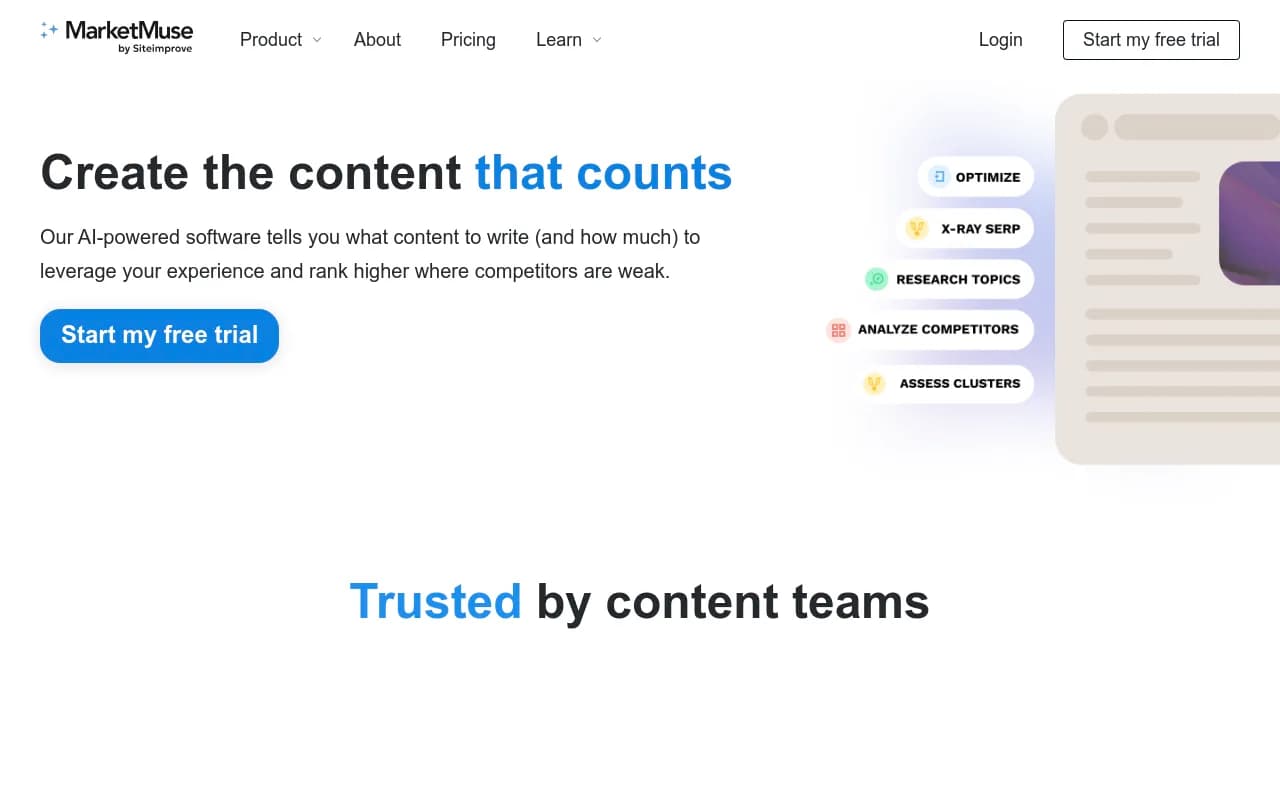
MarketMuse uses patented AI to analyze your entire content inventory, identify topic authority gaps, and generate personalized content plans. It's built for SEO teams and content strategists who need data-driven decisions on what to create, update, or skip -- not just keyword lists.
The core strength: MarketMuse's personalized difficulty scoring. Most tools show you keyword difficulty based on domain authority and backlinks. MarketMuse analyzes your existing topical authority and tells you which topics are easiest for you specifically to rank for. If you've already published 20 articles on email marketing, MarketMuse recognizes that authority and shows you related topics where you have a competitive advantage.
The workflow: MarketMuse scans your site, builds a topic model, identifies clusters where you have authority and gaps where you don't, then prioritizes opportunities based on personalized difficulty and search volume. The Content Briefs are comprehensive -- they include target word count, topics to cover, questions to answer, and competitor analysis.
What MarketMuse does better than Content Harmony: inventory-wide strategy. Content Harmony focused on individual briefs. MarketMuse looks at your entire site and helps you build a cohesive content strategy that leverages existing authority. For teams managing hundreds of articles, that strategic layer is valuable.
The downside: price and complexity. MarketMuse starts at $150/mo (Standard) but most teams need the Premium tier, which requires custom pricing. The platform has a learning curve -- it's powerful but not intuitive. Content Harmony was faster and easier for teams that just needed briefs.
MarketMuse doesn't include AI search tracking. It's focused entirely on traditional SEO and topical authority in Google.
Best for: Content strategists and SEO teams managing large content inventories who need personalized difficulty scoring and inventory-wide analysis. If you're building long-term topical authority and have budget for premium tools, MarketMuse delivers strategic depth.
Trade-off: Expensive. Steeper learning curve than Content Harmony. No AI search tracking. Overkill for small teams or solo creators.
How to choose the right Content Harmony alternative
Start with your primary goal:
If you want to dominate AI search (ChatGPT, Claude, Perplexity) alongside Google: Promptwatch is the only platform that tracks AI citations, shows you content gaps AI models care about, generates content optimized for AI responses, and measures the results. Content Harmony never addressed AI search -- Promptwatch was built for it.
If you want fast briefs + AI writing + optimization in one tool: Surfer SEO or Frase. Surfer is more polished and includes better AI writing. Frase is cheaper and works for budget-conscious teams.
If you need deep strategic insights and topical authority planning: Clearscope or MarketMuse. Clearscope has better intent analysis and a cleaner interface. MarketMuse offers personalized difficulty scoring and inventory-wide strategy.
If you're already using a full SEO platform: Add the content optimization layer from that platform (SEMrush Writing Assistant, SE Ranking's tools). The integration makes sense if you're committed to the ecosystem.
If you need volume and speed over depth: Scalenut's Cruise Mode generates drafts fast. Expect to invest editing time.
The search landscape split. Google still matters but AI models now answer millions of queries that used to send traffic to websites. Tools that only optimize for traditional search miss half the opportunity. Content Harmony helped you create great briefs for Google. The next generation of tools -- led by Promptwatch -- helps you show up everywhere your audience searches.