Sedestral Review 2026
Named agents handle blog automation, page optimization, technical audits and keyword research.
Key takeaways
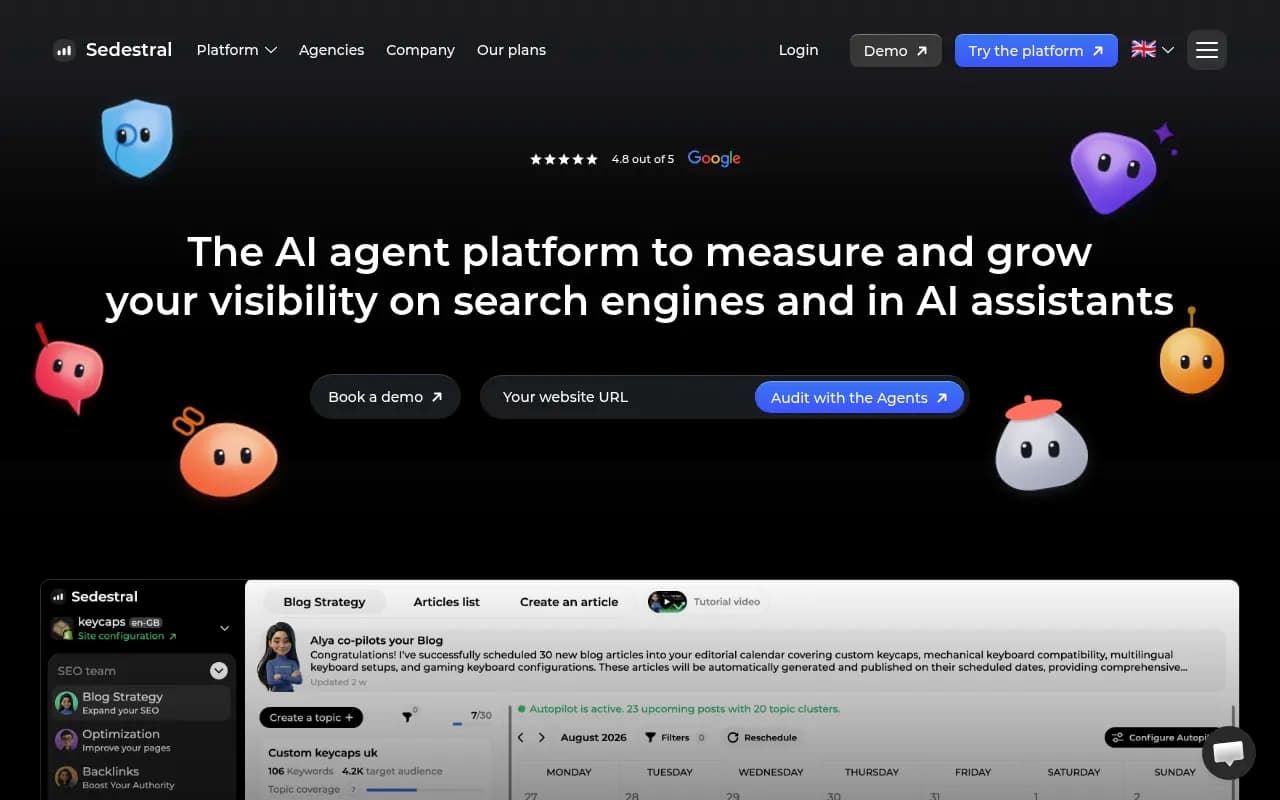
- Sedestral is an agent-based SEO platform: five named agents (Alya, Remi, Maya, Nox, Marc) plus a creative agent (Louise) that write, publish, audit and optimize, rather than only report.
- Strong for SMBs, Shopify and PrestaShop stores and agencies that want white-label SEO output. Native connectors cover PrestaShop, Shopify, WordPress, Wix, Webflow, Odoo, Joomla and Storyblok.
- Pricing starts at $144/month (Lite), with usage-based add-ons that can lift the real bill above the headline number.
- AI visibility tracking exists but is a side feature. It lacks the crawler logs, AI traffic attribution, prompt volumes, Reddit/YouTube tracking and query fan-outs that Promptwatch offers, so GEO specialists will outgrow it.
- Independent review coverage is thin. The Shopify listing shows 5.0 from just 3 reviews, so treat vendor claims with some caution.
Sedestral is an SEO and AI search platform built around the idea that software should do the work instead of handing you a to-do list. Instead of one dashboard with dozens of modules, it gives you a team of named agents: Alya for blog content, Remi for optimization, Maya for backlinks, Nox for indexing, Marc for competitor analysis, and Louise for images and video. The company is French, with a founding team that includes Anis (CEO and co-founder) and Quentin (managing director), and its site claims more than 1,800 brands, marketing teams and agencies as users.
The pitch is simple. You connect your site, configure your brand context once, and the agents write, publish, fix and optimize. Nothing goes live without your approval, which is the part I find most reassuring. Autonomous publishing sounds great until an agent posts something off-brand, and the approval gate keeps the human in charge.
The audience is clear from the product: small and mid-sized businesses, e-commerce merchants on Shopify or PrestaShop, and agencies that want to resell SEO under their own name. A2Com, an agency customer quoted on the site, says it offers Sedestral in white label as one more service under its own brand.
Key features
Alya, the blog agent. Alya builds an editorial calendar, writes articles and publishes them to your blog. Sedestral's own guide describes a seven-phase writing process that starts from a keyword, analyzes Google and AI results, builds an outline, drafts the piece and scores it in an editor. The content score covers structure, SEO optimizations and AI search readiness. There is an Edit with AI function for revisions, and an autopilot mode for the editorial calendar. A third-party breakdown of Alya by GDM Pixel exists, which is worth reading alongside the vendor's own claims.
Remi, the optimization agent. Remi watches your existing pages, spots drops in performance and optimizes the ones you approve. It also handles product pages and category pages, which matters a lot for online stores. This approval-first workflow is more careful than tools that rewrite pages automatically.
Maya, the backlink agent. Maya analyzes your backlinks and those of competitors, finds partner sites in your niche and runs monthly backlink campaigns on the pages that matter. The homepage shows a sample dashboard with total backlinks and a comparison against the average competitor profile. Link acquisition is the hardest thing to automate honestly, so ask for examples of placed links before you commit.
Nox, the indexing agent. Nox monitors Google indexing, detects pages that are missing and pushes them for indexing, with a headline claim of five minutes. Fast indexing is a paid add-on at $29/month. Research notes also credit Nox with technical audits and fixes.
Marc, the competitor agent. Marc learns your business, identifies your real SEO competitors and shows how to capture their traffic. The competitor analysis view displays SEO traffic and total keyword counts for any site, which is useful for sizing up a rival quickly.
Technical audit and SEO visibility. The audit view reports a health score, performance, crawlability, and counts of errors, warnings and suggestions. A separate SEO visibility module tracks rankings. There is also cannibalization detection, which flags pages competing for the same keyword.
Keyword research and topic clusters. The topics module groups keywords into clusters with total volume and topical authority tracking. Sedestral's toolbox guide mentions volume, difficulty and intent, plus AI ALT tags and photo retouching. This is solid for content planning, though it is not as deep as a dedicated keyword database like Semrush or Ahrefs.
AI visibility tracking. Sedestral tracks mentions and appearance frequency on ChatGPT, Gemini, Perplexity and Google, with weekly prompts, sentiment and which competitors get cited instead. It is a reasonable starting point. Compared with dedicated GEO platforms it is shallow, which I cover below.
Who is it for
The sweet spot is a small business owner or a two-to-ten person marketing team with no dedicated SEO specialist. Think a Shopify store with 200 products that needs better category copy, or a local service company that wants steady blog output. The agent model replaces a freelance writer, a technical auditor and part of a link builder with one subscription.
Agencies are the second audience. The pricing scales per managed site and per user (extra seats are $23/month), and white-label delivery is a stated feature. An agency running 15 small-business clients could plausibly run delivery through Sedestral and brand it as its own.
Who should skip it? Enterprise SEO teams that need log-file analysis, custom crawling and massive keyword databases will find it too light. Brands whose main goal is AI search visibility, meaning measuring and improving citations across ChatGPT, Perplexity and AI Overviews, should look at a dedicated platform. Developer-tool companies tracking how coding agents recommend them also need something else.
Integrations and ecosystem
Native connectors are the headline: PrestaShop, Shopify, WordPress, Wix, Webflow, Odoo, Joomla and Storyblok. That is a notably broad list for a platform this size, and the PrestaShop blog module is sold on the official PrestaShop store. Social connections shown include Instagram, Facebook, LinkedIn and Google Maps, and the AI visibility side references ChatGPT, Perplexity and Gemini.
A Shopify app exists, listed with English, French and Spanish. I could not verify a public API, MCP server, Slack integration or Looker Studio connector, so I would not assume any of them. Ask before buying if you depend on one. Support is human-led: the team lists customer success managers and SEO consultants, and the site stresses personalized onboarding.
Pricing and value
Sedestral publishes three tiers, all month-to-month with no commitment:
- Lite: $144/month ($101/month billed annually)
- Middle tier: $288/month ($202/month annually)
- Standard: $601/month ($421/month annually)
Annual billing saves roughly 30%. The model is usage-based: you pay per managed site and per active user. Add-ons include local presence at $19/month per location, image packs from $23/month (100 images) up to $120/month (800), optimization packs from $59/month for 125 optimizations (about $0.47 each), and fast indexing at $29/month.
The site compares itself with a typical SEO stack costing $729/month, listing Semrush at $134, Ahrefs at $229, Screaming Frog at $20, ChatGPT Plus and Claude Pro. That is marketing, and the listed items do not obviously sum to $729, so discount it. Also note the Shopify App Store shows a free plan and a $239/month plan that do not match the website tiers, so confirm current pricing at sedestral.com/en/pricing before you buy.
Value depends on how much you would otherwise pay for writing and optimization. For a small business, $144 to $288 a month for continuous content and fixes is competitive. Once you stack add-ons, the cost climbs, so model your real usage.
Strengths and limitations
Strengths
- Execution-first design: agents write, publish and fix, with approval gates.
- Wide CMS coverage, especially for PrestaShop and Shopify merchants.
- Transparent month-to-month pricing with no lock-in.
- White-label option for agencies.
- Combines classic SEO and basic AI visibility in one place.
Limitations
- Thin independent validation. Three Shopify reviews and no G2 or Trustpilot presence I could find.
- Usage-based add-ons can push real spend well above the headline price, and the Shopify pricing is inconsistent with the website.
- Keyword and backlink data depth is unverified against Semrush or Ahrefs.
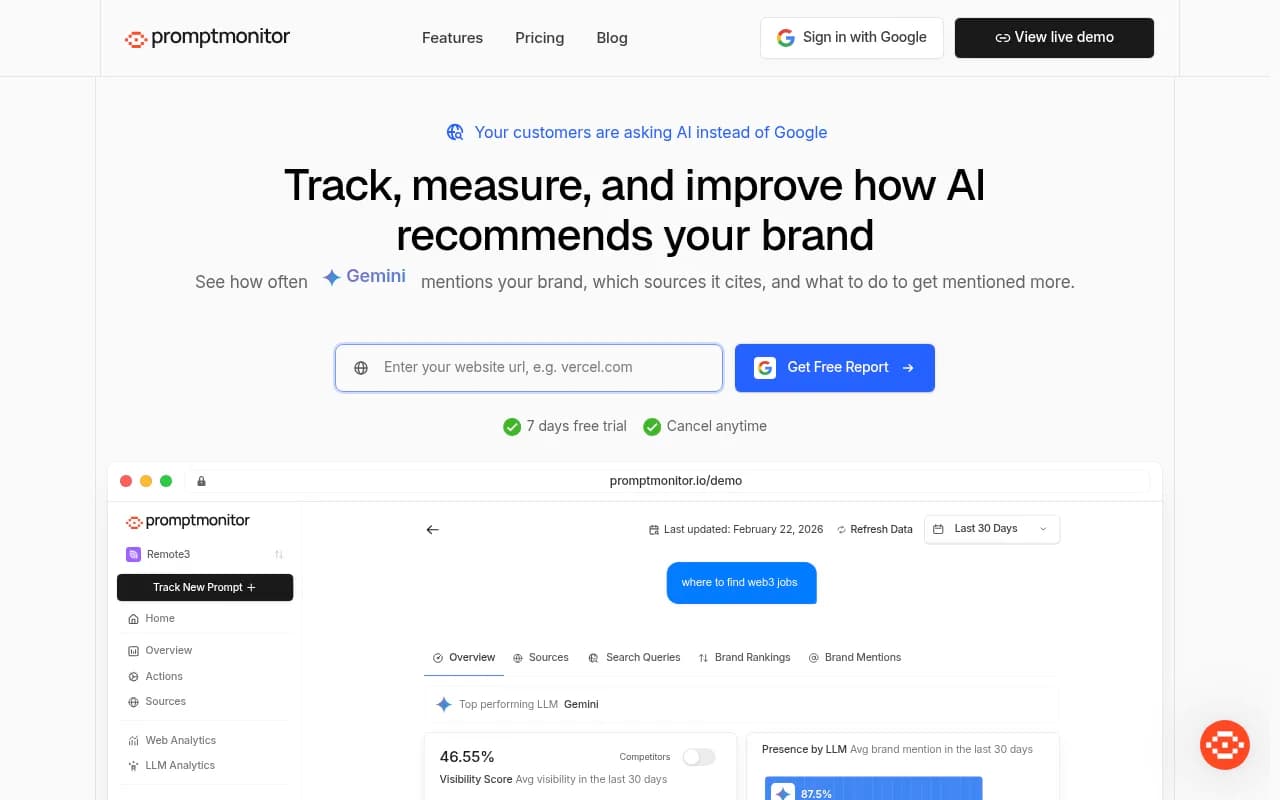
Gaps versus Promptwatch. If AI search is your priority, Sedestral's tracking is monitoring-level. It lacks several things Promptwatch provides: IP-verified AI crawler logs and crawl-to-citation tracking, AI traffic attribution through visitor analytics, Google Search Console and Bing data joined to AI data, prompt volumes and difficulty scores, query fan-outs, Reddit, YouTube and LinkedIn citation tracking, AI Shopping and Ads Radar, page-level citation tracking, offsite mentions, Agent Chat and a prioritized Action Board. Promptwatch also tracks real UIs across 15+ AI engines, including Codex and Claude Code, while Sedestral lists ChatGPT, Gemini, Perplexity and Google. For context on how AI engines choose sources, see Promptwatch Data.
Bottom line
Sedestral is a sensible buy for small businesses, e-commerce stores and agencies that want an SEO team in software form and are comfortable approving what the agents propose. Its agent model, broad CMS support and flexible billing are real advantages over stitching together separate tools.
If your priority is growing revenue from AI search, with citation analytics, crawler logs and traffic attribution, Promptwatch is the stronger option because it optimizes and measures, not just monitors. For more options, the GEO software directory at bestgeosoftware.com is a good place to compare.
Best use case: a Shopify or PrestaShop merchant who wants steady blog and product-page SEO without hiring a team.
Frequently asked questions
What is Sedestral?
How much does Sedestral cost?
Does Sedestral publish content without my approval?
Which platforms does Sedestral integrate with?
Is Sedestral good for tracking AI search visibility?
Is there a free plan?
Similar and alternative tools to Sedestral