11x AI Review 2026
Autonomous AI SDRs that research companies, qualify leads, and initiate outreach, helping GTM teams scale pipeline generation efforts.
Summary
- Two specialized AI workers: Alice (AI SDR) handles prospecting, research, and multi-channel outreach; Julian (AI Phone Agent) manages inbound/outbound calls with adaptive conversation capabilities
- End-to-end sales automation: Covers the full funnel from prospect identification and research to personalized engagement and meeting booking, all within a single platform
- Enterprise-grade deployment: SOC-2 compliant, deeply integrated with CRMs (Salesforce, HubSpot), email platforms, LinkedIn, and calendars—no manual data entry required
- Proven ROI: Gupshup generated 50%+ more SQLs per SDR; Leica saved $500k on hiring costs; customers report significant cost-per-lead reductions and pipeline growth
- Premium pricing: Alice starts around $5,000/month for 3,000 contacts; custom pricing for Julian and enterprise deployments—this is a high-ticket tool aimed at mid-market and enterprise GTM teams, not startups on a shoestring budget
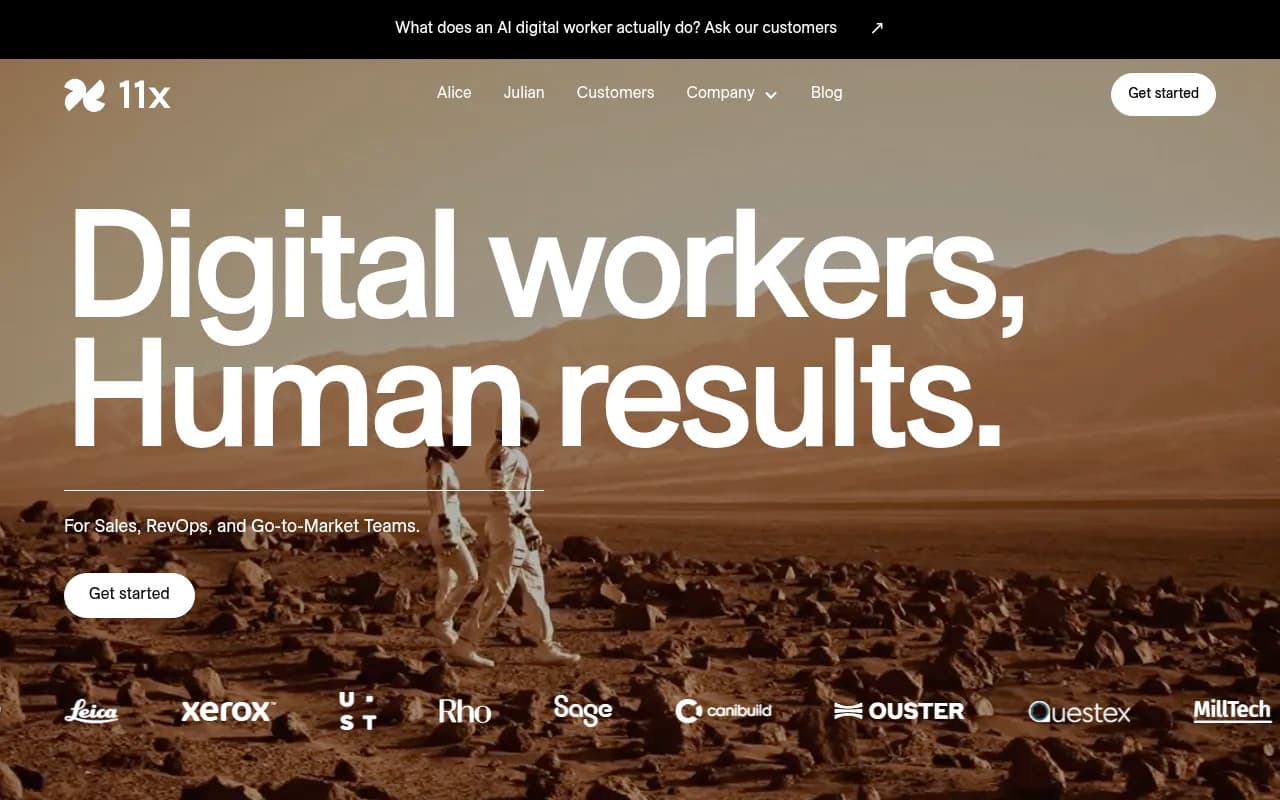
11x AI sells a vision that sounds like science fiction but is already running in production at companies like Xerox, Rho, and Paymentology: fully autonomous AI workers that don't just automate tasks but actually execute complex sales workflows end-to-end. You're not buying a chatbot or a lead enrichment API. You're hiring Alice, an AI SDR who researches prospects across dozens of signals, crafts personalized outreach, manages multi-touch sequences across email and LinkedIn, and books meetings directly into your calendar. Or Julian, an AI phone agent who handles inbound calls, qualifies leads, and follows up—learning from every conversation to get better over time.
The company launched in 2022 and has raised significant venture funding (exact amounts not publicly disclosed, but they're backed by Benchmark and other top-tier VCs). Their customer roster includes mid-market SaaS companies, enterprise software vendors, and B2B service providers who need to scale outbound without hiring armies of SDRs. The pitch is simple: one Alice can do the work of 3-5 human SDRs at a fraction of the cost, with zero ramp time and 24/7 availability.
Alice – AI SDR (The Core Product)
Alice is 11x's flagship digital worker. She's designed to replace or augment your outbound SDR team by handling the entire prospecting-to-meeting workflow. Here's what that actually means in practice:
Prospect Identification: Alice connects to your CRM, marketing automation platform, and intent data sources to identify prospects that match your ICP. She filters through millions of signals—job changes, funding announcements, website visits, content downloads, LinkedIn activity—to surface accounts showing buying intent. You define the criteria (industry, company size, tech stack, growth signals, geographic region), and Alice continuously scans for new matches. This isn't a static list upload; it's dynamic prospecting that adapts as your ICP evolves.
Agentic Research: Before reaching out, Alice researches each prospect using public data (LinkedIn, company websites, news articles, job postings, earnings calls) and proprietary signals (website visitor behavior, engagement history, CRM notes). She builds a contextual profile: what the company does, recent initiatives (product launches, regional expansion, hiring sprees), pain points inferred from job postings or blog content, and the prospect's role and likely priorities. This research feeds into personalization—Alice doesn't send generic templates; she references specific company details in every message.
Multi-Channel Outreach: Alice executes sequences across email and LinkedIn (with phone and SMS coming soon, according to their roadmap). She sends initial emails, follows up if there's no response, sends LinkedIn connection requests with personalized notes, engages with prospects' LinkedIn posts, and adjusts cadence based on engagement signals (email opens, link clicks, LinkedIn profile views). The sequences aren't rigid—Alice adapts in real-time. If a prospect opens an email three times but doesn't reply, she might send a shorter follow-up or try a different angle. If they engage on LinkedIn but ignore email, she shifts focus there.
Personalization at Scale: Every message Alice sends is dynamically generated based on the prospect's profile, recent activity, and engagement history. She doesn't cycle through pre-written templates with merge tags—she writes new copy for each touchpoint, adjusting tone and messaging to match the prospect's communication style (inferred from their LinkedIn posts, blog articles, or previous email replies). You set guardrails (brand voice, key value props, compliance rules), and Alice operates within them while maintaining a human-like conversational flow.
Meeting Booking: When a prospect replies with interest, Alice handles the back-and-forth to schedule a meeting. She checks your calendar availability, proposes times, sends calendar invites, and confirms attendance. If the prospect asks questions or raises objections, Alice responds autonomously (within defined parameters) or escalates to a human rep if the conversation requires nuanced judgment. Meetings are logged in your CRM with full context—research notes, email thread history, engagement timeline.
Continuous Learning: Alice improves over time by analyzing which messages get replies, which subject lines drive opens, which value propositions resonate with different personas, and which accounts convert to pipeline. She A/B tests messaging variations, adjusts targeting criteria based on conversion data, and refines her research process to focus on the signals that matter most. This isn't manual optimization—it happens automatically as she processes more interactions.
The platform provides a dashboard where you can monitor Alice's activity: emails sent, replies received, meetings booked, pipeline generated, and a detailed activity feed showing every action she takes. You can review her outreach before it goes live (approval workflows for compliance-sensitive industries) or let her run fully autonomous. Most customers start with human-in-the-loop approval and gradually shift to full autonomy as they build trust in her judgment.
Julian – AI Phone Agent
Julian is 11x's voice AI agent, designed to handle inbound and outbound phone calls. He's newer than Alice (launched in late 2024) but already deployed at several enterprise customers for lead qualification, appointment setting, and customer support triage.
Inbound Call Handling: Julian answers inbound calls 24/7, qualifies leads by asking discovery questions (budget, timeline, decision-making process, pain points), and either books a meeting with a sales rep or routes the call to the appropriate team member. He integrates with your phone system (Twilio, RingCentral, Aircall) and CRM to log call notes, update lead scores, and trigger follow-up workflows. Unlike traditional IVR systems, Julian has natural conversation capabilities—he can handle interruptions, clarify questions, and adapt his script based on the caller's responses.
Outbound Calling: Julian can also make outbound calls to follow up on cold emails, re-engage stale leads, or conduct qualification calls at scale. He uses the same research data Alice generates to personalize each call, referencing specific details about the prospect's company and role. If the prospect isn't ready to buy, Julian can schedule a follow-up call, send additional resources via email, or update the CRM with notes for the human sales team.
Adaptive Learning: Like Alice, Julian learns from every call. He analyzes which questions get the best responses, which objection-handling techniques work, and which call outcomes (meeting booked, not interested, call back later) correlate with specific conversation patterns. Over time, he gets better at reading tone, pacing his questions, and knowing when to escalate to a human.
Julian's voice quality is reportedly very good—customers mention that prospects often don't realize they're talking to an AI until later in the conversation. He supports multiple languages and accents, making him viable for global teams.
The 11x Platform (Unified Orchestration Layer)
Alice and Julian don't operate in isolation—they're part of a unified platform that orchestrates the entire sales workflow. The platform includes:
CRM Integration: Deep two-way sync with Salesforce, HubSpot, Pipedrive, and other major CRMs. Alice and Julian read data from your CRM (account details, contact info, deal stage, custom fields) and write back every interaction (emails sent, calls made, meetings booked, research notes). No manual data entry, no CSV exports—everything flows automatically.
Email & Calendar Integration: Connects to Gmail, Outlook, Google Calendar, and Office 365. Alice sends emails from your domain (proper SPF/DKIM/DMARC setup required), and both Alice and Julian book meetings directly into your calendar with full context.
LinkedIn Integration: Alice can send connection requests, InMail messages, and engage with posts on LinkedIn. This requires LinkedIn Sales Navigator licenses for your team (not included in 11x pricing).
Intent Data & Enrichment: 11x integrates with intent data providers (Bombora, 6sense, Clearbit) and enrichment tools (ZoomInfo, Apollo, Lusha) to pull in firmographic data, technographic signals, and buying intent scores. You can also upload your own data sources.
Compliance & Security: SOC-2 Type II certified, GDPR compliant, end-to-end encryption for all customer data. The platform includes approval workflows, opt-out management, and audit logs for regulated industries (financial services, healthcare). You can set rules for what Alice and Julian can and cannot do (e.g., never mention pricing, always escalate legal questions, don't contact competitors).
Reporting & Analytics: Real-time dashboards showing activity metrics (emails sent, calls made, replies received, meetings booked), conversion funnels (MQL to SQL to opportunity to closed-won), and ROI calculations (cost per meeting, cost per SQL, pipeline generated vs. cost). You can slice data by campaign, persona, industry, or time period. Looker Studio and Tableau integrations available for custom reporting.
Who Is 11x AI For?
This is not a tool for early-stage startups with five-figure ARR and a founder doing all the sales. 11x is built for mid-market and enterprise B2B companies with established GTM motions, defined ICPs, and the budget to invest $5,000-$15,000/month in sales automation. Specific personas:
VP of Sales / CRO at $10M-$100M ARR SaaS companies: You're scaling outbound but hiring SDRs is slow, expensive, and unpredictable. Ramp time is 3-6 months, turnover is high, and quota attainment is inconsistent. Alice lets you scale pipeline generation without expanding headcount. One customer (Gupshup, a CPaaS platform) used Alice to generate 50%+ more SQLs per SDR by automating top-of-funnel prospecting and letting human reps focus on high-intent conversations.
RevOps Leaders managing complex sales tech stacks: You're already using Salesforce, Outreach/SalesLoft, ZoomInfo, 6sense, and a dozen other tools. 11x consolidates prospecting, enrichment, sequencing, and meeting booking into one platform with deep CRM integration. Less tool sprawl, fewer manual handoffs, cleaner data.
Agencies and Consulting Firms selling high-ticket services: You need to reach decision-makers at enterprise accounts but don't have the budget for a full SDR team. Alice handles the grunt work (research, initial outreach, follow-ups) while your senior consultants focus on discovery calls and proposals.
Enterprise Sales Teams with long sales cycles: You're selling to Fortune 500 accounts with 6-12 month sales cycles and multiple stakeholders. Alice can nurture early-stage leads, re-engage cold opportunities, and keep your pipeline warm with personalized touchpoints while your AEs focus on active deals.
Who Should NOT Use 11x AI:
- Early-stage startups (pre-PMF, <$1M ARR): You don't have a repeatable sales process yet, and you need founder-led sales to learn what messaging works. Alice can't replace that discovery phase.
- Transactional/low-ACV sales (<$5k deal size): The ROI math doesn't work. If your average deal is $2k and you're paying $5k/month for Alice, you need to close a lot of deals just to break even.
- Companies without clean CRM data: Alice needs accurate account and contact data to function. If your CRM is a mess (duplicate records, missing fields, outdated info), you'll spend more time cleaning data than Alice saves you.
- Teams that need full control over every message: If you're in a highly regulated industry (pharma, legal) where every piece of outreach must be pre-approved by compliance, Alice's autonomous mode won't work for you. You can use approval workflows, but that defeats the purpose of automation.
Integrations & Ecosystem
11x integrates with the core tools in a modern GTM stack:
- CRMs: Salesforce, HubSpot, Pipedrive, Zoho CRM, Microsoft Dynamics
- Email & Calendar: Gmail, Outlook, Google Calendar, Office 365
- Sales Engagement: Outreach, SalesLoft (for teams that want to keep their existing sequencing tools and use Alice for research/personalization)
- Intent Data: Bombora, 6sense, Clearbit, Demandbase
- Enrichment: ZoomInfo, Apollo, Lusha, Cognism
- Phone Systems: Twilio, RingCentral, Aircall (for Julian)
- LinkedIn: Sales Navigator (required for LinkedIn outreach)
- Slack: Notifications for meetings booked, high-intent replies, and escalations
The platform also has a REST API for custom integrations and webhooks for real-time event triggers. Developer docs are available but not publicly accessible—you need to be a customer to get API access.
No mobile app yet, though the web dashboard is mobile-responsive. Browser extension planned for 2026 to let reps trigger Alice actions directly from LinkedIn or CRM pages.
Pricing & Value
This is where 11x gets expensive. Pricing is custom and not published on the website, but based on customer reports and third-party reviews:
Alice (AI SDR): Starts around $5,000/month for 3,000 contacts (prospects Alice can actively engage). This includes research, multi-channel outreach, meeting booking, and CRM integration. Higher-volume plans scale up to $10,000-$15,000/month for 10,000+ contacts. Annual contracts required (no month-to-month). Setup fee of $2,000-$5,000 depending on complexity (CRM migration, custom workflows, compliance requirements).
Julian (AI Phone Agent): Custom pricing based on call volume and use case (inbound vs. outbound). Estimated $3,000-$8,000/month for mid-market deployments. Requires integration with your phone system (Twilio, RingCentral, etc.), which adds separate costs.
Add-ons: LinkedIn Sales Navigator licenses (required for LinkedIn outreach, ~$80/user/month), intent data subscriptions (Bombora, 6sense), enrichment credits (ZoomInfo, Apollo), and premium support ($1,000-$2,000/month for dedicated CSM and faster response times).
Total Cost of Ownership: Expect to pay $7,000-$20,000/month all-in for a full deployment (Alice + Julian + integrations + data subscriptions). This is comparable to hiring 1-2 full-time SDRs ($60k-$80k/year salary + benefits + tools), but Alice and Julian work 24/7, never take PTO, and scale instantly.
ROI Calculation: Gupshup reported 50%+ more SQLs per SDR after deploying Alice. Leica saved $500k on hiring costs by using Alice instead of expanding their SDR team. If you're generating $50k-$100k in pipeline per month from Alice's meetings, the $5k-$10k monthly cost is a no-brainer. But if you're only booking 5-10 meetings/month, the math doesn't work—you'd be better off hiring a junior SDR or using a cheaper tool like Instantly or Lemlist.
Free Trial: No free trial or freemium tier. 11x offers a 30-day pilot program (paid, ~$2,500) where they deploy Alice on a limited set of accounts to prove ROI before you commit to an annual contract. This is standard for enterprise sales tools but frustrating if you want to test before buying.
Strengths & Limitations
What 11x Does Exceptionally Well:
- End-to-end automation: Most AI SDR tools (Instantly, Lemlist, Reply.io) only handle email sequencing. 11x covers prospecting, research, multi-channel outreach, meeting booking, and phone calls in one platform. You're not stitching together five tools with Zapier.
- Agentic research: Alice's research capabilities are legitimately impressive. She doesn't just pull firmographic data from ZoomInfo—she reads job postings, analyzes LinkedIn activity, monitors news mentions, and synthesizes it into actionable insights. This level of context is hard to replicate manually.
- Adaptive learning: Alice and Julian improve over time by analyzing what works and adjusting their approach. Most competitors use static playbooks that require manual optimization.
- Enterprise-grade compliance: SOC-2, GDPR, approval workflows, audit logs—11x is built for regulated industries where compliance matters. Competitors like Clay or Instantly are more DIY and don't offer the same level of governance.
- Proven at scale: Customers like Gupshup, Leica, Sage, and Xerox are running Alice in production with measurable ROI. This isn't vaporware or a beta product.
Honest Limitations:
- Premium pricing: $5,000-$15,000/month is out of reach for most startups and small businesses. Competitors like Instantly ($37/month), Lemlist ($59/month), or Clay ($149/month) offer similar email automation at a fraction of the cost. You're paying for the full-stack orchestration and agentic capabilities, but if you just need basic cold email, 11x is overkill.
- Annual contracts: No month-to-month option. If you sign up and Alice doesn't perform, you're locked in for 12 months. The 30-day pilot helps mitigate this risk, but it's still a big commitment.
- Setup complexity: Deploying 11x requires CRM migration, email domain setup (SPF/DKIM/DMARC), LinkedIn Sales Navigator licenses, intent data integrations, and workflow configuration. Expect 2-4 weeks of onboarding with help from their CSM team. Competitors like Instantly or Lemlist are plug-and-play by comparison.
- Limited transparency: Pricing isn't public, and the platform's AI decision-making process is a black box. You can see what Alice does (emails sent, research notes, meeting bookings), but you can't see why she chose a specific message or targeting criteria. This lack of explainability can be frustrating for teams that want full control.
- No mobile app: The web dashboard works on mobile, but there's no native iOS/Android app. If your reps are on the road, they'll need to use a browser.
Bottom Line
If you're a mid-market or enterprise B2B company with a $10M+ ARR, a defined ICP, and the budget to invest $7,000-$20,000/month in sales automation, 11x AI is one of the most capable AI SDR platforms on the market. Alice and Julian handle the full sales workflow—prospecting, research, outreach, meeting booking, phone calls—with a level of autonomy and intelligence that's hard to match. Customers like Gupshup and Leica report significant ROI (50%+ more SQLs, $500k in hiring cost savings), and the platform is built for enterprise compliance and scale.
But if you're an early-stage startup, a solopreneur, or a team with a limited budget, 11x is overkill. You'll get more value from cheaper tools like Instantly, Lemlist, or Clay that offer similar email automation without the premium price tag. And if you're in a highly regulated industry where every message needs pre-approval, Alice's autonomous mode won't work for you—you'll spend more time reviewing her output than she saves you.
Best use case in one sentence: Mid-market and enterprise B2B sales teams that need to scale outbound pipeline generation without hiring more SDRs, and have the budget to pay $5,000-$15,000/month for a fully autonomous AI sales workforce.
Similar and alternative tools to 11x AI