Quick verdict: These tools solve different problems. 11x AI deploys autonomous AI agents (Alice for outbound SDR work, Julian for phone calls) that research prospects, write personalized emails, and book meetings -- think of it as hiring digital sales reps. ActiveCampaign is a marketing automation platform that handles email campaigns, workflow automation, and CRM for inbound and nurture sequences. Pick 11x if you need to scale outbound pipeline generation without hiring more SDRs. Pick ActiveCampaign if you're running email marketing campaigns, nurturing leads through sequences, or need a lightweight CRM with automation.
What 11x AI does
11x AI sells autonomous digital workers -- specifically Alice (an AI SDR) and Julian (an AI phone agent). Alice handles the full outbound motion: she researches companies, identifies decision-makers, writes personalized emails, sends follow-ups, and books meetings. Julian makes and receives phone calls, qualifying leads and handling customer conversations. Both agents learn from interactions and integrate with your CRM (Salesforce, HubSpot, etc.).
The pitch is simple: instead of hiring three human SDRs at $60k each plus overhead, you pay $5,000/month for Alice to contact 3,000 prospects. She works 24/7, never takes PTO, and doesn't need training on your ICP. 11x has raised $70M from a16z and Benchmark and claims to have powered "hundreds of millions in pipeline" for customers.
Pricing starts around $5,000/month for Alice (3,000 contacts), $3,000-$8,000/month for Julian. Annual contracts required. They offer a 30-day paid pilot (~$2,500) to test the agents before committing.
What ActiveCampaign does
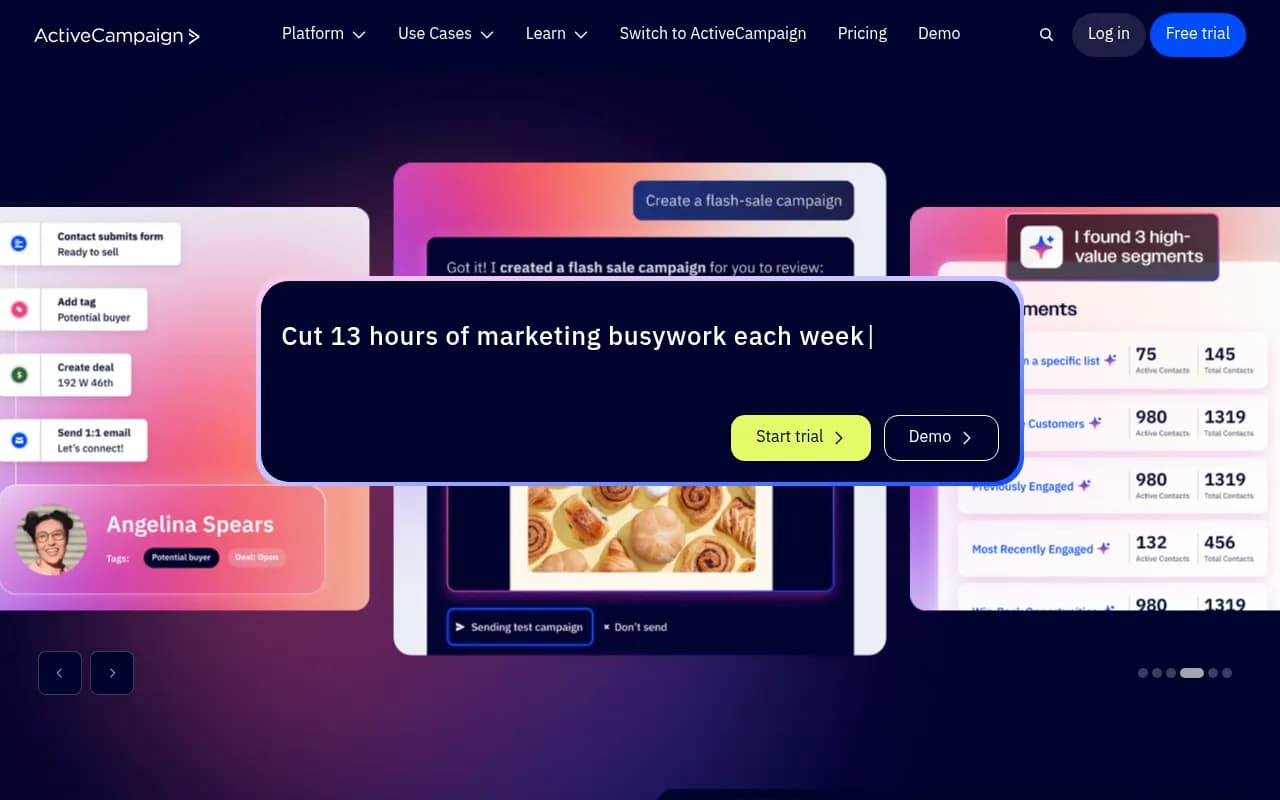
ActiveCampaign is a marketing automation and CRM platform. It handles email campaigns, SMS/WhatsApp messaging, workflow automation, lead scoring, segmentation, and deal tracking. The platform recently added "Active Intelligence" -- AI features that suggest segments, build campaigns, and generate insights from your data.
ActiveCampaign is built for marketers running nurture sequences, drip campaigns, and lifecycle automation. You design the workflows (or let the AI suggest them), set triggers based on behavior (opened email, visited pricing page, abandoned cart), and the platform executes. It's not autonomous in the 11x sense -- you're still building the campaigns and defining the logic. The AI helps with content generation, subject lines, and optimization recommendations.
Pricing starts at $15/month for 500 contacts (Starter plan), but most businesses need the Plus plan at $49/month for full automation and AI features. Pro is $79/month, Enterprise is custom. 14-day free trial, 30-day money-back guarantee. SMS and WhatsApp are pay-as-you-go add-ons.
Head-to-head comparison
Core use case
11x AI is purpose-built for outbound prospecting. Alice's job is to find people who match your ICP, research their company, write a personalized email explaining why your product matters to them specifically, send it, follow up 2-4 times, and book a meeting if they respond. This is classic SDR work -- cold outreach at scale with personalization.
ActiveCampaign is built for inbound and nurture. Someone fills out a form on your website, downloads a lead magnet, or signs up for a webinar. ActiveCampaign captures that contact, segments them based on behavior, and sends a series of emails over days or weeks to move them toward a purchase. It also handles post-purchase sequences, re-engagement campaigns, and lifecycle marketing.
Verdict: If you're doing outbound (cold email, LinkedIn outreach, prospecting into accounts), 11x is the tool. If you're nurturing inbound leads or running email marketing campaigns, ActiveCampaign is the tool. They don't overlap much.
Autonomy vs control
11x AI's agents are autonomous. You give Alice an ICP ("VP of Sales at Series B SaaS companies with 50-200 employees"), connect your CRM, and she starts working. She decides which prospects to contact, what to say, when to follow up. You review her work in a dashboard and approve or reject messages, but the default mode is autopilot. Julian (the phone agent) similarly handles calls without you scripting every response.
ActiveCampaign gives you control. You build the automation workflows, write the email copy, set the triggers, define the segments. The AI can suggest a campaign structure or write a subject line, but you're approving every step. This is traditional marketing automation -- you design the machine, the platform runs it.
Verdict: 11x is hands-off (which is the point -- you're outsourcing SDR work to an AI). ActiveCampaign is hands-on (you're the marketer, the platform is your execution layer). Pick based on how much control you want.
Personalization depth
11x AI's Alice researches each prospect individually. She reads the company website, recent news, LinkedIn profiles, and crafts a message that references specific details ("I saw you just raised a Series A" or "Your Q3 earnings call mentioned expanding into Europe"). This is 1:1 personalization at scale -- each email is unique.
ActiveCampaign personalizes using merge tags and conditional content. You can insert the contact's name, company, industry, or any custom field into the email. You can show different content blocks based on tags or segments ("If they're in healthcare, show this case study; if they're in fintech, show that one"). But you're not researching each contact individually -- you're segmenting them into groups and personalizing at the segment level.
Verdict: 11x wins on depth of personalization (true 1:1 research). ActiveCampaign wins on flexibility (you control exactly what gets personalized and how). For cold outreach, 11x's approach works better. For nurture sequences where you're working with known contacts, ActiveCampaign's approach is more practical.
Channel coverage
11x AI focuses on email and phone. Alice sends emails and LinkedIn messages (via integration). Julian handles phone calls. That's the stack.
ActiveCampaign covers email, SMS, WhatsApp, site messaging, and Facebook custom audiences. You can build omnichannel workflows that send an email, wait 2 days, send an SMS, wait 3 days, show a site popup. It's a broader channel set, but it's all inbound/nurture channels -- no cold calling, no LinkedIn automation.
Verdict: ActiveCampaign has more channels, but they're different channels. If you need SMS and WhatsApp for customer communication, ActiveCampaign. If you need AI-powered cold calling, 11x.
CRM and deal tracking
ActiveCampaign includes a built-in CRM with deal pipelines, contact management, lead scoring, and task automation. It's not Salesforce, but it's enough for small businesses that don't want to pay for a separate CRM. You can track deals, assign tasks to sales reps, and automate follow-ups based on deal stage.
11x AI integrates with your existing CRM (Salesforce, HubSpot, Pipedrive, etc.) but doesn't replace it. Alice logs all her activities in your CRM -- emails sent, replies received, meetings booked. She pulls data from the CRM to understand your ICP and avoid contacting existing customers. But you're not managing deals or contacts in 11x's interface.
Verdict: If you need a CRM and don't have one, ActiveCampaign gives you one. If you already have a CRM and just need an AI SDR to feed it with meetings, 11x integrates cleanly.
Pricing and ROI math
11x AI costs $5,000/month for Alice (3,000 contacts). That's $60,000/year. A human SDR costs ~$60k base salary plus $20k in benefits, tools, and management overhead -- call it $80k fully loaded. So Alice is cheaper than one SDR, but she's contacting 3,000 prospects/month (36,000/year). A human SDR might contact 1,000-1,500 prospects/month if they're good. Alice's volume is 2-3x higher.
ActiveCampaign costs $49/month for 500 contacts on the Plus plan (the one most businesses need). That's $588/year. For 10,000 contacts, you're paying ~$200/month ($2,400/year). For 50,000 contacts, ~$500/month ($6,000/year). It scales with list size, but it's dramatically cheaper than 11x because it's not replacing headcount -- it's automating workflows you'd otherwise do manually.
Verdict: 11x is expensive but justifiable if it replaces SDR hiring. ActiveCampaign is cheap because it's a tool, not a worker replacement. Different budget categories.
Setup and learning curve
11x AI requires a paid pilot (~$2,500 for 30 days) where you work with their team to define your ICP, connect your CRM, and train Alice on your messaging. After the pilot, you sign an annual contract. The onboarding is hands-on -- they're setting up a digital worker, not just giving you software access.
ActiveCampaign has a 14-day free trial. You sign up, import your contacts, and start building automations. The interface is intuitive if you've used any email marketing tool before (Mailchimp, HubSpot, etc.). They have templates for common workflows (welcome series, abandoned cart, re-engagement). You can be live in a few hours.
Verdict: ActiveCampaign is faster to start. 11x requires a pilot and onboarding because you're deploying an AI agent, not just configuring software.
AI capabilities
11x AI's agents are the product. Alice uses LLMs to research prospects, generate personalized emails, and decide when to follow up. Julian uses voice AI to handle phone conversations. The AI is doing the work, not just assisting you.
ActiveCampaign's "Active Intelligence" is AI-assisted automation. It suggests segments ("contacts who opened 3+ emails but didn't click"), generates email subject lines, writes campaign copy, and surfaces insights ("your open rates dropped 5% this month"). It's helpful, but you're still building the campaigns. The AI is a copilot, not the pilot.
Verdict: 11x is autonomous AI (the agent does the job). ActiveCampaign is assistive AI (the tool helps you do the job). Both are useful, but they're different paradigms.
Pros and cons
11x AI pros:
- Replaces SDR headcount with autonomous agents that work 24/7
- Deep 1:1 personalization (researches each prospect individually)
- Handles the full outbound motion (research, outreach, follow-up, booking)
- Integrates with existing CRMs (Salesforce, HubSpot, etc.)
- Backed by top-tier VCs (a16z, Benchmark) with strong product development
11x AI cons:
- Expensive ($5k+/month) -- only makes sense if you're replacing SDR hiring
- Annual contracts required (no month-to-month option)
- Limited to email and phone (no SMS, WhatsApp, or other channels)
- Requires a paid pilot before you can fully commit
- Not suitable for inbound nurture or marketing automation use cases
ActiveCampaign pros:
- Affordable ($49/mo for most businesses, scales with list size)
- Covers email, SMS, WhatsApp, site messaging, and Facebook audiences
- Built-in CRM with deal pipelines and lead scoring
- Flexible workflow builder with conditional logic and branching
- 14-day free trial and 30-day money-back guarantee (low risk to test)
ActiveCampaign cons:
- Not built for cold outbound (no prospecting, no AI SDR capabilities)
- AI features are assistive, not autonomous (you're still doing the work)
- Personalization is segment-level, not 1:1 research per contact
- Can get expensive as your list grows (50k contacts = $500+/mo)
- Learning curve for advanced automation (if you want complex workflows)
Who should pick which tool
Pick 11x AI if:
- You're doing outbound prospecting and need to scale without hiring more SDRs
- Your ICP is well-defined and you have a clear target account list
- You're willing to invest $5k+/month to replace or augment your SDR team
- You want autonomous agents that handle research, outreach, and follow-up
- You already have a CRM and just need pipeline generation feeding into it
Pick ActiveCampaign if:
- You're running email marketing campaigns or nurturing inbound leads
- You need a lightweight CRM with automation for small business or startup use
- You want to automate lifecycle marketing (welcome series, onboarding, re-engagement)
- You need multi-channel campaigns (email + SMS + WhatsApp + site messaging)
- You're working with a smaller budget and want a tool that scales with your list size
Pick both if:
- You're a mid-market or enterprise B2B company with both outbound and inbound motions. Use 11x for cold prospecting and meeting generation. Use ActiveCampaign for nurturing those meetings into opportunities and running post-sale lifecycle campaigns. They don't overlap -- they're complementary parts of the GTM stack.
Final verdict
11x AI and ActiveCampaign aren't competitors. They solve different problems for different parts of the revenue funnel. 11x is an AI SDR that generates pipeline through cold outreach. ActiveCampaign is a marketing automation platform that nurtures leads and manages customer communication. If you're trying to decide between them, you're probably asking the wrong question -- the real question is whether you need outbound prospecting (11x) or inbound nurture (ActiveCampaign). Most B2B companies eventually need both.