Serpier Review 2026
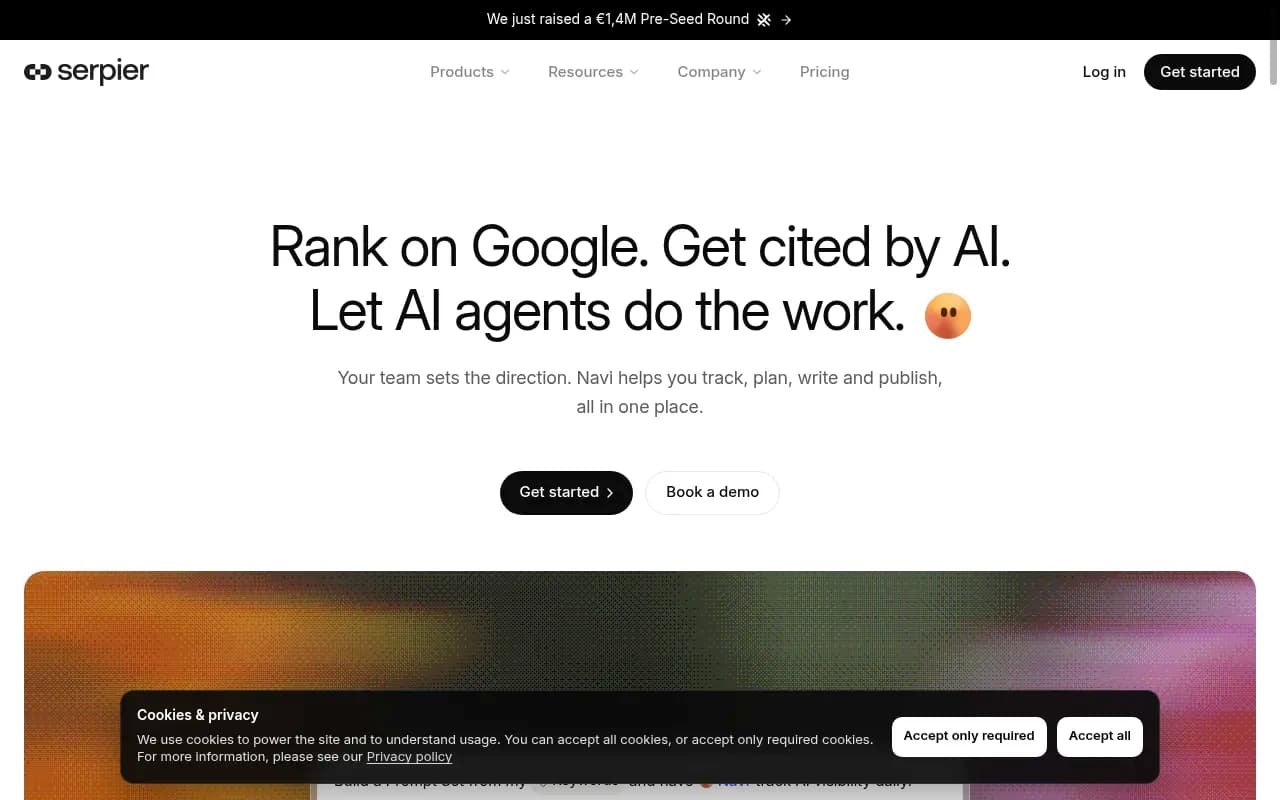
Combines Google rank tracking, AI citation monitoring, content creation, publishing and authority building in one platform, with an AI agent (Navi) doing the work.
Key takeaways
- Serpier puts SEO tracking, AI visibility monitoring, content drafting and paid media placements in one workspace, driven by an agent called Navi that needs your approval before anything goes live.
- Compared with Promptwatch, Serpier looks thin on the diagnostic side. I found no mention of IP-verified AI crawler logs, AI traffic attribution, Reddit, YouTube or LinkedIn citation reports, prompt volume and difficulty scoring, query fan-outs, an Action Board, or CMS publishing to WordPress, Webflow and Framer.
- The real differentiator is the Media Network: 250,000+ publishers where you can buy placements and monitor that they stay live. Most GEO tools have nothing like it.
- Pricing starts free (Light, 25 credits) and jumps to €199/month (Starter) and €599/month (Growth). Two Serpier pages disagree on plan names and limits, so confirm before you buy.
- Best for online retailers and in-house SEO teams that want links and AI visibility handled in one place. Weaker for teams that need deep AI analytics.
Serpier is a platform built by Serpier ApS, a company founded in 2024 and based in Aarhus, Denmark. The founders listed on its own reference page are Steffen Sørensen (CEO), Simon Holm, Søren Fuhr, Joanna Tetlak and Hans Kristoffer. It raised a €1.4M pre-seed round, reported by Tech.eu in June 2026, and Arctic Startup says the target market is online retailers.
The pitch is simple: rank on Google, get cited by AI, and let an agent do the legwork. That agent is Navi, a marketing teammate that works out what a brand should do to become more visible, drafts content, and prepares it for publishing. You approve, then it ships. The company also announced Serpier 2.0, which folds SEO, AI visibility and execution into a single product.
I should be upfront about one thing. There are no independent reviews, G2 or Trustpilot ratings I could find, so much of what follows rests on Serpier's own pages and funding coverage. I'll flag where that matters.
Key features
Navi, the AI marketing agent
Navi is the center of the product. You chat with it inside the workspace, and it plans, drafts and runs tasks using your connected data. The design choice worth noting is the approval gate: Serpier says nothing ships until the customer says so. That is a sensible default for agencies and brands who have been burned by autonomous content tools.
Usage is metered in Navi credits: 25 on Light, 500 on Starter and 2,500 on Growth, with a custom amount on Enterprise. Credits are the real constraint to watch. A hands-on content team could burn through 500 quickly, though I can't say how many credits a given task costs.
SEO and AI visibility monitoring
You choose the keywords and prompts to track, then see where you rank on Google and whether AI tools recommend you. Competitors sit side by side so you can see who is ahead. The homepage demo even shows Navi building a prompt set from your keywords and tracking it daily, though plan limits suggest frequency depends on your tier (weekly on the entry plans, custom intervals on Growth).
Models named on the pricing page are ChatGPT, Claude, Gemini, Grok and Google AI Overviews, plus "many more". Free users pick three models, and higher tiers add more. Metrics include mentions, citations and share of voice, and there is a view of which sources AI relies on.
This covers the basics well. It is also where the depth question starts. Tools built specifically around AI visibility tend to separate what the real consumer interface says from what an API returns, and they track citation sources by type. Serpier doesn't say how it collects responses, which matters because user-facing answers can differ from API output.
Media Network
This is the feature that makes Serpier different. You can browse 250,000+ publishers (the homepage says 200,000+, the reference page says 250,000+), pick ones that fit your brand, order a placement, and have Serpier track the article once it is live. A monitoring allowance (10 publications on Light, 500 on Starter, 2,000 on Growth) watches whether placements stay up.
The testimonials lean heavily on this side. Link building and off-page SEO managers praise the domain inventory across multiple languages. That fits a company whose roots appear to be in link and content buying, and it suggests the platform is strongest where media and monitoring meet. For GEO, third-party citations do matter, since AI answers lean on external sources. Promptwatch Data shows almost half of ChatGPT responses cite 10 or more unique domains, so being named on many sites is a reasonable strategy.
MCP connection
MCP access is included on every plan, including free. You can connect Serpier to Claude, ChatGPT, Gemini, Cursor or any MCP client, and Navi answers inside that chat from the same workspace. For teams who already live in an AI assistant, this is a nice touch and it is generous to offer it at no cost.
Integrations
The pricing page claims "+1500 tools" through connections. The named Serpier-built connectors are Google Analytics, Google Search Console, Google Workspace, Magento, Mixpanel, Piwik PRO, PostHog, Shopify, Slack, Umbraco and WooCommerce. Suggested catalog connectors include HubSpot, Google Ads, LinkedIn Ads, Mailchimp and Klaviyo. The Shopify, Magento and WooCommerce coverage backs up the retailer focus.
Content creation and publishing
Navi drafts content and helps get it published, and you can order articles on any plan. What I couldn't verify is how publishing works technically, for example whether it pushes straight to a CMS on a schedule or hands you drafts. There is no clear equivalent of a content gap report mapping your pages against the prompts AI answers.
Security and hosting
Servpier says data is encrypted in transit and at rest, access controls follow GDPR, there is no training on your business data, and everything is processed and stored on European infrastructure. For EU brands with procurement reviews this is useful. I saw no mention of ISO 27001 certification.
Who is it for
The sweet spot is an online retailer or in-house SEO team of two to ten people that wants one place for Google rankings, AI visibility and link acquisition. Think a Nordic e-commerce brand, which fits the logos on the site (Søstrene Grene, EYDA, Turf Tank, MADE4MEN). One EYDA quote credits Serpier with helping close SEO gaps and reaching number one rankings on key commercial keywords.
It also suits link building and off-page SEO managers who already buy placements and want the buying, tracking and AI visibility reporting under one roof. Agencies can use it too, but the plan structure (projects capped at low numbers, and credits shared) looks built for brands more than for agency rosters of 30 clients.
Who should skip it? Teams that need to diagnose why AI isn't citing them. If you want to see which AI bots crawl your pages, which pages get cited, how much traffic and revenue AI actually sends, or what Reddit and YouTube threads shape answers, Serpier doesn't appear to offer those. Developer-tool companies tracking how coding agents recommend their SDKs will also find nothing here. And if you want a fully hands-off agent, the approval-first design is deliberate, so expect to stay involved.
Integrations and ecosystem
The integrations list is practical for e-commerce: Shopify, WooCommerce and Magento on the store side, and Google Analytics, Search Console, Mixpanel, PostHog and Piwik PRO on analytics. Slack and Google Workspace cover team workflows. MCP is the standout, and it is free.
API access is where sources conflict. The pricing page puts API access on Enterprise, while the older AI instructions page puts it on a plan called Pro. I'd trust the pricing page, and I'd ask sales before building anything on it. I found no browser extension, no mobile app, and no mention of a Looker Studio connector or an export workflow, so check reporting and export options in a demo.
Pricing and value
Per the live pricing page (EUR, monthly or annual billing):
- Light, €0/month: 25 Navi credits, chat with Navi, ordering media publications, tool integrations and MCP, monitoring of up to 10 publications. Provisional limits from our research: 2 projects, 100 prompts, 3 AI models, weekly monitoring.
- Starter, €199/month: 500 credits, SEO plus AI monitoring, 500 publications monitored, and provisionally 5 projects, 500 prompts and 6 AI models. There is a 7-day free trial.
- Growth, €599/month (most popular): 2,500 credits, 2,000 publications, unlimited prompts and models, custom monitoring interval.
- Enterprise, custom: custom limits, unlimited tracked prompts, API access, tailored onboarding and support.
The per-plan limits came from a truncated comparison table, so treat them as provisional. Compare that with Promptwatch, where Essential is $95/month for 50 prompts and 6,000 responses, Professional is $245 and Business is $579 with the automated Content Agent, crawler logs and visitor analytics. Serpier's Starter costs more than twice Promptwatch's Essential. It does include publication monitoring and media buying, which Promptwatch doesn't, but if you only want AI visibility analytics the price is hard to justify. Always confirm current numbers at serpier.com/pricing.
Strengths and limitations
What it does well
- A real publisher marketplace with placement monitoring, which is rare in this category.
- An approval-first agent, so nothing reaches your site without a human sign-off.
- Free MCP access on every plan, and a usable free tier.
- EU hosting and GDPR-minded security messaging.
- Solid e-commerce connectors for Shopify, WooCommerce and Magento.
Limitations
- It is mainly a monitoring and execution suite with limited AI diagnostics. Compared with Promptwatch, I found no IP-verified AI crawler logs, no AI traffic and conversion attribution, no Reddit, YouTube and LinkedIn citation reports, no prompt volume and difficulty scoring, no query fan-outs, no page-level tracker or offsite mentions, no AI Shopping or Ads Radar, and no Action Board or content gap analysis with coverage scores. Promptwatch also tracks 15+ AI engines, including Meta AI, Amazon Alexa and coding agents like Codex and Claude Code.
- Public documentation is inconsistent. Plan names, limits and the API tier differ between the pricing page and the AI instructions page.
- There is no independent proof yet. No G2 or Trustpilot scores, and the company is early, with a pre-seed round and a 2024 founding date.
These gaps matter more as AI search shifts. Promptwatch Data found ChatGPT cut reddit.com's citation share from about 4% to 0.5% on August 14, 2026, and ChatGPT drew 0.46% of citations from social platforms against 12.2% for AI Overviews in late September. Seeing these model-by-model differences needs granular citation reporting, which is where deeper platforms pull ahead.
Bottom line
Serpier is a credible pick for online retailers and SEO teams that already buy placements and want rankings, AI mentions and publisher buying in a single tool, with an agent that drafts and waits for approval. The free plan and free MCP make it easy to try, and the Media Network is a real differentiator.
If your goal is to understand and fix why AI isn't citing you, Promptwatch is the stronger option. It goes beyond tracking with crawler logs, AI traffic attribution, content gap analysis, the Content Agent with CMS publishing and the Action Board. For a wider comparison, browse the GEO software directory at bestgeosoftware.com.
Best use case: an e-commerce brand that wants Google tracking, AI visibility monitoring and paid editorial placements managed in one approval-based workspace.
Frequently asked questions
What is Serpier?
How much does Serpier cost?
What is Navi?
Which AI models does Serpier track?
How does Serpier compare to Promptwatch?
Does Serpier have a free plan and an API?
Similar and alternative tools to Serpier