Seomator Review 2026
Crawls sites to flag technical SEO issues and tracks changes over time. Suited to agencies and site owners who want recurring audit reports.
Key takeaways
- SEOmator has changed from a classic audit crawler into an "AI SEO Manager for B2B SaaS": it diagnoses, audits, drafts fixes, ships them after approval, then measures the result in Google and AI answers.
- Its strongest asset is a 172-check free audit and a free MIT-licensed CLI with 365 rules. Both are useful without paying anything.
- Pricing is usage-based with unlimited seats: free, then $49, $99 and $249 a month, plus credits for one-off jobs.
- Compared with Promptwatch, it covers only ChatGPT, Gemini and Google AI Mode for prompts, and lacks IP-verified AI crawler logs, AI traffic attribution, Reddit/YouTube/LinkedIn citation tracking, AI Shopping and Ads Radar, prompt volumes and difficulty scoring, and query fan-outs.
- Caveats: the trial buttons point to a waitlist, customer proof is self-reported, and I found no independent reviews beyond G2 quotes the vendor selected.
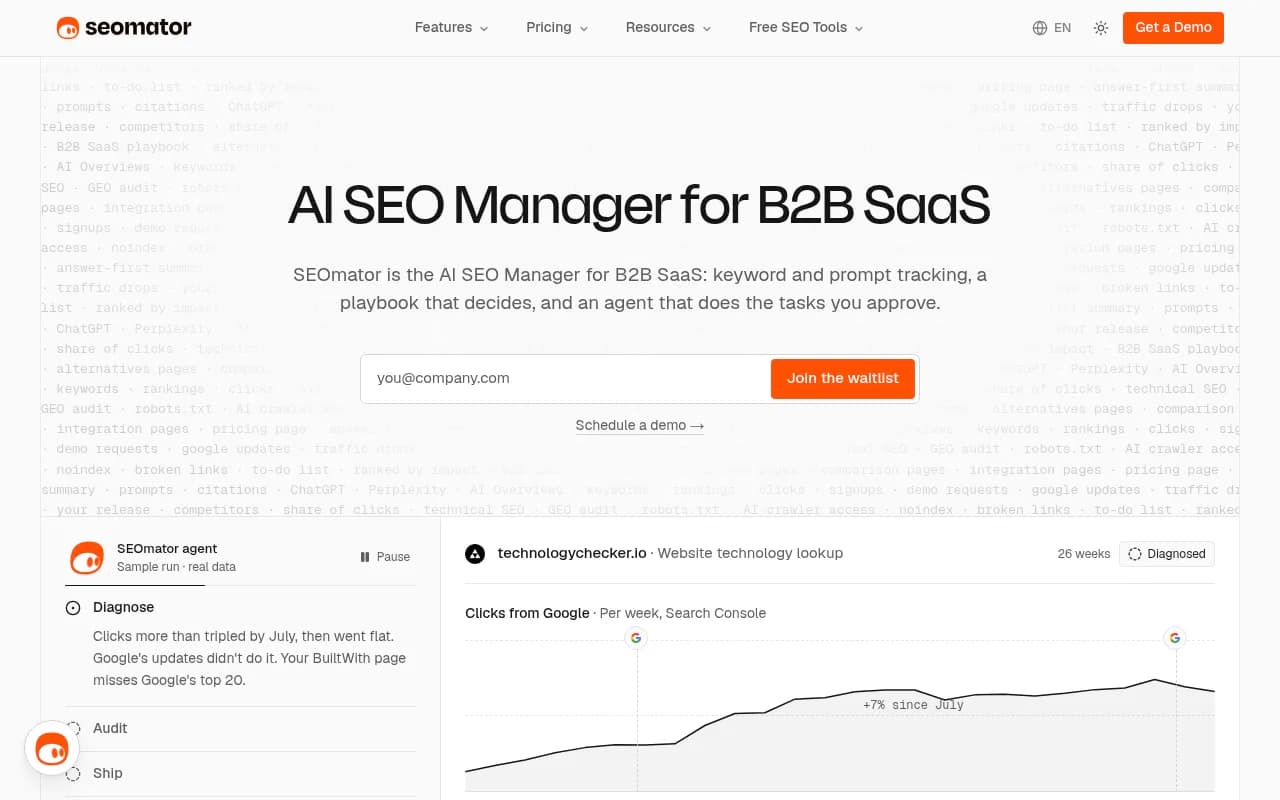
SEOmator is an SEO platform founded by Emre Elbeyoglu, who also co-founded the agency Flatart. For years it was known as a website audit tool: crawl a site, score it, produce a PDF. In October 2026 the homepage describes something different, an AI SEO Manager for B2B SaaS that combines keyword and prompt tracking, a playbook that decides what to work on, and an agent that does the tasks you approve.
The pitch is aimed at a real frustration. Teams buy an SEO suite, run an audit, and the fixes sit in a backlog because nobody knows which one brings signups. SEOmator's answer is to rank findings by impact and focus the agent on revenue pages: integrations, alternatives, comparisons and pricing pages. The founder says he has done B2B SaaS SEO for more than 16 years, and the playbook is meant to encode that.
That is a bold repositioning, and I would treat it with some caution. The product is clearly early. The trial buttons lead to a waitlist, and the homepage says "Join the waitlist", so access may be gated.
Key features
Diagnosis of traffic and ranking problems. The homepage sample run, on the client site technologychecker.io, shows the idea. The agent reads Search Console clicks over 26 weeks, checks whether Google's May and September updates explain the movement (in the sample, clicks moved under 7% around each, so "not the cause"), and then points at a specific page, a BuiltWith alternatives post sitting outside Google's top 20 for its own term. Diagnosis costs 4,500 credits ($4.50) with Search Console connected, 6,250 without, and 8,750 after a traffic drop of 25% or more. The company is careful to say recovery isn't guaranteed.
Audits for Google and AI answers. The audit runs technical checks first, then content checks per page. The sample lists issues like 29 sitemap URLs still dated June 2025, 79+ character titles on 474 pages and 570 KB of HTML per page. Findings are ranked by what each costs you rather than dumped alphabetically, which is the part most audit tools get wrong.
Keyword and prompt tracking. Prompts are asked daily on ChatGPT, Gemini and Google AI Mode. Google keywords are tracked along with AI Overviews. Each answer is parsed for the brands named and the pages cited. The dashboard reports visibility, position and citation rate per brand, plus the most-cited domains. In the sample, the client is #2 on Google for its main term yet appears in 12% of AI answers against BuiltWith's 98%. Showing that gap is useful. The homepage also lists Claude, Copilot and Perplexity as measured surfaces, but the pricing page names only three engines for prompts, so check coverage before buying.
Approval-gated execution. This is the headline. You connect a CMS (WordPress, Webflow or Shopify), the agent drafts a change, shows it in full, and publishes only after you approve. The task log in the demo reads: picked from the playbook, draft written with schema and six internal links, you approved, published to Webflow, tracking rankings and AI citations since publish. Auto-publish can be turned on for low-risk fixes. A fix draft costs 2,250 credits ($2.25), a new page 4,500 ($4.50).
Off-site work. The agent also handles entity stacking, content distribution and pitching roundups that AI answers already cite without you. Earned links and mentions are a bigger deal in the done-for-you packages. I would want to see real output here before trusting it, because off-site work is where automation tends to look better in demos than in practice.
Free audit tool. The web audit runs 172 checks, scores AI visibility and returns a PDF in about 30 seconds, with no account or email. G2 reviewers quote the PDF export on the free tier and the free competitor keyword research with country and language selection.
Open-source audit engine. The CLI (@seomator/seo-audit, v5.1.0 on 15 October 2026) checks 365 rules across 20 categories, including AI-crawler access and Core Web Vitals. It ships as a CLI, a Claude Code skill, a local dashboard (seomator serve) and an Electron desktop app built from source. It runs in CI, and seomator compare diffs audits. Limits are stated plainly: lab Core Web Vitals only, no INP. The GitHub repo had 531 stars and 69 forks in mid-October, and the founder made 253 of 254 commits, so this is effectively a solo project.
Ask from where you work. You can reach the agent through the web app, Claude, ChatGPT, Telegram or MCP. A Data API is mentioned on the pricing page, though I could not confirm its scope.
Who is it for
The sweet spot is a B2B SaaS marketing team of one to five people, say a growth lead at a 20-person startup with a comparison-page backlog and no SEO hire. The checks assume buyers search category terms, alternatives, integrations and pricing, and the platform is explicit that it is for SaaS only. Unlimited seats help when founders, content people and developers all need access.
Developers and technical SEOs get value from the free CLI and the Claude Code skill. Running an audit in CI before a deploy is a neat use that needs no subscription.
Agencies should look carefully. White-label reports are listed as coming after launch, and Scale includes monthly diagnosis for only 10 projects. The legacy positioning as an agency audit tool no longer matches the product. Ecommerce, local, media and health sites should also look elsewhere, since the playbook is tuned to SaaS. Teams that need deep prompt volumes, crawler logs or traffic attribution from AI platforms will find the analytics thin.
Integrations and ecosystem
Confirmed publishing targets are WordPress, Webflow and Shopify. Google Search Console is used for diagnosis and is clearly central. I could not verify other integrations such as Bing Webmaster Tools, Slack or analytics connectors.
On the developer side the picture is better than average: an MIT-licensed audit engine on GitHub, an npm package with roughly 29,000 downloads in total, an installable Claude Code skill, MCP access and a Data API (paid with bought credits only). Exports include PDF audit reports. Tom Dörr shared the repo on X on 21 May 2026, which gives a sense of its developer traction.
Pricing and value
Pricing is usage-based. Plans include daily tracking, credits cover the rest, and seats are unlimited on every tier. Confirm numbers at seomator.com/pricing.
- Free, $0: 10 AI prompts and 25 Google keywords daily, 1 project, one first diagnosis, 1,000 credits a month, 30-day history, help center support.
- Starter, $49/mo: 40 prompts, 100 keywords, unlimited projects (monthly diagnosis for 1), 10,000 credits, email support.
- Growth, $99/mo: 120 prompts, 200 keywords, monthly diagnosis for 3 projects, 20,000 credits, priority email. Labelled for B2B SaaS teams.
- Scale, $249/mo: 320 prompts, 400 keywords, diagnosis for 10 projects, 30,000 credits, onboarding call.
- Enterprise: custom, with SSO, invoices, a named expert and an SLA.
Yearly billing gives two months free. Paid plans have a 14-day trial with no card, and on day 14 you pick a plan or stay on Free with nothing deleted. Credits cost $1 per 1,000 and bought credits last 12 months. Done-for-you packages run $2,500 a month (Momentum: 10 pages, 6 earned links) or $5,000 a month (Accelerate: 25 pages, 20 links), each with a 3-month minimum.
The per-prompt cost is $1.23 on Starter, $0.82 on Growth and $0.78 on Scale by the vendor's math. That is competitive against dedicated AI trackers, and you get a Google keyword tracker and audits in the same price. The catch is credits: every diagnosis, page and project adds up, so budget beyond the sticker price.
Strengths and limitations
Strengths
- The free audit and open-source CLI are generous, and 365 rules is serious coverage.
- Impact-ranked findings and explanations ease the backlog problem.
- Approval before publishing is the right default for an agent touching production sites.
- Unlimited seats and transparent credit prices make costs predictable.
- Combining Google keyword tracking and AI prompt tracking in one task list is practical for SaaS teams.
Limitations
- Customer evidence is self-reported, and the figures on the pricing page look inconsistent (the same click count appears for two different periods), so treat claims cautiously. The Flatart case is not independent, since the founder co-founded the agency.
- Access appears waitlisted, and I found no independent reviews beyond G2 quotes the vendor chose.
- It is built for B2B SaaS only.
What it lacks versus Promptwatch
SEOmator tracks prompts on three engines and parses answers for brands and citations. Promptwatch goes further in the following ways:
- IP-verified AI crawler logs and crawl-to-citation tracking, which show why AI does or doesn't read your pages.
- Visitor analytics that attribute real traffic and conversions from AI platforms.
- Reddit, YouTube and LinkedIn citation reports, plus offsite mentions and page-level tracking.
- Prompt volumes, difficulty scores, query fan-outs and persona-based prompts.
- AI Shopping (ChatGPT, Amazon Alexa) and Ads Radar.
- Real-UI tracking across 15+ engines, including Meta AI and coding agents like Codex and Claude Code.
- A Content Agent with scheduled CMS publishing, Agent Chat, a prioritized Action Board and Google plus Bing search data layered on AI data.
Promptwatch also has ISO/IEC 27001 certification and 1,840+ customers. SEOmator is much newer in this area and its AI measurement is shallower.
Bottom line
SEOmator suits small B2B SaaS teams that want one agent handling audits, keyword tracking and approved page fixes, and developers who like a free, open-source audit engine. Start with the free audit and CLI before spending anything.
If your priority is AI visibility with crawler data, traffic attribution and broader engine coverage, Promptwatch is the stronger choice because it optimizes and measures, not just monitors. For a wider look at the category, the GEO software directory at bestgeosoftware.com is a good next stop.
Best use case: a SaaS team with a backlog of comparison and alternatives pages that wants approved fixes drafted and shipped to Webflow or WordPress.
Frequently asked questions
What is SEOmator?
How much does SEOmator cost?
Is there a free version or trial?
Does SEOmator change my site without approval?
Is SEOmator open source?
How does SEOmator compare with Promptwatch?
Similar and alternative tools to Seomator