RankSpot Review 2026
AI SEO tool that spots content opportunities and publishes to WordPress, Webflow, Wix, Shopify, Framer and Ghost, for teams without a big content staff.
Key takeaways
- RankSpot bundles AI visibility tracking, keyword research and automated article publishing into one $99/month plan, which makes it unusually cheap for what it covers.
- It is built for small businesses and solo founders with no SEO staff. The site claims 50+ customers, so the track record is thin and mostly self-reported.
- Compared with Promptwatch, it lacks IP-verified AI crawler logs, AI traffic attribution, prompt volumes and difficulty scoring, Reddit/YouTube/LinkedIn citation reports, AI Shopping and Ads Radar, and deeper site audits.
- Content is generated at volume (up to 30 articles a month), so quality control depends on how much you use the review queue.
- A 3-day free trial and a stated full-refund guarantee lower the risk of trying it.
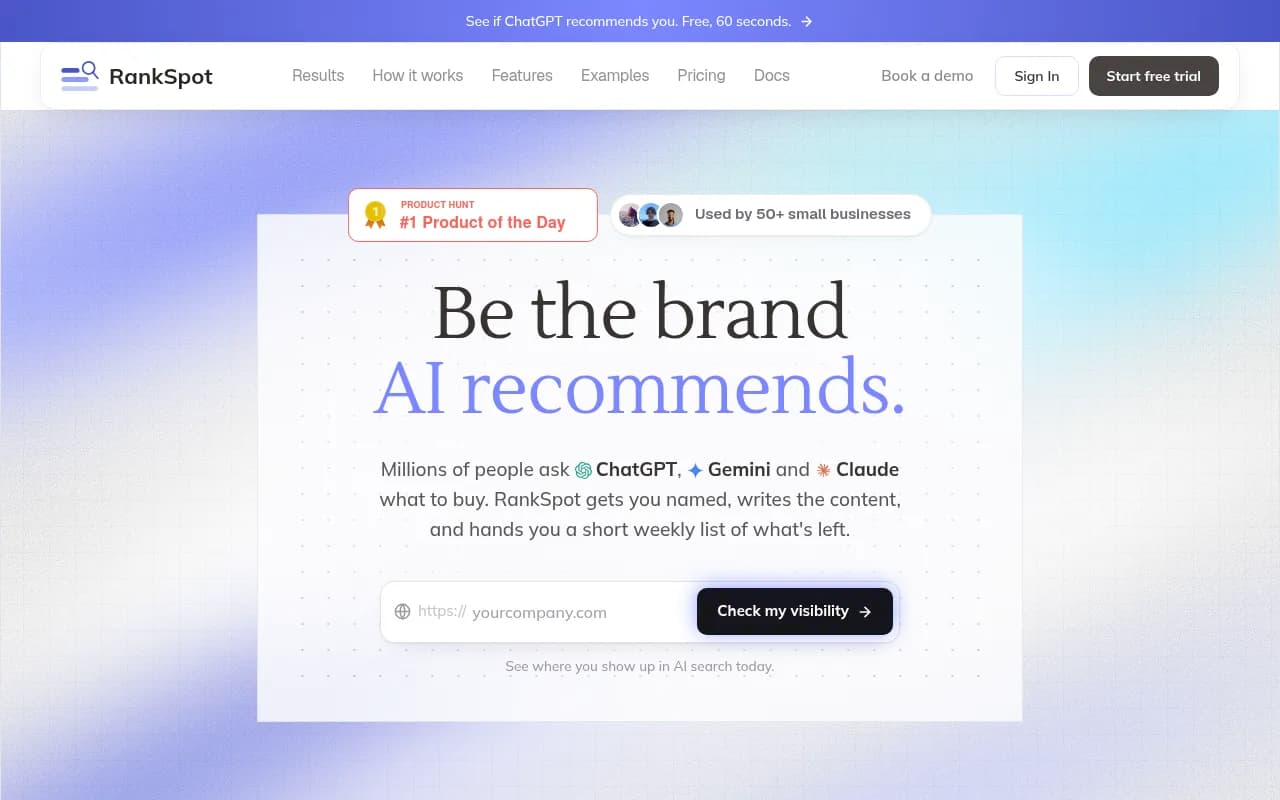
RankSpot is an AI SEO and AI-search visibility product from a small independent team. The founder named on the company blog is Daniil Poletaev. It reportedly launched in May 2026 (one YouTube review is the only source for that date) and was listed on Product Hunt as an AI SEO blog agent driven by competitor intelligence. The pitch is simple: measure whether ChatGPT, Claude, Gemini and Google AI name your brand, write the content that closes the gaps, publish it to your CMS, and hand you a short weekly list of the things only a human can do.
The target buyer is the founder or marketer who knows organic traffic matters but has no time or budget for an agency. RankSpot's own FAQ says agencies charge $1,000 to $5,000 a month for similar work. That is a marketing claim, but the contrast explains the product's positioning. You paste in your URL, RankSpot works out your niche and competitors, suggests the questions buyers ask AI assistants, and builds a content plan you approve once.
What stands out is the combination. Most AI visibility tools stop at dashboards. Most AI writers have no idea what AI engines currently cite. RankSpot tries to join both halves for a price closer to a writing tool than an enterprise platform.
Key features
AI visibility tracking. RankSpot runs your tracked prompts daily across ChatGPT, Perplexity, Google AI Overviews and Google AI Mode, and the marketing copy also names Claude and Gemini. It reports four numbers: visibility score (share of tracked prompts where you appear), share of voice, citation share (how often your own domain is the linked source) and category rank. A leaderboard shows who owns the answers in your category. The plan includes 50 tracked questions.
Prompt discovery. On day one the tool reads your site and proposes the questions people ask AI assistants about your category, grouped by intent and ranked by value to you. You can open any question to see which brands get named. It is a useful shortcut for people who would otherwise guess at prompts. What I could not find is monthly prompt volume or difficulty scoring, which some competitors provide.
Competitor gap analysis. RankSpot lists the exact questions where competitors are cited and you are not, refreshed weekly, and writes content for the biggest gap first. The API exposes fan-out queries, meaning the web searches the engines ran, and uses them to find content gaps. Up to five competitors are monitored on the plan.
Article generation and publishing. This is the core of the product. Articles come with headings, tables, embedded YouTube videos, internal and external links and sources. You can generate up to 30 a month, edit each in a built-in editor, and approve them through a review queue, or let them publish automatically. Publishing targets are WordPress (there is a free plugin on WordPress.org, listed May 2026), Webflow, Wix, Shopify, Framer and Ghost. Articles can be written in 100+ languages, which the site says are written for the local market rather than translated.
Weekly action list. RankSpot generates 5 to 10 tasks a week that software cannot do alone: getting listed on roundups AI already cites, claiming directory listings, refreshing a slipping comparison page, connecting accounts. Each item has a link and a reason. It promises under an hour of your time weekly. This is a smart design choice, because most AI visibility work ends up being off-site.
Cited source and forum opportunities. The tool identifies which roundups, directories, Reddit and Quora threads are cited in your category and watches which ones earn you mentions. A customer testimonial specifically calls out Reddit links as a big help. The API also surfaces competitor and own backlinks with domain rank, spam score and outreach status.
Keyword research and Google rankings. Thousands of keywords are scored by relevance, competition, volume and 12-month trend, then turned into articles. Search Console connects in one click, so clicks, impressions and position sit next to AI mentions in one dashboard. That unified view is a real convenience for small teams.
MCP server and API. RankSpot offers an MCP server so Claude, ChatGPT, Cursor or n8n can query your live visibility data in plain English, included on every plan. There is also a REST API at api.rankspot.ai/v1 with bearer-key auth, plus an open-source agent skill on GitHub installed via npx. Live Google search and page fetch through the API cost credits per call, so heavy API use may cost beyond the flat fee.
Who is it for
The sweet spot is a solo founder or two-to-five-person team running a SaaS product, a niche content site, a directory or a small ecommerce store. People like the customers quoted on the site: a founder with a decent domain rating but no time for articles, a director launching a hyper-niche site, or an owner starting on a brand-new domain. If you would otherwise publish one post a month, going to daily is the main draw.
It also works for small agencies or operators managing several sites. Volume discounts apply automatically (10% off for 2 to 4 sites, 15% off for 5+), and you can manage separate content plans per website. Multilingual publishers get an edge from the 100+ language support.
Who should skip it? Enterprise marketing teams that need prompt volume data, crawler log analysis, SSO, audit trails and deep reporting will outgrow it. Brands with strict editorial standards should be cautious about auto-publishing machine-written articles, though the review queue helps. And anyone who needs to prove AI-driven revenue, with traffic and conversions attributed per AI platform, will find the measurement here focused on mentions and Google Search Console rather than visitor analytics.
Integrations and ecosystem
- CMS publishing: WordPress (official plugin), Webflow, Wix, Shopify, Framer, Ghost and others.
- Google Search Console: one-click connection for clicks, impressions, CTR and position.
- MCP server: works with Claude, ChatGPT, Gemini, Perplexity, Cursor and n8n.
- REST API: covers tracked prompts, cited pages, fan-out queries, keyword scoring and clustering, backlinks, Reddit and Quora opportunities, People Also Ask mining, Search Console data and articles delivered as HTML. The API has no built-in period comparison, and scores return null when there is no data.
- Agent skill: an open-source skill on GitHub needing only curl and jq.
- Docs: a documentation section exists on the site. I did not find a Looker Studio connector, Slack integration or a white-label client portal.
Pricing and value
RankSpot sells one plan called All-in-One at $99 a month, shown against a struck-through $149 list price. It includes 50 tracked questions, 30 articles a month, a weekly priorities list, up to 5 monitored competitors, backlink, directory and forum opportunities, Google rank tracking, the built-in editor, 100+ languages, CMS publishing and MCP access. There is a 3-day free trial (3 articles plus 50 prompts tracked), cancel-anytime billing and a stated 100% satisfaction guarantee with a full refund if you do not see results or do not use it.
One oddity: the affiliate page lists Starter $39, Growth $79 and Premium $149 tiers that do not match the single $99 plan. One of them is probably stale, so confirm on the pricing page before buying.
On value, $99 is cheap. For comparison, Promptwatch starts at $95/month for Essential (50 prompts, 6,000 responses, all models, site audit, crawler-aware insights and API), and its content tools scale up through Professional at $245 and Business at $579. Pure writing tools like AirOps or Jasper do not include citation tracking at all. RankSpot's price-to-scope ratio is its best argument. The trade-off is depth of data.
Strengths and limitations
Strengths
- Measure-then-publish loop in one tool. Gap detection, writing, publishing and re-measurement happen in one product at a low flat price.
- Weekly action list. The human-only tasks, such as directory listings and roundup placements, are where AI citations are often won, and RankSpot prioritizes them for you.
- Broad CMS and language coverage. Six named CMS targets and 100+ languages cover most small-business stacks.
- MCP and API access on every plan. Querying your data from Claude or ChatGPT without extra seats is a nice touch.
- Low-risk trial. Three days free plus a refund guarantee.
Limitations
- Thin track record. Fifty-plus customers, one rating on the WordPress plugin and no independent reviews I could find. Results shown on the site are customer-reported.
- Volume over editorial depth. Up to 30 auto-generated articles a month can raise quality and duplication risks if you skip review.
- Single plan. No higher tiers for more prompts, projects or seats, so growth means paying per additional site.
What it lacks compared with Promptwatch
RankSpot is a direct competitor to Promptwatch, and the gaps are specific. I found no evidence of these capabilities:
- IP-verified AI crawler logs and crawl-to-citation tracking
- AI traffic and conversion attribution through visitor analytics
- Prompt volumes and difficulty scoring
- Reddit, YouTube and LinkedIn citation reports, plus offsite mentions detection
- AI Shopping (ChatGPT, Amazon Alexa) and Ads Radar
- Weekly site audit with a health score, page-level tracking and a Page Tracker
- Agent Chat, a prioritized Action Board with a Discovery agent, and Content Refresh with diffs
- Coverage of 15+ AI engines through real user interfaces, including Codex and Claude Code
- Looker Studio, Slack and white-label agency reporting
RankSpot tracks four platforms and is lighter on measurement. Promptwatch is built on 4.5B+ analyzed citations and has 1,840+ customers.
Bottom line
RankSpot is a sensible pick if you are a small team that wants cheap, hands-off content publishing driven by AI-search gaps, and you are happy to trust a young product. Run the free trial, review the first articles closely, and check whether mentions move in the 4 to 8 weeks the company suggests.
If you need to know why AI does or does not cite you, which crawlers visit your pages, and what traffic AI sends, look at Promptwatch instead. It goes beyond monitoring with the Content Agent, Action Board and page-level tracking. For a wider comparison of tools in this category, the directory at bestgeosoftware.com is a good starting point.
Best use case: a bootstrapped founder who wants daily SEO and AI-search content published automatically for $99 a month.
Frequently asked questions
What is RankSpot?
How much does RankSpot cost?
Which CMS platforms does RankSpot publish to?
Can I edit articles before they publish?
How does RankSpot compare to Promptwatch?
Is there a free trial?
Similar and alternative tools to RankSpot