OpenLens Review 2026
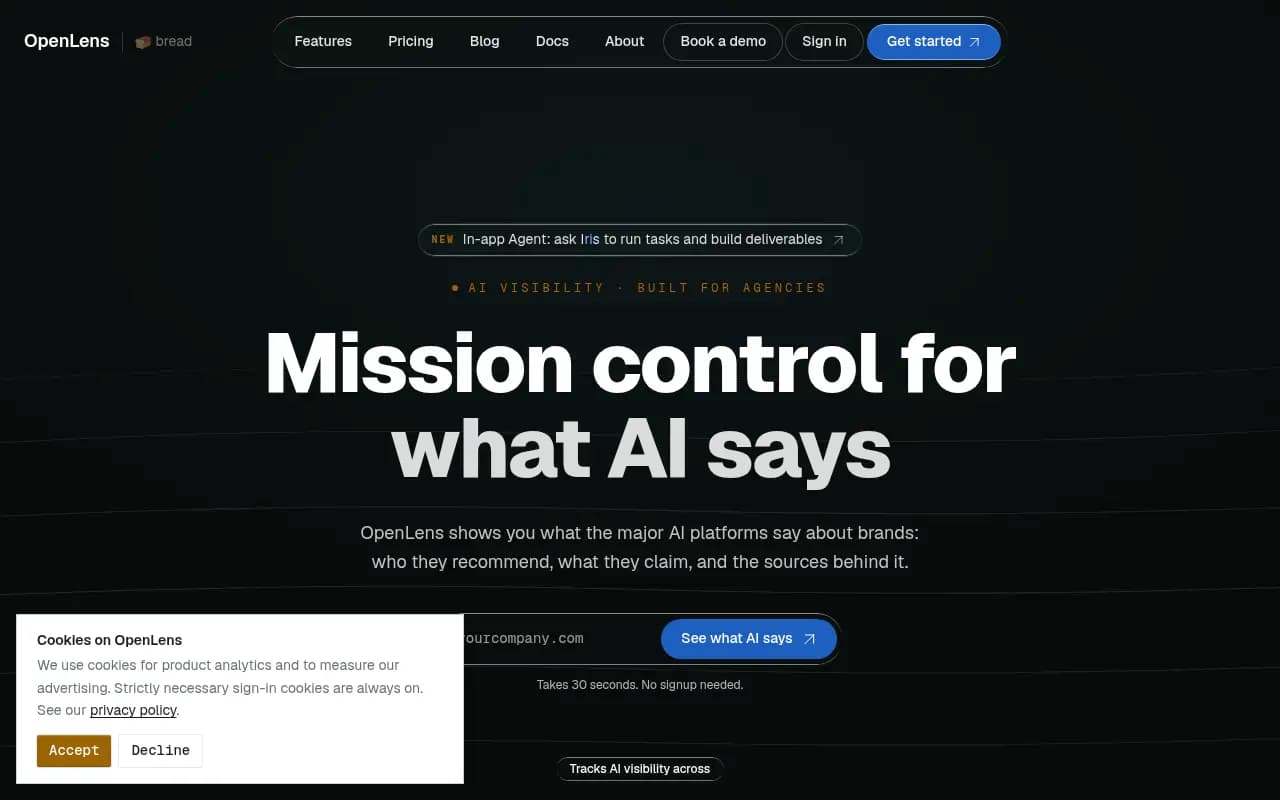
OpenLens monitors prompts across ChatGPT, Perplexity and Google AI, reporting visibility scores, share of voice, average position and mentions at the topical level rather than per prompt. Its free plan includes 2 seats, 3 projects and 1,000 monthly credits, plus MCP and API calls for integrating with your own AI agents. GEO audit tools like AI Indexing, Site Readiness and Content Audit help explain why you are or aren't being mentioned.
Key takeaways
- OpenLens is one of the most generous free tiers in AI visibility tracking: 2 seats, 3 projects, 1,000 monthly credits, weekly and monthly tracking across ChatGPT, Perplexity and Google AI, plus 50 MCP and 100 API calls per month. No credit card, no sales call.
- Agency-focused by design, with unlimited free client logins, a 100-projects-per-seat cap on the Agency plan, and per-topic reporting that reads more like a client deliverable than a raw prompt tracker.
- Monitoring-only with an assist from Iris, the in-app agent: it can run tasks and build deliverables, but OpenLens lacks AI crawler logs, content gap analysis with automated publishing, Reddit and YouTube citation tracking, ChatGPT Shopping tracking, and AI traffic attribution that Promptwatch offers.
- Pricing is credit-based, which keeps the entry point low ($39.99/mo Starter, $299.99/mo Agency) but gets confusing fast: Claude outputs draw 100 credits each, Grok draws 50, and daily tracking uses roughly 30 credits per prompt per platform per month.
- Best fit: small agencies and freelancers who want a credible multi-platform AI visibility dashboard for clients without enterprise budgets, and who are willing to pair it with separate tools for content production and traffic measurement.
What OpenLens does
OpenLens sits squarely in the AI visibility tracking space. You point it at a domain (yours or a client's), add competitors, and it builds the brand and topic setup automatically. From there it sends your prompts to up to seven AI platforms (ChatGPT, Claude, Gemini, Google AI, Perplexity, Grok, DeepSeek), parses every response, and reports mentions, position, sentiment and cited sources.
What I appreciate about the structure is the topical framing. Rather than handing you a flat list of prompts and pass/fail mentions, OpenLens rolls results up to the topic level: visibility score, share of voice, average position per platform, and competitor share broken down side by side. For an agency account manager building a monthly report, that's the shape the client actually wants. You can drill back down into raw responses whenever you need the receipts.
The platform also has a diagnostic layer that most cheap trackers skip. AI Indexing verifies whether AI retrieval surfaces can actually see a client's pages. Site Readiness scores how discoverable a site is to AI agents and crawlers. Content Audit scores how citable each page is and tells you what to fix. And Source Intelligence shows every URL AI models cite in the industries you track, which is genuinely useful for prioritizing digital PR targets.
Then there's Iris, the in-app agent, which can run tasks and build deliverables for you. It's an interesting bet on agentic workflows, and having MCP and API access on every plan (including free) means you can wire OpenLens into your own agents too.
What works well
The free plan is real, not a demo
Plenty of competitors advertise a free tier that turns out to be one brand, five prompts, and a wall between you and anything useful. OpenLens gives free users 3 projects, weekly and monthly cadence, 1,000 pooled monthly credits plus 75 per project, 150 AI Indexing pages a month, 10 manual runs per day, and actual API access. You can run a legitimate visibility program for a small client on $0. That's rare.
Built for the agency workflow
Client logins are free and unlimited on every plan, including Free. Clients get a live, read-only dashboard. Seat math is also friendlier than most: unlimited free viewers means you're only paying for people who actually run the work.
The diagnostic tools close part of the loop
Measurement alone is the easy half, and OpenLens seems to know it. The Content Audit and Readiness scoring at least points you toward why a brand is invisible, not just that it is. Source Intelligence is the sleeper feature here; knowing which third-party URLs your industry's AI answers rely on tells you where to focus PR and content effort.
Setup is fast
Enter a domain and competitors, and it builds the topic setup for you. There's also a no-signup check on the homepage that shows what AI says about a brand in about 30 seconds. Good for qualifying prospects before a sales call.
Where it falls short
It's still a tracker at heart
This is where the comparison with Promptwatch gets blunt, because they're direct competitors. OpenLens monitors and diagnoses, but it stops short of execution:
- No AI crawler logs. You can't see when ChatGPTBot or ClaudeBot actually visited your pages, what they read, or whether they hit errors. Promptwatch logs 400+ crawlers in real time with crawl-to-citation pathing. OpenLens's Readiness score is a proxy, not the underlying data.
- No content generation or CMS publishing. Promptwatch's Content Agents plan, write, and publish GEO-optimized content to Webflow, Framer or WordPress. OpenLens's Content Audit tells you a page falls short; you fix it elsewhere.
- No Reddit or YouTube citation tracking. These are two of the most-cited source types in AI answers, and OpenLens doesn't surface them as dedicated channels.
- No AI traffic attribution. You can connect Search Console and GA4, but there's no native visitor analytics tying AI-driven traffic and conversions to your visibility work, the way Promptwatch does.
- No ChatGPT Shopping or Ads Radar. E-commerce brands tracking product recommendations and competitor ad placements in AI search won't find that here.
- No prompt volumes or difficulty scores. You choose the prompts; OpenLens doesn't tell you which prompts carry search demand or how hard they'll be to win.
Iris partially closes this gap since it can execute tasks, but it's a general-purpose agent over your dashboard, not a grounded content engine with citation data behind it.
Credit math requires a spreadsheet
One output equals one answer from one platform, and most platforms draw 1 credit. But Claude draws 100 credits per output and Grok draws 50. Weekly tracking on three standard platforms burns roughly 13 credits per prompt per month; daily tracking burns around 30 per prompt per platform. On the Agency plan, tracking a single prompt daily across all seven platforms would consume several thousand credits a month once Claude's weight is factored in. The 50,000-credits-per-seat pool handles it, but you'll be doing arithmetic before every campaign.
Platform gating on lower tiers
Free gets three platforms (fine). Starter adds DeepSeek but not Gemini, Claude, or Grok. Claude and Grok only arrive at $299.99/month. If your clients care about Claude specifically, and many do in 2026, the cheapest plan that covers it costs more than three times the Starter price.
Unclear scale
The homepage counters show zeroed-out placeholders in the scraped markup, so I can't verify response volume or citation counts. Competitors like Promptwatch publish concrete figures (4.5B+ citations analyzed, 1,840+ customers, 100M new data points per day). OpenLens's positioning says "built by AI researchers," which is credible but unverifiable from the site.
Pricing summary
- Free, $0: 2 seats, 3 projects, 1,000 + 75/project credits, ChatGPT/Perplexity/Google AI, weekly + monthly tracking, 50 MCP + 100 API calls.
- Starter, $39.99/mo (+$31.99/seat, max 5): 5 projects, 8,000 credits per seat, adds DeepSeek, 500 MCP + 500 API calls. 7-day trial.
- Agency, $299.99/mo (+$239.99/seat): unlimited seats and projects (100/seat), 50,000 credits per seat, daily tracking, adds Gemini, Claude, Grok. 7-day trial.
- Enterprise, custom: tailored allowances, dedicated support, flexible billing.
Annual billing saves 15%, which is a smaller discount than the 12-for-10 deal Promptwatch offers.
Who it's for
- Freelancers and micro-agencies (1-5 clients): the Free and Starter plans are genuinely workable, and client logins cost nothing. This is OpenLens's sweet spot.
- Agencies that already have content production covered: if you have writers and a PR function, OpenLens's diagnostics and Source Intelligence tell you where to point them.
- API-first teams: MCP on every plan, plus an in-app agent, makes it easy to bolt into an existing stack.
It's a weaker fit for e-commerce brands (no Shopping tracking), teams that want one platform to go from insight to published content, and anyone who needs to prove AI-driven revenue, not just visibility.
Bottom line
OpenLens is a smart, fairly-priced visibility tracker with a free plan that isn't a toy, and its topical reporting plus Source Intelligence make it one of the better options for small agencies on tight budgets. The credit system and platform gating will annoy you at scale, though, and it remains a monitoring tool: no crawler logs, no content generation or publishing, no Reddit/YouTube tracking, no traffic attribution. If you want a platform that measures visibility and then actually helps you fix it, with agents that plan, write, and publish GEO content, Promptwatch is the stronger choice. If you already have production covered and just need honest, affordable measurement for a handful of clients, OpenLens earns a look.

Tags:
Similar and alternative tools to OpenLens