Key takeaways
- ChatGPT has no stable result set, so "rank" is a measurement of how often you appear across many runs, not a position you hold.
- Much of the daily wobble comes from query fan-outs, model rollouts, and content-type decay. Some of it is just sampling noise.
- Platform-wide changes (like the GPT-5.3 citation drop on March 4, 2026) can look like you lost visibility when everyone did.
- Read trends over weeks, on many prompts, and compare against your category before reacting to a single day.
- Pair visibility tracking with crawler logs and traffic data so you can tell a content problem from a platform change.
Why there is no "rank" to begin with
If you track your brand in ChatGPT and the number jumps from 40% to 28% to 35% in three days, nothing is broken. The thing you are measuring is not a position.
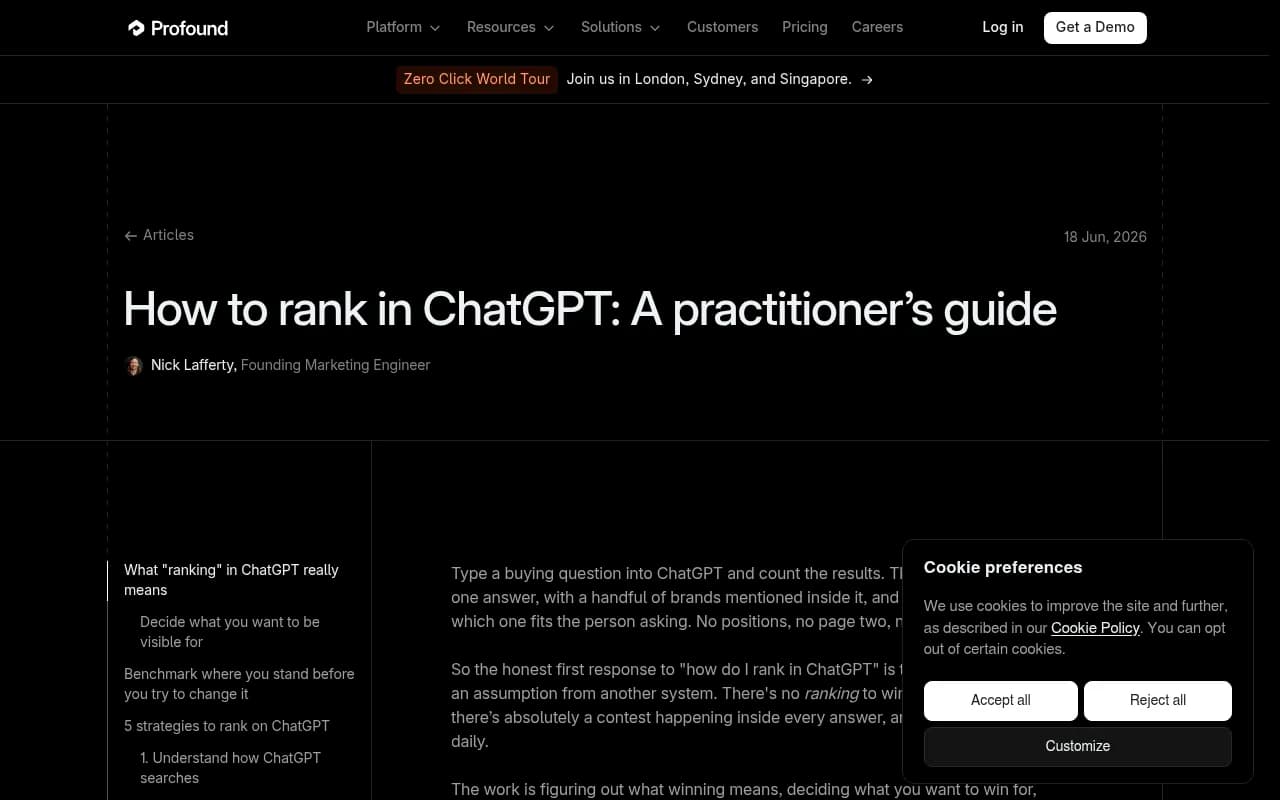
In Google, a keyword returns a list, and thousands of people see roughly the same list. ChatGPT returns one synthesized answer, written fresh, with a handful of brands inside it. As Profound's practitioner guide puts it, there are no positions, no page two, no list to climb. What replaces rank is a set of measurements: mentions, citations, and sentiment.
So when a dashboard says "you rank #3 for this prompt today," read it as one sample from a distribution. Run the same prompt ten times and you may get ten different brand lists. I have not seen a solid public number for how much prompt-level randomness there is, so I will not invent one. What I can say is that you should expect it, and you should design your tracking around it.
The main sources of daily movement
There are at least five distinct reasons a number moves. They stack, which is why daily charts look so chaotic.
1. Query fan-outs change what is actually searched
ChatGPT does not search for the user's prompt. It rewrites it into one or more web searches. Promptwatch Data's query fan-out report says a single prompt can trigger 3 to 8+ searches, though the report's own average is lower: about 2.15 fan-outs per response in early December 2025, easing to about 1.84 by early March 2026, and returning at exactly 1.0 in April. Average fan-out query length fell from about 117 characters in December to roughly 53 characters in April.
Those figures come from different windows and are not October 2026 values. The point is the shape: behaviour changes in steps. Your content only has to match one of the queries ChatGPT generates, not the user's original prompt. When the rewriting style shifts, phrasing that matched last quarter's queries can go stale.
There was another step on August 8, 2026, when ChatGPT started using the site: operator at scale. Site: queries went from about 0.4% to about 17% of all fan-out queries overnight, and searches per response nearly doubled. If a prompt that used to pull general web results now pulls narrower, domain-targeted ones, your appearance rate can change without you touching a page.
2. Model rollouts reset citation behaviour
This is the one that fools people most. According to Promptwatch's citation drop report, the GPT-5.3 rollout on March 4, 2026 cut citations per response across GPT-5.3, GPT-5.4 and GPT-5-Mini at the same time. The week before, ChatGPT cited about 6.4 sources per search-enabled response. By late March it settled around 4.7 to 4.9, roughly 27% fewer, with no recovery a month later. It happened within a day.
Fewer citation slots means fewer chances for everyone. If your citation count fell 25% that week, you probably did not lose anything relative to competitors.
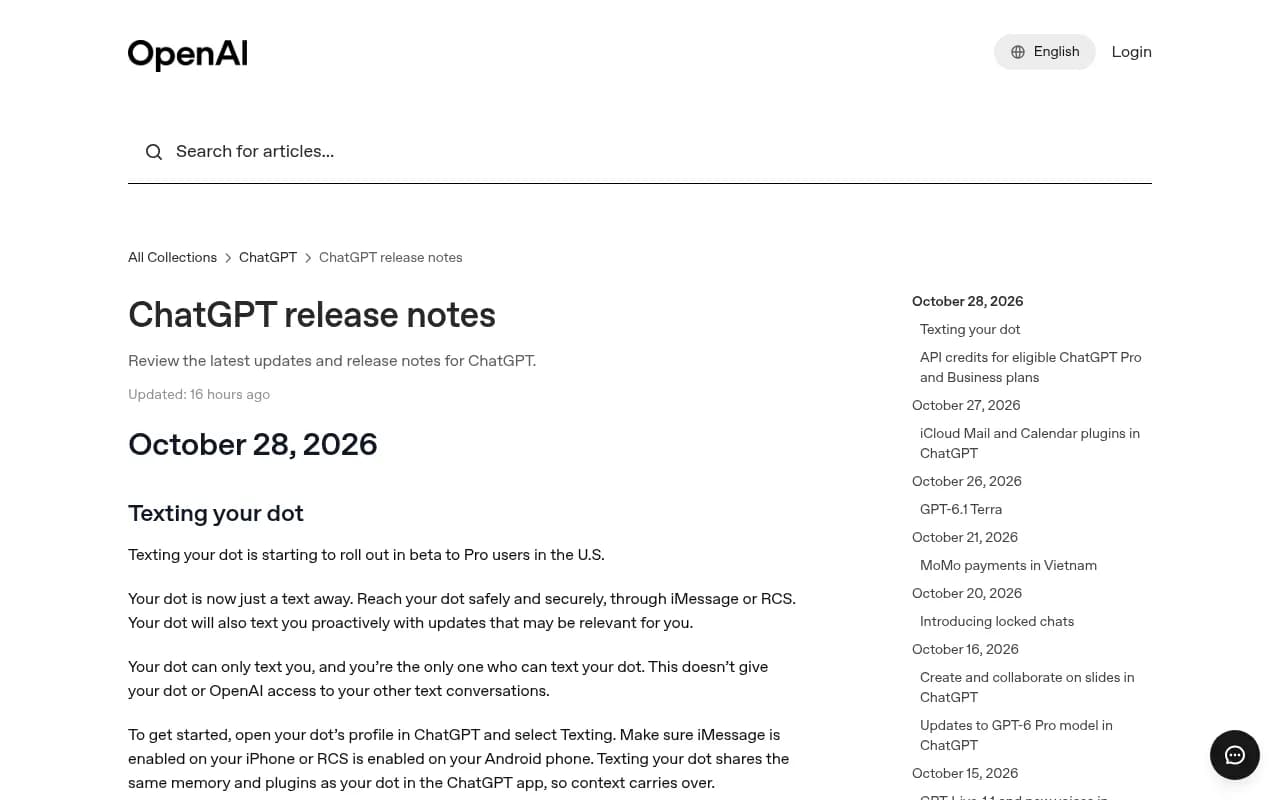
OpenAI ships changes constantly. The ChatGPT release notes show things like GPT-6.1 Terra rolling out on October 26, 2026, and retired models earlier in the year. Not every release touches search, but any of them is a candidate when you see a sudden step.
3. Content type decides how stable your citations are
Some of the churn is just the nature of the page. Promptwatch Data's content half-life study tracked every page ChatGPT cited on July 6, 2026 for 90 days:
| Content type | Still cited after 30 days | Still cited after 60 days | Notes |
|---|---|---|---|
| Landing pages | 78% | 69% | Half-life likely close to or beyond 90 days |
| Docs | 76% | 67% | 93% were cited again after day 0 |
| Comparisons | 72% | 63% | Crosses 50% only in the last week |
| Product pages, reviews, how-tos | n/a | 55% | Half-life of 74 to 77 days |
| Listicles | n/a | 60% | Slow decay |
| News | n/a | 41% | Half gone after 36 days |
News is the volatile one. Almost a quarter of news pages are never cited again after day 0. If your visibility leans on news-style content, expect it to look jumpy. If it leans on docs and landing pages, it should look calmer.
4. Sampling noise from the number of prompts
A tracker with 10 prompts will swing wildly, because each prompt is one coin flip with lots of sides. A tracker with 150 prompts, run daily, smooths most of that out. Before you worry about a drop, ask how many prompts feed the number. If one prompt flips, that is not a trend.
5. Personalization, memory, and location
ChatGPT memory carries across chats now, and users can ask for daily briefings. Real users see answers shaped by their history. I could not find a sourced figure for how much this moves brand mentions, so treat it as a known unknown. Tracking tools that use a clean session give you a consistent baseline, but it is not identical to what any one customer sees.
Fan-out and citation count: a quick diagnostic table
When a number moves, work out which layer moved first.
| What you see | Likely layer | First check |
|---|---|---|
| Citations per response drop for all your prompts, and competitors drop too | Platform change | Compare date against model releases |
| Only some prompts drop, same topic | Fan-out change | Re-audit headings against current fan-out queries |
| Specific pages stop being cited after weeks | Content decay | Check content type and age |
| Mentions stay, citations to your own domain fall | Crawl or content issue | Look at crawler logs and page health |
| Random daily wobble, no trend | Sampling noise | Widen the window, add prompts |
How to read your own data
Use a rolling window, not a day
A 7-day or 14-day average removes most of the randomness. For decisions, I would want to see a consistent direction for at least two weeks. Anything shorter is entertainment.
Track citations per response as a control
Promptwatch's own advice from the citation drop report is worth copying: check the date of any dip against model releases before blaming your content, and track citations per response for your tracked prompts. That lets you separate "we lost visibility" from "ChatGPT is citing fewer sources across the board." Their line is that citation behaviour is a platform-controlled variable that can change overnight, which makes single-snapshot audits unreliable.
Benchmark against competitors, not against yesterday
Share of voice relative to a set of competitors is more stable than your raw mention rate. If everyone dropped, nothing happened to you. If only you dropped, now you have a story.
Separate visibility from traffic
Mentions are not visits. Traffic data is noisy for its own reasons. One outside dataset reported chatgpt.com referrals spiking to 0.91% of crawler-observed referral traffic in July 2026, then falling to 0.53% in August (see Technology Checker's ChatGPT statistics). Even the site-level ranking figures for chatgpt.com itself moved between rank 22 and 29 within a single month in that analysis. If the platform's own numbers wobble like that, yours will too.
Check that AI can actually reach you
If your mentions hold but your own-domain citations fall, look at crawling. Which bots hit your pages, which returned errors, which pages never got read. Server logs or a tool with AI crawler logs will tell you. Promptwatch Data's AI crawler traffic report shows how much crawler volume shifts week to week across OpenAI, Anthropic, Google, Perplexity, and Mistral, so some fluctuation there is also normal.
A practical setup for tracking without panic
- Build a prompt set of at least 50 to 150 prompts across informational, commercial, and branded intent. More prompts, less noise.
- Run them daily and report weekly. Daily data is for diagnosis, weekly for decisions.
- Log external events: model releases, ChatGPT feature launches, your own content changes. Annotate your charts.
- Track three things together: mention rate, citation rate to your own domain, and citations per response.
- Re-audit heading-to-query mapping after any major ChatGPT update, since fan-out phrasing changes.
- Refresh the pages most likely to decay (news, reviews, how-tos) on a schedule, and protect your landing pages and docs.
Tools that help you read the signal
You can do some of this in a spreadsheet, but daily multi-prompt tracking is tedious by hand. Different tools cover different layers.
Promptwatch tracks the real ChatGPT interface across countries and languages, and combines prompt tracking with IP-verified crawler logs, citation trends, and visitor analytics, so you can tell a platform shift from a page-level problem. It also shows query fan-outs per response, which is the most useful single lens on why a prompt behaves differently today.

If you want a lighter, cheaper monitor, trackers like Otterly.AI and Peec AI cover the basics of mention tracking.


Enterprise teams sometimes pick Profound, which has its own research on fan-outs.

For free search-side context, Google Search Console is still the best place to check whether ordinary organic impressions moved at the same time.
| Need | Tool type | Examples |
|---|---|---|
| Daily prompt tracking with fan-outs and crawler logs | AI visibility platform | Promptwatch |
| Basic mention monitoring | Prompt tracker | Otterly.AI, Peec AI |
| Enterprise monitoring | Visibility platform | Profound |
| Organic search baseline | Search analytics | Google Search Console |
If you are comparing options in this space, the GEO software directory at bestgeosoftware.com lists many more.
When a change is real
Not all movement is noise. Treat it as real when:
- The drop persists for two or more weeks and shows on most prompts in a topic.
- Competitors held steady or rose while you fell.
- Citations per response stayed flat, so the pool did not shrink.
- Crawler logs show errors or a drop in bot visits to key pages.
- You published or changed pages just before the move.
In those cases, look at the page level. Which cited URLs disappeared, which prompts they answered, and whether competitors' pages replaced them. Then fix the content or the crawl path, and watch whether the pages get picked up again.
What to tell your boss
The short version: ChatGPT visibility is a rate, not a rank. Report it as an average over a window, relative to competitors, with the date of any known platform change noted next to it. A line that says "visibility dipped 25% the week GPT-5.3 shipped, and the whole category dipped with it" is more credible than a daily chart that looks like a heart monitor.
If you outsource this work, ask whoever runs it how many prompts feed each number, how often they run, and whether they control for citations per response. Agencies like 1001 SEO Media build reporting around exactly those questions. The answers tell you whether the numbers are worth acting on.
For more on how AI answers are built, browse the research at Promptwatch Data.
FAQ
Why does my brand appear in ChatGPT one day and not the next?
Because the answer is generated each time, from searches ChatGPT rewrites itself. Small differences in fan-out queries, the sources retrieved, and the model version can swap one brand for another.
How many days of data do I need before acting?
Two weeks of consistent direction on a decent prompt set. A single day is not enough.
Did a model update cause my drop?
Check the date against the release notes and against competitors' numbers. The March 4, 2026 rollout cut citations per response by roughly 27% across the board, so a simultaneous drop for everyone points to the platform, not your content.
Is the noise getting better or worse?
I would not bet on it settling. ChatGPT's search behaviour has changed in steps all year, and the site: operator shift in August showed it can happen without warning. Build for noise rather than waiting for it to go away.