Key takeaways
- Omnia does a respectable job of tracking brand visibility across AI search engines, with a clean interface and solid prompt monitoring basics
- Seven meaningful gaps -- including no content generation, limited crawler insights, and weak prompt intelligence -- are pushing teams toward more capable platforms
- Teams that need to act on their data (not just read it) consistently outgrow Omnia quickly
- Several alternatives cover specific gaps well; one platform covers all of them
- If your goal is to improve AI visibility, not just measure it, you'll likely need more than Omnia offers
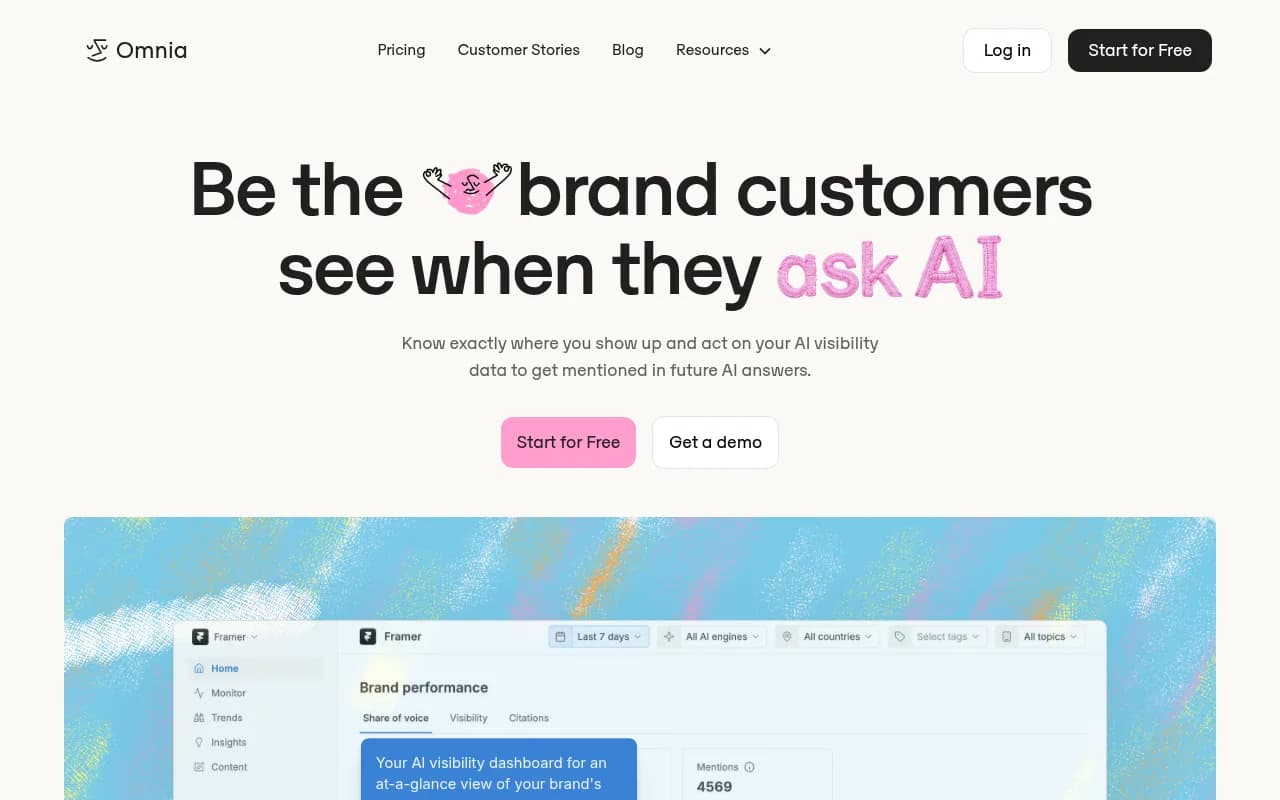
Omnia has built a decent reputation as an entry point into AI search visibility monitoring. The interface is clean, onboarding is fast, and for teams just waking up to the fact that ChatGPT and Perplexity are now sending (or not sending) traffic to their sites, it offers a reasonable starting point.
But "reasonable starting point" is doing a lot of work in that sentence.
In 2026, the GEO (Generative Engine Optimization) space has matured fast. Brands aren't just asking "are we showing up in AI search?" anymore. They're asking "why aren't we showing up, what do we do about it, and is it working?" That's a fundamentally different question -- and it's one Omnia isn't really built to answer.
This guide breaks down what Omnia genuinely does well, then gets specific about the seven gaps that are pushing teams toward alternatives.
What Omnia actually gets right
Before getting into the gaps, it's worth being honest about what works. Omnia isn't a bad tool -- it's a limited one.
Clean, accessible monitoring
Omnia's core visibility tracking is genuinely easy to use. You can set up prompt monitoring across multiple AI models without a steep learning curve, and the dashboard gives you a reasonably clear picture of where your brand appears (or doesn't) in AI-generated responses. For teams new to GEO, that clarity matters.
Multi-model coverage
Omnia monitors across several major LLMs, which is table stakes in 2026 but still worth acknowledging. Seeing how your brand performs differently across ChatGPT, Perplexity, and Gemini in one place is useful, and Omnia handles this adequately.
Competitor tracking basics
You can track competitor mentions alongside your own, which gives you a rough sense of the competitive landscape in AI search. It's not deep, but it's there.
Reasonable pricing for small teams
Compared to enterprise-tier platforms, Omnia's pricing is accessible. For a small marketing team that just wants to dip a toe into AI visibility monitoring without a major budget commitment, the cost-to-entry is manageable.
The 7 gaps that push teams toward alternatives
Here's where things get honest. These aren't minor quibbles -- they're structural limitations that matter more as your AI visibility strategy matures.
Gap 1: No content generation or optimization tools
This is the biggest one. Omnia shows you where you're invisible in AI search. It does not help you do anything about it.
There's no built-in content generation. No AI writing tools. No way to take the visibility data and turn it into articles, listicles, or comparison pages that might actually get cited by ChatGPT or Claude. You see the problem; you're on your own to fix it.
For teams that want to close the loop between "we found a gap" and "we published content that fills it," Omnia leaves a significant hole. Platforms like Promptwatch have built content generation directly into the workflow -- the gap analysis feeds directly into an AI writing agent that creates content grounded in real citation data.

Gap 2: No AI crawler logs
Omnia doesn't show you which AI crawlers are visiting your site, which pages they're reading, how often they return, or what errors they're hitting. This matters more than most teams realize.
Understanding how ChatGPT's crawler or Perplexity's bot interacts with your site is foundational to fixing indexing issues. If an AI model can't properly read your content, it won't cite it -- and you'd never know why from Omnia's dashboard alone.
Gap 3: Weak prompt intelligence
Omnia lets you track prompts, but it doesn't tell you much about them. There's no volume estimation, no difficulty scoring, no sense of which prompts are high-value and winnable versus which ones are dominated by competitors with far more authority.
Without that context, you're essentially guessing which prompts to prioritize. That's a problem when your team has limited time and needs to focus effort where it'll actually move the needle.
Gap 4: No traffic attribution
Seeing that your brand appeared in an AI response is one thing. Knowing whether that appearance drove actual traffic -- and whether that traffic converted -- is another thing entirely.
Omnia doesn't connect AI visibility to business outcomes. There's no code snippet for traffic attribution, no Google Search Console integration, no server log analysis. You can't answer the question "is our AI visibility actually driving revenue?" with Omnia's data alone.
This is a gap that becomes increasingly uncomfortable as leadership starts asking for ROI on GEO investments.
Gap 5: No Reddit or YouTube tracking
A growing body of evidence shows that AI models frequently cite Reddit threads, YouTube videos, and community discussions in their responses. If those sources are shaping what ChatGPT recommends in your category, you need to know about it -- and ideally, you need to be present in those conversations.
Omnia doesn't surface this. You get no visibility into which Reddit discussions or YouTube content is influencing AI recommendations in your space. That's a blind spot that competitors without this limitation can exploit.
Gap 6: No answer gap analysis
This is closely related to the content generation gap but distinct enough to call out separately. Omnia shows you your current visibility. It doesn't systematically show you the prompts where competitors are visible but you're not -- the specific questions AI models are answering for your competitors that they're ignoring you for.
Answer gap analysis is arguably the most actionable output a GEO platform can provide. It tells you exactly what content to create. Without it, you're working from general intuition rather than data.
Gap 7: Limited query fan-out and persona targeting
When someone asks an AI model a question, the model doesn't just process that one query -- it fans out into related sub-queries, pulling from multiple angles to construct its answer. Understanding that fan-out structure helps you see the full content landscape you need to cover.
Omnia also doesn't support customizable personas, which means you can't simulate how your actual customers prompt AI models. A B2B buyer researching enterprise software prompts very differently than a consumer looking for a product recommendation. If you can't model that, your visibility data is less useful than it looks.
How alternatives stack up
Here's a quick comparison of how Omnia sits relative to the broader field:
| Capability | Omnia | Otterly.AI | Peec AI | Promptwatch |
|---|---|---|---|---|
| AI model monitoring | Yes | Yes | Yes | Yes (10 models) |
| Content generation | No | No | No | Yes |
| Answer gap analysis | No | No | No | Yes |
| AI crawler logs | No | No | No | Yes |
| Traffic attribution | No | No | No | Yes |
| Prompt volume/difficulty | No | Limited | No | Yes |
| Reddit/YouTube tracking | No | No | No | Yes |
| Query fan-outs | No | No | No | Yes |
| ChatGPT Shopping tracking | No | No | No | Yes |
The pattern is pretty clear. Omnia, Otterly.AI, and Peec AI are all monitoring-first tools. They tell you what's happening; they don't help you change it.


For teams that have moved past the "let's just see what's happening" phase and into "let's actually improve our AI visibility," the monitoring-only category starts to feel like a treadmill. You're generating reports but not making progress.
Who Omnia still makes sense for
To be fair: Omnia isn't the wrong choice for everyone.
If you're a small team or solo marketer who just wants to understand the basics of how your brand appears in AI search -- and you're not yet ready to invest in a full optimization workflow -- Omnia's simplicity and lower price point make it a reasonable starting point. It's better than having no visibility data at all.
It also works as a supplementary tool if you're already using a more capable platform and want a second opinion on specific metrics.
But if you're running a marketing team with real accountability for AI search performance, or an agency managing multiple clients' GEO strategies, Omnia's gaps will catch up with you quickly.
What to look for in an alternative
When evaluating alternatives, the key question isn't "does it monitor more AI models?" -- most tools in this space cover the major LLMs. The real question is: does it help you act on the data?
Specifically, look for:
- Answer gap analysis that shows you exactly which prompts competitors win and you don't
- Built-in content generation that's grounded in citation data, not generic AI output
- AI crawler logs so you can diagnose indexing issues, not just visibility gaps
- Traffic attribution that connects AI appearances to actual site visits and conversions
- Prompt intelligence (volume, difficulty, fan-outs) so you can prioritize intelligently
- Reddit and YouTube tracking for a complete picture of what's shaping AI recommendations
Platforms like Promptwatch are built around this full loop: find the gaps, create content to fill them, track whether it's working. That's a fundamentally different product philosophy than monitoring-only tools -- and in 2026, it's the difference between a dashboard and an actual optimization program.

The broader theme from Omnia Group's own 2026 Talent Trends research is relevant here: organizations are adopting AI tools faster than they're building the processes to use them well. The same tension exists in GEO tooling. Buying a monitoring dashboard is easy. Building a workflow that actually improves your AI visibility takes more.
The bottom line
Omnia is a clean, accessible monitoring tool that does what it says on the tin. For teams just starting to think about AI search visibility, it's not a bad place to start.
But the seven gaps above -- no content generation, no crawler logs, no traffic attribution, no answer gap analysis, weak prompt intelligence, no Reddit/YouTube tracking, no query fan-outs -- add up to a platform that tells you where you stand without helping you move. For teams serious about improving their position in AI search, that's a meaningful limitation.
The GEO tools that are pulling ahead in 2026 are the ones that close the loop between data and action. Monitoring is table stakes now. What matters is what you do with it.