Key takeaways
- Peec AI is a solid monitoring tool, but it stops at visibility -- it doesn't help you close the gaps it finds
- B2B companies specifically need multi-engine coverage, content optimization, and the ability to tie AI visibility to pipeline
- The best alternatives in 2026 go beyond dashboards: they show you what to fix and help you fix it
- Promptwatch is the only platform rated "Leader" across all GEO categories in a 2026 comparison of 12 platforms
- Most alternatives fall into two camps: monitoring-only tools (cheaper, limited) and full optimization platforms (more expensive, more actionable)
Peec AI made a lot of sense in early 2025. AI search had arrived faster than most marketing teams could adapt, and the first question everyone needed answered was simple: are we showing up at all?
Peec answered that. It tracked Google AI Overview visibility, brand presence in LLM responses, and prompt-level analytics. For teams just waking up to the generative search problem, it was a reasonable starting point.
But B2B marketing teams don't stay at "starting point" for long. By mid-2026, the complaints showing up in communities like TrafficThinkTank and r/SEO were consistent: costs were climbing for large keyword sets, accuracy varied across industries, and the platform didn't help teams do anything with what they found. Monitoring without action is just a more expensive way to feel anxious.
If you're evaluating alternatives, the question isn't just "what else tracks AI visibility?" It's "what actually helps us improve it?" Here are six platforms worth considering -- with honest notes on where each one fits.
What B2B teams actually need from a GEO platform
Before getting into the tools, it's worth being specific about what "more than brand tracking" means for B2B companies.
B2B buyers use AI search differently from consumers. They're researching vendors, comparing software categories, looking for implementation guides, and asking questions like "what's the best CRM for mid-market SaaS companies?" Your brand either appears in those answers or it doesn't -- and if it doesn't, you're invisible at a critical moment in the buying journey.
That creates a few specific requirements:
- Multi-engine coverage across ChatGPT, Perplexity, Claude, Gemini, and Google AI Overviews (B2B buyers use all of them)
- Prompt-level data that maps to actual buyer questions, not generic brand queries
- Content gap analysis that shows what's missing from your site, not just where competitors are winning
- Traffic attribution so you can connect AI visibility to actual pipeline, not just impressions
- The ability to generate or optimize content based on what AI models actually cite
Most monitoring-only tools cover the first two. The last three are where the real differentiation happens.
The 6 best Peec AI alternatives for B2B in 2026
1. Promptwatch -- best for teams that want to close the loop
Promptwatch is the most complete GEO platform available right now, and the only one rated "Leader" across all categories in a 2026 comparison of 12 platforms. The core difference from Peec AI and most competitors is that it's built around action, not just observation.

The workflow goes like this: Answer Gap Analysis shows you exactly which prompts competitors are visible for that you're not. You see the specific content your site is missing -- the topics, angles, and questions AI models want to answer but can't find on your pages. Then the built-in AI writing agent generates content grounded in real citation data (880M+ citations analyzed), prompt volumes, and competitor analysis. Then you track whether it worked.
For B2B teams, a few capabilities stand out specifically. The AI Crawler Logs show which pages ChatGPT, Claude, and Perplexity are actually reading on your site -- and which ones they're ignoring or hitting errors on. That's genuinely useful for technical teams trying to understand why certain pages aren't getting cited. The Prompt Intelligence feature gives volume estimates and difficulty scores for each prompt, so you can prioritize high-value queries instead of guessing. And the ChatGPT Shopping tracking is relevant for any B2B company that sells through e-commerce or wants to appear in product recommendation flows.
Pricing starts at $99/month (Essential), $249/month (Professional, which adds crawler logs and city-level tracking), and $579/month (Business). There's a free trial. It monitors 10 AI models including ChatGPT, Claude, Perplexity, Gemini, Grok, DeepSeek, and Google AI Overviews.
The honest caveat: it's not the cheapest option. If you're a solo marketer just trying to check whether your brand shows up in a handful of prompts, the entry price is higher than some alternatives. But for B2B teams that need to connect AI visibility to revenue, it's the most complete option available.
2. Profound -- best for enterprise teams focused on AI Overview precision
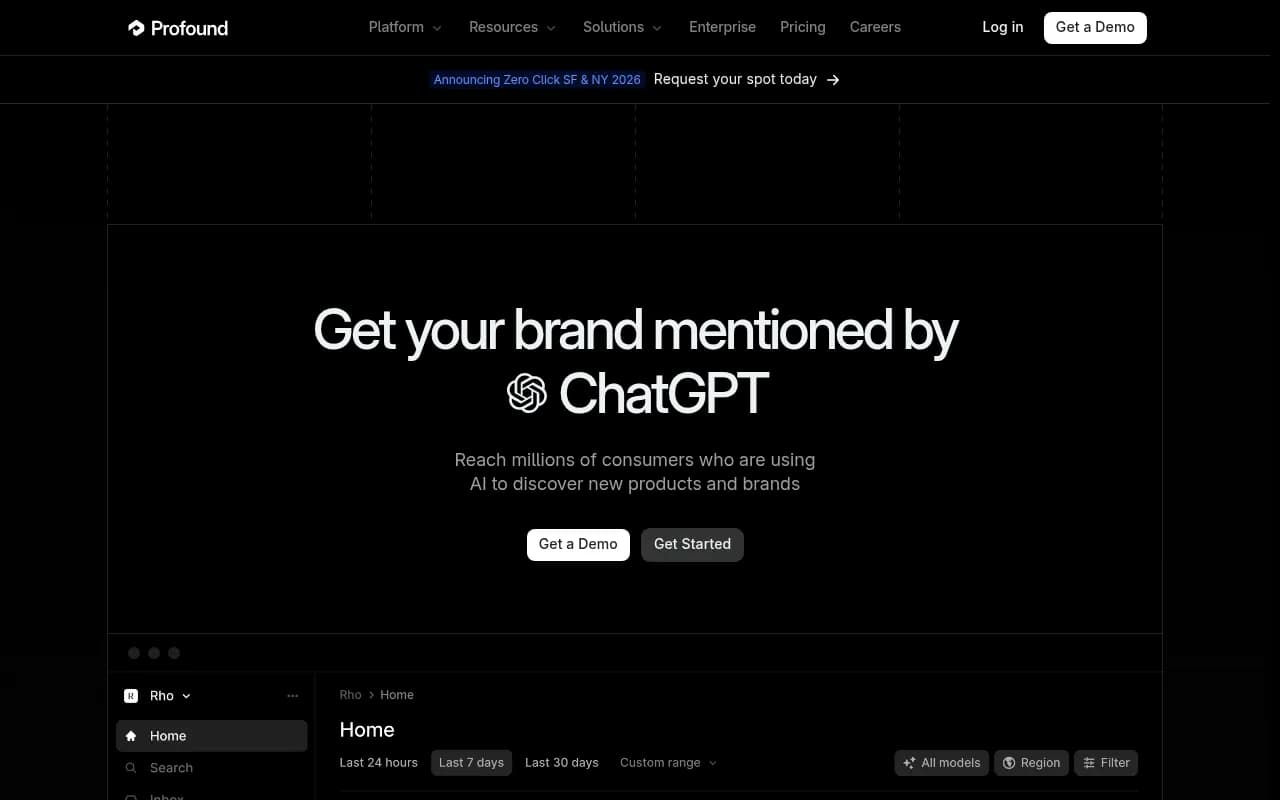
Profound has built a strong reputation for precise AI Overview tracking, entity extraction, and attribution mapping. It's particularly good at showing how your brand is described in AI-generated answers -- not just whether you appear, but what the AI says about you and which entities it associates with your brand.
For B2B companies in competitive categories (software, financial services, professional services), that narrative layer matters. If ChatGPT consistently describes a competitor as "the industry standard" and describes you as "an alternative," that framing shapes buyer perception even if you appear in the same response.
Profound starts at $99/month, which makes it competitive on price. The trade-off is that it's more monitoring-focused than action-focused -- it shows you the problem clearly, but you'll need to do the content work yourself.
3. Writesonic -- best for teams that want monitoring and content generation in one tool
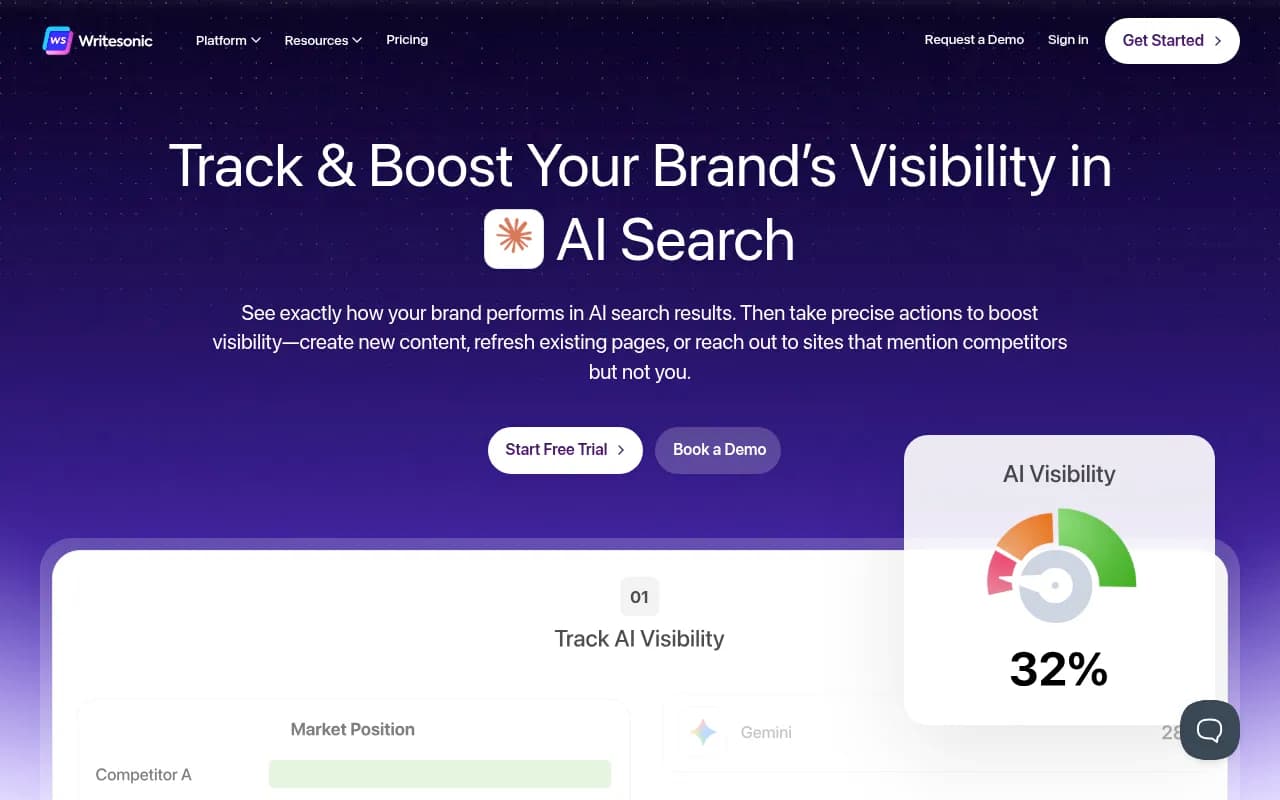
Writesonic has evolved from an AI writing tool into a GEO platform that combines visibility tracking with content generation. It monitors across ChatGPT, Google AI Mode, Gemini, Perplexity, and Claude, and includes actionable optimization workflows that help teams create content designed to get cited.
The appeal for B2B marketing teams is the reduced tool sprawl. Instead of paying for a monitoring platform and a separate content tool, Writesonic handles both. The content generation is grounded in visibility data rather than generic SEO signals, which is a meaningful difference.
Starting price is $199/month, positioning it in the mid-market range. It's worth evaluating if your team is already using Writesonic for content and wants to add AI visibility tracking without onboarding a separate platform.
4. SE Visible -- best for strategic visibility tracking with sentiment analysis
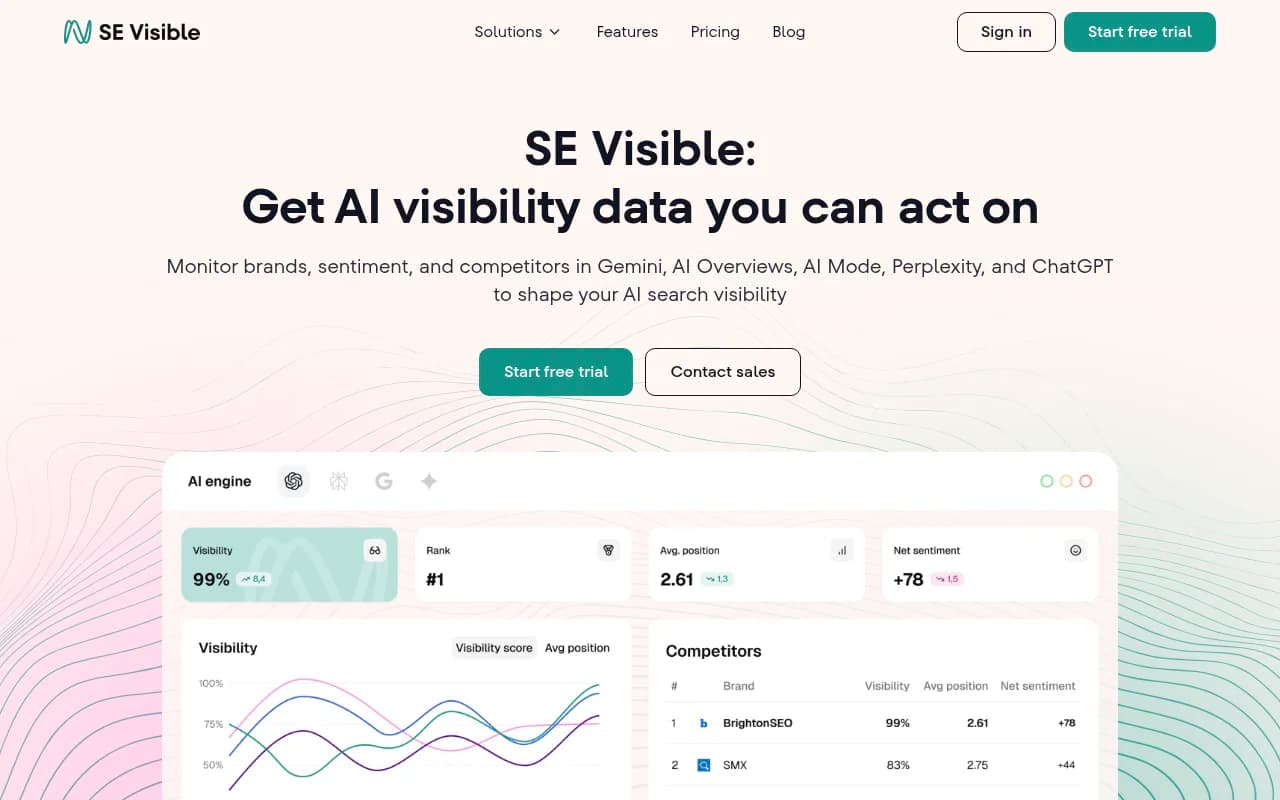
SE Visible is SE Ranking's dedicated AI visibility product, and it's one of the more thoughtful monitoring tools in this space. Beyond tracking whether you appear in AI results, it analyzes brand sentiment in AI-generated responses -- useful for B2B companies where how you're described matters as much as whether you appear.
The competitive benchmarking features are solid, and the platform is designed for marketing leaders and CMOs who need strategic views rather than raw data dumps. Starting price is $189/month.
The limitation is similar to Profound: SE Visible is primarily a monitoring and analysis tool. It gives you excellent data on the problem, but the optimization work happens elsewhere.
5. AthenaHQ -- best for multi-engine coverage across AI-native search
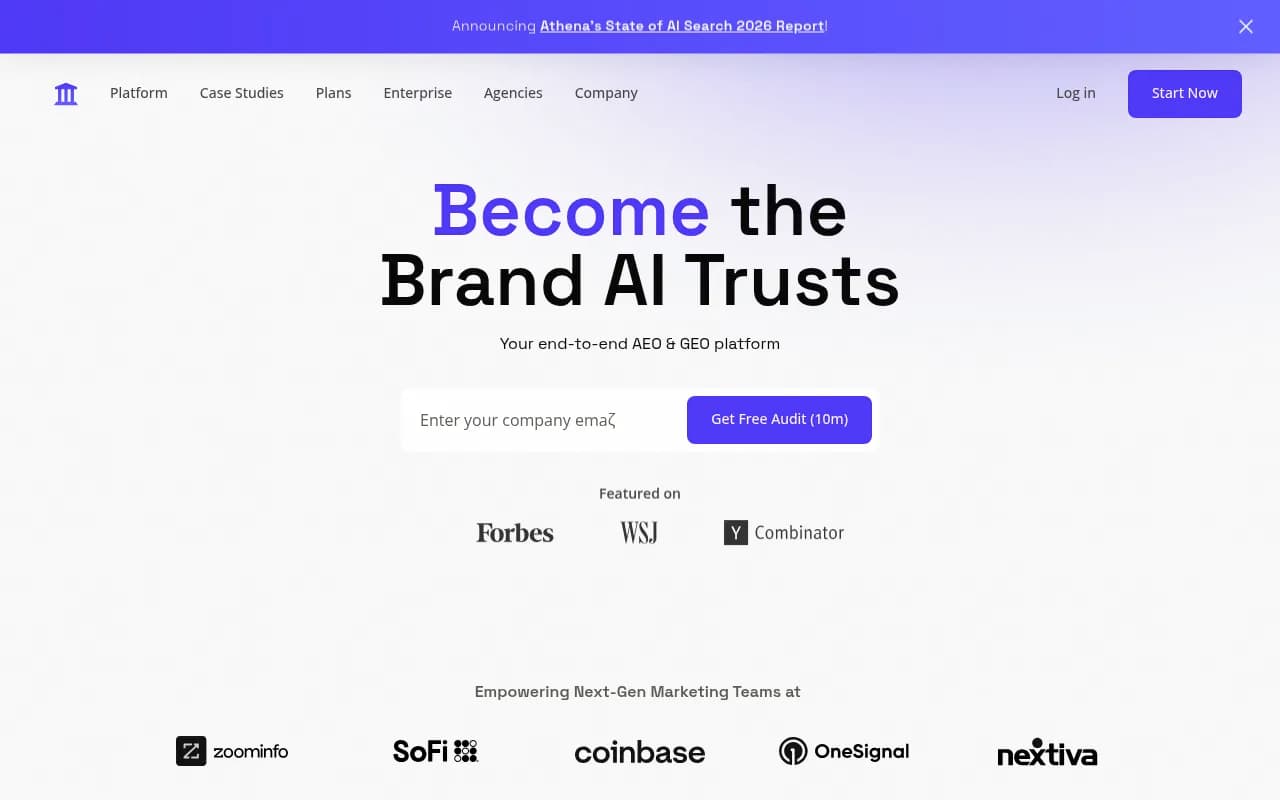
AthenaHQ covers eight or more AI search engines, which is more breadth than most competitors. For B2B companies with international presence or buyers who use a mix of AI tools, that coverage matters -- you can't assume all your prospects are using the same model.
It's positioned as a monitoring and competitive intelligence platform, with strong features for tracking how your brand appears across different AI engines and comparing that against competitors. Starting price is $295/month, which puts it at the higher end of the monitoring-only category.
The honest assessment: AthenaHQ is excellent at showing you where you stand. Like most monitoring tools, it doesn't help you change where you stand. For teams that already have content production capacity and just need better data to direct it, that's fine. For teams that need the full loop, it's a partial solution.
6. Scrunch AI -- best for brand narrative and descriptor analysis
Scrunch AI takes a different angle than most GEO platforms. Rather than focusing primarily on whether you appear in AI results, it focuses on how you're described -- the language, descriptors, and associations AI models use when they mention your brand.
For B2B companies, this is underrated. If your brand is consistently described in ways that don't match your positioning (or worse, in ways that are factually wrong), that's a problem that pure visibility tracking won't surface. Scrunch helps you identify those narrative gaps and track whether your content efforts are shifting how AI models talk about you.
It's a more specialized tool than the others on this list, which means it works best as a complement to a broader GEO platform rather than a standalone solution.
How these tools compare
| Tool | Monitoring | Content generation | Multi-engine | Traffic attribution | Starting price |
|---|---|---|---|---|---|
| Promptwatch | Yes | Yes (built-in) | 10 models | Yes | $99/mo |
| Profound | Yes | No | Multiple | Limited | $99/mo |
| Writesonic | Yes | Yes | 5 models | Limited | $199/mo |
| SE Visible | Yes | No | Multiple | No | $189/mo |
| AthenaHQ | Yes | No | 8+ models | No | $295/mo |
| Scrunch AI | Yes (narrative) | No | Multiple | No | Custom |
| Peec AI | Yes | No | Limited | No | ~€89/mo |
The pattern is clear: most alternatives are monitoring tools with varying degrees of sophistication. Promptwatch and Writesonic are the two platforms that include content generation alongside monitoring. Promptwatch goes further with traffic attribution and crawler logs, which closes the loop from visibility to revenue.
How to choose
The right tool depends on what your team is actually trying to accomplish.
If you're starting from zero and just need to understand your current AI visibility before deciding what to do about it, Profound or SE Visible are solid, reasonably priced entry points. They'll give you a clear picture without overwhelming your team.
If you have content production capacity and need better data to direct it, AthenaHQ's multi-engine coverage or Scrunch AI's narrative analysis might be exactly what you need -- they're good at surfacing specific problems that your writers can then address.
If you need the full cycle -- find gaps, create content, track results -- Promptwatch is the most complete option. The Answer Gap Analysis, built-in content generation, crawler logs, and traffic attribution work together in a way that no other platform currently matches. For B2B teams that need to show marketing's contribution to pipeline, that attribution layer is particularly valuable.
Writesonic is worth considering if you want monitoring plus content generation at a slightly lower price point, with the trade-off of less depth on the attribution and technical crawl analysis side.
The one thing to avoid: choosing a monitoring-only tool and assuming the data will translate into action on its own. It won't. AI visibility data is only useful if your team has a clear process for acting on it -- whether that's built into the platform or handled separately.
A note on what Peec AI does well
To be fair: Peec AI isn't a bad tool. Its prompt suggestion engine is genuinely useful for teams that don't know where to start, and its Google AI Overview tracking is accurate. If your primary need is a lightweight, affordable way to check brand presence in AI results and you don't need content optimization or deep attribution, it might still be the right fit.
The issue is that most B2B marketing teams outgrow that use case quickly. Once you know you're not showing up in the prompts that matter, the next question is always "what do we do about it?" -- and that's where Peec AI runs out of runway.
The alternatives above are for teams that have already asked that second question.