Key takeaways
- Traditional SEO tools don't track AI search visibility — you need a dedicated GEO/AEO platform to know if ChatGPT, Perplexity, or Gemini is recommending your brand.
- Most platforms in this space are monitoring-only: they show you where you're invisible but don't help you fix it.
- The tools that drove real results in 2025 combined citation tracking, content gap analysis, and some form of content optimization or generation.
- Pricing ranges from free tiers to $500+/month for enterprise plans — the right choice depends heavily on whether you need monitoring, optimization, or both.
- If you want a platform that closes the loop from gap identification to content creation to traffic attribution, Promptwatch is the only one currently rated as a leader across all categories.
Why 2025 was the year AI visibility became non-negotiable
For most of the past decade, "visibility" meant one thing: Google rankings. Then 2025 happened. ChatGPT crossed 200 million weekly active users. Perplexity became the go-to research tool for a growing slice of knowledge workers. Google's AI Overviews started appearing on the majority of commercial queries. And brands started noticing something uncomfortable: their organic traffic was flat or declining even when their rankings held.
The reason? A lot of the answers people used to click through to find were now being delivered directly by AI. No click required. And if your brand wasn't being cited in those answers, you were effectively invisible to a growing segment of your market.
This created a scramble. Marketing teams started asking questions their existing tools couldn't answer: Is ChatGPT recommending us? Which competitors is Perplexity citing? Why does Claude mention our rival but not us? What would we need to publish to change that?
A whole category of tools emerged to answer these questions. Some were genuinely useful. Others were dashboards dressed up as strategy platforms. This guide cuts through the noise.
What separates a useful AI visibility tool from a vanity dashboard
Before getting into specific platforms, it's worth being clear about what actually matters.
The bare minimum is monitoring: can the tool tell you whether your brand appears in AI responses for a given set of prompts? Most platforms do this. The problem is that knowing you're invisible doesn't tell you what to do about it.
The more useful tools go further. They show you which prompts your competitors rank for that you don't (gap analysis), what content you'd need to create to close those gaps, and whether the content you publish actually improves your citation rate over time. That's the difference between a monitoring tool and an optimization platform.
A few other things worth checking: Does it cover the AI models your customers actually use? Does it track citations at the page level, not just the domain level? Can it connect AI visibility to actual traffic and revenue? Does it have any insight into how AI crawlers interact with your site?
With that framework in mind, here's how the leading platforms stacked up in 2025.
The top 10 AI visibility platforms of 2025
1. Promptwatch
Promptwatch is the platform that most consistently came up when marketing teams talked about actually moving their AI visibility metrics, not just measuring them. It monitors 10 AI models including ChatGPT, Perplexity, Claude, Gemini, Google AI Overviews, Grok, DeepSeek, and Copilot — and it goes well beyond showing you a score.
The core loop works like this: Answer Gap Analysis surfaces the specific prompts your competitors appear for but you don't. The built-in AI writing agent then generates content grounded in citation data from 880M+ analyzed citations, targeting those exact gaps. Page-level tracking shows whether that new content starts getting cited, and traffic attribution (via GSC integration, a code snippet, or server log analysis) connects citations to actual revenue.
What makes it genuinely different from most competitors is the AI Crawler Logs feature — real-time logs of when ChatGPT, Claude, Perplexity, and others crawl your site, which pages they read, and what errors they hit. That's the kind of technical insight that helps you fix indexing problems before they become visibility problems. It also tracks Reddit and YouTube discussions that influence AI recommendations, which most tools ignore entirely.
Pricing: Essential at $99/mo, Professional at $249/mo, Business at $579/mo. Free trial available.

2. Profound
Profound has built a strong reputation as an enterprise-grade AI visibility solution, particularly for brands that need rigorous tracking across a large prompt set. It's frequently cited as a benchmark for identifying which platforms actually increase brand mentions inside ChatGPT, Google AI Overviews, and Perplexity.
The platform's strength is in its data depth and reporting quality. Enterprise teams running structured GEO programs tend to find it well-suited to their workflow. The tradeoff is price — it sits at a higher price point than most mid-market options — and it doesn't offer the content generation capabilities that close the optimization loop.
3. Otterly.AI
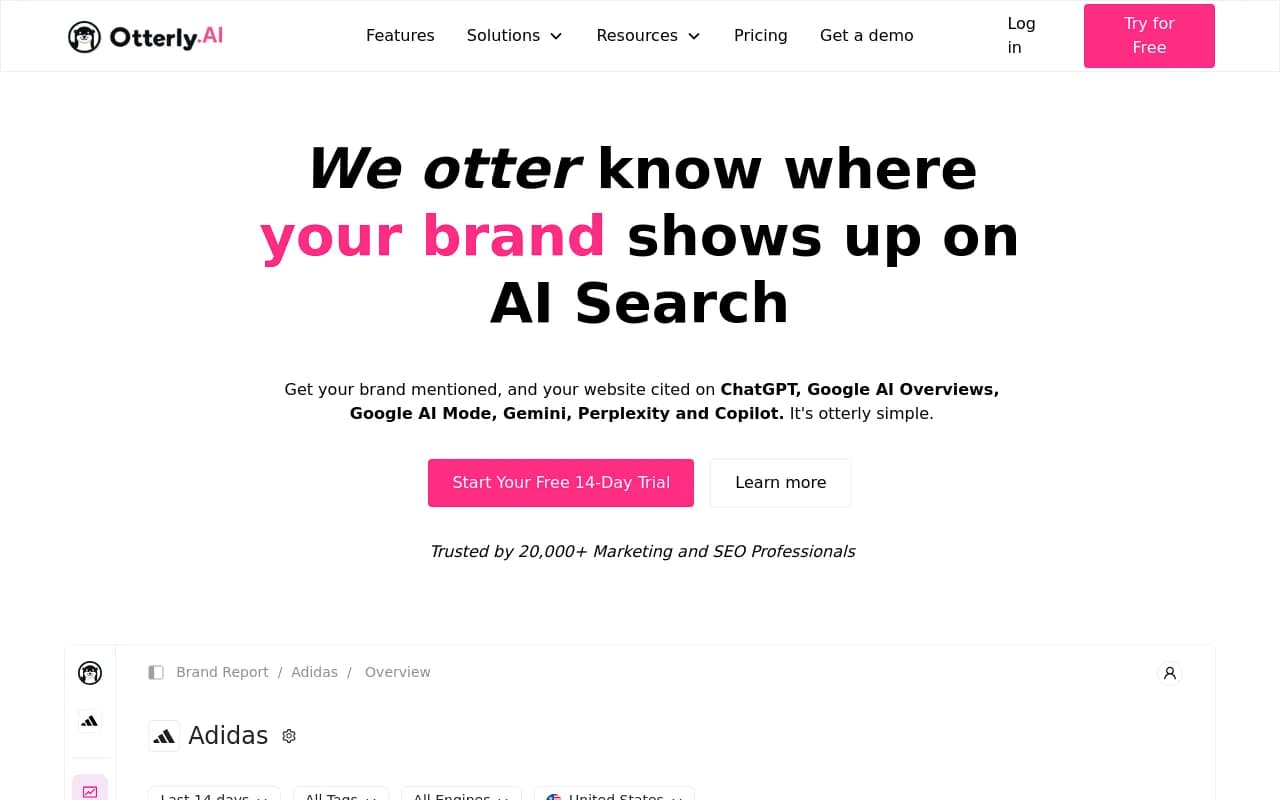
Otterly.AI is one of the more accessible entry points into AI visibility tracking. It covers the major AI models, gives you brand mention tracking and sentiment analysis, and is priced for teams that are just starting to take GEO seriously.
The honest limitation: it's a monitoring tool. You'll know where you stand, but you won't get much help figuring out what to do about it. For teams that already have a content operation and just need the data layer, that's fine. For teams that need the full optimization workflow, it's a starting point rather than a destination.
4. Evertune
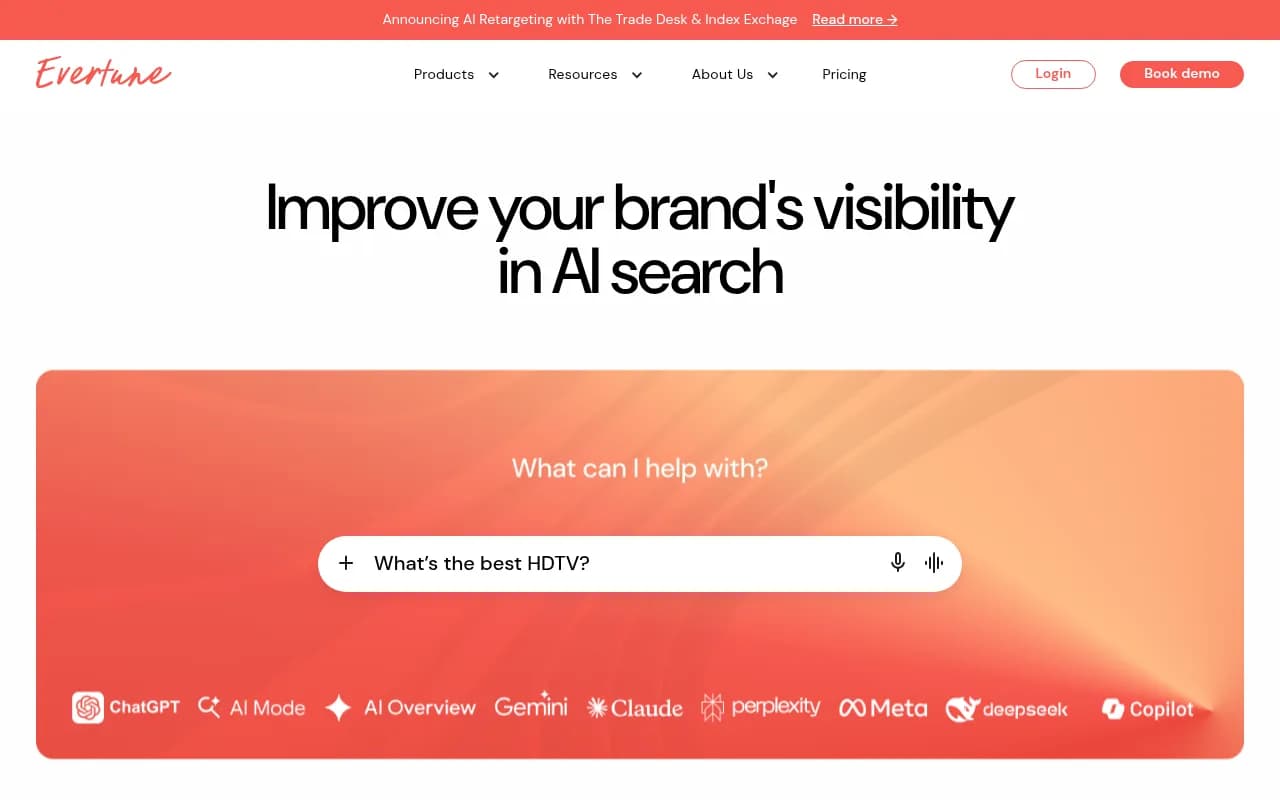
Evertune positions itself as an enterprise GEO platform and has raised $19M in funding, which gives it resources most competitors don't have. It analyzes over 1 million AI responses monthly per brand and has built a following among larger brands that want comprehensive GEO insights.
It's particularly strong on the analytics side — understanding how your brand is portrayed across AI responses, not just whether it appears. The depth of perception analysis (how AI models describe your brand, not just whether they mention it) is a genuine differentiator.
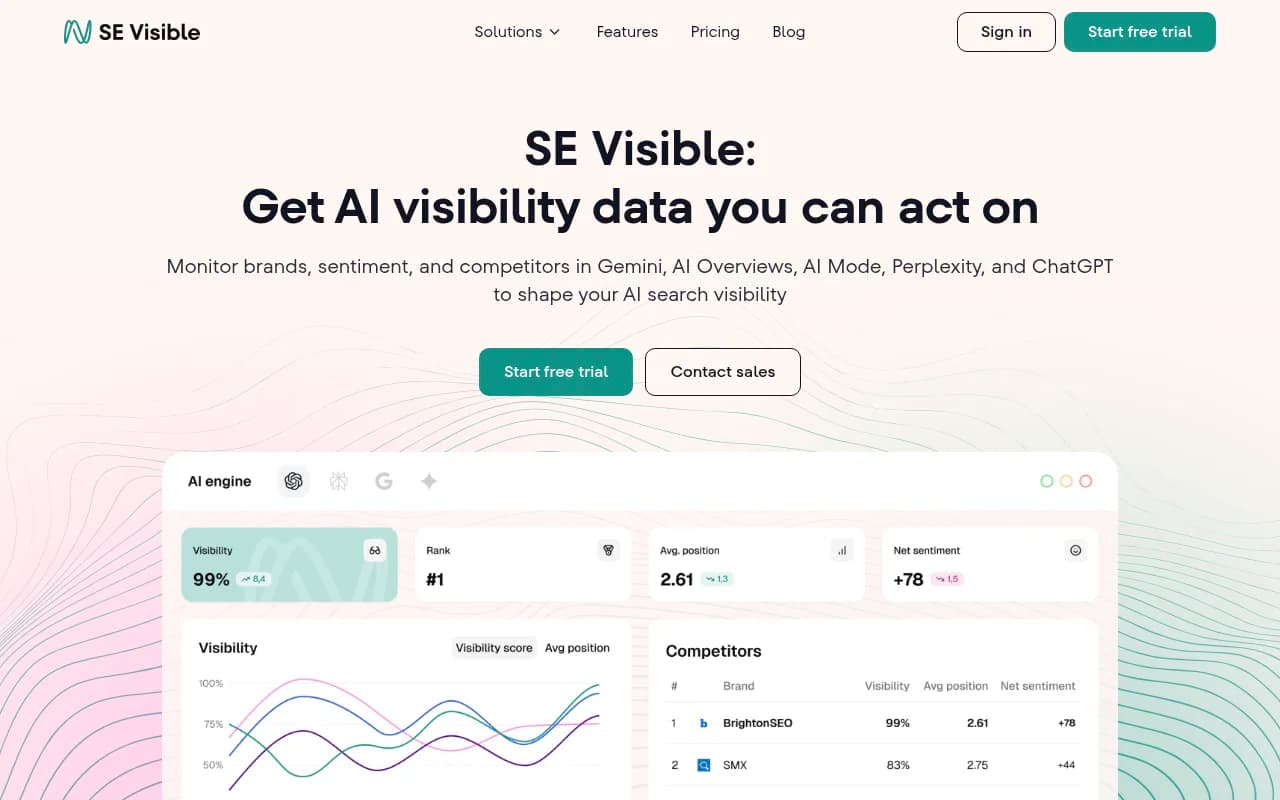
5. SE Ranking / SE Visible
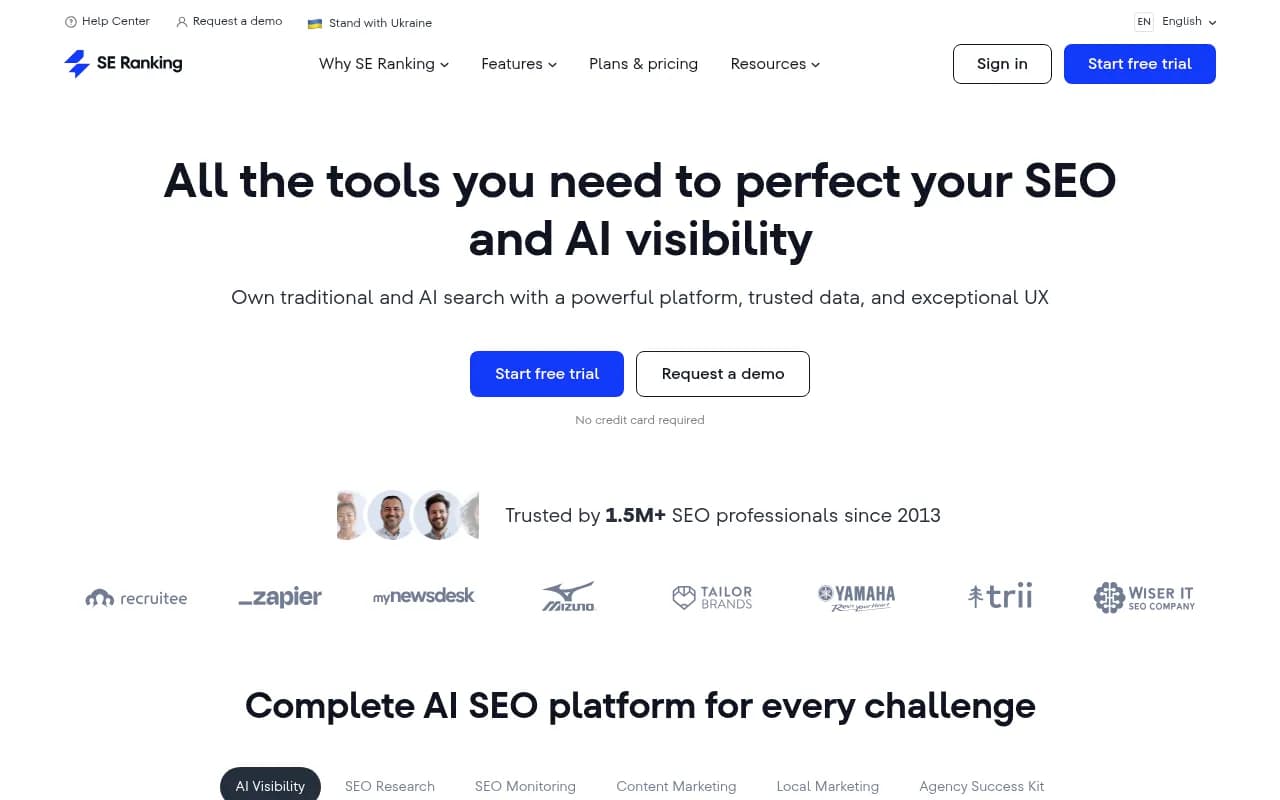
SE Ranking has been a reliable SEO platform for years, and its AI visibility module (SE Visible) extends that into the GEO space. For teams already using SE Ranking for traditional SEO, the integration is a natural fit — you get AI visibility data alongside your keyword rankings, backlink data, and site audits in one place.
The AI visibility features are solid rather than exceptional. It covers the major models and gives you brand tracking and sentiment. Where it falls short is in the optimization layer — SE Ranking is still primarily an SEO tool that has added AI monitoring, not a purpose-built GEO platform.
6. Scrunch AI
Scrunch AI focuses on monitoring and optimizing how AI assistants like ChatGPT and Claude describe your brand. It's built for marketing teams that want to understand brand perception in AI responses, not just citation frequency.
The platform is cleaner and more focused than some of the larger enterprise tools, which makes it easier to get up and running. It's a reasonable choice for brands that care specifically about how they're being described — the sentiment and framing angle — rather than just whether they appear.
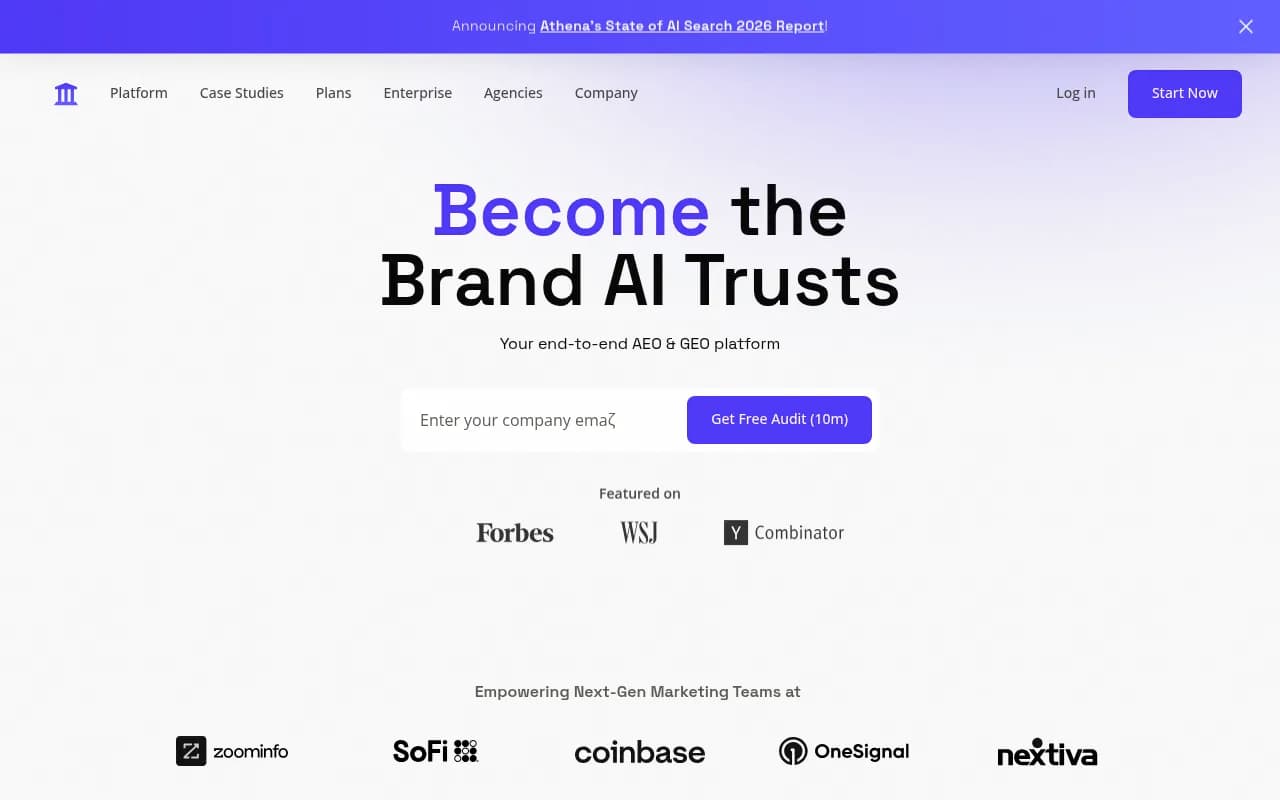
7. Athena HQ
AthenaHQ has carved out a niche as a monitoring-focused AI visibility platform covering 8+ AI search engines. It's solid for tracking brand mentions and understanding competitive positioning across models.
The gap is on the optimization side. AthenaHQ shows you the data but doesn't offer content gap analysis or content generation to help you act on it. Teams that pair it with a separate content operation can make it work, but it's not a self-contained optimization platform.
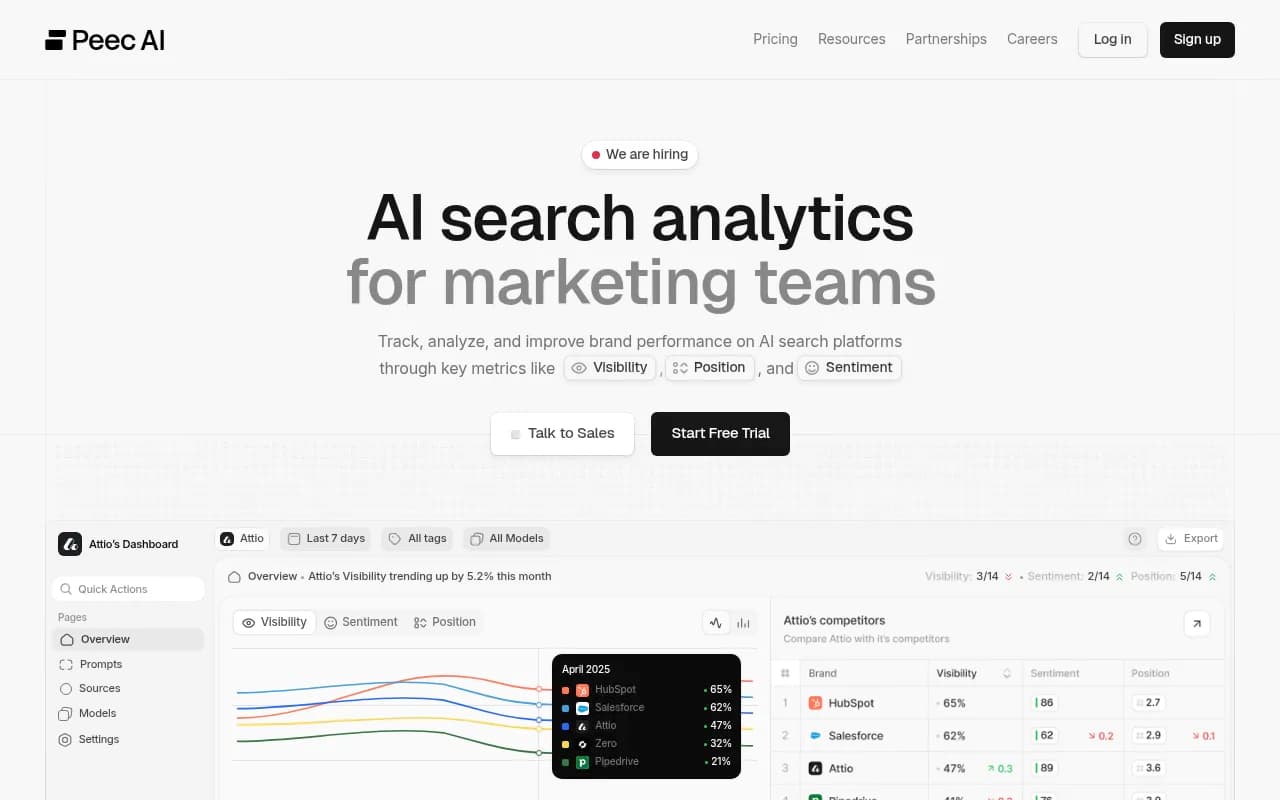
8. Peec AI
Peec AI stands out for its multi-language support, which matters more than most tools acknowledge. AI search is a global phenomenon, and if your customers are prompting in German, French, or Spanish, you need visibility data in those languages. Peec AI handles this better than most.
It's a monitoring-first platform, but the language coverage and regional tracking make it a strong choice for international brands or agencies managing clients across multiple markets.
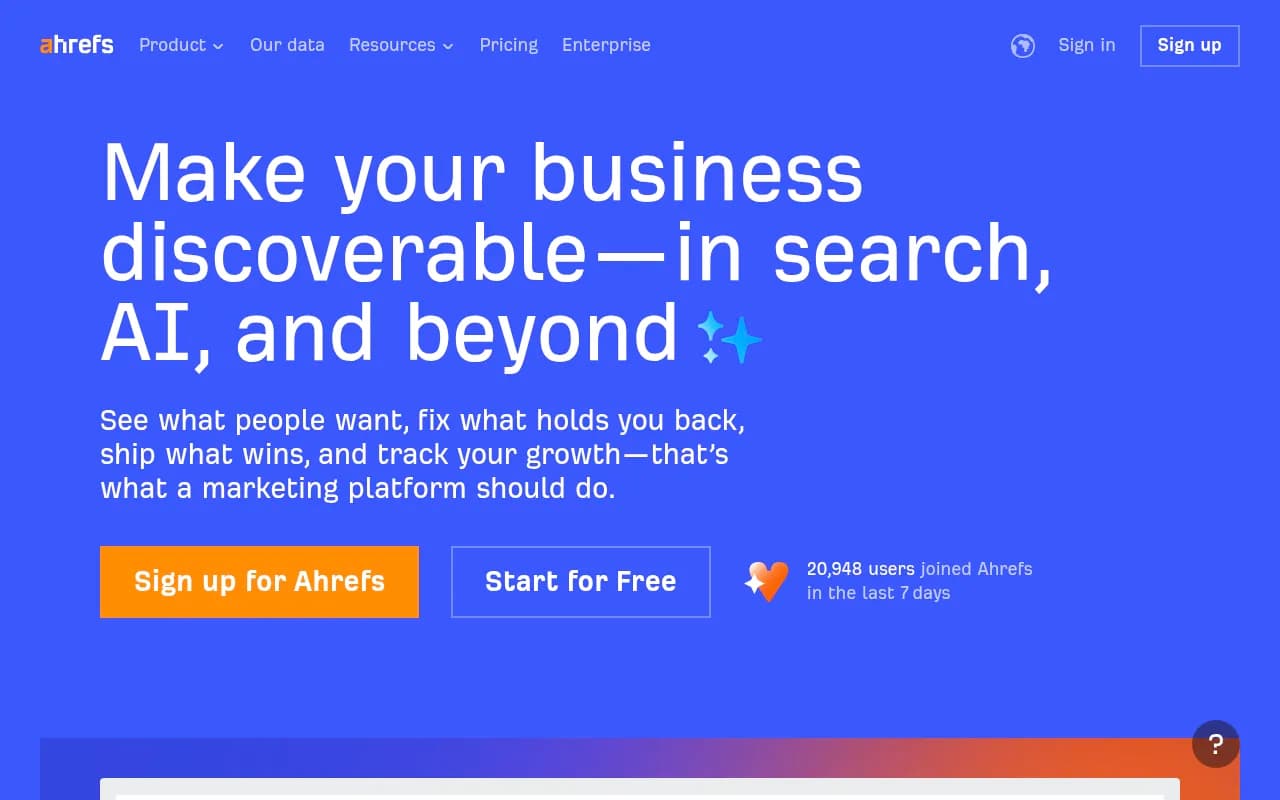
9. Ahrefs Brand Radar
Ahrefs needs no introduction as an SEO tool, and Brand Radar is its attempt to extend into AI visibility monitoring. For teams already deep in the Ahrefs ecosystem, it's a convenient addition.
The honest assessment: it's limited compared to purpose-built GEO platforms. Fixed prompt sets mean you're tracking what Ahrefs decides matters, not necessarily what your customers are actually asking. There's no AI traffic attribution. And the optimization layer doesn't exist — it's purely a monitoring feature within a broader SEO platform.
10. Semrush
Similar story to Ahrefs. Semrush has added AI visibility features to its already comprehensive platform, and for teams that live in Semrush, having some AI monitoring built in is convenient. But the fixed prompt approach limits how useful the data actually is, and there's no content generation or gap analysis to help you act on what you find.
If you're already paying for Semrush and want a basic sense of your AI visibility, it's worth exploring. If AI visibility is a serious priority, you'll outgrow it quickly.
Feature comparison: what each platform actually offers
| Platform | AI models covered | Content gap analysis | Content generation | Crawler logs | Traffic attribution | Multi-language | Price range |
|---|---|---|---|---|---|---|---|
| Promptwatch | 10 | Yes | Yes (built-in) | Yes | Yes | Yes | $99-$579/mo |
| Profound | 5+ | Partial | No | No | No | Limited | Enterprise |
| Otterly.AI | 5+ | No | No | No | No | Limited | $49-$199/mo |
| Evertune | 5+ | Partial | No | No | No | Yes | Enterprise |
| SE Visible | 4+ | No | No | No | No | Limited | Bundled with SE Ranking |
| Scrunch AI | 5+ | No | No | No | No | Limited | Mid-market |
| AthenaHQ | 8+ | No | No | No | No | Limited | $99-$399/mo |
| Peec AI | 5+ | No | No | No | No | Yes | $49-$299/mo |
| Ahrefs Brand Radar | 3-4 | No | No | No | No | Limited | Bundled with Ahrefs |
| Semrush | 3-4 | No | No | No | No | Limited | Bundled with Semrush |
The monitoring-only problem
Here's the thing that kept coming up when talking to marketing teams in 2025: most of them had tried a monitoring tool, confirmed they had an AI visibility problem, and then... didn't know what to do next.
Knowing that ChatGPT mentions your competitor 3x more often than you is useful information. But it doesn't tell you which pages to create, which topics to cover, or how to structure content so that AI models actually cite it. And it definitely doesn't tell you whether the content you publish is working.
This is the gap that separates the tools worth paying for from the ones that generate interesting reports and not much else. The platforms that drove real results in 2025 — the ones where marketing teams could point to improved citation rates and tie them to specific content investments — were the ones that helped with the full cycle: find the gap, create the content, measure the outcome.
A Reddit thread on r/DigitalMarketing from mid-2025 put it bluntly: most tools give you data on when or how AI models mention your brand, but very few tell you what to actually do about it. That's still true for most of the market.
Which platform is right for your situation
The honest answer is that it depends on where you are in your GEO journey and what resources you have.
If you're just starting out and want to understand the basics of your AI visibility before committing to a full platform, Otterly.AI or Peec AI give you a low-cost entry point. You'll get monitoring data and a sense of where you stand.
If you're an international brand or agency managing clients across multiple languages and regions, Peec AI's multi-language support makes it worth a closer look.
If you're an enterprise team with a large prompt set and need rigorous, structured reporting to share with leadership, Profound or Evertune are worth evaluating — budget permitting.
If you want a platform that doesn't just show you the problem but actively helps you fix it — with content gap analysis, built-in content generation grounded in real citation data, crawler logs, and traffic attribution — Promptwatch is the most complete option available right now. It's the only platform in the 2026 comparison of 12 GEO tools rated as a leader across all categories, and the reason is straightforward: it's built around optimization, not just observation.
What to watch for in 2026
The category is moving fast. A few things to keep an eye on:
AI shopping and product recommendations are becoming a significant visibility channel. ChatGPT's shopping carousels are already influencing purchase decisions, and most platforms don't track this at all yet. Promptwatch does, which gives it an early advantage in e-commerce use cases.
Query fan-outs — the way a single prompt branches into multiple sub-queries inside an AI model — are becoming more important to understand. If you're only tracking top-level prompts, you're missing a lot of the actual decision-making surface area.
Traffic attribution is still the hardest problem in GEO. Connecting AI citations to actual website visits and revenue requires either a code snippet, server log analysis, or GSC integration — and most platforms haven't solved this cleanly yet. It's the metric that will separate serious platforms from monitoring dashboards as the category matures.
The brands that invested in GEO infrastructure in 2025 are already seeing compounding returns. The ones that waited are playing catch-up. If you haven't started tracking your AI visibility yet, the gap is only going to widen.