Key takeaways
- The GEO tool market exploded in 2026, and with it came a wave of platforms that track AI visibility without helping you improve it.
- The most common failure mode: dashboards that show you where you're invisible but give you no path to fix it.
- Missing features that separate real platforms from glorified trackers: content generation, crawler log access, prompt volume data, and traffic attribution.
- Several well-known tools (including traditional SEO giants) bolted on "AI visibility" features that are shallow at best and misleading at worst.
- Before committing to any platform, ask one question: after I see the data, what does this tool actually let me do?
The GEO space in 2026 feels a lot like the social media analytics space circa 2013. Everyone has a dashboard. Everyone has a score. Everyone promises you'll "dominate AI search." And most of them will show you a beautiful chart of how invisible you are, then leave you completely alone to figure out what to do about it.
This guide isn't a hit piece. It's a pattern recognition exercise. After watching dozens of AI visibility tools launch, pivot, and quietly stop updating their roadmaps, certain failure modes keep appearing. Some tools are genuinely useful for narrow use cases. Others are monitoring wrappers dressed up as optimization platforms. A few are just... vibes.
Here are nine platforms that fall short of what they promise -- and what the gaps look like in practice.
The monitoring-only trap: why most GEO tools stop at step one
Before getting into specific tools, it's worth naming the core problem clearly.
Tracking where your brand appears in ChatGPT, Perplexity, or Claude responses is genuinely useful. But it's only useful if it leads somewhere. If a tool tells you "your competitor appears in 68% of responses about project management software and you appear in 12%," that's interesting. What do you do with it?
Most tools have no answer. They show you the gap. They don't help you close it.
The platforms worth using in 2026 have a full loop: find where you're missing, understand why, generate content that fixes it, and track whether the fix worked. That loop is rare. Most tools cover one or two steps and call it a day.
With that framing in mind, here are the tools that fall into this trap -- and a few others with different problems entirely.
1. Otterly.AI: solid monitoring, nowhere to go next
Otterly.AI is one of the more established names in AI visibility tracking. It monitors brand mentions across several LLMs, gives you sentiment breakdowns, and tracks how your visibility changes over time. For a team that just wants a pulse check, it works.
The problem is what happens after you see the data. There's no content gap analysis, no writing tools, no crawler log access, and no prompt volume estimates to help you prioritize. You can see that you're losing to a competitor on certain queries. You cannot do anything about it inside the tool.
For agencies or marketing teams that want to actually move their visibility scores, Otterly.AI is a starting point that quickly becomes a ceiling.

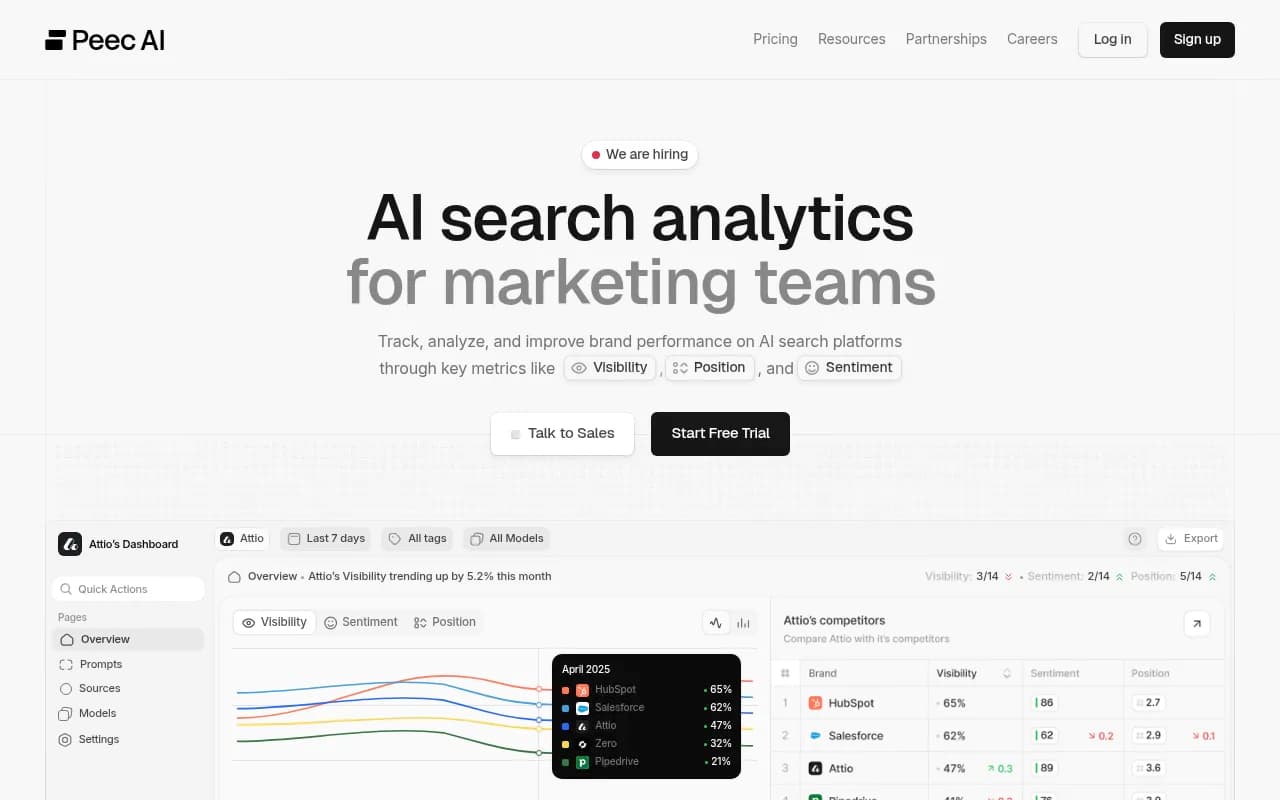
2. Peec AI: prompt monitoring without the muscle
Peec AI tracks prompt-based visibility across AI platforms and gives you a reasonably clean interface for seeing how your brand performs across different queries. The daily monitoring cadence is useful, and the UI is approachable for teams without deep technical resources.
But Peec AI is fundamentally a monitoring tool. There's no content generation, no answer gap analysis, no Reddit or YouTube source tracking, and no way to see which of your pages AI crawlers are actually visiting. You're watching numbers move without any levers to pull.
At €89/month, it's not cheap for what you get. Teams that outgrow basic monitoring will find themselves hitting a wall quickly.
3. Ahrefs Brand Radar: a legacy tool's AI add-on problem
Ahrefs is a genuinely excellent traditional SEO platform. Brand Radar, its AI visibility feature, is a different story.
The core issue is that Brand Radar uses fixed prompts. You can't customize which queries you track, which means you're monitoring visibility for questions Ahrefs decided matter -- not the actual prompts your customers are typing into ChatGPT. There's also no AI traffic attribution, so you can't connect AI mentions to actual website visits or revenue.
For a tool at Ahrefs' price point, the AI visibility layer feels like a checkbox feature rather than a genuine investment. If you're already paying for Ahrefs for traditional SEO, Brand Radar is a nice-to-have. If AI visibility is your primary concern, it's not built for that.
4. Semrush: same fixed-prompt problem, bigger price tag
Semrush has made significant moves into AI visibility tracking, and credit where it's due -- the platform has enormous data infrastructure and a well-established user base. But its AI visibility features share the same fundamental limitation as Ahrefs Brand Radar: fixed prompts.
You're tracking visibility for a preset list of queries rather than the specific prompts your audience actually uses. That's a meaningful gap. A SaaS company selling to mid-market finance teams has very different prompt patterns than a D2C skincare brand, and a fixed-prompt system can't capture that nuance.
Semrush also lacks depth on the optimization side. It can show you AI visibility data, but it doesn't help you create content engineered to improve those numbers.
5. Search Party: agency-flavored, data-light
Search Party positions itself as an agency-oriented AI visibility solution, and the pitch is compelling. Agencies managing multiple clients need consolidated reporting, and Search Party delivers a reasonable version of that.
Where it falls short is in the underlying data. Prompt metrics are limited -- you don't get volume estimates or difficulty scores that would help you prioritize which queries to target. There's no content gap analysis to show you what your clients' sites are missing. And the optimization workflow is thin compared to platforms built around the full GEO loop.
For agencies that want to show clients a dashboard, Search Party works. For agencies that want to actually improve client visibility, the toolset runs out quickly.
Search Party
6. AthenaHQ: monitoring with enterprise pricing
AthenaHQ tracks brand visibility across multiple AI search engines and offers competitive benchmarking. The interface is clean, the coverage is decent, and it's clearly built for larger organizations.
The gap is optimization. AthenaHQ is monitoring-focused -- it doesn't offer content generation, content gap analysis, or crawler log access. For an enterprise-tier platform, that's a significant omission. You're paying enterprise prices for a tool that tells you what's wrong without helping you fix it.
The other issue is that without crawler logs, you can't see how AI engines are actually discovering (or failing to discover) your content. That's a blind spot that matters a lot when you're trying to understand why your visibility scores aren't moving.
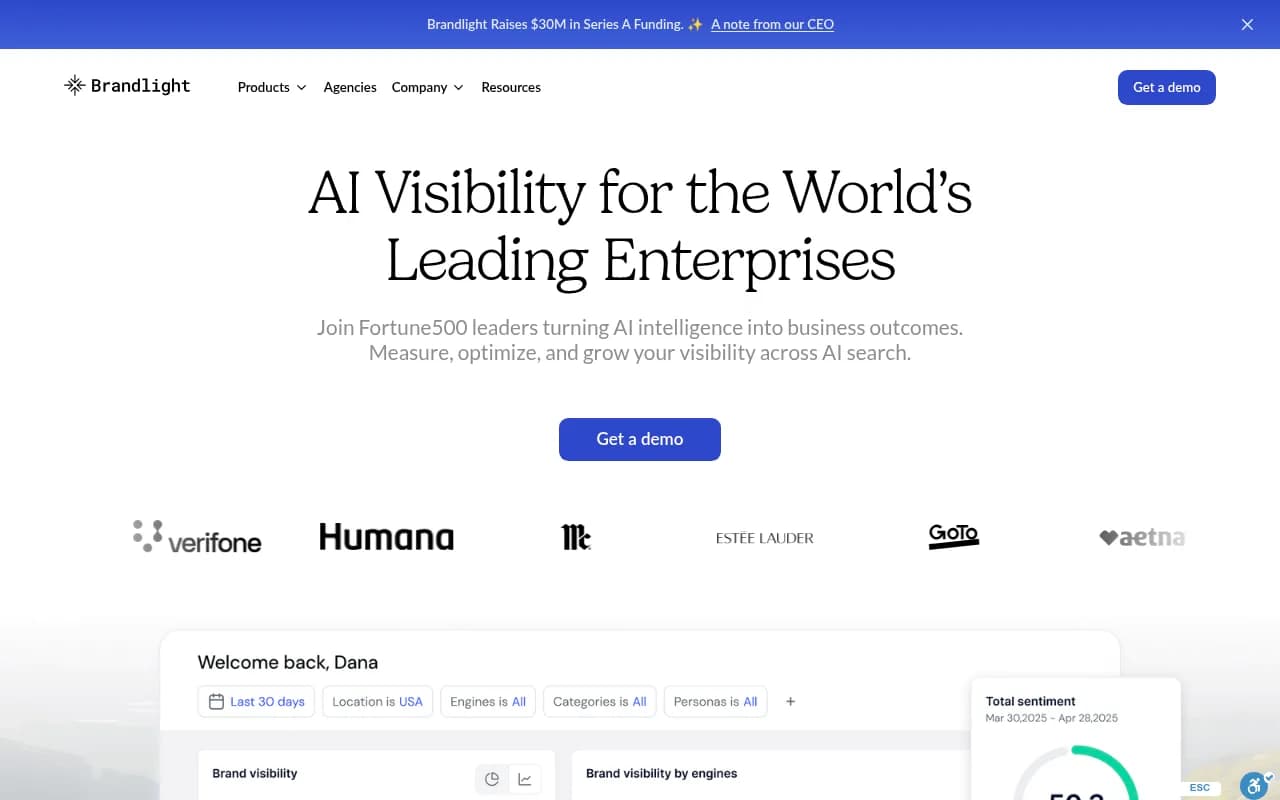
7. Brandlight.ai: limited scope, limited depth
Brandlight.ai focuses on brand monitoring in AI responses, which is a legitimate use case. But the feature set is narrow. Coverage across AI models is limited compared to more comprehensive platforms, and there's no meaningful optimization layer.
For teams that need to monitor a handful of specific queries across one or two AI platforms, Brandlight.ai might be sufficient. For anyone with broader ambitions -- tracking across 10+ LLMs, understanding prompt volumes, generating content to close gaps -- it's not built for that.
8. Profound: strong features, steep entry point
Profound is one of the more capable platforms in the GEO space. It has genuine depth on the monitoring side, competitive intelligence features, and a more serious approach to AI visibility than many of its peers.
The honest criticism here isn't about features -- it's about access. Profound's pricing puts it out of reach for most mid-market teams and smaller agencies. And even at the enterprise tier, it lacks some capabilities that matter: Reddit tracking, ChatGPT Shopping monitoring, and the kind of traffic attribution that connects AI visibility to actual revenue.
For large enterprises with budget to match, Profound is worth evaluating. For everyone else, the value equation is harder to justify.
9. Scrunch: monitoring wrapper with a GEO label
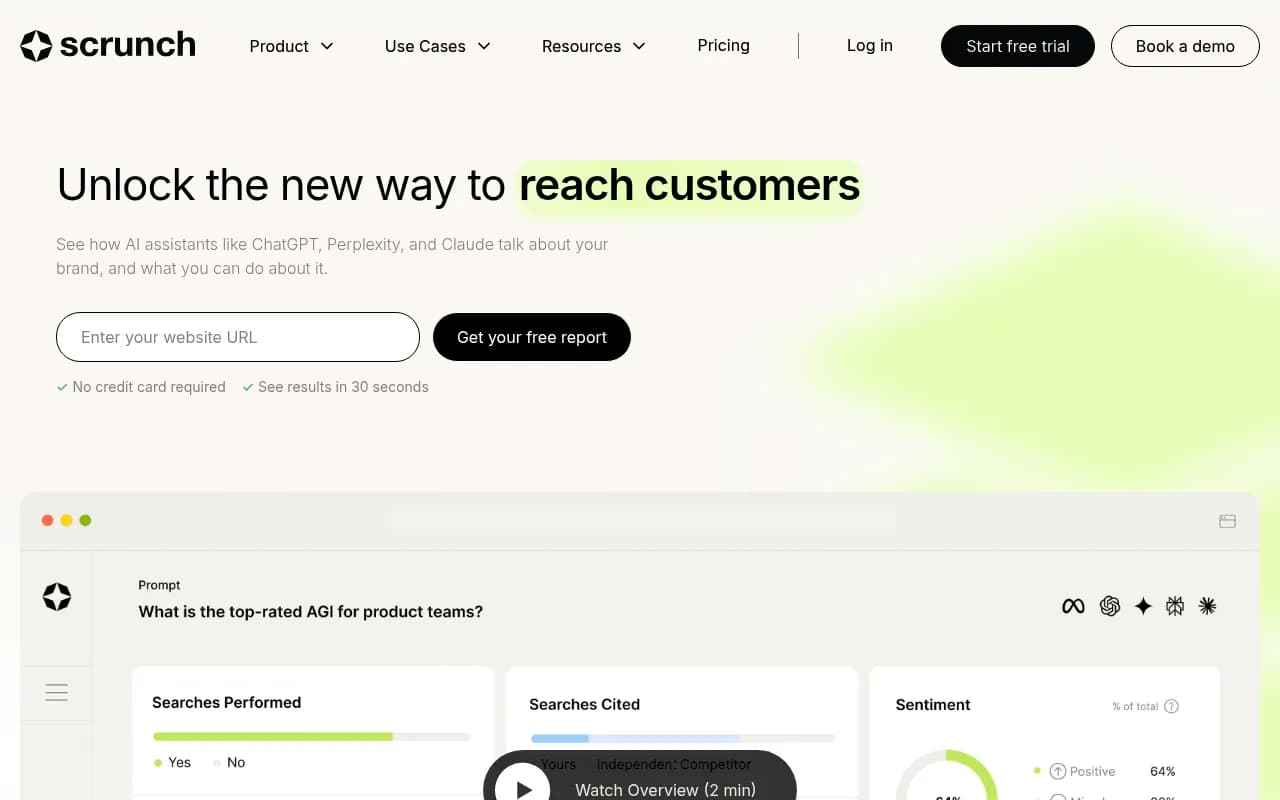
Scrunch markets itself as a GEO optimization platform, but in practice it's closer to a monitoring tool with optimization-adjacent language in the marketing copy. You can track how AI assistants like ChatGPT and Claude respond to queries about your brand, which is useful.
What you can't do is generate content inside the platform, access crawler logs, track prompt volumes, or get Reddit and YouTube source analysis. The "optimization" part of the pitch is thin. Teams that buy Scrunch expecting a full GEO workflow will find themselves exporting data and doing the actual work elsewhere.
What a complete GEO platform actually looks like
It's easy to criticize. It's more useful to describe what "good" looks like, so you know what to compare against.
A platform that actually closes the GEO loop needs to do three things well:
Find the gaps. Not just "your competitor ranks higher" but specifically which prompts they're winning, what content is being cited, and what's missing from your site. Answer gap analysis -- showing you the exact questions AI models want answered that your content doesn't address -- is the key capability here.
Help you fix them. This means content generation built around real citation data, not generic SEO filler. The content needs to be engineered for AI citation: structured correctly, covering the right topics, targeting the right prompt patterns.
Track whether it worked. Page-level citation tracking, traffic attribution (via code snippet, GSC integration, or server logs), and visibility scores that move in response to your content changes. Without this, you're flying blind.
Most tools in the market cover one of these three. A few cover two. Very few cover all three.
Promptwatch is one of the platforms that covers the full loop -- find gaps, generate content, track results -- and it's the approach that separates optimization platforms from monitoring dashboards. It also adds capabilities most competitors don't have at all: real-time AI crawler logs (so you can see which pages ChatGPT and Perplexity are actually reading), Reddit and YouTube source tracking, ChatGPT Shopping monitoring, and prompt volume and difficulty scores to help you prioritize.

How the tools compare
Here's a quick comparison of the platforms covered in this guide against the capabilities that actually matter for GEO:
| Platform | Custom prompts | Content generation | Crawler logs | Traffic attribution | Reddit/YouTube tracking | Prompt volume data |
|---|---|---|---|---|---|---|
| Otterly.AI | Yes | No | No | No | No | No |
| Peec AI | Yes | No | No | No | No | No |
| Ahrefs Brand Radar | No (fixed) | No | No | No | No | No |
| Semrush | No (fixed) | No | No | No | No | No |
| Search Party | Yes | No | No | No | No | Limited |
| AthenaHQ | Yes | No | No | No | No | No |
| Brandlight.ai | Limited | No | No | No | No | No |
| Profound | Yes | No | No | Limited | No | No |
| Scrunch | Yes | No | No | No | No | No |
| Promptwatch | Yes | Yes | Yes | Yes | Yes | Yes |
The pattern is obvious. Most platforms stop at monitoring. The tools that help you actually improve your AI visibility are a much shorter list.
The questions to ask before buying any GEO tool
If you're evaluating AI visibility platforms right now, here are the questions that cut through the marketing copy:
After I see the data, what can I do inside this tool? If the answer is "export it and work elsewhere," that's a monitoring tool, not an optimization platform.
Can I track the prompts my customers actually use? Fixed-prompt systems are a significant limitation. Your audience's queries are specific to your category, your competitors, and your product -- a preset list won't capture that.
Can I see which of my pages AI crawlers are visiting? Without crawler log access, you're guessing at why your visibility is or isn't improving. This is a capability most tools don't offer.
Can I connect AI visibility to actual traffic and revenue? Visibility scores are vanity metrics without attribution. If a tool can't show you that AI citations are driving real visits, you can't make a business case for the investment.
Does the tool track Reddit and YouTube? These platforms are significant sources for AI citations. A tool that ignores them is missing a meaningful part of the picture.
Most platforms will struggle to answer at least two or three of these questions. That's fine if your needs are genuinely narrow -- basic monitoring is better than no monitoring. But if you're trying to build a real GEO program, you need a platform that can grow with you.
The bottom line
The AI visibility tool market in 2026 is full of dashboards. Dashboards are not strategies. A beautiful chart showing that your competitor appears in 70% of AI responses and you appear in 15% is only useful if you have a clear path to close that gap.
Before signing any contract, run through the questions above. Ask for a demo that shows the full workflow -- not just the monitoring view, but what happens after you see the data. The tools that can walk you through that workflow are the ones worth paying for.
The ones that respond with "we're working on that" or redirect you back to the dashboard? Those are the loading spinners.