Key takeaways
- Otterly.AI is the cheapest entry point ($29/mo) but its base tier is too limited for real enterprise programs -- 15 prompts and no Gemini tracking.
- Promptwatch is the only platform in this group that closes the full loop: find gaps, generate content, track results. It's the pick for brands that want to act on data, not just collect it.
- Relixir combines GEO monitoring with AI content generation and is worth a look for mid-market teams that want an all-in-one workflow at a lower price than enterprise alternatives.
- Evertune is the most sophisticated brand perception platform in the category, built specifically for Fortune 500 brands and CMOs who need statistically rigorous sentiment analysis -- but it starts at ~$3,000/mo.
- If you're an enterprise brand, the real question isn't "which tool shows me data?" It's "which tool helps me do something about it?"
The AI visibility tool market didn't exist three years ago. Now there are 18+ vendors, every one of them claiming to be the best. Most "comparison" articles are written by vendors ranking themselves first. This one isn't.
What follows is an honest look at four platforms that come up most often in enterprise conversations: Otterly.AI, Promptwatch, Relixir, and Evertune. They're genuinely different products serving different needs, and the right choice depends heavily on what your team actually needs to do.
Let's start with the thing most buyers get wrong.
The question most teams ask vs. the question they should ask
Most teams start by asking: "Which tool tracks the most AI models?"
That's a reasonable question. But it's the wrong one for enterprise brands. The better question is: "Which tool helps us improve our AI visibility, not just measure it?"
Monitoring your brand across ChatGPT, Claude, Gemini, and Perplexity is table stakes now. The real differentiator is what happens after you see the data. Do you get a dashboard full of numbers and then... nothing? Or does the platform actually help you figure out what content to create, where to publish it, and whether it worked?
That distinction separates the four platforms in this comparison more than any feature checklist.
Platform overview
Otterly.AI
Otterly.AI is the entry-level option in this group. At $29/mo for its Lite tier, it's the lowest-priced serious AI visibility tool on the market. It tracks brand mentions across ChatGPT, Claude, Perplexity, and a handful of other models, and it's genuinely useful for solo founders or small teams who want to know if their brand is showing up in AI answers.
The problem for enterprise brands is the ceiling. The $29 tier gives you 15 prompts and no Gemini tracking. One independent review noted that "the real working tier is usually 2-5x the headline price" -- a pattern that holds across most tools in this category. For a real enterprise program, you're looking at Otterly's higher tiers, which narrow the gap with more capable platforms.
Otterly is also monitoring-only. There's no content generation, no gap analysis that tells you what to write, and no crawler logs showing how AI bots interact with your site. You see the data; you figure out what to do with it yourself.

Promptwatch
Promptwatch takes a different approach. It's built around what the team calls an "action loop": find gaps, create content, track results. That sounds like marketing language, but it describes something real.
The Answer Gap Analysis shows you exactly which prompts your competitors are visible for that you're not -- not as a vague category insight, but as specific questions AI models are answering without citing your brand. From there, Content Agents generate articles, listicles, and briefs grounded in actual prompt data, citation patterns, and competitor analysis. Then page-level tracking shows whether the content you published is getting cited, by which models, and how often.
That cycle -- identify the gap, fill it, verify it worked -- is what makes Promptwatch an optimization platform rather than a monitoring dashboard. Most competitors stop at step one.
For enterprise teams, a few capabilities stand out. AI Crawler Logs show which pages AI bots are actually reading on your site, what errors they're hitting, and how often they return. This is genuinely rare -- most platforms don't have it. Prompt Intelligence gives volume estimates and difficulty scores for each prompt, so you can prioritize high-value, winnable queries instead of guessing. And multi-language, multi-region support with customizable personas means you can track how AI models respond to your brand across different markets and customer types.
Promptwatch monitors 10 AI models: ChatGPT, Perplexity, Google AI Overviews, Google AI Mode, Claude, Gemini, Meta/Llama, DeepSeek, Grok, Mistral, and Copilot. Pricing starts at $99/mo (Essential), $249/mo (Professional), and $579/mo (Business). Enterprise and agency pricing is custom.

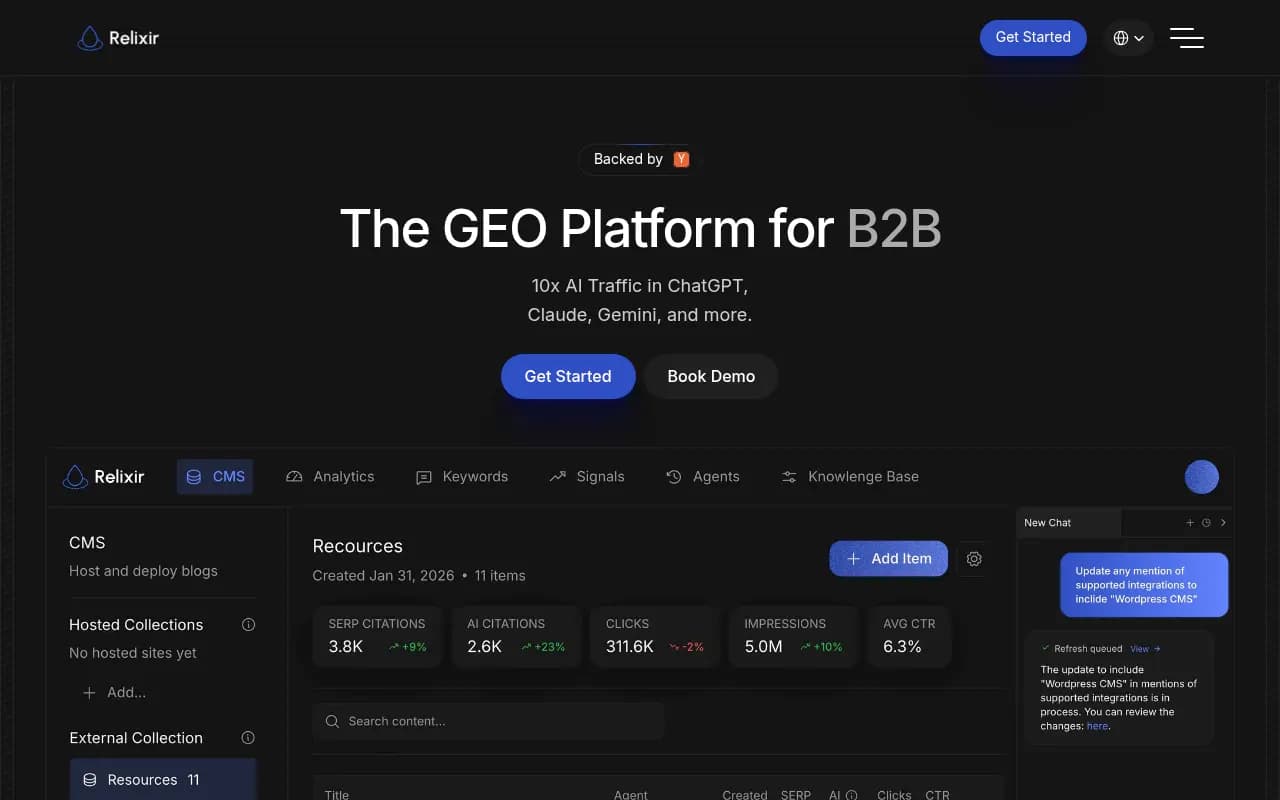
Relixir
Relixir is an all-in-one GEO platform that combines AI search monitoring with content generation. It's positioned between Otterly (monitoring-only, low cost) and the enterprise-tier platforms, which makes it an interesting option for mid-market teams.
The platform tracks brand visibility across major AI models, identifies content gaps, and generates content to fill them -- a workflow similar to Promptwatch's. Where it differs is in depth: Relixir doesn't have the crawler log infrastructure, the prompt volume/difficulty scoring, or the citation analysis depth that Promptwatch offers. It's a capable tool for teams that want an integrated workflow without the full enterprise feature set.
For brands that are just starting to build a GEO program and want something more actionable than pure monitoring, Relixir is worth evaluating.
Evertune
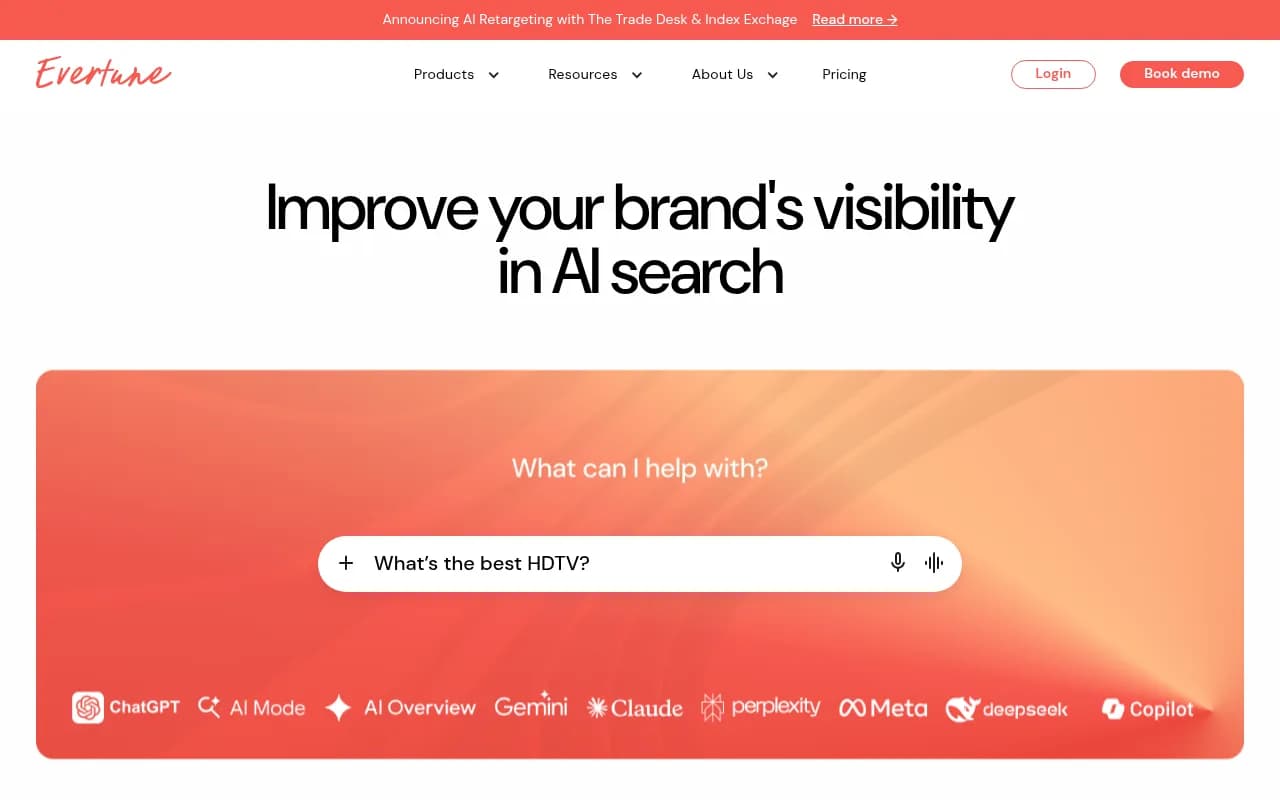
Evertune is the most expensive and most specialized platform in this comparison. It's built for Fortune 500 brands and CMOs who need statistically rigorous brand perception analysis across AI models -- not just "are we mentioned?" but "how are we being described, what sentiment is attached to those mentions, and how does that compare to competitors?"
At roughly $3,000/mo (some sources cite a 1M prompts/brand tier at that price point), it's not for most teams. But for enterprise brands where brand perception in AI answers is a board-level concern, Evertune's depth is hard to match. It's described in multiple independent reviews as the strongest platform for brand perception specifically -- the kind of analysis that goes beyond citation counting into what AI models actually say about you.
What Evertune doesn't do as well is the optimization side. It's strong on measurement and intelligence; it's less focused on helping you create content that improves those scores.
Feature comparison
| Feature | Otterly.AI | Promptwatch | Relixir | Evertune |
|---|---|---|---|---|
| AI models tracked | 4-6 | 10 | 6+ | 8+ |
| Entry price | $29/mo | $99/mo | Custom | ~$3,000/mo |
| Content gap analysis | No | Yes | Yes | Limited |
| AI content generation | No | Yes | Yes | No |
| AI crawler logs | No | Yes | No | No |
| Prompt volume/difficulty | No | Yes | No | No |
| Brand sentiment/perception | Basic | Basic | Basic | Deep |
| Reddit/YouTube tracking | No | Yes | No | No |
| ChatGPT Shopping tracking | No | Yes | No | No |
| Multi-language/region | Limited | Yes | Limited | Yes |
| Traffic attribution | No | Yes | No | No |
| Best for | Solo/small teams | Growth to enterprise | Mid-market | Fortune 500/CMOs |
Where each platform wins
When Otterly.AI makes sense
If you're a solo founder, a small startup, or a consultant who just wants to know whether your brand is showing up in AI answers, Otterly is a reasonable starting point. The price is low, setup is fast, and it gives you a basic read on visibility without a significant commitment.
The honest caveat: once you want to do anything about what you find, you'll outgrow it quickly. There's no path from "I see I'm not being cited" to "here's what I should create to fix that."
When Promptwatch makes sense
Promptwatch is the right choice for marketing and SEO teams that need to move from monitoring to optimization. If your team is asking "we know we're not visible in AI search -- what do we do about it?", Promptwatch is the only platform in this group that answers that question end-to-end.
It's also the right choice if you need to track AI crawler behavior on your site, understand prompt volumes before investing in content, or connect AI visibility to actual traffic and revenue. The $249/mo Professional tier is where most serious programs start; the $579/mo Business tier supports multi-site operations.
For agencies managing multiple clients, the enterprise tier adds white-label reporting and custom workflows.
When Relixir makes sense
Relixir fits mid-market teams that want an integrated GEO workflow -- monitoring plus content generation -- without paying enterprise prices. If Promptwatch's feature depth feels like more than you need right now, Relixir is a reasonable alternative to evaluate.
The trade-off is that you're getting a less mature platform with less depth in analytics, crawler intelligence, and prompt data. For teams that are earlier in their GEO journey, that might be fine.
When Evertune makes sense
Evertune is for enterprise brands where the question isn't "are we visible?" but "how are we being perceived, and is that perception accurate?" If your CMO needs to report to the board on brand health in AI-generated answers -- with statistical confidence intervals and competitive benchmarking -- Evertune is built for that use case.
At $3,000+/mo, it's a significant investment. But for a Fortune 500 brand where brand perception in AI answers is a material business risk, the price is defensible.
The pricing reality check
One thing worth saying directly: the headline prices in this category are almost always misleading.
Otterly's $29/mo tier gives you 15 prompts. A real enterprise program tracks hundreds of prompts across multiple markets. Promptwatch's $99/mo Essential tier covers 50 prompts and one site -- useful for testing, but most enterprise programs need the $249 or $579 tier. Evertune's pricing isn't publicly listed but multiple sources put it in the $3,000+/mo range.
The practical advice: before signing up for any platform, map out how many prompts you actually need to track, how many sites or brands you're managing, and whether you need content generation or just monitoring. Then price accordingly -- not from the homepage headline.
What most enterprise brands get wrong
The biggest mistake enterprise teams make in this category is buying a monitoring tool and calling it a GEO strategy.
Knowing that your brand is cited in 12% of relevant ChatGPT responses is interesting data. But it doesn't tell you which content to create, which prompts to target, or whether your optimization efforts are working. Most platforms in this category -- including Otterly, and to some extent Evertune -- give you the data and leave you to figure out the rest.
The platforms that close the loop (Promptwatch, and to a lesser degree Relixir) are more valuable for teams that actually want to move the needle. The monitoring-only platforms are fine for awareness; they're not sufficient for a serious optimization program.
How to choose
Here's a simple decision framework:
- You're a solo founder or small team with a limited budget and just want basic visibility monitoring: start with Otterly.AI.
- You're a growth-stage or enterprise brand that needs to track gaps, generate content, and measure results: Promptwatch is the strongest end-to-end option.
- You're a mid-market team that wants an integrated workflow at a lower price point than enterprise platforms: evaluate Relixir.
- You're a Fortune 500 brand where AI brand perception is a board-level concern and budget isn't the constraint: Evertune is built for you.
The one thing all four platforms agree on, implicitly, is that AI search visibility is no longer optional for brands that care about discovery. The question is just how seriously you want to take it -- and how much of the work you want the platform to do for you.
For most enterprise marketing teams, the answer to that last question is: as much as possible. That's why the platforms that go beyond monitoring to actually help you optimize are pulling ahead.