Key takeaways
- Conversational and voice-style queries now make up a significant share of AI search prompts -- and most visibility platforms weren't built with that format in mind.
- Promptwatch is the only platform in this comparison that covers the full loop: tracking conversational prompts, identifying content gaps, generating optimized content, and attributing results to revenue.
- Profound is the strongest enterprise option for raw monitoring depth but lacks content generation and Reddit/voice-format insights.
- Peec AI and AthenaHQ are monitoring-only tools -- useful for awareness, but they leave you to figure out what to do with the data.
- If your audience is asking AI engines questions the way they'd ask a friend, you need a platform built around prompt intelligence, not just keyword tracking.
Why conversational queries are a different problem
There's a meaningful difference between someone typing "best CRM software" into Google and someone asking ChatGPT "what's the best CRM for a five-person sales team that doesn't want to deal with a lot of setup?" The second query is longer, more specific, and structured like a real conversation. It has intent baked in. It has context. And it's increasingly how people use AI search engines.
Voice queries push this even further. When someone asks their phone or smart speaker a question, they're not thinking in keywords. They're asking full questions with natural phrasing, follow-ups, and implicit assumptions. AI models like ChatGPT, Perplexity, and Google's AI Mode are built to handle exactly this -- and they're getting better at it every month.
The problem for marketers is that traditional SEO tools were never designed for this. Keyword rank trackers don't capture "what would you recommend for someone who travels a lot and needs offline access?" They track "offline CRM" or "CRM for travelers." That's a fundamentally different signal.
So the question becomes: which AI visibility platforms actually understand conversational and voice-format queries, and which ones are just slapping a new label on old keyword tracking?
What to look for in a platform built for conversational queries
Before comparing tools, it helps to know what actually matters here. A platform that handles conversational and voice-format tracking well should do a few things:
- Track prompts in natural language, not just short-tail keywords
- Show you how AI models respond to question-format queries (not just whether your brand appears)
- Identify which conversational prompts competitors are winning that you're not
- Help you understand the follow-up questions (query fan-outs) that branch off a single prompt
- Generate content that answers conversational queries in the format AI models prefer to cite
That last point is where most tools fall short. Monitoring what's happening is step one. Doing something about it is where the real work is.
The four platforms compared
Promptwatch
Promptwatch is the platform most directly built around the conversational query problem. Its prompt tracking system is designed around natural language inputs -- the kind of questions real users type or speak into AI search interfaces. Rather than tracking fixed keyword sets, it monitors how AI models respond to full-sentence prompts across ChatGPT, Perplexity, Claude, Gemini, Google AI Overviews, Google AI Mode, Grok, DeepSeek, Copilot, and Meta AI.

The feature that sets it apart for conversational tracking is query fan-outs. When someone asks a broad question, AI models don't just answer that question -- they break it into sub-queries, each of which might pull from different sources. Promptwatch maps these fan-outs, so you can see the full tree of related questions your content needs to answer. That's genuinely useful for voice and conversational formats, where a single prompt can branch in five different directions.
Answer Gap Analysis is the other piece. It shows you the specific conversational prompts where competitors are being cited and you're not. Not a vague "you're missing coverage in this topic cluster" -- the actual prompt, the actual competitor, the actual gap. From there, Content Agents can generate articles, listicles, and comparison pages designed to answer those exact questions in the format AI models prefer to cite.
The crawler log feature (available on Professional and Business plans) shows which AI crawlers are hitting your pages, how often, and whether those visits are converting to citations. For conversational content specifically, this tells you whether the pages you've created to answer voice-format questions are actually being read by AI engines.
Pricing starts at $99/month for the Essential plan (1 site, 50 prompts, 5 articles). Professional is $249/month, Business $579/month.
Profound
Profound is the enterprise-grade option in this comparison. It's built for large brands that need deep monitoring across many markets and has shipped some genuinely impressive features in 2026, including autonomous Agents and MCP integration.
For conversational query tracking, Profound does well on the monitoring side. It tracks AI responses across multiple models and can handle complex, multi-part prompts. Enterprise teams with large prompt libraries will appreciate the scale it operates at.
Where it falls short for voice and conversational formats specifically: there's no Reddit tracking, no query fan-out mapping, and no built-in content generation. If you're trying to understand how conversational queries branch and what content you need to create to win them, Profound gives you the data but not the path forward. You'll need a separate content team or tool to act on what you find.
It's also priced for enterprise. Smaller teams or agencies will find the cost hard to justify when they need both monitoring and execution capability.
Peec AI
Peec AI is a monitoring tool. It tracks brand mentions and citations across AI search engines and gives you a dashboard view of where you appear and where you don't. For teams that just want visibility into their current AI search presence, it's a reasonable starting point.
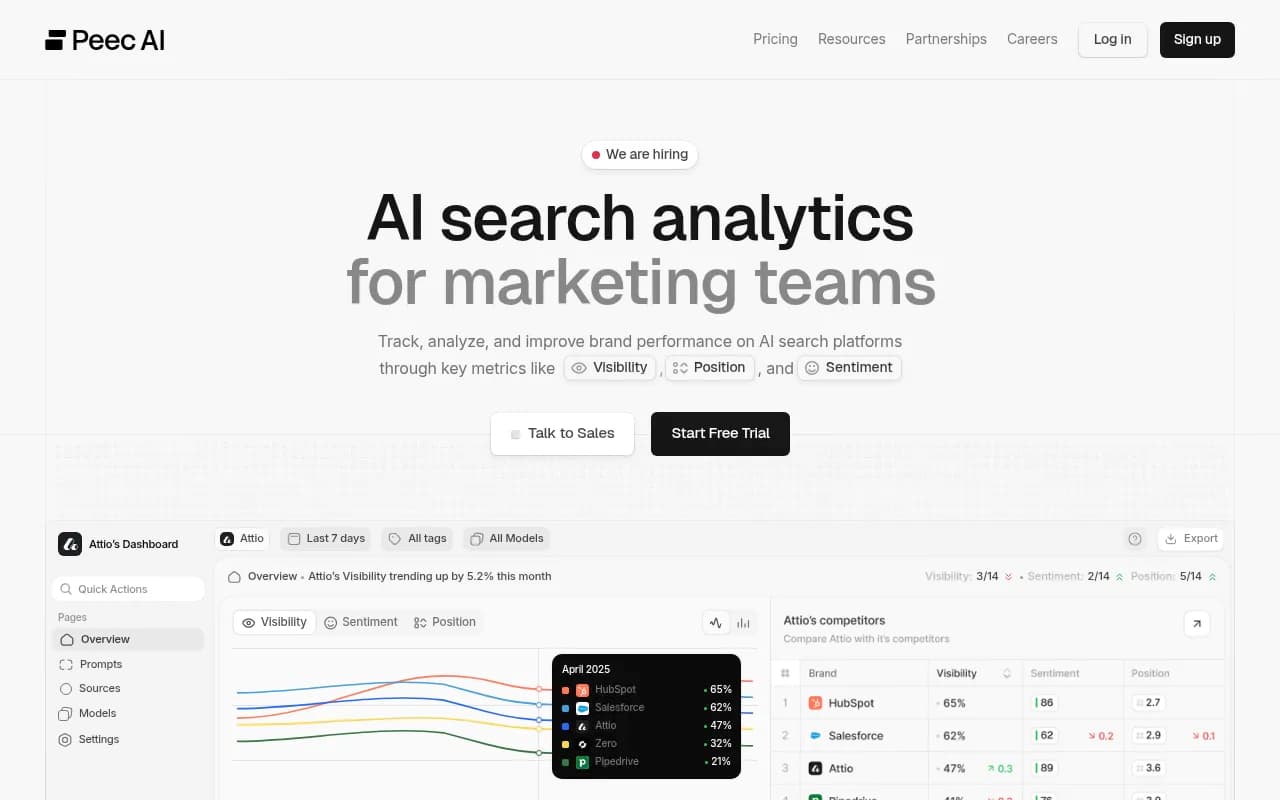
For conversational and voice-format queries, though, it has real limitations. Peec AI doesn't offer prompt volume data, query fan-outs, or content gap analysis. You can see that you're not appearing for a conversational prompt, but you can't easily understand why or what to do about it. There's no content generation layer, no crawler logs, and no Reddit or YouTube insights -- both of which are increasingly important channels for understanding how AI models form their conversational answers.
It's a monitoring-only tool, which is fine if that's all you need. But if you're trying to actually improve your visibility for voice and conversational queries, you'll hit a ceiling quickly.
AthenaHQ
AthenaHQ sits in a similar position to Peec AI -- strong on monitoring, limited on action. It tracks AI search visibility across several models and has added some useful features around share-of-voice tracking and content readiness scoring.
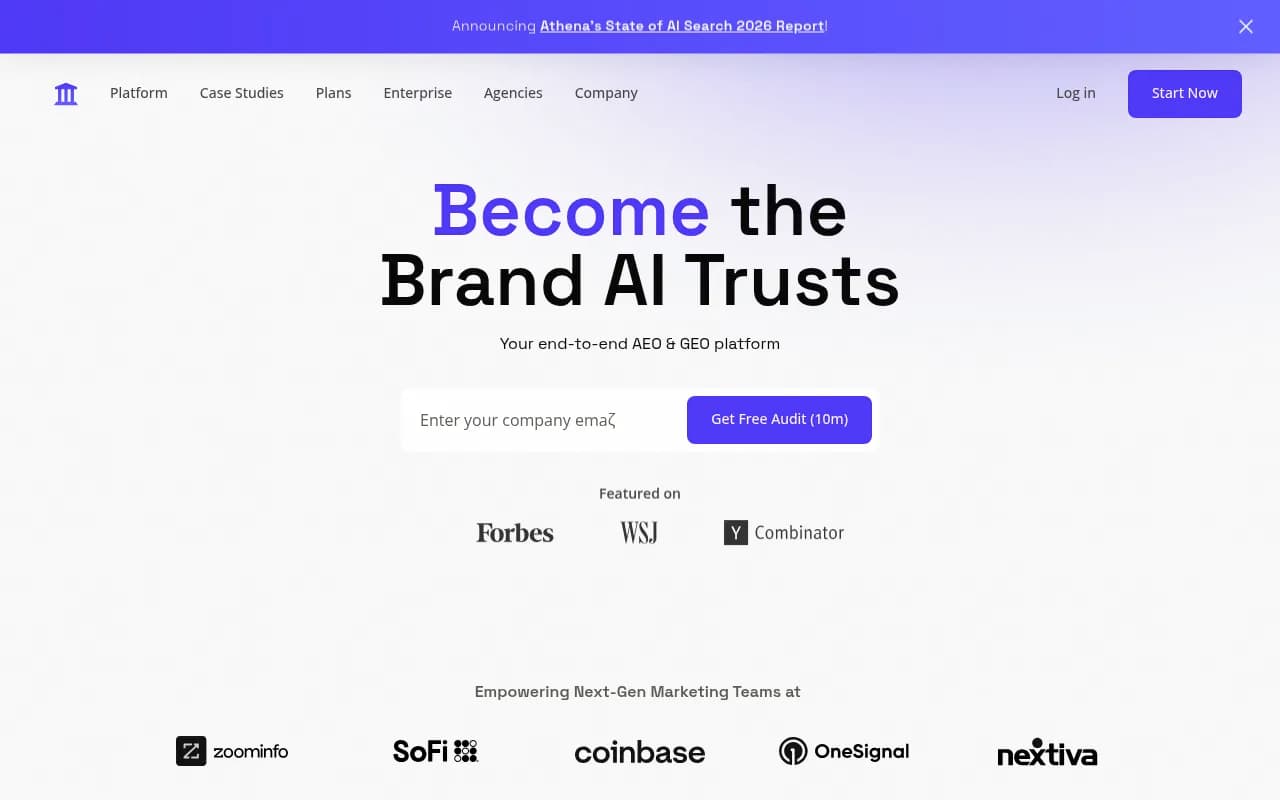
The platform uses prompts as its core mechanism, which is a good sign for conversational query tracking. But the depth isn't quite there. Users have noted that AthenaHQ can feel limited when it comes to newer AI result formats -- Google AI Mode, voice-style responses, and the kind of multi-turn conversational queries that are becoming more common. There's no content generation, no crawler logs, and no Reddit insights.
For teams already using AthenaHQ and wanting to go deeper on conversational query optimization, the gap between what the platform shows you and what you can actually do with that information is frustrating.
Side-by-side comparison
| Feature | Promptwatch | Profound | Peec AI | AthenaHQ |
|---|---|---|---|---|
| Conversational/natural language prompts | Yes | Yes | Limited | Yes |
| Query fan-outs | Yes | No | No | No |
| Answer gap analysis | Yes | Limited | No | No |
| AI models tracked | 10+ | Multiple | Several | 8+ |
| Content generation | Yes (Content Agents) | No | No | No |
| AI crawler logs | Yes | No | No | No |
| Reddit & YouTube insights | Yes | No | No | No |
| ChatGPT Shopping tracking | Yes | No | No | No |
| Prompt volume & difficulty scoring | Yes | No | No | No |
| Traffic & revenue attribution | Yes | Limited | No | No |
| Page-level citation tracking | Yes | No | No | No |
| Multi-language/multi-region | Yes | Yes | Limited | Limited |
| Starting price | $99/mo | Enterprise | ~$49/mo | Custom |
| Free trial | Yes | No | Yes | Limited |
How each platform handles the voice query problem specifically
Voice queries have a few characteristics that make them tricky for standard AI visibility tools:
- They're longer and more conversational in structure
- They often include filler words and natural speech patterns
- They're highly intent-specific -- someone asking "what's a good restaurant near me open now" has very different intent from "best restaurants in [city]"
- They frequently involve follow-up questions that build on the previous answer
Most AI visibility platforms track prompts as static strings. You define the prompt, they track it. That works fine for short-tail queries but misses the dynamic, branching nature of voice and conversational search.
Promptwatch's query fan-out feature is the closest thing to a real solution here. By mapping how a single prompt branches into sub-queries, it captures the conversational structure of how AI models actually process voice-style inputs. If someone asks "what's the best project management tool for remote teams?" the fan-out might include sub-queries about pricing, integrations, ease of use, and team size -- each of which might pull from different sources. Knowing that tree lets you create content that answers the whole conversation, not just the top-level question.
Profound handles the monitoring side of voice queries reasonably well at scale, but without fan-out mapping or content generation, it's showing you the problem without helping you solve it.
Peec AI and AthenaHQ don't have meaningful differentiation for voice formats specifically. They track prompts, including conversational ones, but treat them the same as any other query type.
Which platform is right for you?
The honest answer depends on what you actually need to do.
If you need to track, understand, and act on conversational and voice-format queries -- and you want all of that in one platform -- Promptwatch is the clear choice. The combination of query fan-outs, answer gap analysis, content generation, and crawler logs is purpose-built for this problem. No other tool in this comparison comes close to covering the full loop.
If you're an enterprise brand with a large internal content team and you just need deep monitoring data to feed into your existing workflows, Profound is worth evaluating. You'll need to build the execution layer yourself, but the monitoring depth is real.
If you're early-stage and just want to understand your current AI search presence before committing to a full platform, Peec AI or AthenaHQ can serve as a starting point. Just go in knowing you'll outgrow them quickly if you're serious about conversational query optimization.
A note on the broader market
The GEO and AI visibility space has grown fast. There are now dozens of tools claiming to help with AI search optimization, and the feature lists are starting to blur together. The meaningful distinction isn't between tools that track 8 AI models versus 10 -- it's between tools that show you data and tools that help you do something with it.
Conversational and voice-format queries are a good test case for this. They're harder to track, harder to optimize for, and require a more sophisticated understanding of how AI models process natural language. A platform that handles them well is probably handling the rest of AI search optimization well too.
The market will keep moving. Profound shipped autonomous agents in 2026. AthenaHQ added Shopify revenue attribution. These are real improvements. But the fundamental gap between monitoring-only tools and full-stack optimization platforms hasn't closed -- and for teams trying to win conversational queries, that gap matters more than ever.
Bottom line
Voice and conversational queries aren't a niche use case anymore. They're how a growing share of people interact with AI search engines, and the brands that figure out how to optimize for them now will have a real advantage as the behavior becomes even more widespread.
Of the four platforms compared here, Promptwatch is the only one built to handle the full problem: tracking conversational prompts, mapping query fan-outs, identifying content gaps, generating content that answers those gaps, and attributing the results to actual traffic and revenue. The others have pieces of the puzzle, but not the whole picture.
For teams serious about AI search visibility in 2026, that's the distinction worth paying attention to.