Key takeaways
- Informational and commercial intent queries behave very differently inside AI search engines, and most platforms don't track them separately by default.
- Promptwatch is the only platform in this comparison that combines intent-aware prompt tracking with content generation and crawler logs, making it the only tool that helps you act on the gap, not just see it.
- Profound has strong enterprise-grade monitoring but sits at a higher price point and lacks content creation capabilities.
- Peec AI is a lightweight, affordable option for teams that only need basic monitoring and don't need to separate intent types.
- AthenaHQ is monitoring-focused with Shopify revenue attribution, but doesn't generate content or provide crawler-level data.
- If you're serious about winning AI search in 2026, tracking intent separately is table stakes -- and your platform needs to support it.
Why intent type matters in AI search
Here's something most AI visibility guides skip over: the way an AI model responds to "what is the best project management software?" is fundamentally different from how it responds to "how do project management tools handle dependencies?"
The first is commercial intent. The second is informational. In traditional SEO, we've been separating these for years. In AI search, most teams are still treating every prompt the same way.
That's a problem. AI models like ChatGPT, Perplexity, and Gemini draw on different source types depending on what the user seems to want. A commercial query often surfaces comparison pages, listicles, and review sites. An informational query pulls from documentation, tutorials, and explainer content. If you're tracking both in one bucket, your visibility score is a blurry average of two very different competitive landscapes.
The practical consequence: you might be winning on informational queries (because you have good docs) while losing badly on commercial ones (because your comparison pages are weak), and your dashboard just shows you a middling overall score. You'd never know where to focus.
This guide looks at four platforms that have emerged as the main contenders in 2026 -- Promptwatch, Profound, Peec AI, and AthenaHQ -- and evaluates how well each one handles intent separation, and what you can actually do with that data.
The four platforms at a glance
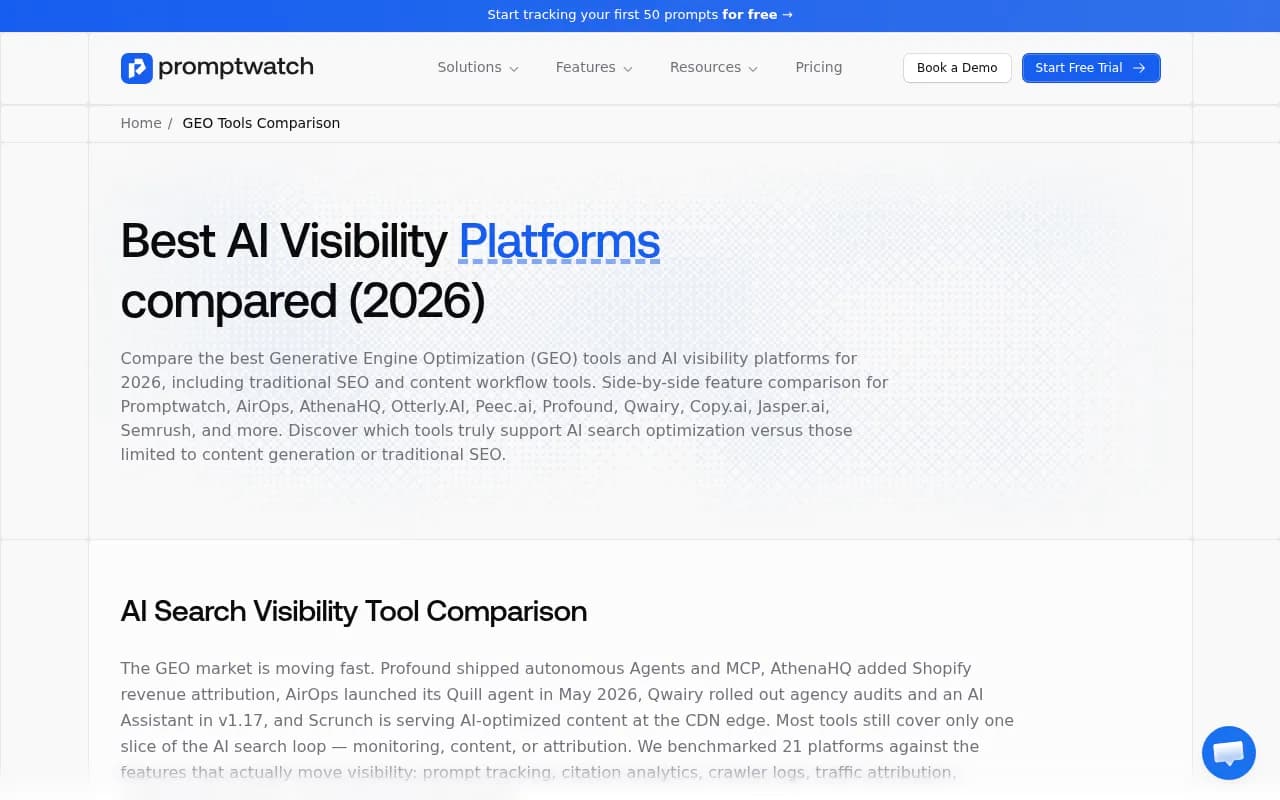
Before getting into the details, here's a quick feature comparison across the dimensions that matter most for intent-based tracking:
| Feature | Promptwatch | Profound | Peec AI | AthenaHQ |
|---|---|---|---|---|
| Intent-based prompt segmentation | Yes | Partial | No | No |
| Custom prompt categories | Yes | Yes | Limited | Yes |
| Informational query tracking | Yes | Yes | Yes | Yes |
| Commercial query tracking | Yes | Yes | Yes | Yes |
| Separate dashboards per intent type | Yes | Partial | No | No |
| Content gap analysis | Yes | No | No | No |
| AI content generation | Yes | No | No | No |
| Crawler logs / agent analytics | Yes | No | No | No |
| Reddit & YouTube tracking | Yes | No | No | No |
| ChatGPT Shopping tracking | Yes | No | No | No |
| Page-level citation tracking | Yes | Yes | No | Partial |
| AI traffic attribution | Yes | No | No | Partial |
| Prompt volume & difficulty scores | Yes | No | No | No |
| Starting price | $99/mo | Higher | Lower | Mid-range |
Promptwatch
Promptwatch takes the most complete approach to intent separation of any platform in this comparison. You can organize your prompt library into categories -- informational, commercial, navigational, or any custom label you want -- and track visibility scores separately for each. That means you can see, at a glance, that you're cited in 34% of commercial queries but only 12% of informational ones, and then actually do something about it.

The thing that separates Promptwatch from the others isn't just the tracking. It's what happens after you identify the gap. The Answer Gap Analysis shows you exactly which prompts your competitors are appearing for that you're not -- broken down by intent type. Then the Content Agents generate articles, comparisons, and briefs specifically designed to fill those gaps, grounded in real prompt data and citation patterns.
For commercial intent specifically, Promptwatch tracks ChatGPT Shopping recommendations and entity mentions, which matters a lot for e-commerce and SaaS brands. If a user asks ChatGPT "what's the best CRM for a 10-person sales team?" and your brand isn't showing up, you can see that, trace it to a content gap, and fix it.
The AI Crawler Logs (called Agent Analytics) are also genuinely useful here. You can see when Perplexity or ChatGPT's crawlers visit your pages, which pages they read, and when those pages move from "crawled" to "cited." For informational content especially, this helps you understand whether your documentation is being discovered at all -- or whether there's a technical reason it's being skipped.
Promptwatch monitors 10 AI models: ChatGPT, Perplexity, Google AI Overviews, Google AI Mode, Claude, Gemini, Meta/Llama, DeepSeek, Grok, and Copilot. Pricing starts at $99/month for the Essential plan (1 site, 50 prompts, 5 articles), with the Professional plan at $249/month adding crawler logs, 150 prompts, and 15 articles per month.
Profound
Profound is a solid enterprise-grade monitoring platform. It covers the major AI models, gives you good citation analytics, and has added autonomous Agents and MCP integration in 2026. For large brands with dedicated AI search teams, it's a reasonable choice.
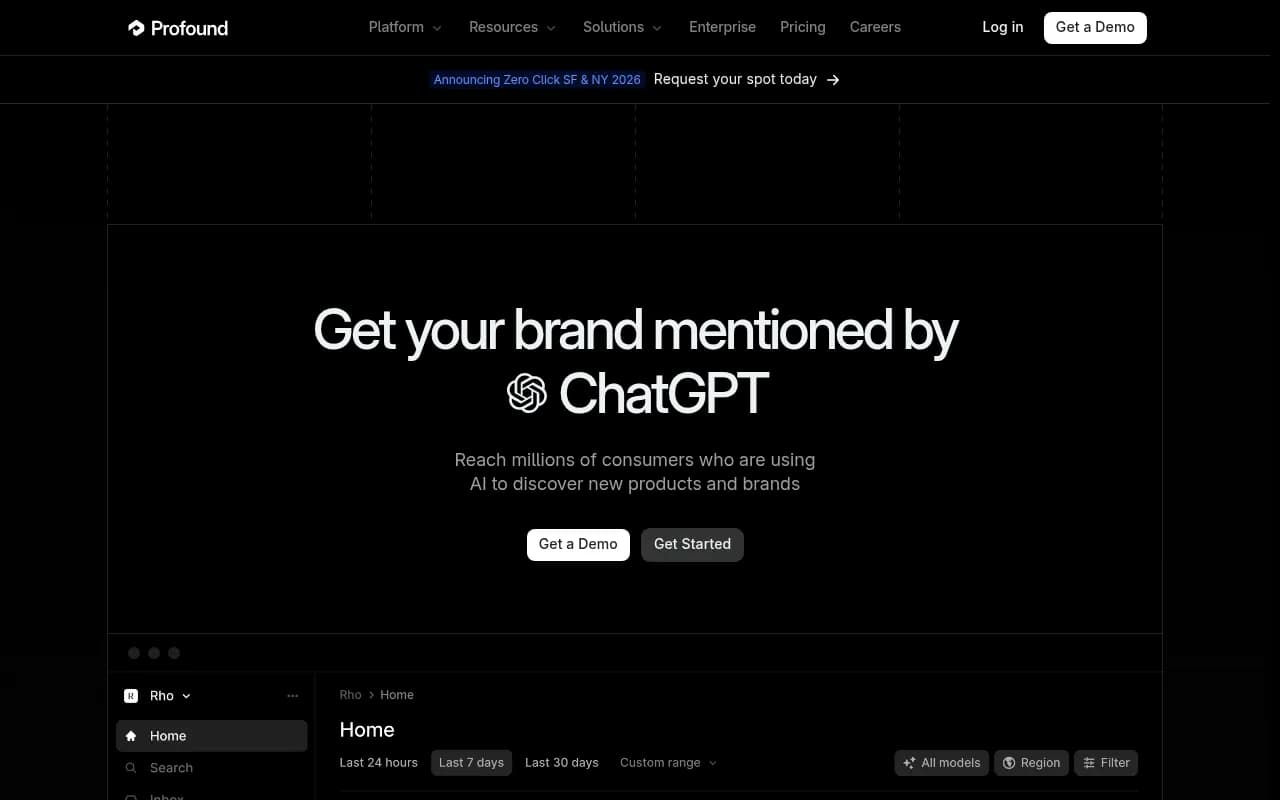
On intent separation specifically, Profound lets you organize prompts into custom categories, so you can create separate buckets for informational and commercial queries. The reporting is clean, and the citation data is detailed. Where it falls short is in what comes next. Profound doesn't generate content, doesn't provide crawler logs, and doesn't have Reddit or YouTube tracking. So you can see that you're losing on commercial queries, but the platform doesn't help you figure out why or what to create to fix it.
Profound also sits at a higher price point than Promptwatch, which makes the monitoring-only positioning harder to justify for mid-market teams. If you're an enterprise with a separate content team and just need the data layer, it works. If you need the full loop from gap to content to tracking, you'll hit a ceiling quickly.
Peec AI
Peec AI is the lightweight option in this group. It's affordable, easy to set up, and gives you basic brand mention tracking across the main AI models. For small teams or agencies that just want to know whether their clients are showing up in AI search at all, it does the job.

The honest limitation: Peec AI doesn't separate intent types in any meaningful way. You get a visibility score and citation counts, but there's no mechanism to tag prompts as informational vs commercial and compare performance across those categories. If you're running a SaaS company and you want to know whether you're winning on "best CRM for startups" (commercial) vs "how to set up a CRM pipeline" (informational), Peec AI can't give you that breakdown.
It's also monitoring-only. No content generation, no crawler data, no gap analysis. For teams that are just getting started with AI visibility and want a low-cost way to check the basics, it's fine. For teams that need to actually improve their position, it runs out of road fast.
AthenaHQ
AthenaHQ has been building out its feature set in 2026, and the Shopify revenue attribution integration is genuinely useful for e-commerce brands. If you're running a Shopify store and want to connect AI visibility to actual purchase data, AthenaHQ is one of the few tools that does this.
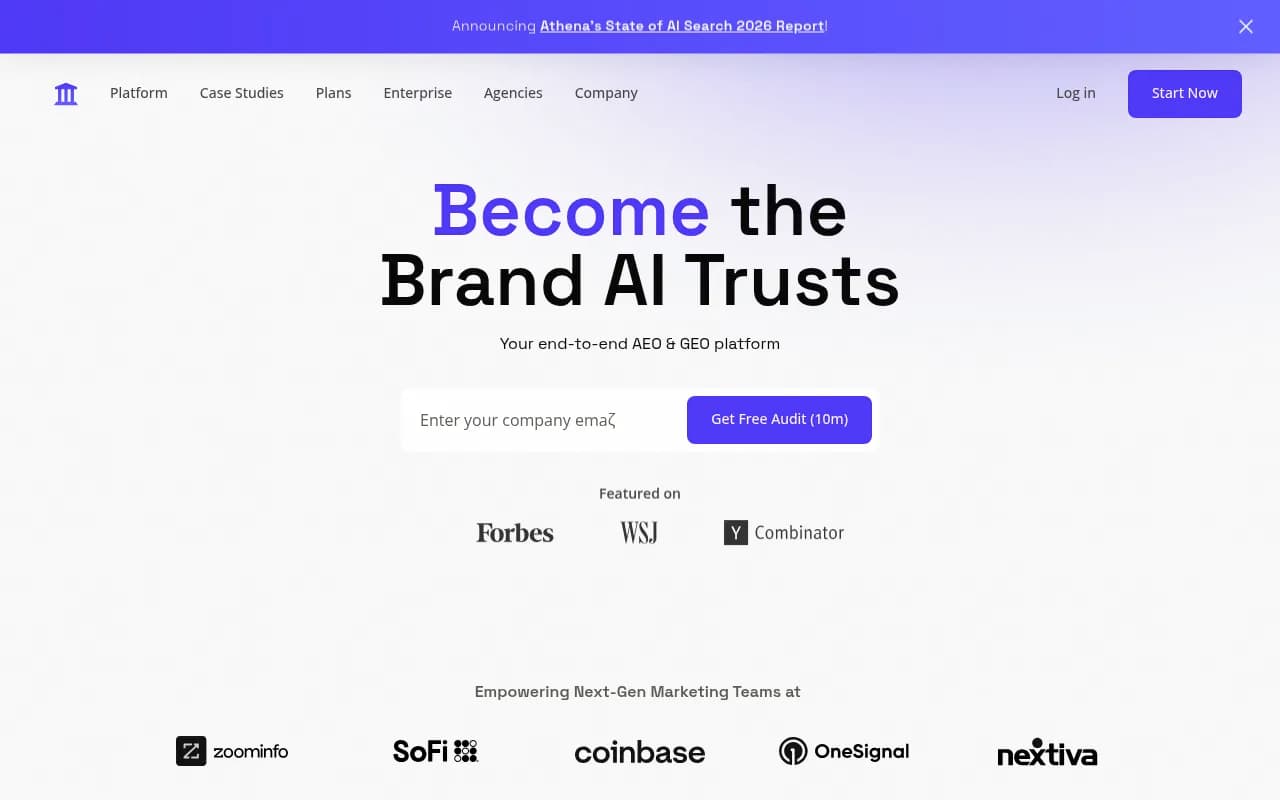
On intent separation, AthenaHQ lets you create custom prompt categories, so you can technically separate informational and commercial queries. The monitoring coverage is decent, and the reporting interface is clean. The gaps are similar to Profound: no content generation, no crawler logs, no Reddit tracking. AthenaHQ is monitoring-focused, which is fine if that's all you need.
For e-commerce teams specifically, the combination of AI visibility monitoring and revenue attribution is a compelling story. For B2B SaaS or content-heavy brands, the lack of content optimization tools is a real limitation.
How to actually use intent separation in practice
Knowing that a platform supports intent separation is one thing. Knowing what to do with that data is another. Here's a practical workflow:
Step 1: Build two prompt lists
Create one list of informational prompts (how-to questions, explainer queries, comparison questions that start with "what is" or "how does") and one list of commercial prompts (best-of queries, "vs" comparisons, buying-intent questions). Aim for 20-30 prompts in each category to start.
Step 2: Track visibility separately
Run both lists through your platform and look at your visibility scores for each category independently. Most brands find a significant gap between the two -- usually performing better on one than the other.
Step 3: Find the specific gaps
For the category where you're underperforming, look at which specific prompts your competitors are winning. In Promptwatch, the Answer Gap Analysis does this automatically. In Profound or AthenaHQ, you'll need to review the citation data manually.
Step 4: Map gaps to content
For informational gaps, you're usually missing documentation, tutorials, or explainer content. For commercial gaps, you're usually missing comparison pages, listicles, or detailed feature breakdowns. The content type matters because AI models pull different source types for different intent categories.
Step 5: Create and track
Publish the content, then track whether AI crawlers discover it and whether it starts generating citations. Promptwatch's Agent Analytics shows you this timeline directly. With other platforms, you're inferring it from visibility score changes over time.
Which platform should you use?
The right answer depends on what you actually need to do.
If you need the full loop -- tracking, gap analysis, content creation, and crawler monitoring -- Promptwatch is the only platform in this comparison that covers all of it. The intent separation is built in, the content generation is grounded in real prompt data, and the crawler logs tell you whether your new content is actually being discovered.
If you're an enterprise with a large content team and just need a clean data layer, Profound is a reasonable choice. The monitoring is solid and the enterprise features are mature.
If you're an e-commerce brand on Shopify and revenue attribution is your primary concern, AthenaHQ's integration is worth looking at.
If you're a small team or agency with a tight budget and just want basic visibility monitoring, Peec AI gets you started without a large commitment.
But here's the thing: most teams that start with a monitoring-only tool eventually hit the same wall. They can see they're invisible for commercial queries. They don't know why. They don't know what to create. They publish something based on a guess, wait three months, and check again. That's a slow and expensive way to improve.
The platforms that separate themselves in 2026 are the ones that close the loop between data and action. Right now, only one of the four does that end to end.
A note on prompt volume and difficulty
One dimension that doesn't get enough attention in intent-based tracking: not all prompts are equally worth winning.
A commercial query like "best enterprise CRM" might be asked by thousands of users per month. A commercial query like "best CRM for independent insurance agents in the midwest" might be asked by dozens. Both are commercial intent, but the effort-to-reward ratio is completely different.
Promptwatch includes prompt volume estimates and difficulty scores for each tracked query, which lets you prioritize high-value, winnable prompts instead of spreading effort evenly. For intent-based strategy specifically, this matters a lot -- you might find that your informational gap is concentrated in a handful of high-volume queries that are actually not that hard to win, while your commercial gap is spread across hundreds of low-volume queries that aren't worth chasing individually.
None of the other three platforms in this comparison provide prompt-level volume or difficulty data. That's a meaningful difference when you're deciding where to focus.
The bottom line
Tracking informational and commercial intent separately isn't a nice-to-have in 2026. AI models behave differently for different intent types, they pull from different sources, and your competitive position in each category is probably different. Treating them as one thing gives you a visibility score that doesn't tell you much.
Of the four platforms compared here, Promptwatch handles intent separation most completely -- and it's the only one that helps you act on what you find. Profound and AthenaHQ are solid monitoring tools with real enterprise use cases. Peec AI works for teams that need basic tracking at low cost.
The question to ask yourself: do you need to know where you stand, or do you need to actually improve your position? The answer determines which platform is worth your time.