Key takeaways
- Over 51% of B2B software buyers now start vendor research in an AI chatbot, making AI search visibility a real pipeline issue, not a vanity metric.
- Otterly.AI is a solid entry point for monitoring, but its prompt limits, steep plan jumps, and lack of content optimization leave most B2B SaaS teams stuck watching numbers that don't move.
- The most important distinction when evaluating alternatives: monitoring-only vs. platforms that help you act on the data.
- For B2B SaaS specifically, buyer research queries ("best CRM for mid-market SaaS", "what project management tool does X use") require different coverage than generic brand tracking.
- The 8 alternatives below cover the full spectrum from budget-friendly trackers to full-stack GEO platforms with content generation.
Why B2B SaaS teams outgrow Otterly.AI
Otterly.AI deserves credit for making AI search monitoring accessible. Its $29/month entry plan is genuinely cheap, and for someone who just wants to see whether their brand shows up in ChatGPT answers, it gets the job done.
But B2B SaaS has a specific problem that basic monitoring doesn't solve.
When a VP of Engineering asks ChatGPT "what's the best incident management platform for a 200-person engineering team," they're not searching for your brand name. They're asking a category question. The AI model pulls from whatever content it has indexed that answers that question well, and if your site doesn't have content that directly addresses those buyer research queries, you won't appear regardless of how many prompts you're tracking.
Otterly's limitations become visible fast:
- The Lite plan gives you 15 prompts across 4 engines. That's not enough to cover a real B2B category with multiple buyer personas.
- Gemini and Google AI Mode are paid add-ons on self-serve plans. Claude support only recently launched.
- The jump from Lite ($29/mo) to Standard ($189/mo) is steep, and most teams hit the ceiling within two weeks of real use.
- There's no content gap analysis, no content generation, and no crawler logs. You see the problem but get no help fixing it.
For a solo founder doing early brand checks, Otterly is fine. For a B2B SaaS marketing team trying to build pipeline from AI search, you need more.

How to evaluate alternatives for B2B SaaS
Before the list, a quick framework. B2B SaaS teams should weight these factors differently than, say, a DTC brand:
Prompt coverage for buyer queries. Can you track the specific questions your ICP asks AI models during vendor evaluation? "Best [category] tool for [use case]" queries matter more than brand name mentions.
Model coverage. ChatGPT and Perplexity dominate B2B research, but Google AI Overviews still drives significant traffic. Claude is growing fast. Any tool that only covers one or two models is leaving blind spots.
Content gap analysis. Monitoring tells you where you're invisible. Gap analysis tells you why and what to do about it.
Crawler and citation data. Which pages are AI models actually reading? Which get cited? This is the difference between guessing and knowing.
Content generation. Can the platform help you create content that fills the gaps it finds? Or do you have to take the data elsewhere?
The 8 best Otterly.AI alternatives for B2B SaaS in 2026
1. Promptwatch
Promptwatch is the most complete option on this list for B2B SaaS teams that need to move from visibility data to actual pipeline impact.
The core difference from Otterly and most other monitoring tools: Promptwatch is built around an action loop. It finds the gaps (which prompts competitors appear for that you don't), generates content to fill them (articles, comparisons, listicles grounded in real prompt data), and tracks whether that content gets cited. Most tools stop at step one.
For B2B SaaS specifically, the Answer Gap Analysis is the most useful feature. It shows you exactly which buyer research queries your competitors are winning and you're not -- with prompt volume estimates and difficulty scores so you can prioritize the ones worth going after. The Content Agents then generate briefs and full articles built around those specific gaps, not generic SEO filler.
The AI Crawler Logs are also genuinely useful for SaaS teams: you can see which pages ChatGPT, Perplexity, and Claude are actually reading on your site, how often they return, and when a crawled page moves to a citation. That kind of page-level visibility is rare.
Covers 10 AI models including ChatGPT, Perplexity, Google AI Overviews, Google AI Mode, Claude, Gemini, Grok, DeepSeek, Copilot, and Meta AI. Pricing starts at $99/month.

2. Profound AI
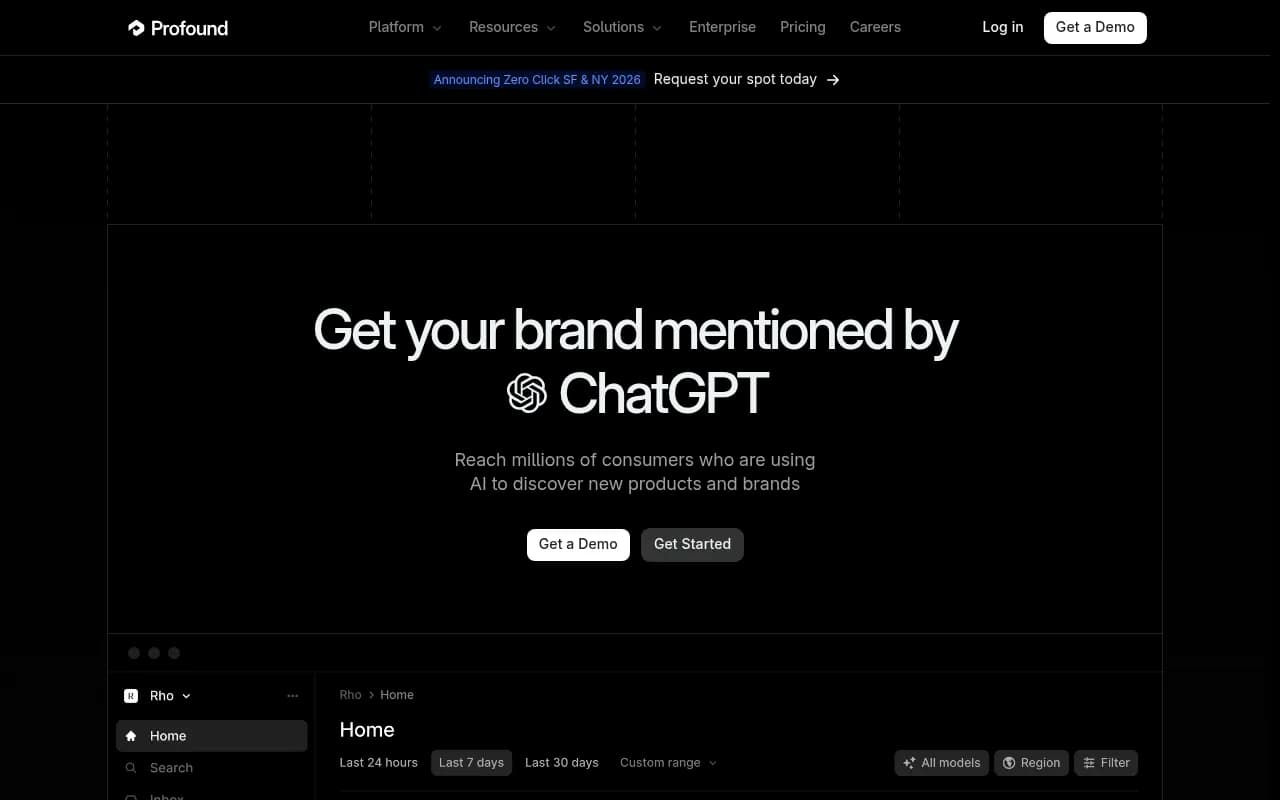
Profound is the enterprise-tier option. It's built for larger brands with dedicated analytics teams and a need for deep competitive benchmarking across AI models.
Where it shines for B2B SaaS: the competitive heatmaps and share-of-voice tracking across categories. If you're in a crowded SaaS category (project management, CRM, security), Profound gives you a clear picture of which competitors are dominating AI responses and why.
The tradeoff is price. Profound sits at the higher end of the market, and the feature set is oriented toward reporting and analysis rather than content creation. You'll still need a separate workflow to act on what you find.
3. Scrunch AI
Scrunch AI focuses on monitoring how AI assistants like ChatGPT and Claude represent your brand in their responses -- including sentiment, accuracy, and citation sources.
For B2B SaaS companies worried about how they're described in AI answers (not just whether they appear), Scrunch is worth a look. It surfaces cases where AI models are giving outdated or inaccurate information about your product, which is a real problem in fast-moving SaaS categories where features change frequently.
Less focused on content optimization, more focused on brand accuracy and reputation in AI responses.
4. AthenaHQ
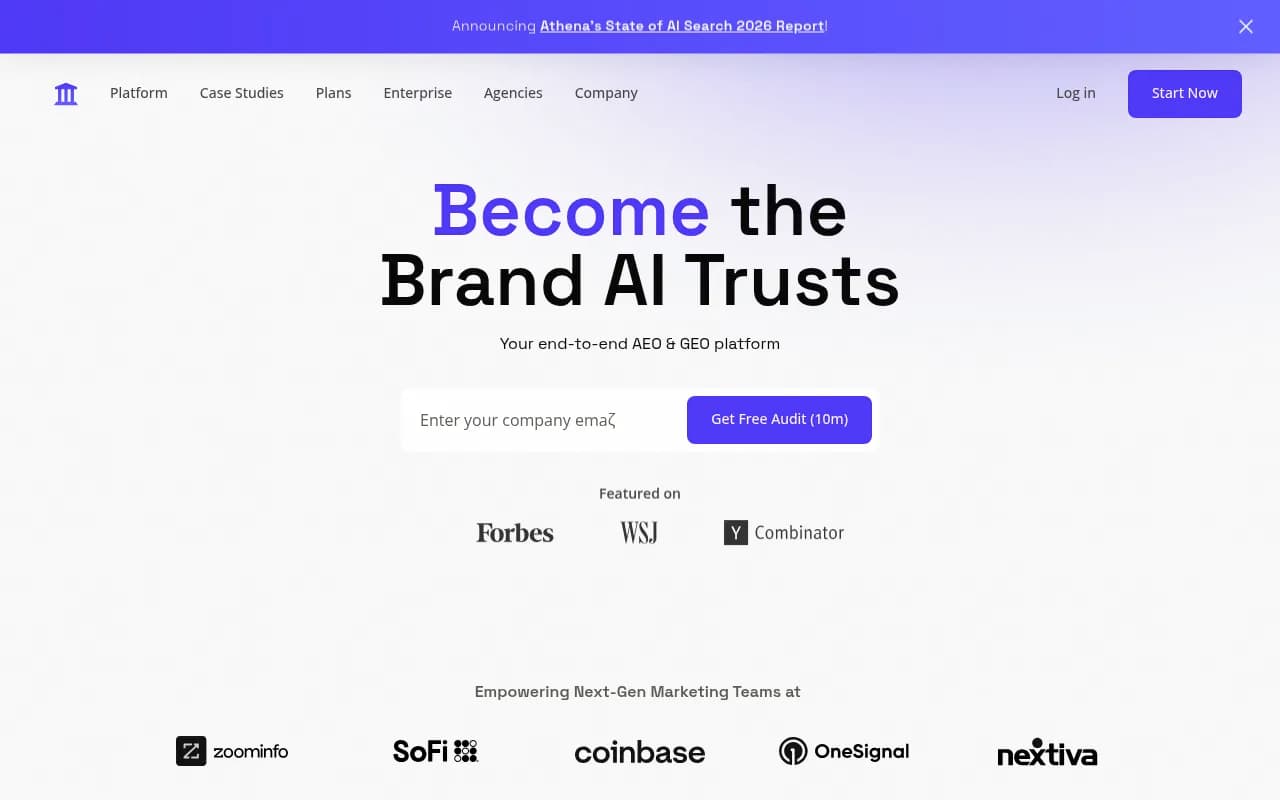
AthenaHQ positions itself as an enterprise AI visibility platform with strong analytics across 8+ AI search engines. It's particularly well-suited for teams that need structured reporting and stakeholder dashboards.
The platform tracks brand mentions, sentiment, and citation sources across models, and the UI is clean enough that non-technical stakeholders can read it without much explanation. That matters in B2B SaaS where you're often reporting AI visibility metrics to a CMO or board.
The gap is on the optimization side. AthenaHQ is primarily a monitoring and analytics tool. It doesn't generate content or provide actionable briefs, so you'll need to pair it with a content workflow.
5. Writesonic
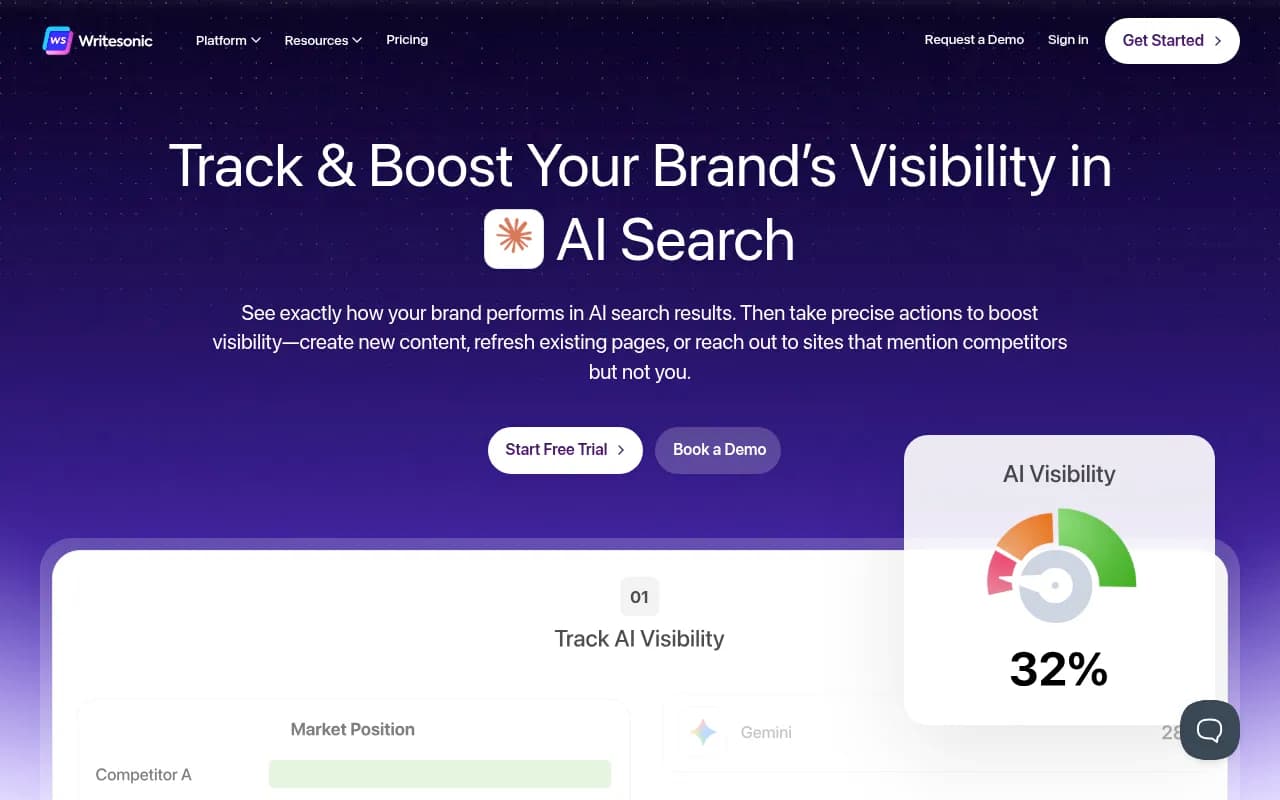
Writesonic has evolved from an AI writing tool into a platform that combines AI search tracking with content creation. For B2B SaaS content teams that want both in one place, it's a practical option.
The AI visibility features track brand mentions across ChatGPT, Perplexity, and Google AI Overviews. The content side generates articles and landing pages. The integration between the two is tighter than most tools that bolt on one capability to the other.
Where it falls short for serious GEO work: the tracking depth is less granular than dedicated platforms. Prompt volume data, crawler logs, and query fan-outs aren't there. It's a good fit for smaller B2B SaaS teams that want one tool rather than a specialized stack.
6. Peec AI
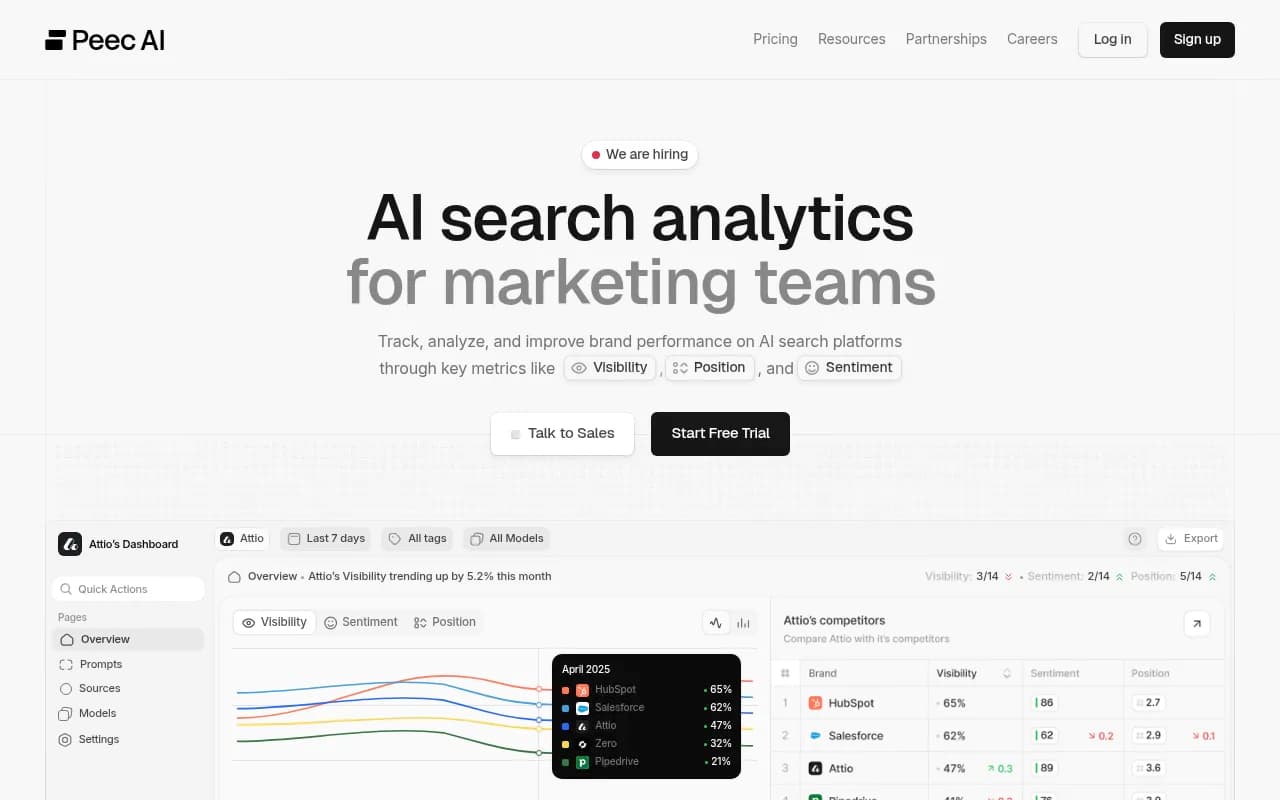
Peec AI is a focused analytics tool. It doesn't try to do content generation or optimization -- it just tracks AI visibility cleanly and precisely.
The interface is straightforward, the data is reliable, and the reporting is easy to export. For B2B SaaS teams that have a separate content operation and just need solid monitoring data to feed into it, Peec is a reasonable choice.
The limitation is exactly what you'd expect from a monitoring-only tool: it shows you the numbers but doesn't tell you what to do with them. If your team has the capacity to interpret data and act independently, that's fine. If you need the platform to guide the action, look elsewhere.
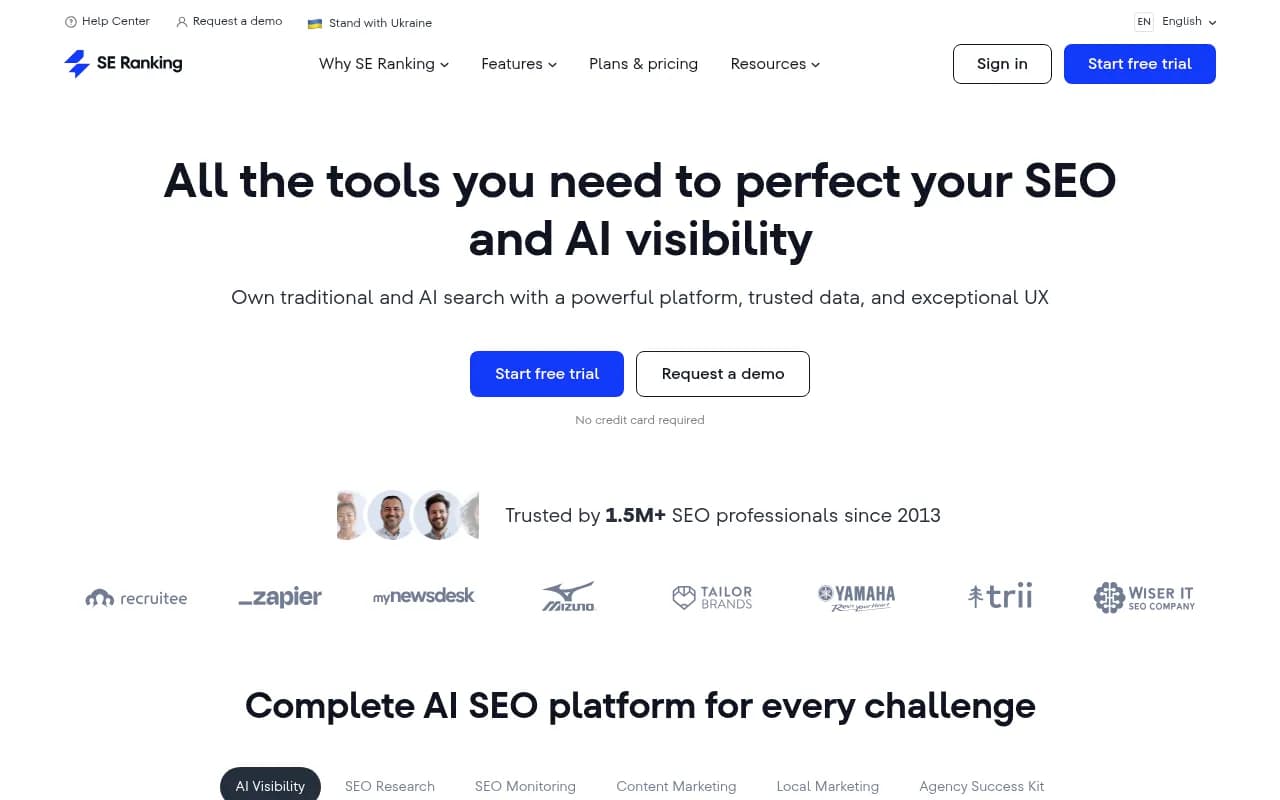
7. SE Ranking (AI Visibility module)
SE Ranking is primarily an SEO platform that has added AI visibility tracking as a module. For B2B SaaS teams already running SE Ranking for traditional SEO, the AI visibility features are a low-friction way to add LLM monitoring without a new tool.
It covers the major AI models and integrates with SE Ranking's existing keyword and ranking data. The combination of traditional search and AI search data in one dashboard is genuinely useful for teams trying to understand how their overall search visibility is shifting.
The AI-specific features are less deep than dedicated GEO platforms, but for teams that don't need the full depth, the consolidation is worth it.
8. AIclicks
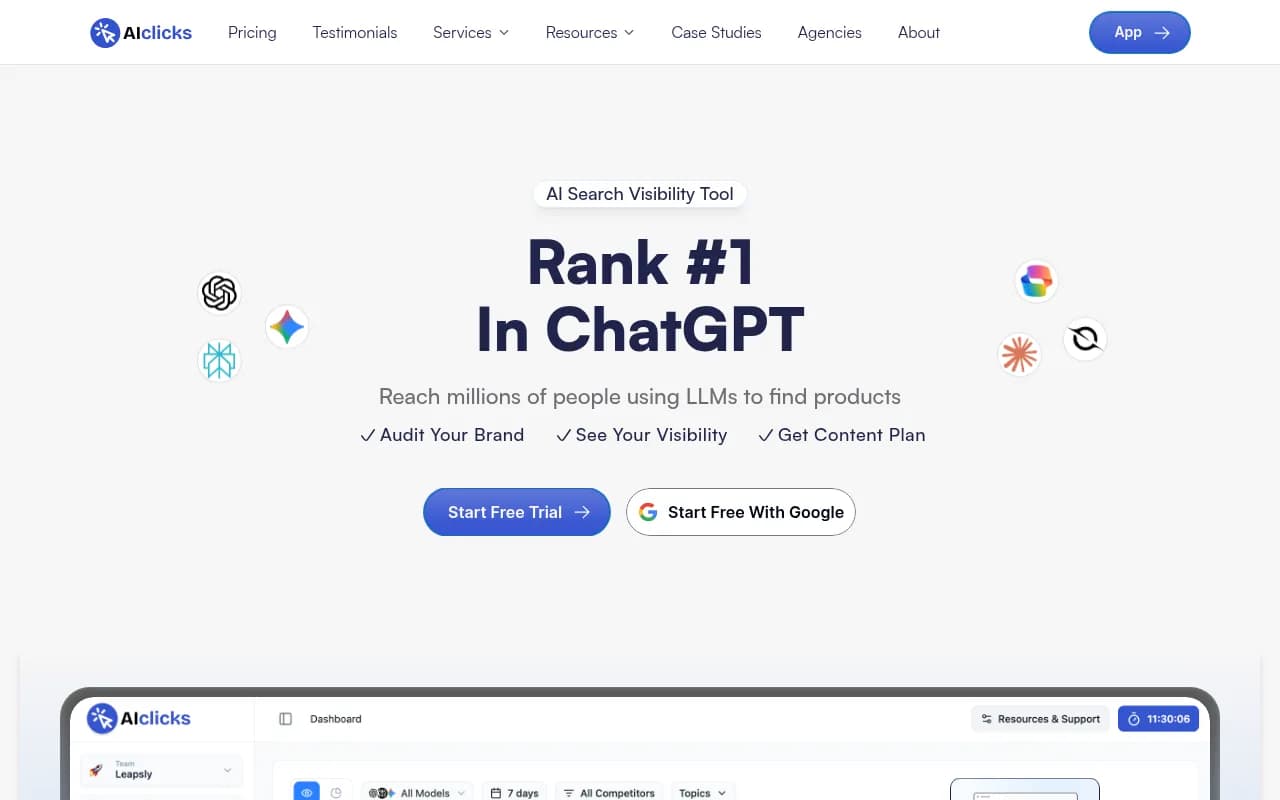
AIclicks tracks and optimizes brand visibility across AI search results. It's positioned as a full-stack alternative with features spanning monitoring, competitive analysis, and content optimization.
For B2B SaaS teams, the competitive analysis features are the most useful -- seeing which competitors are appearing in AI answers for your target queries and what content is driving those citations. The platform covers the major AI models and provides prompt-level data.
It's a solid mid-market option that sits between the lightweight monitoring tools (Peec, Otterly) and the enterprise platforms (Profound, AthenaHQ).
Side-by-side comparison
| Platform | Monitoring | Content generation | Crawler logs | B2B SaaS fit | Starting price |
|---|---|---|---|---|---|
| Promptwatch | 10 models | Yes (Content Agents) | Yes | Strong | $99/mo |
| Profound AI | 6+ models | No | No | Strong (enterprise) | Custom |
| Scrunch AI | Multiple models | No | No | Moderate | Custom |
| AthenaHQ | 8+ models | No | No | Strong (enterprise) | Custom |
| Writesonic | 3 models | Yes | No | Moderate | $49/mo |
| Peec AI | Multiple models | No | No | Moderate | $49/mo |
| SE Ranking | Multiple models | No | No | Moderate (SEO teams) | $65/mo |
| AIclicks | Multiple models | Partial | No | Moderate | $49/mo |
| Otterly.AI | 4-6 models | No | No | Limited | $29/mo |
Which alternative is right for your team?
The honest answer depends on where you are in the GEO maturity curve.
If you're just starting out and want to understand whether your brand appears in AI answers at all, Otterly.AI or Peec AI are fine starting points. They're cheap and easy to set up.
If you've been monitoring for a few months and the numbers aren't improving because you don't know what to do with the data, that's the signal to move to a platform with content gap analysis and generation. Promptwatch is the most complete option here, and the action loop (find gaps, generate content, track results) is exactly what B2B SaaS teams need when they're trying to build pipeline from AI search rather than just measure it.
If you're at a larger company with a dedicated analytics team and need deep competitive benchmarking and stakeholder reporting, Profound AI or AthenaHQ are worth evaluating.
If you're already running SE Ranking for traditional SEO, adding their AI visibility module is the lowest-friction path.
The one thing worth saying clearly: monitoring-only tools are not a GEO strategy. Knowing you're invisible doesn't make you visible. The B2B SaaS teams that are winning in AI search right now are the ones that have figured out which buyer research queries matter, created content that directly answers them, and tracked which pages AI models are actually citing. That requires a platform that supports the full cycle, not just the first step.
A note on prompt strategy for B2B SaaS
One thing that doesn't get enough attention in GEO discussions: the prompts you track matter as much as the platform you use.
B2B buyers don't ask AI models "tell me about [your brand name]." They ask:
- "What's the best [category] tool for [specific use case]?"
- "How does [your product] compare to [competitor]?"
- "What do [job title] teams use for [workflow]?"
- "Is [your product] good for [company size/stage]?"
If you're only tracking brand name mentions, you're missing most of the buyer journey. The platforms that support prompt volume data and query fan-outs (where one prompt branches into related sub-queries) give you a much more complete picture of where the real opportunities are.
This is one area where Promptwatch's Prompt Intelligence feature is particularly useful for B2B SaaS -- it shows you volume estimates and difficulty scores for each prompt, so you can prioritize the buyer research queries that are actually worth going after rather than spreading effort across hundreds of low-value variations.
Bottom line
Otterly.AI is a reasonable starting point, but it's not built for B2B SaaS teams trying to turn AI search visibility into pipeline. The prompt limits, missing models, and absence of any optimization capability mean you'll outgrow it quickly.
The alternatives above cover the full range from cheap monitoring (Peec AI, SE Ranking) to full-stack GEO platforms (Promptwatch, Profound AI). For most B2B SaaS marketing teams in 2026, the right move is a platform that closes the loop between finding gaps and filling them -- because the gap between knowing you're invisible and doing something about it is where most teams are currently stuck.