Key takeaways
- Promptwatch is the only platform in this comparison that pairs competitor heatmaps with actionable content generation -- so you can see where you're losing and immediately do something about it.
- Profound and Scrunch have strong heatmap and competitor benchmarking features, but come at significantly higher price points.
- Peec AI and AthenaHQ both show competitor visibility data, but neither offers the crawler logs or content tooling needed to close the gaps you find.
- The "best" heatmap depends on what you do with the data -- a beautiful chart that doesn't lead to action isn't worth much.
- All five platforms monitor multiple LLMs, but coverage depth varies: Promptwatch tracks 10 models, AthenaHQ covers 8+, Peec AI covers 3 core platforms.
Competitor visibility heatmaps are one of those features that sound straightforward until you actually try to use them. The idea is simple: you want to see, at a glance, which AI models are recommending your competitors for which prompts -- and where you're being left out. But the execution varies wildly across platforms.
Some tools give you a clean visual grid. Others bury the data in tables. A few show you the heatmap and then leave you completely on your own to figure out what to do next.
This guide breaks down how Promptwatch, Peec AI, Profound, AthenaHQ, and Scrunch each handle competitor visibility heatmaps in 2026 -- what they show, how actionable the data is, and which platform is worth your money depending on what you're actually trying to accomplish.
What a competitor visibility heatmap actually does
Before getting into the platforms, it's worth being precise about what we mean. A competitor visibility heatmap in the GEO context shows you:
- Which prompts (questions, queries) trigger AI responses
- Which brands appear in those responses
- How often each brand appears, across which AI models
- Where you appear vs. where your competitors appear
The "heatmap" part usually means a color-coded grid -- prompts on one axis, competitors (or AI models) on the other, with intensity showing how often each brand gets cited. Some platforms call this a "share of voice" view or a "competitor benchmark." The name doesn't matter much; what matters is whether you can quickly spot where you're invisible and why.
Promptwatch: heatmaps with an action loop built in

Promptwatch's competitor heatmap sits inside a broader visibility dashboard that tracks 10 AI models: ChatGPT, Perplexity, Google AI Overviews, Google AI Mode, Claude, Gemini, Meta/Llama, DeepSeek, Grok, and Mistral. The heatmap itself shows you prompt-level visibility for your brand vs. competitors across those models -- so you can see, for example, that a competitor is getting cited by Perplexity and Claude for a specific category of prompts where you're not appearing at all.
What makes this more useful than a static chart is what comes next. Promptwatch's Answer Gap Analysis takes the heatmap data and translates it into specific content gaps -- the exact topics and angles your site is missing that would help AI models cite you. From there, Content Agents can generate articles, comparisons, and briefs built around those gaps.
This is the part most platforms skip. You can have the most beautiful heatmap in the industry, but if it just shows you a problem without helping you solve it, you're paying for a dashboard that makes you feel informed without actually moving the needle.
A few other things worth noting about Promptwatch's competitor view:
- Page-level tracking shows which specific pages on your site (and competitors' sites) are being cited
- AI Crawler Logs reveal when AI bots are visiting your pages and whether they're converting those visits into citations
- Reddit and YouTube insights surface third-party content that's influencing AI recommendations -- a channel most platforms ignore entirely
- ChatGPT Shopping tracking monitors brand appearances in product recommendation carousels
Pricing starts at $99/month for the Essential plan (1 site, 50 prompts), $249/month for Professional (2 sites, 150 prompts, crawler logs), and $579/month for Business (5 sites, 350 prompts). A free trial is available.
Peec AI: clean monitoring, limited depth
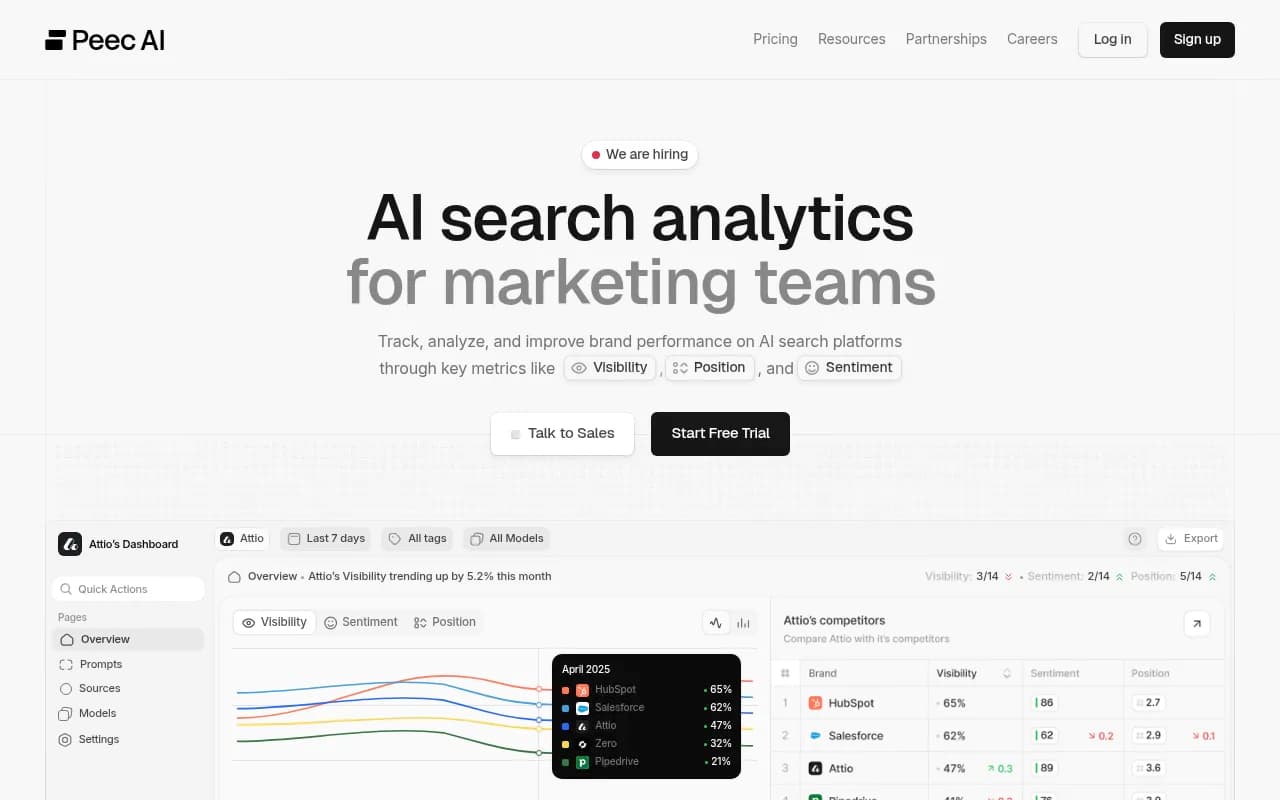
Peec AI is a monitoring-focused platform. Its competitor visibility view shows share-of-voice data across AI models and lets you benchmark your brand against competitors for a set of tracked prompts. The interface is clean and relatively easy to navigate.
The limitations show up quickly, though. Peec AI covers only three core AI platforms -- which creates real blind spots as the AI search ecosystem expands. If a significant chunk of your audience is using Perplexity or Grok, you might be missing visibility shifts that matter.
More fundamentally, Peec AI is a passive analytics tool. It shows you data but doesn't help you act on it. There's no content generation, no crawler log analysis, no gap-to-brief workflow. You see the heatmap, you understand the problem, and then you're on your own.
For teams that just want a lightweight monitoring layer and have separate content workflows already in place, Peec AI can work. But for anyone who wants to actually improve their AI visibility -- not just track it -- the platform runs out of road quickly.
Profound: enterprise-grade heatmaps with strong analytics
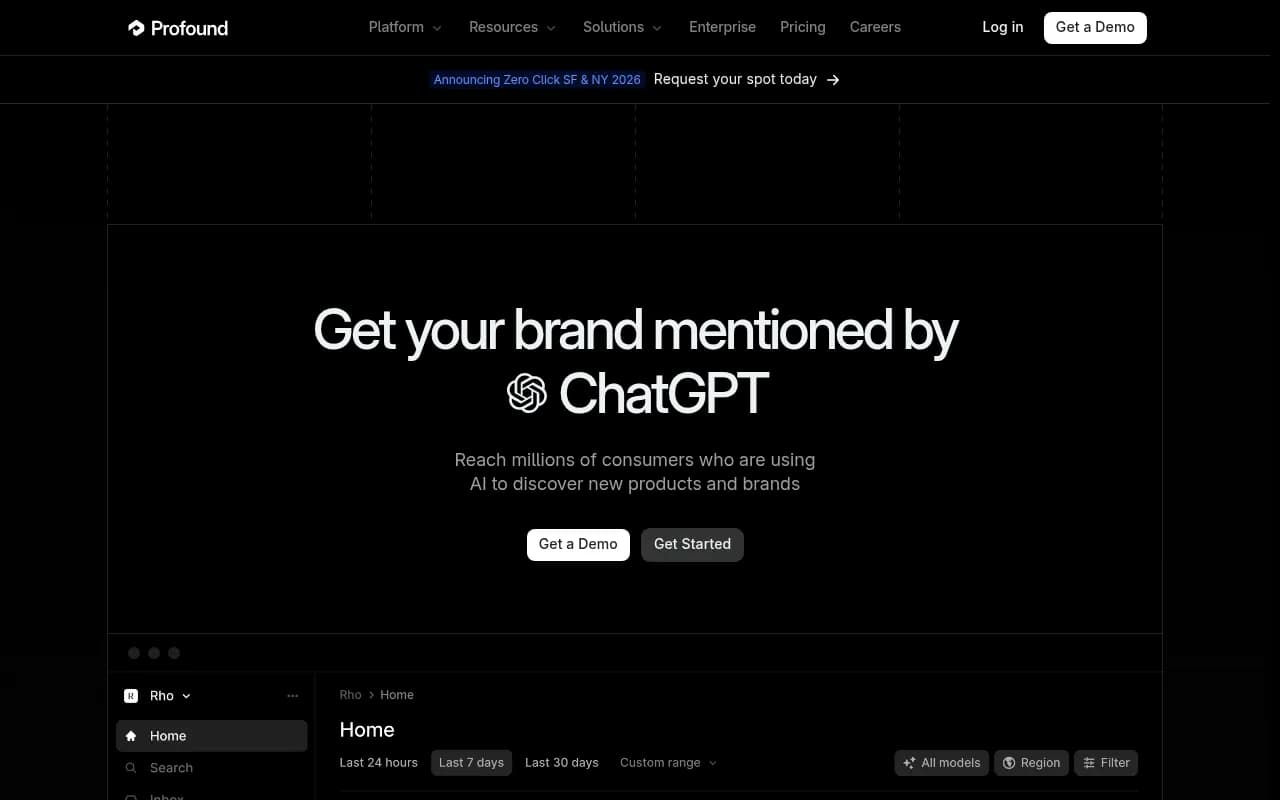
Profound is one of the more mature platforms in this space, and its competitor benchmarking is genuinely strong. The heatmap view shows prompt-level visibility across multiple LLMs, with good filtering and segmentation options. You can slice by topic cluster, by AI model, by competitor, and by time period -- which makes it easier to spot trends rather than just point-in-time snapshots.
Profound also has AI crawler logs, which puts it ahead of Peec AI and AthenaHQ on the technical side. Knowing when AI crawlers are visiting your pages and which pages they're reading is useful context for understanding why your visibility looks the way it does.
The main friction with Profound is price. It's positioned as an enterprise tool, and the pricing reflects that. For mid-market teams or agencies managing multiple clients on a budget, the cost can be hard to justify -- especially when the platform's content optimization capabilities are more limited than what Promptwatch offers at a lower price point.
Profound shipped autonomous Agents and MCP integration in 2026, which adds workflow automation on top of the monitoring. That's a meaningful step toward closing the action gap, but the content generation side is still less developed than Promptwatch's Content Agents.
AthenaHQ: strong on optimization tasks, weaker on raw heatmap depth

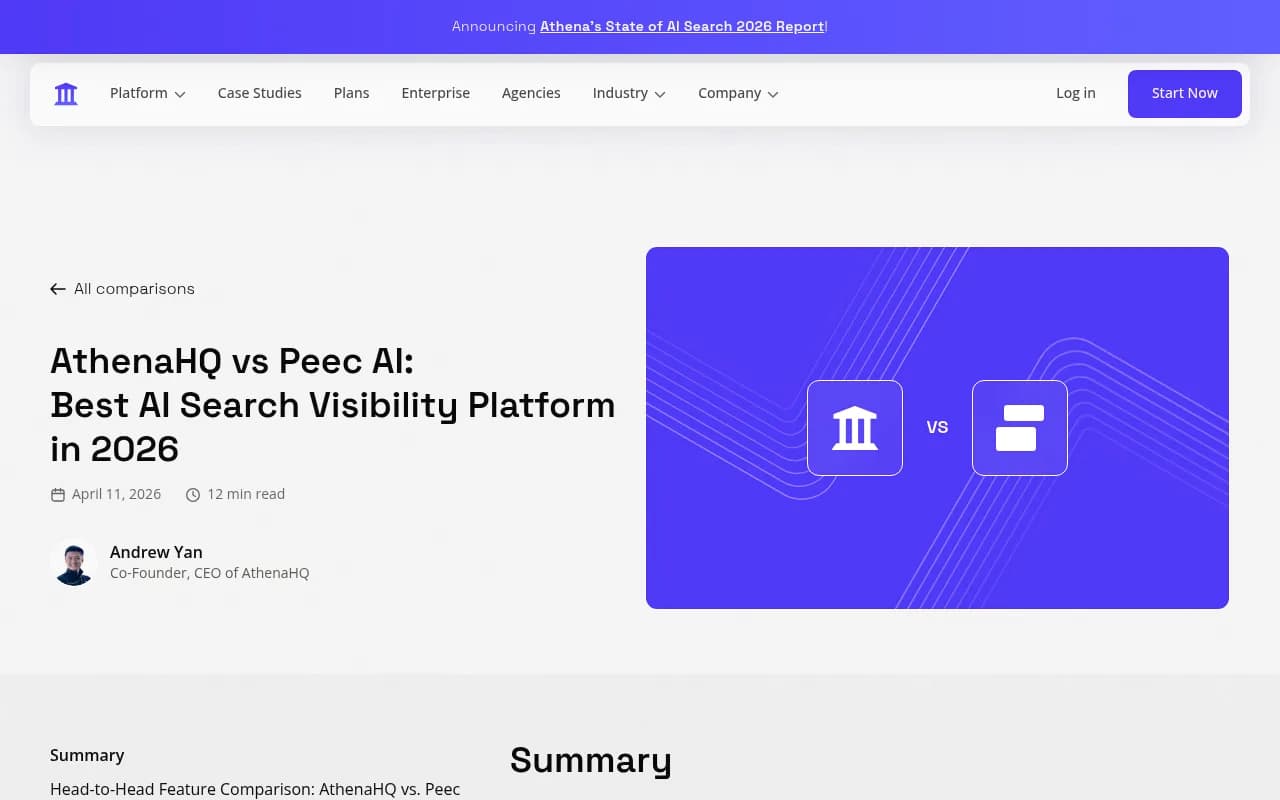
AthenaHQ covers 8+ LLMs and positions itself as an end-to-end AEO platform rather than a pure monitoring tool. Its competitor visibility view shows share-of-voice data and benchmarks your brand against competitors, and the platform translates that data into prioritized optimization tasks -- which is a step beyond what Peec AI offers.
AthenaHQ also added Shopify revenue attribution in 2026, which is genuinely useful for e-commerce brands that want to connect AI visibility to actual sales. That's a capability most platforms in this comparison don't have.
Where AthenaHQ falls short relative to Promptwatch is in the breadth of the heatmap data itself. There are no crawler logs, no Reddit or YouTube insights, and no page-level citation tracking. The optimization task workflow is helpful, but it's built on a narrower data foundation.
AthenaHQ's own comparison page claims a +45% increase in AI answer share in a 30-day test vs. Peec AI's 8% improvement -- though that data comes from AthenaHQ itself, so treat it as directional rather than independent evidence.
Scrunch: monitoring plus CDN-edge content delivery
Scrunch takes a different angle from the other platforms. Beyond monitoring and heatmaps, it serves AI-optimized content at the CDN edge -- meaning it can modify what AI crawlers see when they visit your site without requiring you to redeploy pages. That's a technically interesting approach that none of the other platforms in this comparison offer.
The competitor visibility heatmap in Scrunch is solid. It covers multiple LLMs, shows competitor benchmarking, and includes citation analysis. Scrunch also has crawler logs and visitor analytics, which puts it in the same tier as Profound on the technical monitoring side.
The tradeoff is that Scrunch's content generation capabilities are less developed than Promptwatch's, and the CDN-edge approach -- while clever -- adds complexity that not every team wants to manage. It's a better fit for technically sophisticated teams than for marketing teams that want a clean workflow from gap identification to content publishing.
Head-to-head comparison
Here's how the five platforms stack up across the features that matter most for competitor visibility heatmaps and the work that follows:
| Feature | Promptwatch | Peec AI | Profound | AthenaHQ | Scrunch |
|---|---|---|---|---|---|
| Competitor heatmap | Yes | Yes | Yes | Yes | Yes |
| AI models covered | 10 | 3 | Multiple | 8+ | Multiple |
| Crawler logs | Yes (Pro+) | No | Yes | No | Yes |
| Page-level citation tracking | Yes | No | Partial | No | No |
| Content gap analysis | Yes | No | Partial | Yes | No |
| AI content generation | Yes | No | Limited | Limited | No |
| Reddit/YouTube insights | Yes | No | No | No | No |
| ChatGPT Shopping tracking | Yes | No | No | No | No |
| Revenue attribution | Yes | No | Yes | Yes (Shopify) | Yes |
| Starting price | $99/mo | Lower tier | Enterprise | Mid-market | Mid-market |
| Free trial | Yes | Yes | Limited | Yes | Limited |
Which platform should you choose?
The honest answer is that it depends on what you're trying to do after you look at the heatmap.
If you want to monitor competitor visibility and then act on it -- creating content that closes the gaps AI models are exposing -- Promptwatch is the most complete option. The heatmap is one piece of a workflow that goes from gap identification to content generation to citation tracking. That loop is what actually moves visibility scores over time.
If you're at an enterprise with a dedicated analytics team and need deep segmentation and workflow automation, Profound is worth evaluating. The price is higher, but the analytics depth is real.
If you're an e-commerce brand and want to connect AI visibility directly to Shopify revenue, AthenaHQ's attribution feature is worth a look. Just go in knowing the content optimization side is less developed.
If you want the simplest possible monitoring layer and have separate content workflows, Peec AI works -- but you'll hit its ceiling quickly, and the three-model coverage is a real limitation in 2026.
If you have a technical team and want to serve AI-optimized content at the CDN edge, Scrunch is the only platform in this group that does that.
For most marketing teams and agencies, the combination of comprehensive heatmaps, 10-model coverage, crawler logs, content generation, and a starting price of $99/month makes Promptwatch the most practical choice. The competitor heatmap is only as valuable as what you do with it -- and Promptwatch is the only platform here that helps you do something about what you find.
A note on how to evaluate heatmap quality
When you're demoing these platforms, ask vendors a few specific questions before committing:
- How often is the heatmap data refreshed? Daily, weekly, or on-demand?
- Can you filter by AI model, topic cluster, and time period simultaneously?
- Does the heatmap show prompt-level data or only aggregate share of voice?
- What happens after you identify a gap -- is there a built-in workflow, or do you export the data and work elsewhere?
- Are the AI models queried through user-facing interfaces or just APIs? (This matters because user-facing responses can differ from API outputs.)
That last question is worth pressing on. Promptwatch specifically tracks how AI search engines behave in real user interfaces, not just through API calls. For platforms that only query APIs, there's a real risk that what you're seeing in the heatmap doesn't match what your customers are actually experiencing when they use ChatGPT or Perplexity.
The competitor visibility heatmap is one of the most useful features in GEO platforms -- but only if the data is accurate, current, and connected to a path forward. In 2026, the gap between monitoring-only tools and full-stack optimization platforms has widened considerably. The platforms that help you find gaps and fix them are pulling ahead of the ones that just show you the problem.