Key takeaways
- Peec AI is a strong monitoring and research tool -- great for agencies that need deep data, but it stops before the "fix it" stage
- Relixir combines AI content generation with visibility tracking, making it a genuine all-in-one GEO platform
- Promptwatch is the only platform in this comparison rated as a "Leader" across all GEO categories, with a full action loop: gap analysis, AI content generation, and traffic attribution
- Monitoring-only tools show you where you're invisible -- optimization platforms help you stop being invisible
- If you're choosing purely on budget, Peec AI's entry price is lower; if you're choosing on ROI, the platforms that generate content tend to pay for themselves faster
The GEO tool market has split into two camps, and the divide is getting sharper. On one side: monitoring dashboards that tell you how visible your brand is across ChatGPT, Perplexity, and Gemini. On the other: platforms that take that data and actually do something with it.
Relixir, Peec AI, and Promptwatch each represent a different point on that spectrum. They're not really competing for the same buyer -- but they're often evaluated together, which causes a lot of confusion. This guide breaks down what each platform actually does, where each one falls short, and which approach makes more sense depending on what you're trying to accomplish.
What "GEO" actually means in 2026
Generative Engine Optimization (GEO) is the practice of making your brand, content, and website more likely to be cited by AI models when users ask relevant questions. It's the AI-era equivalent of SEO -- except instead of ranking on a results page, you're trying to appear in a generated answer.
The problem is that most tools in this space were built to measure GEO performance, not improve it. They'll tell you your brand appears in 12% of relevant ChatGPT responses. They won't tell you what content you need to write to get that to 30%.
That gap -- between measurement and action -- is the central tension in this comparison.
Relixir: all-in-one GEO with content generation baked in
Relixir positions itself as an end-to-end GEO platform. The core pitch is that you shouldn't need three separate tools to monitor your visibility, identify content gaps, and then create content to fill those gaps. Relixir tries to do all three in one place.
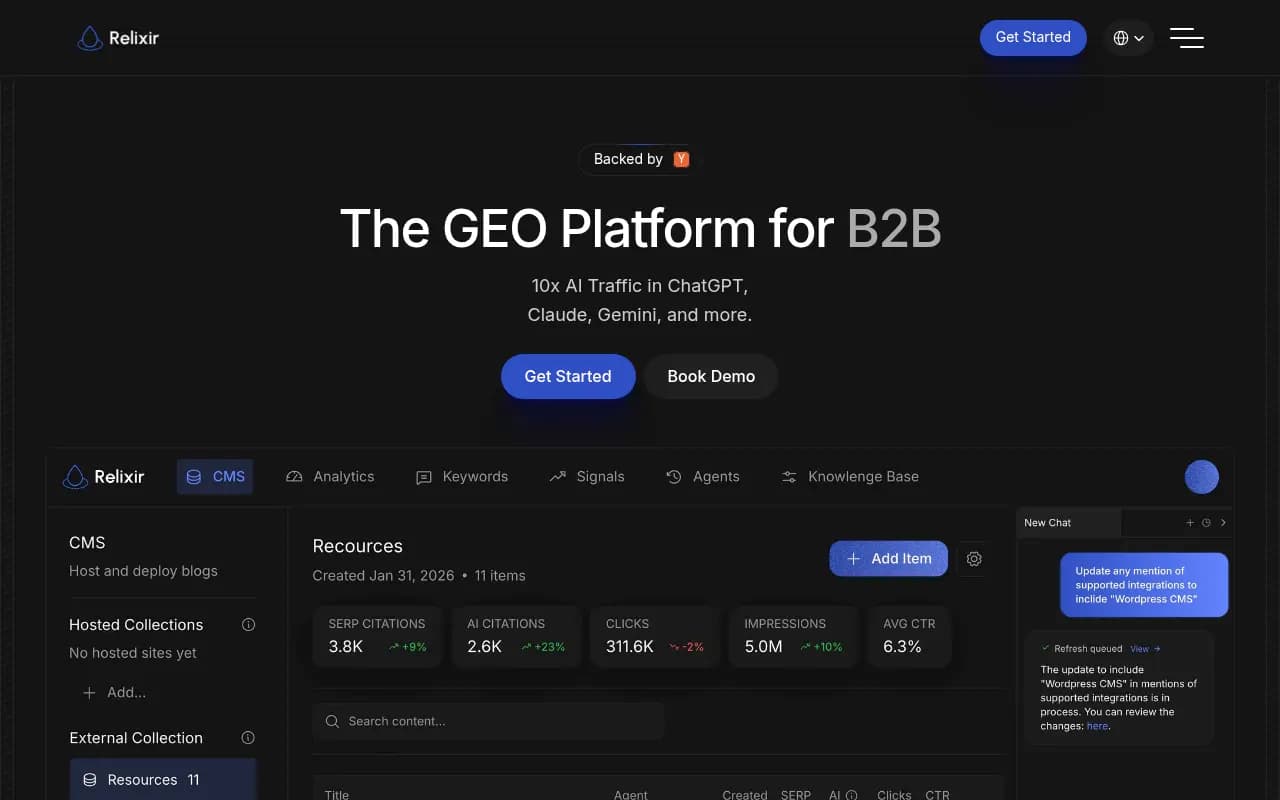
The platform tracks brand mentions across major AI models, surfaces the prompts where competitors are visible but you're not, and includes an AI writing layer to generate content targeting those gaps. For teams that don't want to stitch together a monitoring tool, a content brief tool, and a writing assistant, that's a genuinely useful combination.
Where Relixir tends to get mixed reviews is on the depth of its data. The citation analysis and prompt intelligence aren't as granular as what you'd get from more established platforms. If you're running a large-scale GEO program and need detailed breakdowns by model, region, and persona, you may hit the ceiling faster than expected.
That said, for mid-market brands and smaller agencies that want a single platform covering the full workflow, Relixir is worth evaluating seriously.
Peec AI: deep research, agency-style monitoring
Peec AI takes a different approach. It's built for teams that want detailed, research-grade data on how AI models are responding to queries in their category. The platform covers multiple AI engines, supports multi-language monitoring, and is particularly strong for agencies managing multiple clients across different markets.
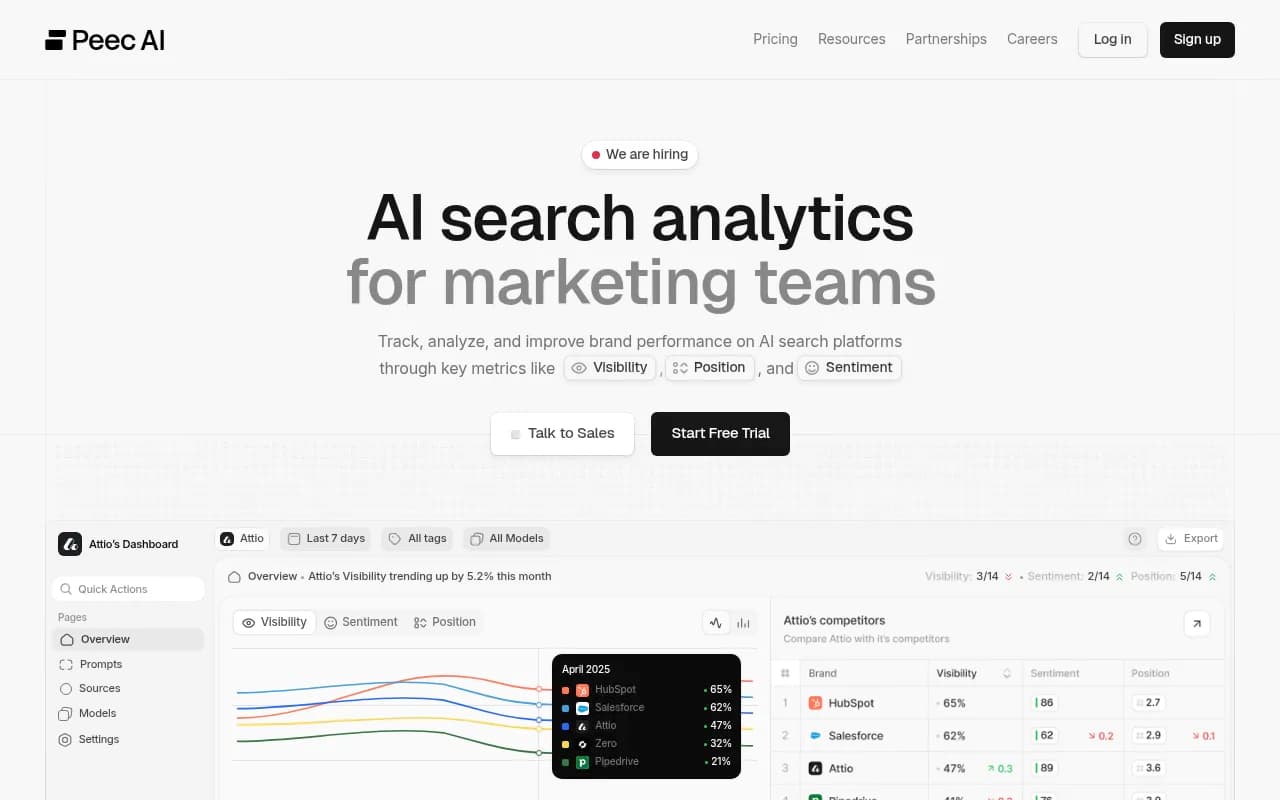
The Reddit SEO community has described Peec AI as the go-to choice for "deep research and agency-style reporting" -- and that's a fair characterization. The dashboards are detailed, the data is solid, and the multi-language support is genuinely useful for international brands.
The limitation is that Peec AI is fundamentally a monitoring tool. It shows you what's happening in AI search. It doesn't help you change what's happening. There's no content generation, no answer gap analysis that produces actionable briefs, and no built-in workflow for turning visibility data into published content. You get the diagnosis without the treatment.
For agencies that have their own content production workflows and just need the data layer, that's fine. For brands that want the full loop closed, it's a gap.
Promptwatch: the action loop
Promptwatch takes the position that monitoring without optimization is a dead end. The platform is built around a three-step cycle: find the gaps, create content that fills them, and track whether that content actually improves your AI visibility.

The "find the gaps" step is Answer Gap Analysis -- it shows you exactly which prompts competitors are being cited for that you're not. Not vague categories, but specific questions and topics that AI models are answering without mentioning your brand.
The "create content" step is where Promptwatch separates itself from most competitors. The built-in AI writing agent generates articles, listicles, and comparisons grounded in actual citation data -- 880M+ citations analyzed across 10 AI models. The content isn't generic; it's engineered around what AI models actually cite and why.
The "track results" step closes the loop with page-level tracking, showing which specific pages are being cited, how often, and by which models. Traffic attribution connects that visibility data to actual revenue through a code snippet, Google Search Console integration, or server log analysis.
Beyond the core loop, Promptwatch also has AI crawler logs (real-time visibility into which pages ChatGPT, Claude, and Perplexity are actually crawling), Reddit and YouTube source tracking, ChatGPT Shopping monitoring, and prompt volume and difficulty scoring. Most competitors don't have any of these.
In a 2026 comparison of 12 GEO platforms, Promptwatch was the only one rated as a "Leader" across all categories -- the distinction being that it's an optimization platform, not just a tracker.
Head-to-head comparison
| Feature | Relixir | Peec AI | Promptwatch |
|---|---|---|---|
| AI model coverage | Multiple LLMs | Multiple LLMs | 10 models (ChatGPT, Claude, Gemini, Perplexity, Grok, DeepSeek, Copilot, Meta AI, Mistral, Google AI Overviews) |
| Brand mention tracking | Yes | Yes | Yes |
| Share of voice / visibility score | Yes | Yes | Yes |
| Answer gap analysis | Basic | No | Yes (detailed, prompt-level) |
| AI content generation | Yes | No | Yes (citation-grounded) |
| Prompt volume & difficulty scoring | No | Limited | Yes |
| AI crawler logs | No | No | Yes |
| Reddit & YouTube source tracking | No | No | Yes |
| ChatGPT Shopping tracking | No | No | Yes |
| Traffic attribution | Limited | No | Yes (snippet, GSC, server logs) |
| Multi-language / multi-region | Limited | Yes | Yes |
| Page-level citation tracking | Limited | No | Yes |
| Free trial | Yes | Yes | Yes |
| Starting price | Contact for pricing | ~€85/mo | $99/mo |
| Best for | Mid-market brands wanting all-in-one | Agencies needing deep monitoring data | Brands and agencies wanting full GEO optimization |
The monitoring-only problem
Here's the honest case against monitoring-only tools: data without action is just anxiety.
If your brand appears in 8% of relevant AI responses and a competitor appears in 34%, knowing that number doesn't close the gap. You still need to figure out which content topics are driving the competitor's citations, create content targeting those topics, publish it in a way that AI models will find and cite, and then verify it's working.
Peec AI gives you the 8% vs 34% data. It doesn't give you the rest of the workflow.
This isn't a knock on Peec AI specifically -- it's a category limitation. Most GEO tools were built by people who came from analytics backgrounds, not content strategy backgrounds. They're excellent at measurement and genuinely weak at optimization.
The counterargument is that some teams don't need the optimization layer built into their monitoring tool. If you have a strong in-house content team or a content agency relationship, you might prefer to keep those workflows separate and just use Peec AI for the data. That's a legitimate setup.
But for most marketing teams -- especially those without dedicated GEO specialists -- having the full loop in one platform is a meaningful advantage.
Which approach wins?
It depends on what "winning" means for your team.
If you're an agency running GEO programs for multiple clients and you need detailed, defensible data to put in client reports, Peec AI's monitoring depth is genuinely valuable. The multi-language support and agency-style dashboards are real differentiators for that use case.
If you're a mid-market brand that wants a single platform covering monitoring, gap analysis, and content creation without needing to integrate multiple tools, Relixir is worth a serious look. The all-in-one approach reduces friction even if the individual components aren't best-in-class.
If you want the most complete GEO platform available -- one that monitors, identifies gaps, generates content, tracks crawler behavior, and connects visibility to revenue -- Promptwatch is the strongest option. The action loop is the core product, not a feature add-on, and the supporting capabilities (crawler logs, Reddit tracking, ChatGPT Shopping, prompt intelligence) are things most competitors simply don't have.
The monitoring-vs-optimization debate will probably resolve itself over the next 12-18 months as more brands realize that knowing you're invisible isn't enough. The tools that help you become visible will win. That's already happening.
Pricing in context
Peec AI starts around €85/month for 50 prompts and 3 engines. That's a reasonable entry point for a monitoring-only tool, though the per-prompt limits can become constraining quickly if you're tracking a competitive category with many relevant queries.
Promptwatch's Essential plan is $99/month for 1 site, 50 prompts, and 5 AI-generated articles. The Professional plan at $249/month adds crawler logs, 150 prompts, 15 articles, and state/city tracking. The Business plan at $579/month covers 5 sites, 350 prompts, and 30 articles per month.
The way to think about the price difference between a monitoring tool and an optimization platform: if the optimization platform helps you produce 10-15 pieces of content per month that wouldn't otherwise exist, and those pieces drive measurable AI visibility improvements, the ROI math tends to work out. The monitoring tool tells you the problem exists. The optimization platform helps you solve it.
Other tools worth knowing about
If you're evaluating this space broadly, a few other platforms are worth a look depending on your specific needs.
Otterly.AI is one of the more affordable entry points for basic AI visibility monitoring.
Profound is strong for enterprise teams that need deep LLM coverage and are comfortable with custom pricing.
Scrunch AI offers solid mid-market monitoring with SOC 2 compliance, which matters for enterprise procurement.
AthenaHQ covers 8+ AI search engines and is monitoring-focused, similar to Peec AI in its overall philosophy.

None of these close the full optimization loop the way Promptwatch does, but they're legitimate options depending on your budget and workflow.
The bottom line
The GEO tool market in 2026 is still maturing, and the monitoring-only vs. optimization-platform distinction is the most important thing to understand before you buy anything.
Peec AI is a good monitoring tool. Relixir is a genuine attempt at an all-in-one platform. Promptwatch is the most complete option for teams that want to actually move their AI visibility numbers, not just measure them.
If you're not sure which approach fits your situation, most of these platforms offer free trials. Start with a clear question: do you need better data, or do you need better content? The answer will point you to the right tool.