Key takeaways
- Brandlight.ai and Peec AI are primarily monitoring tools -- they show you where your brand stands in AI responses but don't help you do much about it.
- Promptwatch is the only one of the three that closes the full loop: find gaps, generate content, track results.
- Peec AI is strong on prompt-level tracking and multi-language support; Brandlight.ai is better for sentiment and brand perception shifts.
- If you're a solo marketer or small team just starting out, Peec AI or Brandlight.ai can get you oriented. If you need to actually move the needle on AI visibility, you'll outgrow them quickly.
- Promptwatch's Answer Gap Analysis and built-in AI writing agent are features the other two simply don't have.
The GEO tools market has exploded. There are now well over 100 platforms claiming to track your brand across ChatGPT, Perplexity, Claude, and the rest. Most of them do roughly the same thing: run your prompts, show you a dashboard, and leave you to figure out what to do next.
Three platforms that come up repeatedly in this space are Brandlight.ai, Peec AI, and Promptwatch. They're often compared because they all sit in the "AI visibility" category, but they're solving meaningfully different problems -- or at least, they're solving the same problem to different depths.
This guide breaks down what each platform actually does, where the gaps are, and which one makes sense depending on what you're trying to accomplish.
What problem are these tools solving?
Before comparing features, it's worth being clear about what the problem is.
When someone asks ChatGPT "What's the best project management tool for remote teams?" or "Which CRM should a B2B startup use?", they get a direct answer. Maybe three to five tools get named. If your brand isn't in that answer, you don't exist to that buyer -- full stop.
Traditional SEO metrics don't capture this. Your rankings might look fine while your AI visibility is quietly collapsing. That's the gap these tools are trying to fill.
The question is: do they just show you the gap, or do they help you close it?
Brandlight.ai: sentiment-first brand monitoring
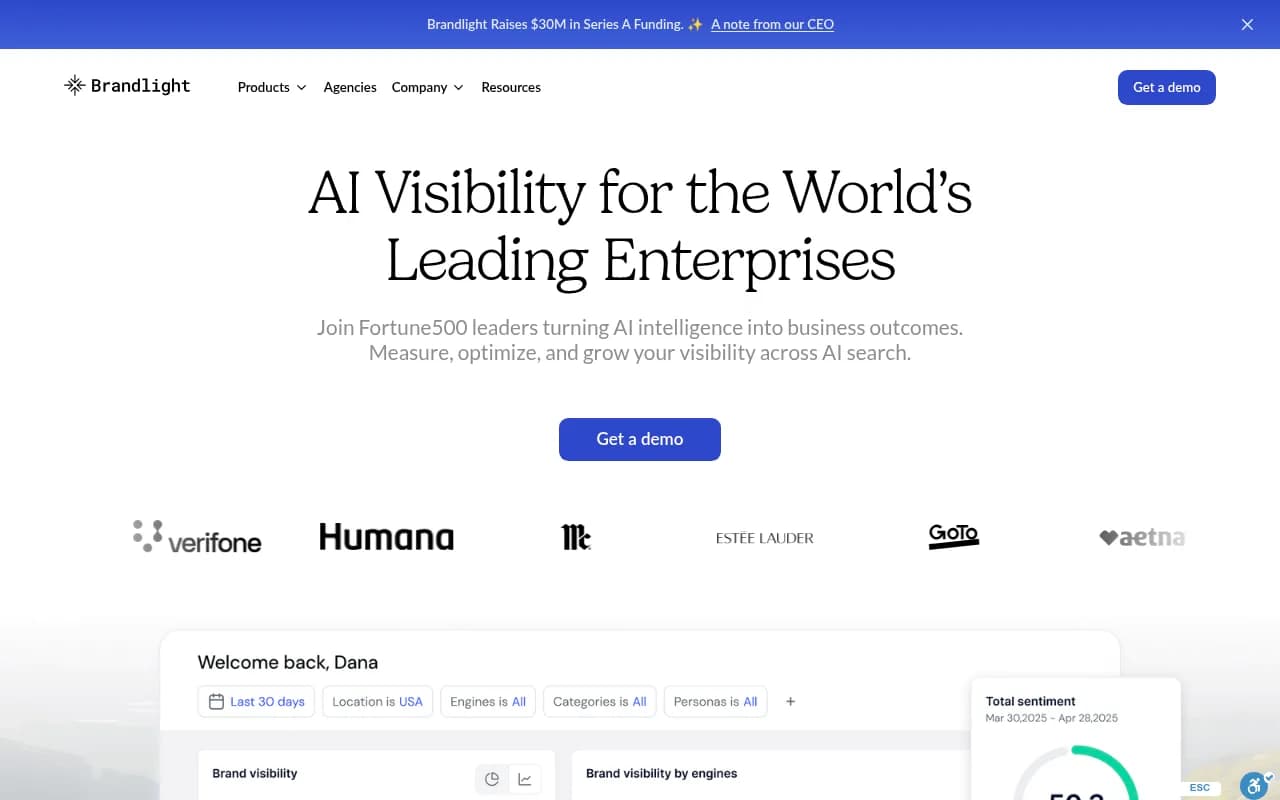
Brandlight.ai positions itself around brand perception inside AI models. The core idea is that it's not enough to know whether you're mentioned -- you also need to know how you're mentioned. Are AI models describing your product positively? Negatively? Are they associating you with the right attributes?
That's a legitimate and underappreciated angle. A brand can have high mention rates but still be losing deals because the AI is framing them as "expensive" or "better for enterprise" when they're actually targeting SMBs.
Brandlight.ai tracks sentiment shifts over time across product attributes, competitive comparisons, and broader brand perception. If you're running a brand refresh or launching a new positioning, that kind of longitudinal sentiment data is genuinely useful.
Where it falls short is on the action side. Brandlight.ai is a monitoring and reporting tool. It tells you what's happening to your brand perception in AI responses, but it doesn't tell you which specific content gaps are causing the problem, and it doesn't help you create the content to fix it. You get the diagnosis without the treatment plan.
It also lacks some of the more technical features that matter for teams doing serious GEO work -- things like AI crawler logs (which pages are AI bots actually reading on your site?), prompt volume estimates, or query fan-out analysis. These aren't niche features; they're the difference between knowing you have a problem and knowing where to start fixing it.
Peec AI: prompt tracking as the core unit
Peec AI takes a different approach. Rather than leading with sentiment, it treats the prompt as the fundamental tracking unit. You define a set of prompts that represent how your customers search for solutions like yours, and Peec tracks your brand's visibility across those prompts over time.
This is a solid mental model. Prompts are the right unit of analysis for AI search -- they're what users actually type, and they're what determines whether your brand gets mentioned. Peec measures mention rate, citation rate, and share of voice per prompt, which gives you a structured way to think about where you're winning and losing.
Peec also has decent multi-language support, which matters more than people realize. AI models respond differently in different languages, and a brand that's well-cited in English might be nearly invisible in German or Spanish responses.
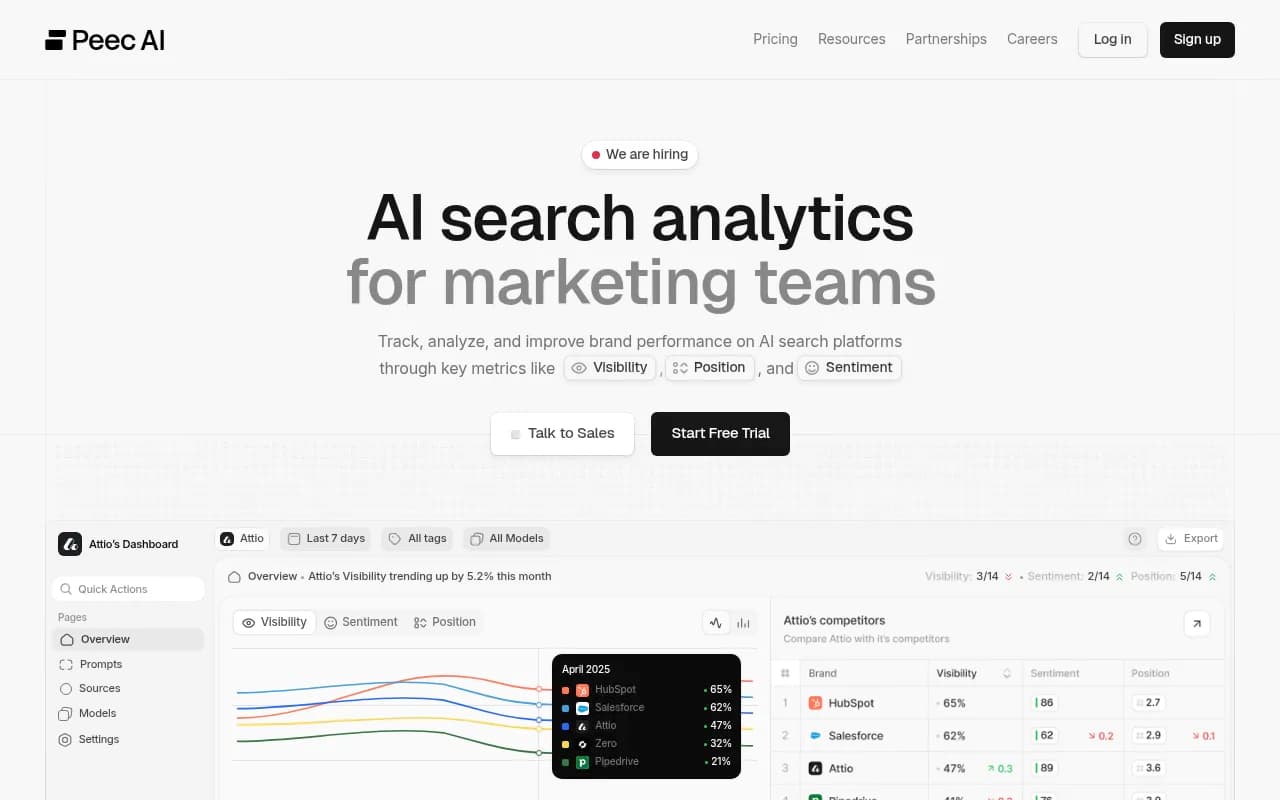
The limitation is the same as Brandlight.ai: Peec is monitoring-focused. Multiple practitioners in the r/GEO_optimization community have noted that PEEC doesn't have built-in content optimization tools. You can see that you're losing visibility for a particular prompt, but the platform doesn't tell you what content you'd need to create to fix it, and it certainly doesn't help you create it.
There's also a prompt cap issue. Peec's entry-level plan limits you to 50 prompts at around €85-89/month. For a brand tracking multiple product lines, geographies, or competitor comparisons, 50 prompts gets used up fast. You end up having to make uncomfortable tradeoffs about what to track.
Promptwatch: monitoring plus the action loop
Promptwatch is a different category of tool, even though it's often listed alongside Brandlight.ai and Peec AI in comparison roundups.
The monitoring capabilities are comparable -- it tracks your brand across 10 AI models (ChatGPT, Claude, Perplexity, Gemini, Grok, DeepSeek, Copilot, Meta AI, Google AI Overviews, and Mistral), measures mention rates, citation rates, and share of voice, and shows you how you compare to competitors. That's table stakes at this point.
What's different is what happens after the monitoring.

Answer gap analysis
Promptwatch's Answer Gap Analysis shows you the specific prompts where competitors are getting cited but you're not. Not just "you're losing to Competitor X" -- but the exact questions, the exact angles, the exact topics that AI models want to answer but can't find on your site. That's a content brief hiding in plain sight.
Built-in content generation
Once you know the gaps, Promptwatch has a built-in AI writing agent that generates articles, listicles, and comparisons grounded in citation data. It's drawing on 880M+ citations analyzed to understand what kinds of content actually get cited by AI models -- not just what reads well to humans. The output is engineered to be picked up by ChatGPT, Claude, and Perplexity, not just to rank in Google.
This is the part that Brandlight.ai and Peec AI simply don't have. You can't buy your way to this capability by adding a separate content tool, because the content generation in Promptwatch is informed by the same citation and prompt data that powers the monitoring. The two are connected.
AI crawler logs
Promptwatch also shows you real-time logs of AI crawlers hitting your website -- which pages ChatGPT's crawler read, which pages Claude visited, how often they return, and any errors they encountered. This is a technical GEO capability that most monitoring tools lack entirely. If AI models aren't indexing your best content, you need to know that before you can fix it.
Traffic attribution
The other piece that matters for justifying GEO spend internally: Promptwatch connects visibility to actual traffic and revenue through a code snippet, Google Search Console integration, or server log analysis. You can see that your new AI-optimized article is being cited by Perplexity, and then trace whether those citations are driving real visits and conversions. Brandlight.ai and Peec AI don't offer this.
Feature comparison
| Feature | Brandlight.ai | Peec AI | Promptwatch |
|---|---|---|---|
| AI models tracked | Multiple | 3+ | 10 |
| Brand mention tracking | Yes | Yes | Yes |
| Sentiment analysis | Strong | Basic | Yes |
| Prompt-level tracking | Basic | Strong | Yes |
| Multi-language support | Limited | Yes | Yes |
| Answer gap analysis | No | No | Yes |
| AI content generation | No | No | Yes |
| AI crawler logs | No | No | Yes |
| Traffic attribution | No | No | Yes |
| Reddit/YouTube insights | No | No | Yes |
| ChatGPT Shopping tracking | No | No | Yes |
| Prompt volume estimates | No | No | Yes |
| Competitor heatmaps | Basic | Basic | Yes |
| Free trial | Yes | Yes | Yes |
| Starting price | Custom/varies | ~€85-89/mo | $99/mo |
Pricing reality check
Peec AI's entry plan runs around €85-89/month for 50 prompts across 3 engines. That's reasonable if you're just getting started and want to understand your baseline visibility. The prompt cap becomes a real constraint as your tracking needs grow.
Brandlight.ai pricing isn't publicly listed in a straightforward way -- you typically need to contact them for a quote, which is a mild annoyance if you're trying to do a quick evaluation.
Promptwatch's Essential plan is $99/month for 1 site, 50 prompts, and 5 articles per month. The Professional plan at $249/month adds crawler logs, 150 prompts, 15 articles, and state/city-level tracking. The Business plan at $579/month covers 5 sites, 350 prompts, and 30 articles.
The honest framing: Promptwatch costs more than a pure monitoring tool, but you're also getting content generation and traffic attribution that you'd otherwise need to buy separately -- and those separate tools wouldn't be connected to your visibility data the way Promptwatch's are.
Who should use which tool?
The answer depends less on budget and more on what stage you're at.
If you're trying to understand your brand's current perception in AI responses -- how you're being described, what attributes are sticking, whether a recent repositioning is showing up -- Brandlight.ai's sentiment focus is genuinely useful. It's a good tool for brand teams who care about narrative, not just mention counts.
If you want clean prompt-level tracking with good multi-language coverage and you're comfortable building your own content strategy separately, Peec AI is a solid choice. It's well-designed for what it does, and the prompt-as-unit-of-analysis framing is the right way to think about AI visibility.
If you need to actually improve your AI visibility -- not just measure it -- Promptwatch is the only one of the three that gives you the full picture. The gap analysis tells you what to create, the writing agent helps you create it, the crawler logs tell you whether AI models are finding it, and the attribution tells you whether it's driving revenue. That's a complete workflow. The other two give you the first step.
A note on the broader market
It's worth acknowledging that Brandlight.ai and Peec AI aren't the only monitoring-only tools in this space. Otterly.AI, AthenaHQ, and Search Party all sit in roughly the same category -- useful dashboards that stop short of helping you act on what they show you.
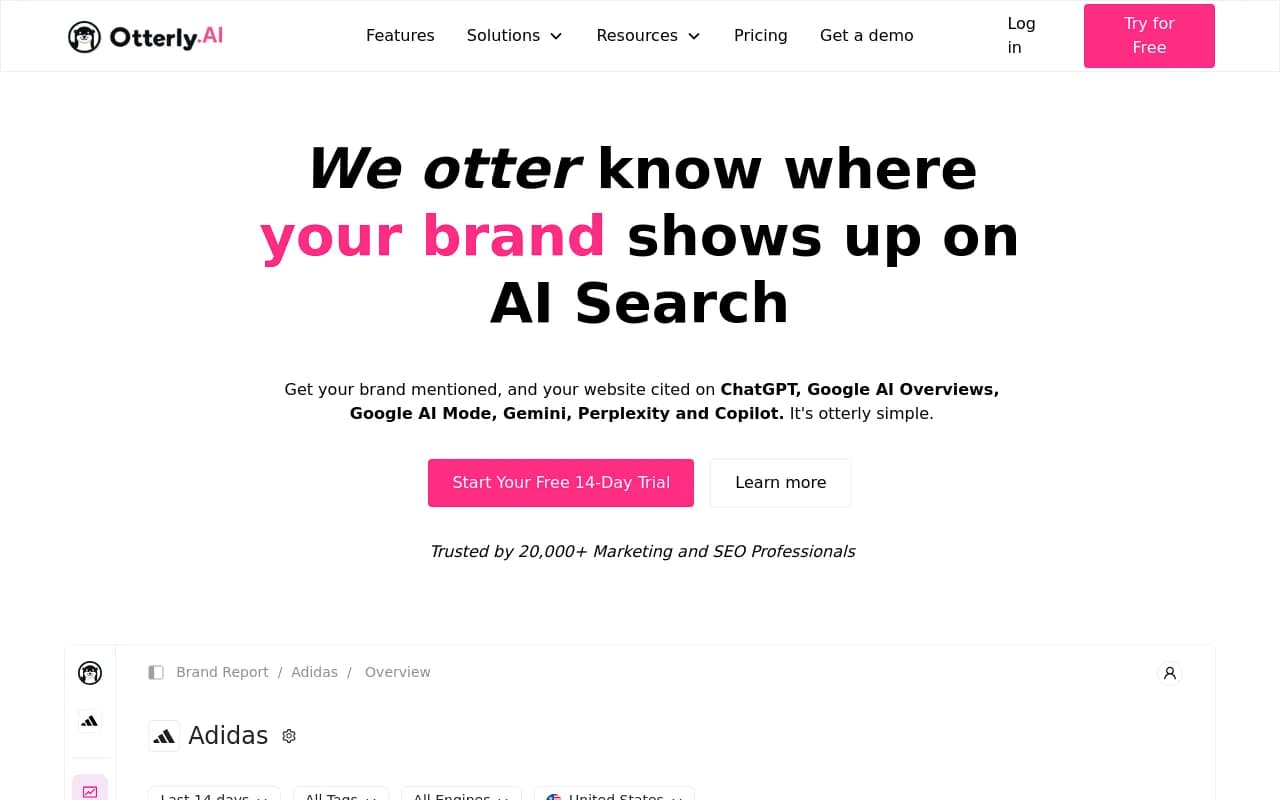

The pattern is consistent across the GEO tools market: most platforms were built to answer "where do I stand?" rather than "what do I do about it?" That's partly because monitoring is easier to build, and partly because content optimization requires a fundamentally different data foundation -- you need to know not just what's happening but why, which means understanding citation patterns at scale.
Promptwatch's 880M+ citations analyzed is what makes the content generation actually useful rather than generic. Without that foundation, an AI writing agent is just producing SEO filler with a GEO label on it.
The bottom line
Brandlight.ai and Peec AI are legitimate tools doing real things. If your primary need is sentiment monitoring or prompt-level tracking and you're comfortable handling content strategy separately, either one can serve you.
But if you're trying to build a systematic process for improving how your brand appears in AI search results -- not just measuring where you are today -- Promptwatch is the more complete platform. It's the difference between a speedometer and a GPS: one tells you how fast you're going, the other tells you how to get where you're trying to go.
The GEO space is moving fast. Brands that are still in "monitoring mode" in late 2026 will find themselves further behind competitors who've been running the full optimization loop for the past year.