Key takeaways
- Ahrefs Brand Radar adds AI search monitoring onto an existing SEO suite, but uses fixed prompts and has no AI traffic attribution -- fine if you're already an Ahrefs user, limiting if AI visibility is your primary goal.
- Peec AI is a clean, well-regarded monitoring dashboard popular with agencies and B2B/SaaS teams, but it stops at reporting -- no content generation, no crawler logs, no gap analysis.
- Promptwatch is the only one of the three that closes the full loop: find where you're invisible, generate content engineered to get cited, and track whether it worked.
- If you're just dipping a toe in, Peec AI is a reasonable starting point. If you actually want to move the needle on AI visibility, you need a platform that does more than show you a dashboard.
The AI search monitoring category has gotten crowded fast. Two years ago, almost nobody was tracking brand visibility in ChatGPT or Perplexity. Now there are dozens of tools competing for the same budget line, and the pitch from most of them sounds nearly identical: "See how your brand appears in AI search."
The problem is that "monitoring" and "optimization" are very different things, and the tools in this category sit at very different points on that spectrum. Ahrefs Brand Radar, Peec AI, and Promptwatch are three of the most commonly compared options right now -- partly because they hit different price points, and partly because they represent genuinely different philosophies about what this category of software should do.
This guide breaks down exactly what each tool does, where it falls short, and how to decide which one (if any) is worth the spend.
What we're actually comparing
Before getting into the tools, it's worth being clear about what "AI search monitoring" means in practice, because the term covers a wide range of capabilities.
At the basic level, a monitoring tool queries AI engines (ChatGPT, Perplexity, Claude, Gemini, etc.) with prompts relevant to your brand or category, then records whether your brand was mentioned, cited, or recommended. That's the floor.
More advanced platforms go further: they tell you why you're being cited (or not), which specific pages are getting picked up, what content gaps are costing you visibility, and -- in some cases -- they help you actually create the content that fills those gaps.
The gap between "monitoring" and "optimization" is where the real differences between these three tools show up.
Ahrefs Brand Radar
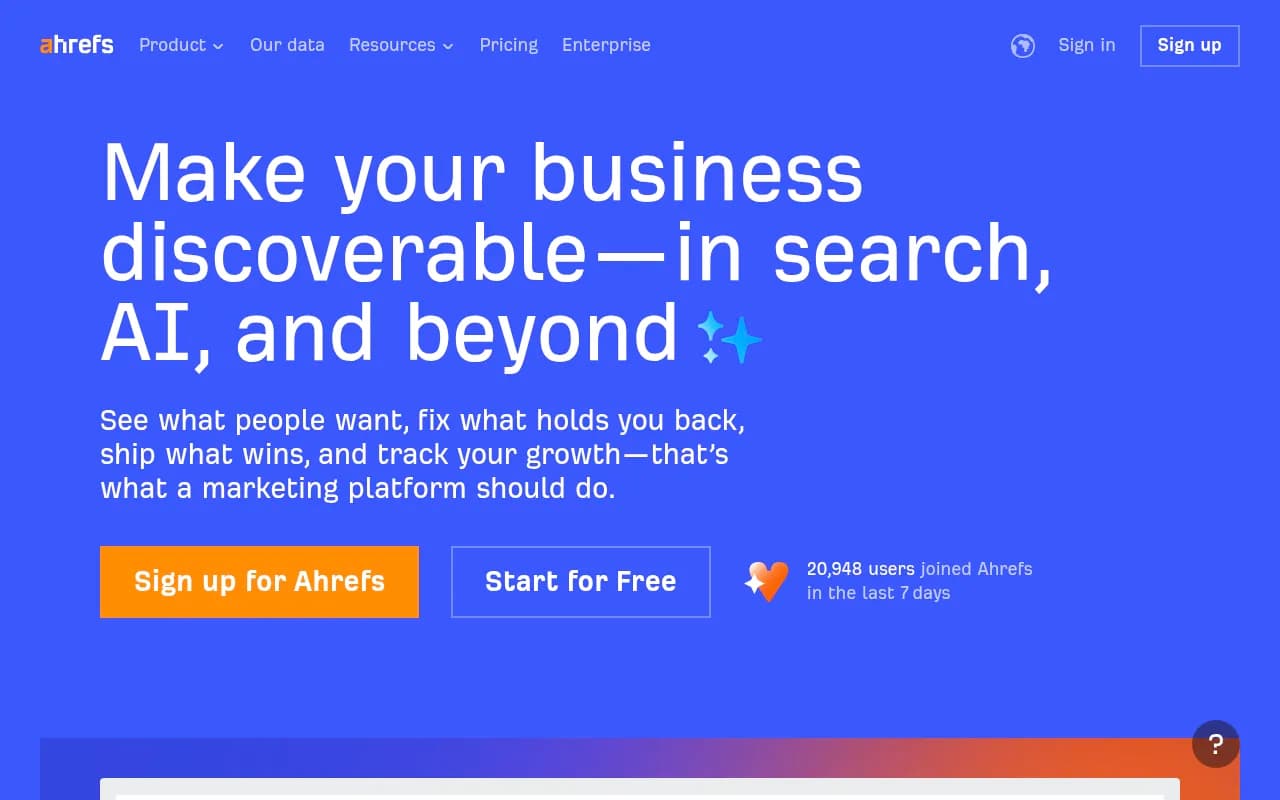
Ahrefs is one of the most established names in SEO, and Brand Radar is their answer to the AI visibility question. It monitors brand mentions across AI engines and gives you share-of-voice data alongside Ahrefs' existing keyword and backlink datasets.
The appeal is obvious if you're already paying for Ahrefs: you get AI monitoring without adding another vendor. The data sits in the same interface as your traditional SEO metrics, which makes reporting easier.
But there are real limitations worth knowing about.
First, Brand Radar uses fixed prompt sets. You can't define your own prompts based on how your actual customers search. This matters because AI search is highly context-dependent -- the prompts that matter for a B2B SaaS company look nothing like those for a travel brand, and a fixed library will miss a lot of what's relevant to your specific situation.
Second, there's no AI traffic attribution. You can see that your brand was mentioned in an AI response, but you can't connect that to actual visits or revenue. That makes it hard to justify the investment internally or to prove that AI visibility work is moving the needle.
Third, the "all platforms" tier that covers six AI engines sits at €654/month -- which is a significant spend for a feature set that's still monitoring-only.
For teams that are deeply embedded in the Ahrefs ecosystem and want a basic AI visibility layer without switching tools, Brand Radar is convenient. For anyone who wants to actually improve their AI visibility rather than just observe it, the feature set runs out quickly.
Peec AI
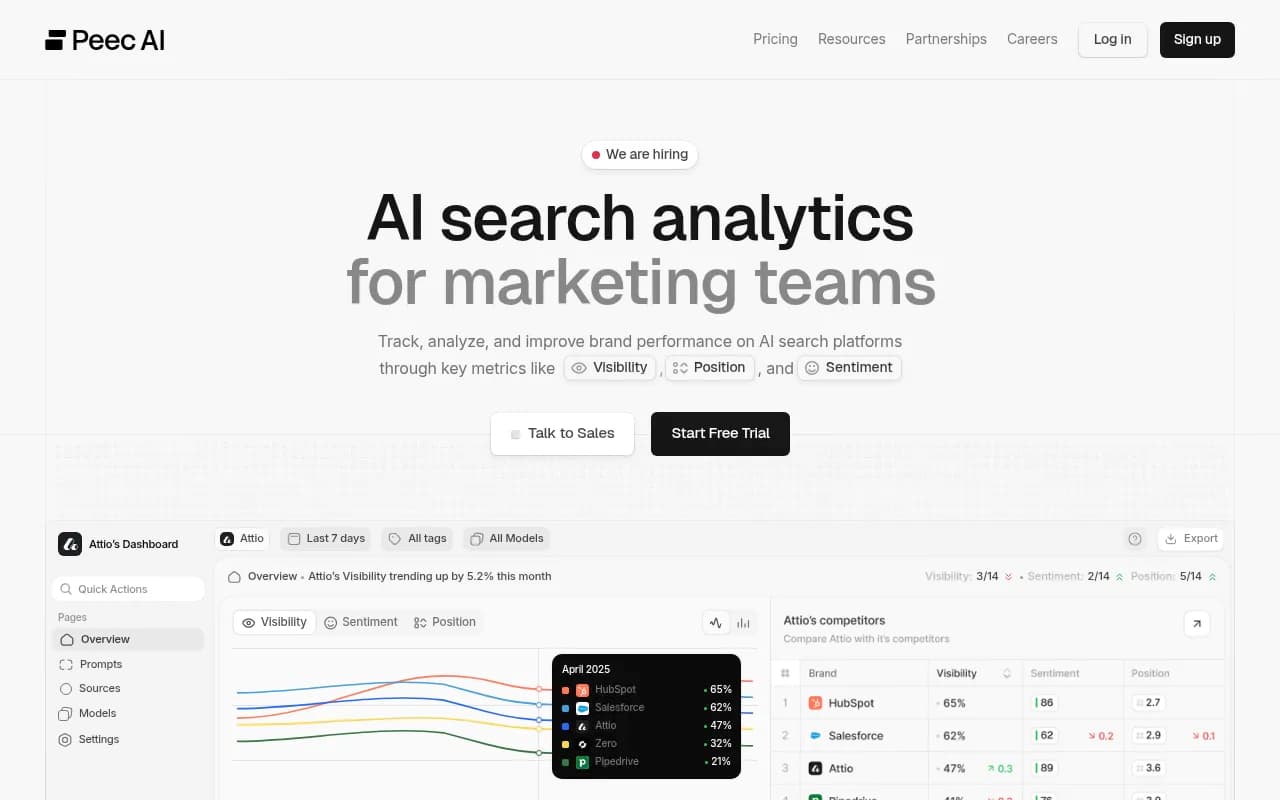
Peec AI has built a solid reputation, particularly among agencies and B2B/SaaS teams. The interface is clean, the reporting is polished, and the multi-language support is genuinely useful for international brands. It starts at around €85/month for 50 prompts across three AI engines.
What Peec AI does well: it gives you a clear picture of your brand's current AI visibility, tracks changes over time, and presents the data in a way that's easy to share with clients or stakeholders. For agencies that need to show clients a professional-looking AI visibility report, it's a reasonable choice.
What it doesn't do: anything about the visibility gaps it finds.
Peec AI is a monitoring dashboard. It shows you where you're invisible, but it doesn't tell you what content to create, doesn't help you create it, and doesn't give you the crawler-level data to understand why AI engines are or aren't picking up your pages. There's no answer gap analysis, no content generation, no AI crawler logs.
That's not a knock on the product -- it's just what it is. If your workflow is "get the data, hand it to the content team, figure it out from there," Peec AI can work. But you're paying for the first step of a multi-step process and doing the rest manually.
The Reddit thread from the SEO tools reviews community captures this pretty well: Peec AI is recommended for teams that want "deep research and agency-style" reporting. The implication being that you need to bring your own strategy layer on top of it.
Promptwatch
Promptwatch takes a different approach to the category. Where Ahrefs and Peec AI are fundamentally monitoring tools, Promptwatch is built around what happens after you see the data.

The core workflow is a loop: find the gaps, create content to fill them, track whether it worked.
The Answer Gap Analysis shows you exactly which prompts your competitors are appearing for that you're not -- not just that a gap exists, but the specific topics and questions AI models want to answer that your site doesn't currently address. That's a meaningful difference from a share-of-voice dashboard.
From there, the built-in AI writing agent generates articles, listicles, and comparisons grounded in citation data from 880M+ analyzed citations. The content isn't generic SEO filler -- it's built around what AI models actually cite, which prompts have volume, and what angles competitors are winning on.
Then you track results at the page level: which specific pages are being cited, by which AI models, how often. And you can connect that to actual traffic through a code snippet, Google Search Console integration, or server log analysis.
A few other capabilities that set it apart from the other two:
- AI Crawler Logs: Real-time logs of when AI crawlers (ChatGPT, Claude, Perplexity) hit your site, which pages they read, and what errors they encounter. Most competitors don't have this at all.
- Prompt Intelligence: Volume estimates and difficulty scores for each prompt, plus query fan-outs that show how one prompt branches into sub-queries. This lets you prioritize high-value, winnable prompts instead of guessing.
- Reddit and YouTube tracking: Surfaces discussions that directly influence AI recommendations -- a channel most monitoring tools ignore entirely.
- ChatGPT Shopping tracking: Monitors when your brand appears in ChatGPT's product recommendations and shopping carousels.
Pricing runs from $99/month (Essential: 1 site, 50 prompts, 5 articles) to $249/month (Professional: 2 sites, 150 prompts, 15 articles, crawler logs, state/city tracking) to $579/month (Business: 5 sites, 350 prompts, 30 articles). There's a free trial, and annual billing brings the price down.
It covers 10 AI models: ChatGPT, Perplexity, Google AI Overviews, Google AI Mode, Claude, Gemini, Meta/Llama, DeepSeek, Grok, Mistral, and Copilot.
The honest caveat: Promptwatch is more platform than most small teams need if they're just starting to think about AI visibility. If you want to dip a toe in and see what your brand looks like in AI search, Peec AI is a lower-friction entry point. But if you're serious about improving your AI visibility -- not just measuring it -- the gap between monitoring-only tools and Promptwatch is significant.
Side-by-side comparison
| Feature | Ahrefs Brand Radar | Peec AI | Promptwatch |
|---|---|---|---|
| AI engines monitored | 6 | 3 (starter) | 10 |
| Custom prompts | No (fixed) | Yes | Yes |
| Answer gap analysis | No | No | Yes |
| AI content generation | No | No | Yes |
| AI crawler logs | No | No | Yes |
| Page-level citation tracking | No | Limited | Yes |
| Traffic attribution | No | No | Yes (GSC, snippet, logs) |
| Reddit/YouTube tracking | No | No | Yes |
| ChatGPT Shopping tracking | No | No | Yes |
| Prompt volume/difficulty scores | No | No | Yes |
| Multi-language | Limited | Yes | Yes |
| Starting price | €654/mo (all platforms) | ~€85/mo | $99/mo |
| Free trial | No | Yes | Yes |
| Best for | Existing Ahrefs users | Agencies, reporting | Teams that want to improve AI visibility |
Who should use which tool
Use Ahrefs Brand Radar if you're already paying for Ahrefs and want AI visibility data without adding another vendor. It's the path of least resistance for existing Ahrefs customers, and the integration with traditional SEO data has real value. Just don't expect it to tell you what to do with the data.
Use Peec AI if you need clean, shareable AI visibility reports for clients or stakeholders, you're working across multiple languages, or you want a lower-cost entry point to understand the category before committing to a more comprehensive platform. It's a solid monitoring tool -- just know that monitoring is all it does.
Use Promptwatch if you're past the "let's see what's happening" phase and want to actually improve your AI visibility. The content gap analysis and AI writing agent mean you're not just watching competitors win -- you have a path to catching up. The crawler logs and traffic attribution also make it much easier to prove ROI internally, which matters when you're trying to justify a new budget line.
The real question: monitoring or optimization?
Most of the AI visibility tools on the market right now are monitoring dashboards. They're useful for understanding your current position, but they leave you with the hardest part of the problem unsolved: what do you actually do about it?
The tools that are worth paying for in 2026 are the ones that help you take action -- not just the ones that show you a score and leave you to figure out the rest.
If you're evaluating this category, the most important question to ask any vendor is: "After I see the gap, what does your platform do to help me close it?" Most of them don't have a good answer.
The monitoring-only tools aren't going away, and they're not useless. But the category is maturing fast, and the gap between "we show you data" and "we help you act on it" is becoming the defining competitive dimension. That's the gap worth paying attention to when you're deciding where to spend.