Key takeaways
- Most AEO platforms stop at monitoring -- they show you where you're invisible but don't help you do anything about it
- Conductor is the strongest choice for teams already embedded in an enterprise SEO workflow, but its AEO features are an add-on to its core SEO product
- Profound has the deepest raw data and enterprise governance features, but comes at a price point that filters out most teams
- Peec AI is a solid monitoring-only tool with good multi-language support, but lacks content generation and crawler insights
- Promptwatch is the only platform in this comparison that closes the full loop: gap analysis, AI content generation, and traffic attribution in one place
The AEO platform market in 2026 is confusing, and that's partly by design. Every vendor describes themselves as an "AI visibility optimization platform." But when you actually dig into what each tool does, most of them are dashboards that tell you where you're not showing up in ChatGPT or Perplexity -- and then leave you to figure out what to do next.
That gap between monitoring and optimization is where real differences emerge. This comparison focuses specifically on four platforms that enterprise teams are actively evaluating: Conductor, Profound, Peec AI, and Promptwatch. The question isn't just "what do they track?" It's "how far do they go toward actually fixing the problem?"
What "optimization depth" actually means
Before getting into the platforms, it's worth being precise about what we mean by optimization depth. There are roughly three levels of capability in this category:
Level 1 is tracking -- you can see your brand's mention rate across AI engines, compare it to competitors, and watch it change over time. Most tools do this.
Level 2 is diagnosis -- you can understand why you're not appearing. Which prompts are you missing? What content gaps are causing AI models to cite competitors instead of you? What are AI crawlers actually reading on your site?
Level 3 is execution -- you can generate content that's specifically engineered to earn citations, publish it, and then close the loop by attributing AI-driven traffic back to revenue.
The platforms below sit at very different points on this spectrum.
Conductor
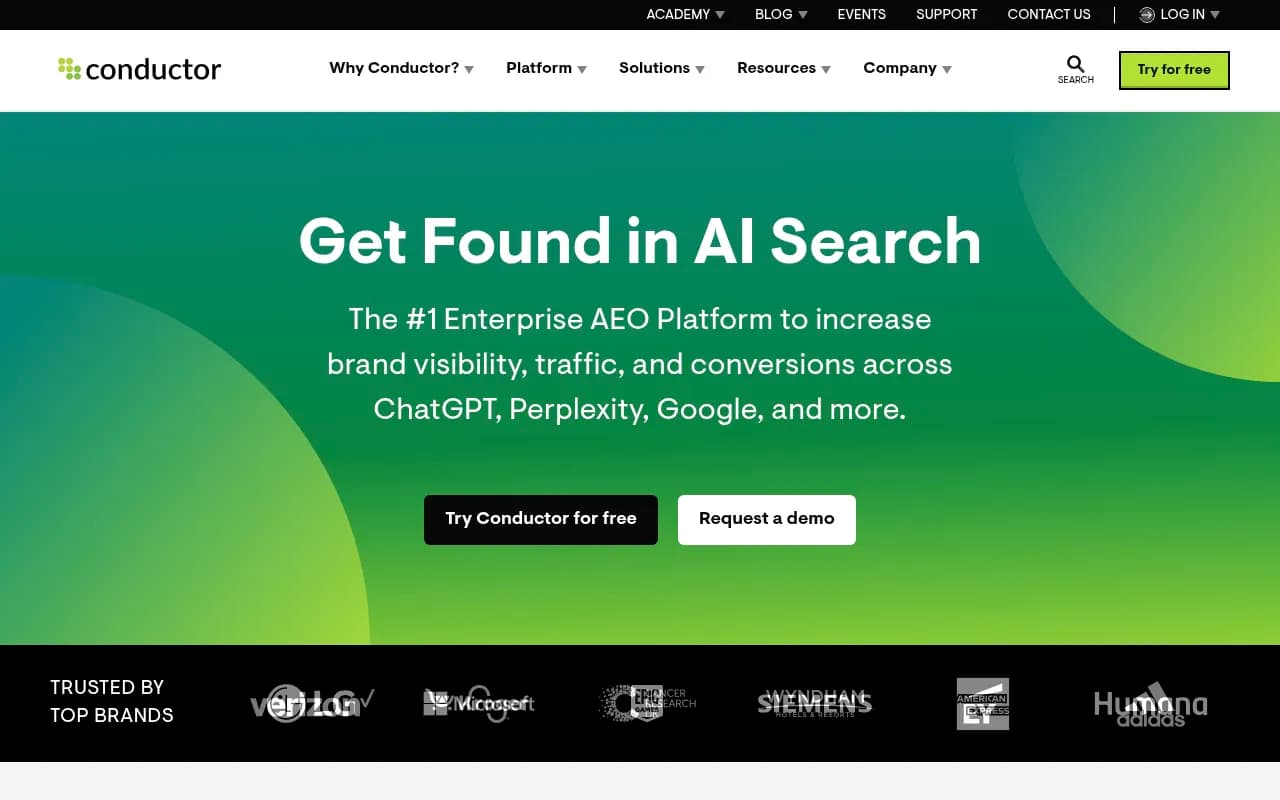
Conductor is primarily an enterprise SEO platform that has added meaningful AEO capabilities over the past 18 months. It's built for large in-house SEO teams and agencies that want a single platform covering traditional search and AI search together.
On the AEO side, Conductor tracks brand visibility across major AI engines including ChatGPT, Perplexity, and Google AI Overviews. Its content guidance features help writers understand what topics and angles are likely to perform in AI-generated responses. The platform also has strong workflow features -- content calendars, approval flows, team assignments -- that matter a lot to enterprise teams managing dozens of stakeholders.
Where Conductor is genuinely strong is in connecting AI visibility data back to its existing SEO infrastructure. If you're already using Conductor for keyword tracking and content optimization, the AEO layer slots in reasonably well. You're not starting from scratch.
Where it's weaker: the AEO features feel like a layer on top of a traditional SEO product rather than something built from the ground up for AI search. Prompt intelligence (volume estimates, difficulty scoring, query fan-outs) is less developed than dedicated AEO platforms. Crawler log analysis for AI bots is limited. And the content generation tools are more SEO-oriented than citation-optimized.
Conductor makes sense for enterprise SEO teams that want one platform for everything and are willing to accept that the AEO features are good but not best-in-class.
Profound
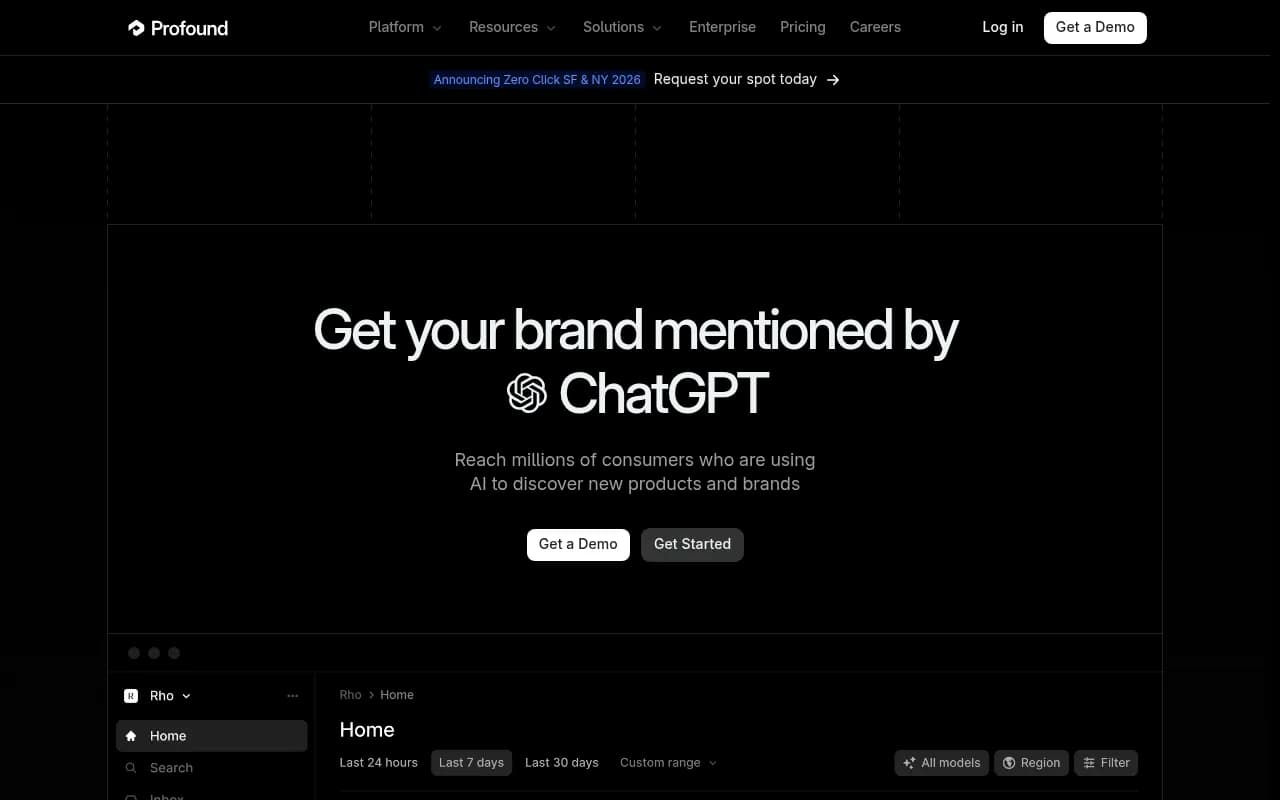
Profound is the platform most often cited when people want the deepest raw data in the AEO category. Its positioning is explicitly enterprise -- it targets dedicated AI visibility teams and data-heavy organizations that want to understand the mechanics of AI citations, not just count them.
The platform tracks 10+ AI engines, has processed 400M+ prompts according to its own data, and holds SOC 2 Type II certification, which matters for enterprise procurement. Its "why did we appear?" analysis is genuinely more detailed than most competitors -- you can trace citation patterns back to specific content attributes and understand what signals AI models are responding to.
Profound also has strong governance features: user roles, audit trails, multi-brand management. For a large organization with multiple product lines and compliance requirements, this is meaningful.
The honest limitation is price and accessibility. Profound starts around $499/month and scales up from there, which puts it out of reach for most marketing teams. It's also a monitoring and analysis platform -- content generation is not a core feature. You get excellent data about what's missing, but you still need to go elsewhere to fix it. That's a real gap for teams that want an end-to-end workflow.
Profound is the right choice if your team has a dedicated AI visibility analyst, a budget to match, and a separate content production process already in place.
Peec AI
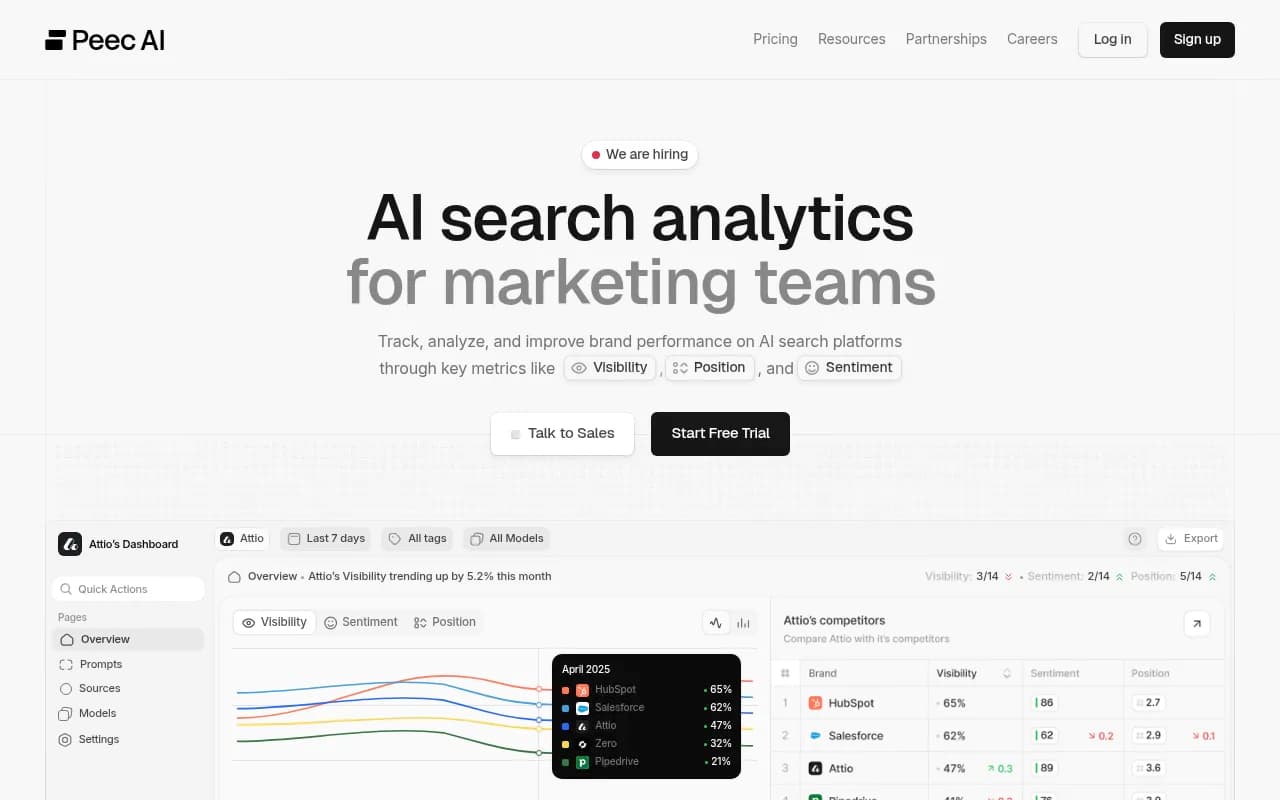
Peec AI is a more focused tool -- it does AI mention tracking across multiple engines and has notably good multi-language and multi-region support, which is underrated in this category. If you're a European brand or a company with significant non-English markets, Peec's language coverage is a genuine differentiator.
The interface is clean and the onboarding is faster than Profound or Conductor. It's a monitoring tool that doesn't try to be everything, which some teams actually prefer.
But that focus comes with real limitations. Peec AI doesn't have AI crawler log analysis. It doesn't generate content. It doesn't have prompt volume or difficulty scoring. It doesn't attribute AI-driven traffic to revenue. For teams that need to go beyond "here's your mention rate," Peec hits a ceiling fairly quickly.
It's a reasonable starting point for teams new to AEO tracking, or for brands that primarily need multi-language monitoring and have separate tools for content production.
Promptwatch
Promptwatch takes a different approach to the category. Where the other platforms in this comparison are primarily monitoring tools (with varying degrees of diagnostic depth), Promptwatch is built around a three-step loop: find the gaps, create content that fills them, and track whether it worked.

The gap analysis piece -- called Answer Gap Analysis -- shows you exactly which prompts competitors are appearing for that you're not. Not just "you're missing prompts in this topic area" but the specific questions and angles AI models want answered that your site doesn't currently address.
The content generation piece is where Promptwatch separates itself from every other platform in this comparison. It has a built-in AI writing agent that generates articles, listicles, and comparisons grounded in citation data (880M+ citations analyzed), prompt volumes, and competitor analysis. This isn't a generic AI writer -- it's producing content specifically engineered to earn citations from ChatGPT, Claude, Perplexity, and other models.
The tracking piece closes the loop. Page-level tracking shows which specific pages are being cited, how often, and by which AI models. Traffic attribution (via code snippet, Google Search Console integration, or server log analysis) connects AI visibility to actual sessions and revenue.
Promptwatch also has AI crawler logs -- real-time data on which AI crawlers are hitting your site, which pages they're reading, and what errors they're encountering. Most competitors in this category don't have this at all.
Pricing is more accessible than Profound: $99/month for the Essential plan (1 site, 50 prompts, 5 articles), $249/month for Professional (2 sites, 150 prompts, 15 articles, crawler logs), and $579/month for Business (5 sites, 350 prompts, 30 articles). Agency and enterprise plans are available with custom pricing.
Side-by-side comparison
| Feature | Conductor | Profound | Peec AI | Promptwatch |
|---|---|---|---|---|
| AI engine coverage | ChatGPT, Perplexity, Google AIO, others | 10+ engines | Multiple engines | 10 engines (ChatGPT, Claude, Gemini, Perplexity, Grok, DeepSeek, Copilot, Mistral, Meta AI, Google AIO) |
| Prompt volume & difficulty scoring | Limited | Yes | No | Yes |
| Answer gap analysis | Partial | Yes | No | Yes (core feature) |
| AI content generation | No | No | No | Yes (built-in writing agent) |
| AI crawler logs | No | No | No | Yes |
| Traffic attribution | Via SEO platform | Limited | No | Yes (snippet, GSC, server logs) |
| Reddit & YouTube tracking | No | No | No | Yes |
| ChatGPT Shopping tracking | No | No | No | Yes |
| Multi-language support | Yes | Yes | Strong | Yes |
| SOC 2 / enterprise governance | Yes | Yes (Type II) | Limited | Yes |
| Starting price | Enterprise (custom) | ~$499/mo | Contact for pricing | $99/mo |
| Best for | Enterprise SEO teams | Data-heavy AI visibility teams | Multi-language monitoring | Teams that want to monitor AND fix |
How to choose
The honest answer is that the right platform depends on where your team is in the AEO maturity curve.
If you're an enterprise SEO team that already uses Conductor for traditional search and wants to add AI visibility tracking without switching platforms, staying with Conductor is defensible. The AEO features are good enough for most use cases, and the workflow integration with your existing SEO process is real.
If you have a dedicated AI visibility team, a data-heavy culture, and a budget above $500/month, Profound gives you the deepest analytical layer in the category. Just be prepared to have a separate content production workflow.
If multi-language monitoring is your primary need and you're not yet ready to invest in content generation or crawler analysis, Peec AI is a clean, fast option.
If you want a platform that takes you from "we don't know why we're invisible in AI search" to "we've published content that's now being cited by ChatGPT and we can prove it drove traffic," Promptwatch is the only platform in this comparison that actually does all of that. The action loop -- gap analysis, content generation, tracking -- is what makes it an optimization platform rather than a monitoring dashboard.
The monitoring-only trap
One thing worth naming directly: there's a real risk in buying a monitoring tool and calling it an AEO strategy. Knowing your brand mention rate in Perplexity is useful data. But if that data doesn't lead to specific actions -- content you create, pages you optimize, technical issues you fix -- it's just a number on a dashboard.
Most platforms in this category are very good at producing that number. Fewer are good at telling you what to do about it. And almost none of them help you actually do it.
That's the gap that separates monitoring tools from optimization platforms. In 2026, with AI search eating an increasing share of zero-click queries, the teams that win are the ones that close that loop -- not just the ones with the best dashboard.
Bottom line
Conductor, Profound, and Peec AI are all legitimate tools for specific use cases. None of them are bad choices for what they're designed to do. But if the goal is to actually improve your AI search visibility -- not just measure it -- the platform that goes furthest is Promptwatch. It's the only one in this comparison with content generation built in, AI crawler logs, traffic attribution, and a workflow designed around fixing the problem rather than documenting it.
Start with a clear question: do you need to understand your AI visibility, or do you need to improve it? The answer determines which platform belongs in your stack.