Key takeaways
- Writesonic is primarily an AI writing platform that added GEO features -- great for content volume, weaker on deep visibility analytics.
- Peec AI is a lightweight monitoring tool: clean dashboards, low price, but no content generation or crawler insights.
- Promptwatch is the only platform that covers the full cycle -- tracking, gap analysis, AI content generation, and traffic attribution -- without requiring separate tools.
- If you only need to write marketing copy, Writesonic fits. If you only need basic brand monitoring, Peec works. If you need to actually improve your AI search rankings, you need a full GEO stack.
- Price is not the deciding factor here -- workflow fit is.
The GEO tool market has gotten crowded fast. A year ago, most marketing teams hadn't heard of "AI visibility." Now there are dozens of platforms claiming to help you rank in ChatGPT, Perplexity, and Google AI Overviews -- and they're not all solving the same problem.
Writesonic, Peec AI, and Promptwatch are three of the most-searched options right now. They're often compared in the same breath, but they're genuinely different products built for different jobs. Lumping them together does a disservice to anyone trying to make a real purchasing decision.
This guide breaks down what each tool actually does, where it falls short, and which type of team should use it.
What problem are we actually trying to solve?
Before comparing features, it's worth being clear about the problem. AI search engines -- ChatGPT, Perplexity, Claude, Gemini, Google AI Mode -- are now answering questions that used to send traffic to your website. When someone asks "what's the best project management tool for remote teams?" they get an AI-generated answer with citations. If your brand isn't cited, you're invisible.
The challenge has three distinct parts:
- Knowing where you're visible and where you're not (monitoring)
- Understanding why you're not getting cited (gap analysis)
- Creating content that gets you cited (optimization and content generation)
Most tools handle one or two of these. The question is which combination your team needs.
Writesonic: the content platform that added GEO
Writesonic started as an AI writing assistant and has since expanded into GEO territory. It tracks AI visibility across major engines, offers an "Action Center" for diagnosing citation gaps, and includes content generation as a core feature.
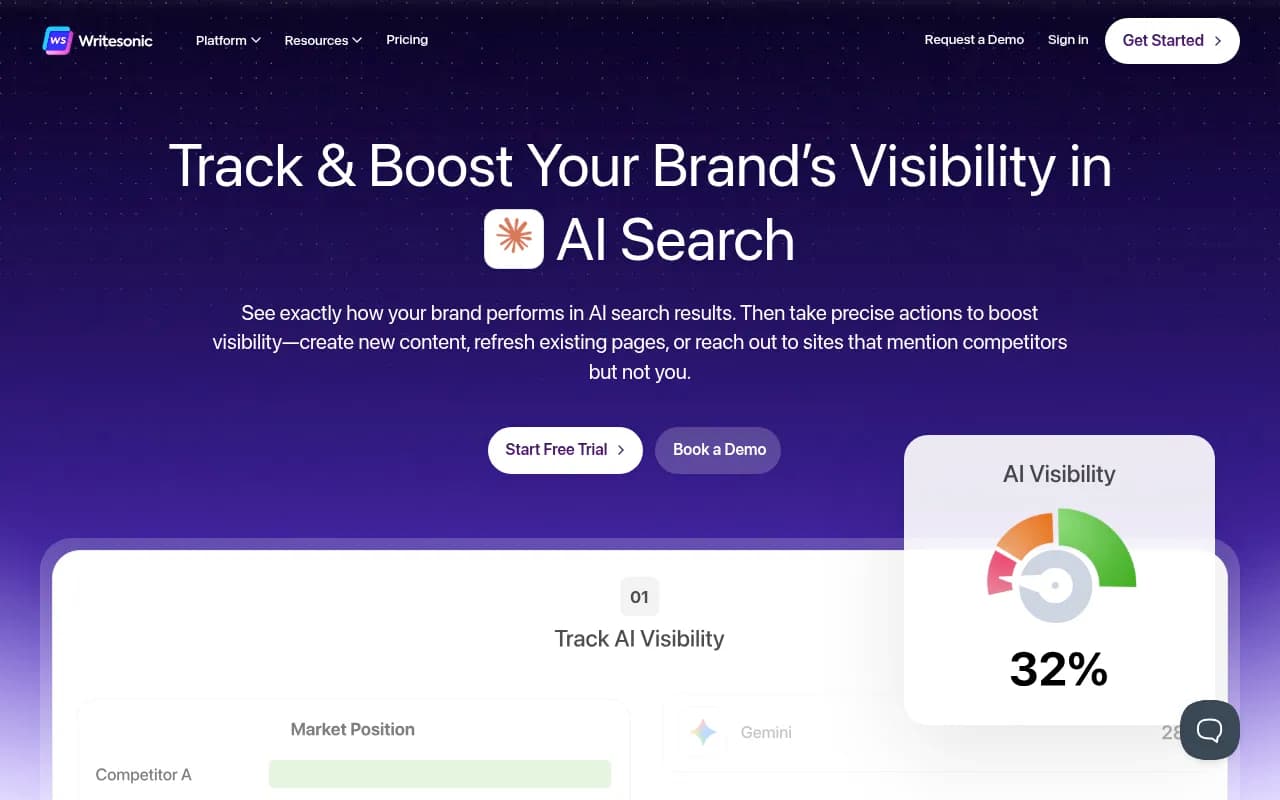
The pitch is appealing: one platform to track your visibility AND generate the content to fix it. In practice, Writesonic's content generation is its strongest suit. If your team needs a steady stream of blog posts, landing pages, product descriptions, and marketing copy -- all with some GEO optimization baked in -- Writesonic delivers.
Where it gets complicated is on the analytics side. Writesonic's monitoring features are solid for most use cases, but they're built around a content platform's priorities. The depth of prompt-level tracking, crawler log analysis, and competitive benchmarking you'd get from a dedicated GEO platform isn't quite there. It's a content tool that tracks visibility, not a visibility platform that generates content. That distinction matters depending on your workflow.
Writesonic is a reasonable choice for agencies that need to produce a lot of GEO-optimized content for clients and want basic visibility reporting alongside it. It's less suited to teams whose primary job is monitoring and improving AI search rankings at scale.
Peec AI: clean monitoring, nothing more
Peec AI sits at the opposite end of the spectrum. It's a focused, affordable monitoring tool that tracks how your brand appears across AI engines. The interface is clean, setup is fast, and the pricing is accessible for smaller teams.
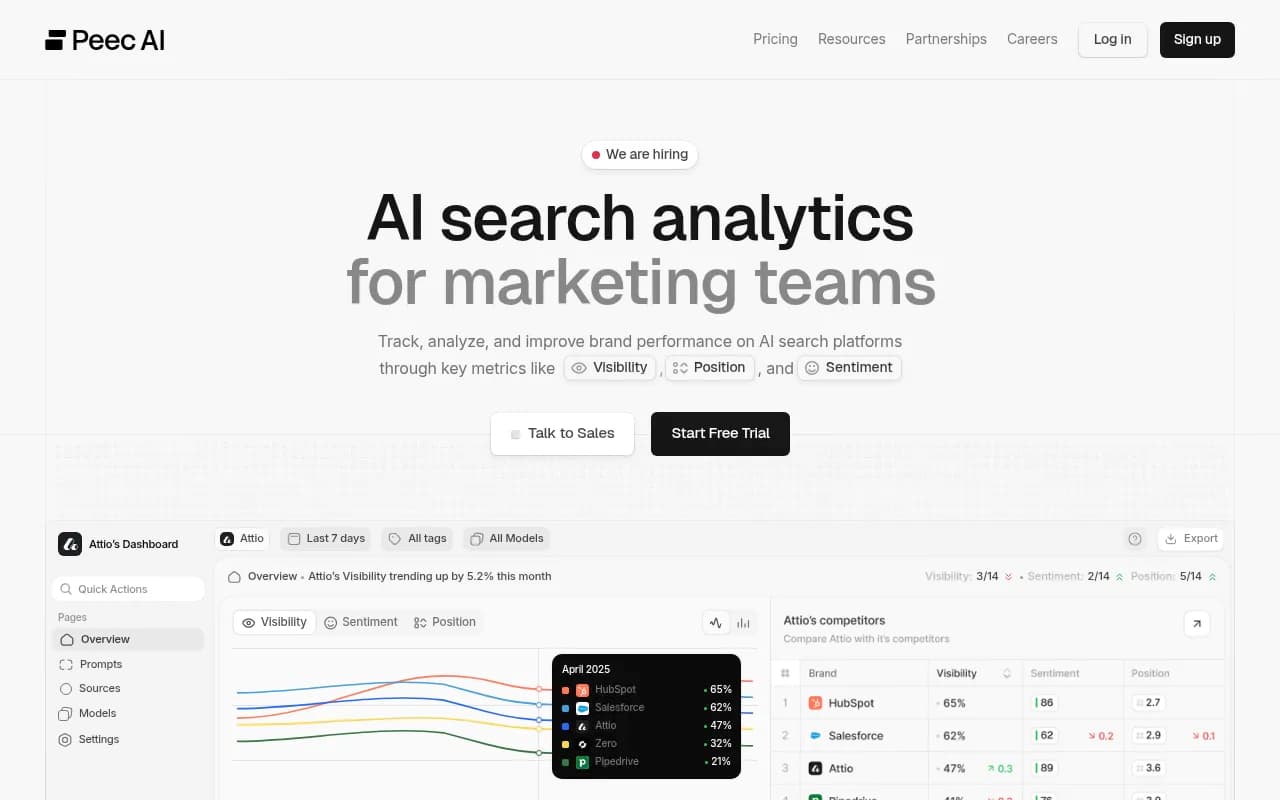
What Peec does well: it shows you where your brand is mentioned in AI responses, tracks sentiment, and gives you a simple dashboard to watch trends over time. For teams that just want to know "are we showing up in ChatGPT?" without a lot of complexity, Peec is genuinely pleasant to use.
What Peec doesn't do: it won't tell you why you're not showing up, what content you're missing, which prompts competitors are winning that you're not, or how AI crawlers are interacting with your site. There's no content generation, no gap analysis, no traffic attribution. It's a monitoring dashboard, full stop.
That's not a criticism -- it's just what the product is. The problem is that monitoring without action is only half the job. Knowing you're invisible in Perplexity for a key query doesn't help you fix it if the tool can't tell you what to do next.
For teams with a very limited budget who just need a basic pulse check on AI visibility, Peec is fine. For anyone who needs to actually move the needle, it's a starting point at best.
Promptwatch: the full GEO stack
Promptwatch takes a different approach entirely. Rather than starting from content generation or basic monitoring, it's built around a specific workflow: find the gaps, create content that fills them, track the results.

The "find the gaps" part is where Promptwatch separates itself from both Writesonic and Peec. Its Answer Gap Analysis shows you exactly which prompts your competitors are visible for that you're not -- not just that a gap exists, but the specific topics, angles, and questions AI models are looking for answers to on your site. That's actionable in a way that a visibility score isn't.
From there, Promptwatch's built-in AI writing agent generates content grounded in real citation data. It's not generic SEO filler -- the content is engineered around what actually gets cited by ChatGPT, Claude, Perplexity, and other models, using analysis of 880M+ citations. You can target specific personas, factor in competitor content, and prioritize by prompt volume and difficulty.
Then the tracking closes the loop. Page-level tracking shows which pages are being cited, how often, and by which AI models. Traffic attribution connects that visibility to actual revenue through a code snippet, Google Search Console integration, or server log analysis.
A few other things worth knowing about Promptwatch that neither Writesonic nor Peec offer:
- AI Crawler Logs that show in real time which AI crawlers are hitting your site, which pages they're reading, and what errors they're encountering
- Reddit and YouTube tracking to surface discussions that directly influence AI recommendations
- ChatGPT Shopping tracking for brands that appear in product recommendation carousels
- Prompt Intelligence with volume estimates and difficulty scores, plus query fan-outs that show how one prompt branches into sub-queries
- Multi-language and multi-region monitoring across 10 AI models
Promptwatch covers 10 models: ChatGPT, Perplexity, Google AI Overviews, Google AI Mode, Claude, Gemini, Meta/Llama, DeepSeek, Grok, and Mistral. That's broader coverage than either Writesonic or Peec.
Feature comparison
| Feature | Writesonic | Peec AI | Promptwatch |
|---|---|---|---|
| AI visibility monitoring | Yes | Yes | Yes |
| Prompt-level tracking | Partial | Basic | Yes |
| Answer gap analysis | Yes | No | Yes |
| AI content generation | Yes (core feature) | No | Yes |
| Crawler log analysis | No | No | Yes |
| Traffic attribution | No | No | Yes |
| Reddit/YouTube tracking | No | No | Yes |
| ChatGPT Shopping tracking | No | No | Yes |
| Competitor heatmaps | Partial | No | Yes |
| Multi-language support | Partial | Yes | Yes |
| AI models covered | ~5 | ~5 | 10 |
| Starting price | ~$49/mo | ~$29/mo | $99/mo |
| Best for | Content-heavy teams | Basic monitoring | Full GEO optimization |
Pricing reality check
Peec AI is the cheapest option, which makes sense given what it offers. Writesonic's pricing varies depending on which plan you're on -- the GEO features sit in higher tiers, so the entry price isn't always the relevant number.
Promptwatch starts at $99/month for the Essential plan (1 site, 50 prompts, 5 articles), $249/month for Professional (2 sites, 150 prompts, 15 articles, crawler logs), and $579/month for Business (5 sites, 350 prompts, 30 articles). Agency and enterprise pricing is available on request.
The honest framing: if you're comparing these tools on price alone, you're asking the wrong question. A monitoring tool that doesn't help you act on what it finds isn't cheap -- it's just incomplete. The relevant question is what you're getting for the spend.
Who should use which tool
Use Writesonic if...
Your team's primary job is producing content at volume and you want some GEO optimization baked into that workflow. Writesonic makes sense for content-heavy agencies, marketing teams with a lot of copy to produce, and situations where the writing capability is the core need and visibility tracking is secondary.
Use Peec AI if...
You're early in your GEO journey, have a small budget, and just want to start tracking whether your brand shows up in AI responses. It's a reasonable first step for teams that aren't ready to invest in a full platform but want some visibility data to work with.
Use Promptwatch if...
You need to actually improve your AI search rankings, not just monitor them. If your team is accountable for AI visibility as a channel -- with metrics, content output, and traffic attribution -- Promptwatch is the only one of these three that supports the full workflow without requiring you to stitch together separate tools.
It's also the right choice for agencies managing multiple clients' GEO programs, brands in competitive categories where prompt-level gap analysis matters, and any team that wants to connect AI visibility to revenue.
The monitoring-only trap
One thing worth naming directly: there's a real risk in buying a monitoring tool and treating it as a GEO strategy. Knowing your visibility score went down doesn't tell you what to do. Knowing a competitor is cited more often doesn't tell you why or how to catch up.
This is the gap that separates Promptwatch from the other two in a meaningful way. Writesonic gets closer to closing the loop because it generates content, but it's still primarily a writing platform. Peec stops entirely at the monitoring layer.
The teams getting real results from GEO in 2026 are the ones treating it like a proper channel: tracking, diagnosing, creating, and measuring. That requires a tool built around that workflow, not a dashboard that shows you data and leaves you to figure out the rest.
A note on the broader market
Writesonic, Peec, and Promptwatch aren't the only options. The GEO tool space now includes platforms like Profound (strong monitoring, enterprise pricing), Otterly.AI (affordable but monitoring-only), and AthenaHQ (monitoring-focused, limited optimization). There are also traditional SEO platforms like Semrush and Ahrefs that have added AI visibility features, though neither goes deep on content optimization for AI search.


If you're evaluating the broader market, the key questions to ask any platform are: Can it show me which specific prompts I'm losing to competitors? Can it help me create content to fix those gaps? Can it attribute AI search traffic to revenue? Most tools answer "no" to at least two of those.
Bottom line
Writesonic, Peec AI, and Promptwatch are solving related but distinct problems. Writesonic is a content platform. Peec is a monitoring dashboard. Promptwatch is a GEO optimization stack.
If you're serious about AI search visibility as a channel in 2026 -- not just curious about it, but actually accountable for improving it -- the tool you need is the one that helps you act, not just observe. That's what makes the choice clearer than it might initially appear.