Key takeaways
- A prompt tracker answers one question: did my brand show up in an AI answer. A full GEO platform answers four more: why (or why not), where AI found the content that got cited, what traffic that actually drove, and what to do next.
- Citation behavior is not stable. ChatGPT's average citations per search-enabled response dropped roughly 27% around the GPT-5.3 rollout in March 2026 and never recovered, which is exactly the kind of shift a one-off prompt check will miss entirely (Promptwatch Data).
- Prompt volume numbers across every vendor, including the expensive ones, are modeled estimates, not measured counts. Treat them as directional signals, not budget justification.
- Pricing in this category is a moving target. Peec AI repriced into euros in August 2026, Scrunch AI got absorbed into Sitecore for a reported $225M in June 2026, and several "starter" plans now gate basic engines behind add-on fees.
- Teams under 10 prompts and one engine can get by on a tracker. Teams that need to turn a visibility gap into published content, on a schedule, without a developer, need the full platform.
The question nobody asks before buying
Most teams start this evaluation backward. They open a comparison spreadsheet, count how many AI engines each tool covers, and pick whichever one has the most checkmarks. That's a reasonable way to buy a rank tracker in 2015. It's a bad way to buy an AI visibility tool in 2026, because the checkmark doesn't tell you what happens after the dashboard loads.
Here's the actual question: when your dashboard shows you're invisible for a prompt that matters, what happens next? If the answer is "someone on the team manually writes a brief, someone else edits it, someone else logs into the CMS and publishes it, three weeks later" -- you don't have a GEO program. You have a very expensive screenshot generator.
That's the real line between a prompt tracker and a full GEO platform. Not engine count. Not pricing tier. Whether the tool closes the loop from "you're missing" to "you're not missing anymore" without six people and three Slack threads in between.
What a prompt tracker actually gives you
A pure prompt tracker runs a set list of prompts against one or more AI engines on a schedule and tells you whether your brand appeared, where, and sometimes what sentiment the answer carried. That's it. No crawler data, no content generation, no traffic attribution.
Tools like [tool:otterly-ai] and [tool:peec-ai] sit squarely in this lane. Otterly's Lite plan runs $29/month for 15 prompts on one engine; Peec restructured its pricing in August 2026 to a euro-denominated model starting around $95/month for 50 prompts across three of six engines, with each additional model costing $30 to $140/month on top.
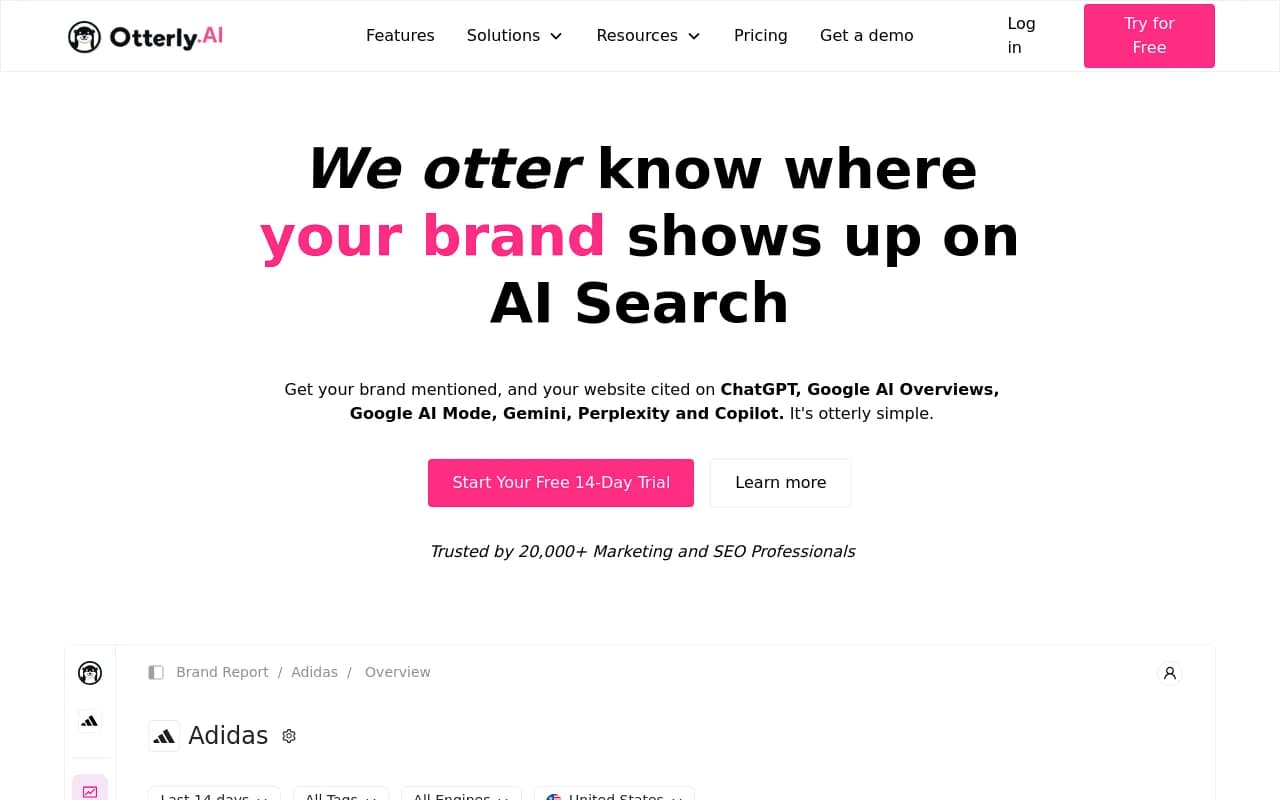
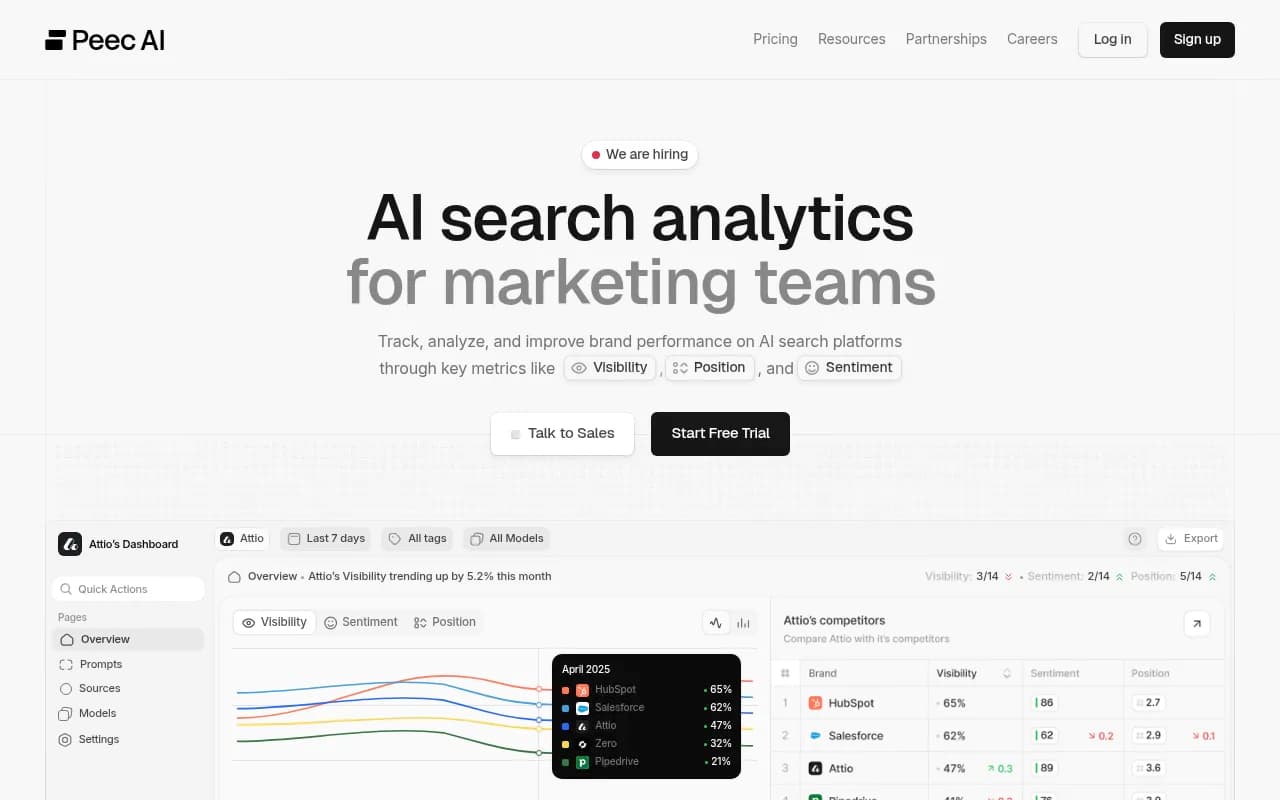
This is a legitimate starting point. If your team has never looked at how ChatGPT or Gemini talks about your brand, a tracker is the cheapest way to find out whether the problem exists at all. The failure mode is treating the tracker as the finish line instead of the first step.
Where trackers run out of road
Three gaps show up fast once a team tries to operationalize a pure tracker:
First, no crawler visibility. You can see that you're not cited, but you can't see whether ChatGPT's crawler ever actually reached your page, hit a block, or read it and chose not to cite it. Those are three completely different problems requiring three completely different fixes, and a prompt tracker can't tell them apart.
Second, no execution path. The tool flags a gap and stops. Somebody still has to write a content brief, somebody still has to publish it, and nobody in the tool tells you which gap is worth fixing first.
Third, prompt-add pricing creep. Nearly every tracker in this lane charges extra per engine beyond the base set. A $189/month Otterly Standard plan becomes $357/month once you add Claude and Gemini coverage. That's not a dealbreaker, but it means the sticker price rarely reflects what multi-engine tracking actually costs.
What a full GEO platform adds
A full platform starts from the same prompt-and-citation foundation, then adds the layers that explain the "why" and do something about it. Four things separate the category:
Crawler logs. Real-time visibility into when ChatGPTBot, ClaudeBot, PerplexityBot, and 400+ other crawlers hit your site, which pages they read, and whether they errored out. This is the difference between "we're not cited" and "we're not cited because Meta-WebIndexer's share of crawler traffic jumped from roughly 2% to nearly 38% between mid-July and early August 2026 and our WAF rules never accounted for it" (Promptwatch Data).
Offsite and third-party citation tracking. Reddit, YouTube, and third-party pages that mention your brand even without linking back. Reddit's share of ChatGPT citations collapsed from about 4% to 0.5% on August 14, 2026, which is the kind of swing that changes where your GEO effort should go next month, not last quarter (Promptwatch Data).
Traffic attribution. Actual visits and conversions from AI platforms to your site, not just a mention count. A mention with zero resulting traffic and a mention that drives revenue look identical in a tracker. They don't look identical in a full platform.
Automated execution. Content agents that draft, and in some cases publish, GEO-optimized pages to your CMS based on the gaps the platform already found, plus a prioritized action list so your team isn't guessing what to fix first.
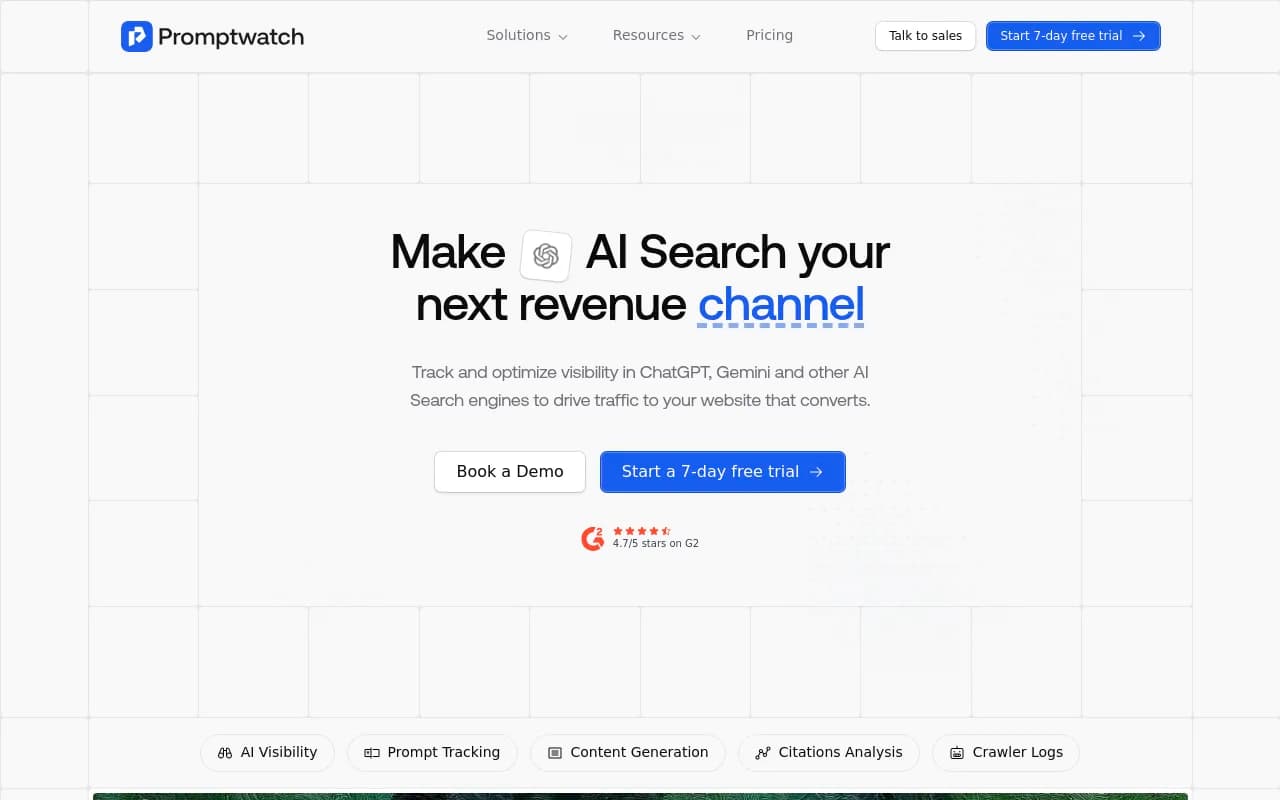
This is the lane Promptwatch built for. It covers ChatGPT, Gemini, Claude, Perplexity, Grok, DeepSeek, Copilot, Mistral, Meta Llama, Google AI Overviews, and Google AI Mode, and it adds the crawler logs, Reddit and YouTube citation tracking, ChatGPT Shopping and Ads Radar, and Content Agents that most of the trackers above simply don't have. Promptwatch is used by 1,840+ brands and agencies, rated 4.7/5 on G2, and has analyzed more than 4.5 billion citations, clicks, and prompts. The Content Agent piece matters in practice: Crisp used it to scale to 5 to 10 published articles a day and saw 2x higher conversion rates from AI traffic than from traditional channels.
Why a one-off prompt check is an anecdote
The case for continuous tracking over periodic spot-checks isn't theoretical. ChatGPT's citation count per response dropped from about 6.4 sources to 4.7-4.9 within a day of the GPT-5.3 rollout and stayed there a month later, with no warning and no announcement (Promptwatch Data). Query fanout behavior compressed too: average fanout queries per ChatGPT response fell from 2.15 in early December to roughly 1.84 by March, then effectively to 1.0 by April, while average query length shrank from about 117 characters to 53 (Promptwatch Data). ChatGPT also started using the site: operator in close to 17% of fanout queries overnight on August 8, 2026, up from under 1% the day before (Promptwatch Data).
None of these are slow trends you'd catch by checking once a quarter. They're overnight shifts in platform behavior that a continuously running tool flags the next morning and a quarterly audit discovers three months after the fact, if ever.
The prompt volume problem, and why it matters for both categories
Every vendor in this space, tracker or full platform, reports a "prompt volume" number: how many times people supposedly ask a given question inside ChatGPT or Gemini each month. None of these vendors have direct access to OpenAI's or Google's query logs. The number is a model, not a measurement, and the consensus across the industry is blunt: prompt volume is a forecast, not a fact.
In practice that means the absolute number is unreliable (a tool claiming "4,820 prompts/month" could be off by 2x in either direction), the relative ranking between topics inside the same tool is mostly trustworthy, and the trend over time within one tool is the most useful signal of the three. Don't compare volume numbers across vendors; they're built on different methodologies and different definitions of what counts as "a prompt." And don't let a volume estimate drive a content investment decision on its own. Use it to pressure-test a strategy you already built from customer research, not to build the strategy from scratch.
Side-by-side: tracker vs full platform
| Capability | Pure prompt tracker | Full GEO platform |
|---|---|---|
| Core job | Tells you if you were mentioned | Tells you why, where, what it drove, and what to fix |
| AI crawler logs | No | Yes (Promptwatch, Profound) |
| Reddit / YouTube citation tracking | Rare | Yes, on Promptwatch |
| Traffic / conversion attribution | No | Yes |
| Automated content generation + CMS publishing | No | Yes (Promptwatch Content Agents) |
| Typical entry price (2026) | $29-$95/mo | $95-$579/mo |
| Multi-engine coverage at entry tier | Often capped at 1-3 engines | Usually all major engines included |
| Best for | First read on whether AI visibility is even an issue | Teams ready to act on what they find, weekly |
Matching the tool to the team
A solo marketer or an early-stage startup testing the waters doesn't need crawler logs or a content agent yet. A tracker like Otterly or [tool:peec-ai] answers the only question that matters at that stage: does anyone need to care about this at all. If the answer is no, you've spent $29-95 and a week finding that out.
Agencies managing multiple client brands usually land in the middle, where mid-market action platforms like [tool:athenahq] or [tool:scrunch-ai] try to bridge monitoring and prioritization, though both come with caveats: AthenaHQ's prompt volume relies on an undisclosed estimation model, and Scrunch AI's June 2026 acquisition by Sitecore for a reported $225M means its roadmap is now shaped by a digital-experience platform's priorities, not an independent point tool's.
Teams that have already confirmed the problem, have content resources to deploy, and need the visibility-to-action loop closed without a six-person chain of custody, are the ones who outgrow trackers fastest. That's the group a platform like Promptwatch is built for, with crawler logs explaining the why, citation and traffic data explaining the where and the impact, and Content Agents and Unified Actions closing the loop automatically.
Enterprise teams with governance requirements, SSO needs, and dozens of markets to track tend to end up evaluating [tool:profound] or [tool:semrush] alongside Promptwatch, usually for the enterprise reporting and integration depth rather than any gap in core tracking.
Multi-language and multi-region: a separate decision
If your brand operates in more than one language or market, the calculus changes again. A prompt translated into Spanish and run against ChatGPT in Mexico is not measuring the same thing as the English version in the US; different publishers get cited, different local competitors get recommended, and the assistant may describe your category differently altogether. A platform needs to preserve language and region as independent trackers, not merge them into one "global visibility" score that hides four distinct outcomes. Worth confirming this explicitly during any trial, because plenty of tools translate the prompt list and call that "global coverage" without actually separating the data afterward.
A practical decision framework
Ask these four questions before signing anything:
- Has anyone on the team confirmed AI visibility is actually a problem for this brand? If not, start with a tracker or a free tool, not a platform.
- When a gap shows up, who writes the fix, and how long does that take today? If the answer is "weeks" or "nobody, honestly," that's the gap a full platform closes.
- Do you need to know why you're invisible, not just that you are? Crawler logs are the only way to answer that, and most trackers don't have them.
- Are you tracking more than one language or region? Confirm the platform keeps those as separate baselines before you buy, not after.
The bottom line
A prompt tracker is a smoke detector. A full GEO platform is the smoke detector plus the sprinkler system plus the fire department's number already dialed. Both have a place. The mistake is paying full-platform prices for smoke-detector functionality, or sticking with a smoke detector long after you've confirmed the building is actually on fire.
If you're still in the "is this even a problem" phase, start cheap and small. If you've already found the gaps and need someone, or something, to close them this week, that's the moment to move up the stack. For a broader look at where each platform in this category lands, the GEO software directory at bestgeosoftware.com is a reasonable place to keep comparing options as pricing and positioning keep shifting through the rest of 2026.