Key takeaways
- ChatGPT Shopping processes around 50 million queries a day, but which brands show up in the carousel shifts in step changes, not slow drift, because OpenAI is actively tuning how often shopping features trigger.
- The same prompt run twice rarely returns the same answer. Research on LLM inference found 80 different responses from 1,000 runs of an identical prompt at temperature 0, which means a single manual check is one draw from a distribution, not a verdict.
- Manual testing breaks down somewhere around 10 to 50 prompts a week. Past that point you're sampling too thin to see real patterns, and you have no record of what the answer looked like three weeks ago.
- Dedicated tools track a four-tier visibility funnel (mention, citation, carousel recommendation, ranking position) that a human skimming a chat response almost always collapses into one bucket.
- Tools like Promptwatch run prompts on a schedule, log raw responses, and flag when shopping trigger rates or ad density shift, catching changes a weekly manual glance would miss entirely.
Why ChatGPT Shopping is worth tracking at all
OpenAI rolled out shopping research in ChatGPT as a way to turn a vague request like "find the quietest cordless stick vacuum for a small apartment" into a structured buyer's guide, complete with clarifying questions, a swipeable product feed, and a final shortlist of four to six items. It's not a side feature anymore. ChatGPT handles an estimated 50 million shopping-related queries daily, out of roughly 2.5 billion total prompts, according to OpenAI's own research cited across multiple outlets.
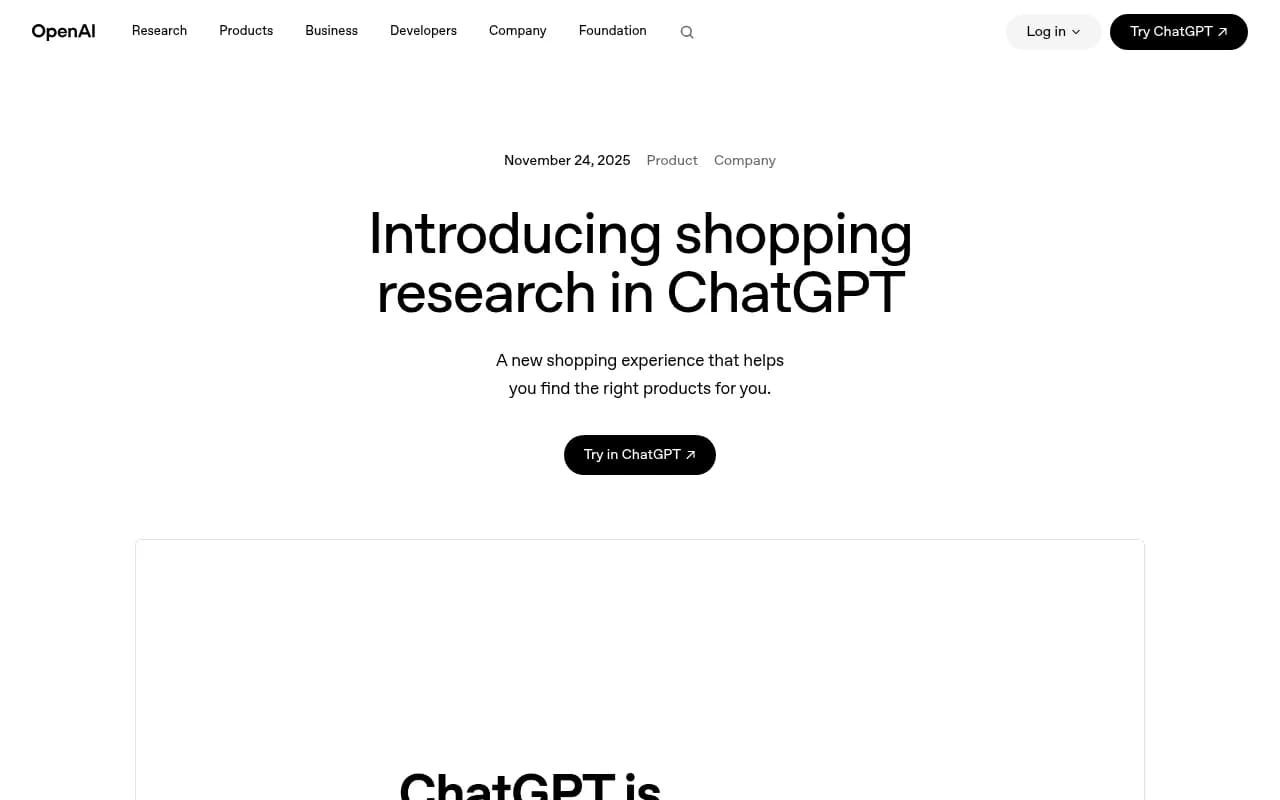
That's a real discovery channel sitting next to Google Shopping and Amazon search, and it behaves nothing like either. There's no keyword bid you can place, no fixed SERP you can screenshot once and call it done. The carousel that shows up for "best running shoes under $150" today might look completely different next week, and nobody at your company gets an email telling you that.
So the question isn't whether to track it. It's whether you check in manually every so often, or set up something that watches continuously. The gap between those two approaches is bigger than it looks.
What a manual check actually captures
A manual check usually looks like this: someone opens ChatGPT, types in a handful of prompts related to their category, reads the response, and jots down whether their brand showed up. Maybe they do this weekly, maybe monthly when someone remembers.
The problem isn't that this is lazy. It's that it's structurally incapable of capturing what's actually happening, for a few concrete reasons.
Responses aren't deterministic, even when they're supposed to be
Thinking Machines Lab ran the identical prompt 1,000 times at temperature 0, the setting that's supposed to make outputs fully reproducible, and still got 80 different responses. Only the first 102 words matched across runs. The cause is floating-point rounding that varies with GPU server load, nothing to do with your prompt. A separate peer-reviewed study found that 43 to 76 percent of prompts returned a non-identical response across just five runs, even on coding tasks with objectively correct answers. Open-ended shopping recommendations vary more than that, not less.
What this means practically: if you check once and your brand isn't in the carousel, that tells you almost nothing. It's one sample from a distribution. Run the same prompt ten times and you might see your brand in six of them, or two. A single manual check can't tell the difference between "we're genuinely losing this category" and "we just drew a bad sample."
Personalization changes the answer underneath you
ChatGPT memory, custom instructions, and conversation history all shift what gets recommended. A user who's told ChatGPT they're "a solo freelancer on a budget" gets a different product suggestion than someone who said they "lead a 50-person team," on the exact same question. Your manual test, run from a fresh incognito session with no history, is testing a version of ChatGPT that most real shoppers never actually see.
Shopping triggers are a dial OpenAI turns, not a steady feature
Promptwatch's monitoring data on ChatGPT's shopping feature trigger rate shows that shopping cards and product recommendations attach to only a low single-digit percentage of web-search responses overall, but that rate isn't stable. It roughly doubled overnight in late May 2026, then fell back weeks later. That's consistent with OpenAI actively adjusting the feature, not organic usage drift. A team checking once a month would see wildly different pictures depending purely on which week they happened to look.
The same data shows shopping features concentrate heavily on commercial and transactional prompts, well above the all-prompt average. If your manual tests skew toward generic, organic-sounding questions, you're systematically underestimating how often shopping recommendations actually appear for the prompts that matter.
Ads showed up from nowhere, then kept climbing
ChatGPT served zero ads in web-search responses until May 27, 2026. By July 1 the rate had passed 30 percent of citation-enabled responses, and Promptwatch's 90-day ads tracking data puts the most recent 7-day average at 32.4 percent. That's not a gradual trend you'd notice by eyeballing a response here and there. It's the kind of step change that only shows up if something is logging the data daily.
A single prompt doesn't reflect the real competitive set
Promptwatch's analysis of sources cited per ChatGPT response found that 47.6 percent of citation-bearing responses cite ten or more unique domains, and the mix varies by intent: organic prompts cite 10+ domains over half the time, while brand-specific prompts narrow to just 21.3 percent. If you only ever test branded prompts ("is Nike good for marathon training"), you're seeing a much narrower, more concentrated citation set than what actually happens when someone asks the open-ended question your potential customer is typing.
Query fanouts mean your prompt isn't the only prompt
ChatGPT frequently breaks a single user question into multiple underlying web searches. Promptwatch's query fanout data shows this fanout behavior has changed dramatically over time, from averaging over two searches per response to settling closer to one leaner, shorter query. The sub-queries ChatGPT actually runs against the web, and against your product catalog, often don't match the literal words you typed. A manual tester has no visibility into what's happening one layer down.
The visibility funnel manual checks collapse into one bucket
Industry research on ChatGPT shopping tracking describes a four-tier funnel that's easy to describe and hard to track by hand:
- Mention: your brand is named in the text, nothing more.
- Citation: your brand is tied to a specific product reference.
- Recommendation: your product lands in the carousel with pricing and a merchant link.
- Ranking position: where you land in that carousel, first versus third versus tenth.
A weighted scoring approach treats these tiers differently, with carousel recommendations counting roughly three times as much as citations, and citations counting twice as much as a plain mention. When someone manually skims a ChatGPT response, they almost always flatten all four into a single yes/no: "were we mentioned." That erases the difference between dominating the carousel and getting a passing namecheck buried in paragraph three, which are two completely different business outcomes.
Where manual testing actually works fine
It's worth being honest here: manual spot-checks aren't useless. If you're running under roughly 10 to 50 prompts a week, a disciplined human process is genuinely workable, according to Siftly's own methodology for ChatGPT shopping tracking. A small team watching two or three key categories, running the same five prompts every Friday and logging results in a spreadsheet, will catch most of the big swings. It won't catch the subtle stuff, but it's not nothing.
The trouble starts the moment you scale past that. More categories, more competitors, more locales, or a desire to actually correlate shopping visibility with revenue, and manual tracking collapses under its own weight. One buyer's guide on ChatGPT rank tracking put it bluntly: manual prompt testing "breaks almost immediately" past ten prompts, leaving teams unaware of hundreds of daily conversations where competitors are quietly winning the carousel.
What dedicated tools catch that manual checks structurally cannot
| What you lose manually | What a dedicated tool does instead |
|---|---|
| One snapshot, treated as the answer | Runs prompts repeatedly (often 3-10 times a day per prompt) and reports a position distribution, not a single data point |
| No record of what changed or when | Logs raw responses with timestamps and model/version metadata, so you can pinpoint exactly when a shift happened |
| Mentions, citations, and carousel placements all look the same | Separates the four-tier funnel and weights carousel recommendations heavier than plain mentions |
| Blind to ad density and shopping trigger rate shifts | Tracks trigger-rate and ad-density trends day over day, catching step changes within hours |
| No sense of the real domain competition set | Tracks which domains and competitors actually get cited across the full range of fanout queries, not just the literal prompt typed |
| Can't connect visibility to business impact | Correlates visibility trends with branded search lift or site traffic, since AI shopping influence sits upstream of a clean clickstream |
What a tool like Promptwatch actually adds
This is squarely the kind of monitoring gap tools like Promptwatch exist to close. Rather than one person remembering to open ChatGPT and type five prompts on a Friday afternoon, Promptwatch runs a defined set of shopping and commercial prompts on a schedule, tracks whether your products show up in the carousel, and gives you a visibility score, sentiment read, and entity tracker for competing brands mentioned in the same responses. It also logs real AI crawler visits to your product pages, which matters because roughly 83 percent of ChatGPT's shopping carousel products are believed to originate from merchant feed data pulled through Google Shopping, per Siftly's analysis, meaning Google Merchant Center hygiene is a prerequisite most manual testers never think to check.
What separates this kind of platform from a basic prompt tracker is that it doesn't stop at telling you a competitor outranked you this week. It flags the gap and helps you close it, whether that's catching a product schema issue, surfacing which content type ChatGPT favors for your category (product pages lead overall citations at roughly 22 percent, rising to 26 percent for commercial prompts specifically, per Promptwatch's citation-type data), or routing the fix into a content workflow instead of a sticky note on someone's monitor.
A practical starting checklist
If you're deciding whether to move off spreadsheets, a few signals suggest it's time:
- You're tracking more than roughly ten prompts, or more than a couple of product categories.
- You've noticed your brand disappear from a carousel and had no idea when it happened or why.
- You want to know if a drop is a real trend or just noise from one unlucky sample.
- You need to tie shopping visibility back to actual site traffic or sales, not just anecdotes.
- Someone on your team is manually copy-pasting ChatGPT answers into a doc more than once a week.
If none of that applies yet, keep doing the weekly spot-check and revisit this in a quarter. ChatGPT Shopping is still young enough that the gap between "casual watcher" and "systematic tracker" is only going to widen as OpenAI keeps adjusting trigger rates, ad placement, and the checkout flow underneath it. If you're evaluating options beyond Promptwatch, the GEO software directory at bestgeosoftware.com is a reasonable place to compare the broader field of AI visibility platforms side by side.