Key takeaways
- Seat pricing matters more than feature lists for marketing teams. Peec AI and Otterly.AI offer unlimited users on every plan; Semrush charges $99/mo per additional seat, which adds up fast once content, SEO, and leadership all want dashboard access.
- Monitoring and fixing are different jobs. Most prompt trackers tell you whether you were cited. Fewer tools turn that gap into a content brief, let alone publish it. Promptwatch and a handful of others close that loop.
- Which engines you track should match where your buyers actually are. ChatGPT cites roughly 5 sources per web-search answer, AI Overviews and Perplexity cite closer to 10, and Copilot's citation count swings wildly week to week, according to Promptwatch's average sources per response data.
- Watch for stacked add-on pricing. Otterly charges separately for Claude, Gemini, and Google AI Mode on top of its base plan, and Ahrefs Brand Radar charges $199/mo per additional AI platform, which can double a "headline" price once you add the engines your team actually cares about.
- Agencies managing multiple brands should weight workspace design and credit systems (AthenaHQ, Scrunch) over single-brand depth.
Why "workflow fit" beats feature count
Every AI visibility vendor will hand you a feature comparison sheet, and almost every sheet looks the same after a while: prompt tracking, citation share, sentiment, competitor benchmarking. What actually separates a tool your team adopts from one that gets opened twice a month is whether it slots into how a marketing team already works.
That means: can your SEO lead, content writer, and CMO all log in without someone paying for five extra seats? Does the tool hand a content brief to the person who writes the article, or does it just produce a chart that sits in a Slack screenshot? Can an agency spin up a new client workspace in minutes instead of a new contract?
I ranked these nine platforms on that basis, not on who has the biggest prompt database. Pricing and feature specifics below reflect plans as published at the time of writing; always check the vendor page before buying, since this category reprices often (Profound dropped its entire self-serve mid-market tier in September 2026, for instance).
The ranking
1. Promptwatch: best for teams that want monitoring and execution in one tool
Promptwatch is built differently from most of this list. Instead of stopping at "were we cited," it runs Content Agents that draft and publish GEO-optimized articles straight to Webflow, Framer, or WordPress, and it generates a prioritized to-do list (Unified Actions) from your visibility, citation, and crawler data. For a marketing team, that's the difference between a dashboard someone checks and a system that actually produces assigned work.
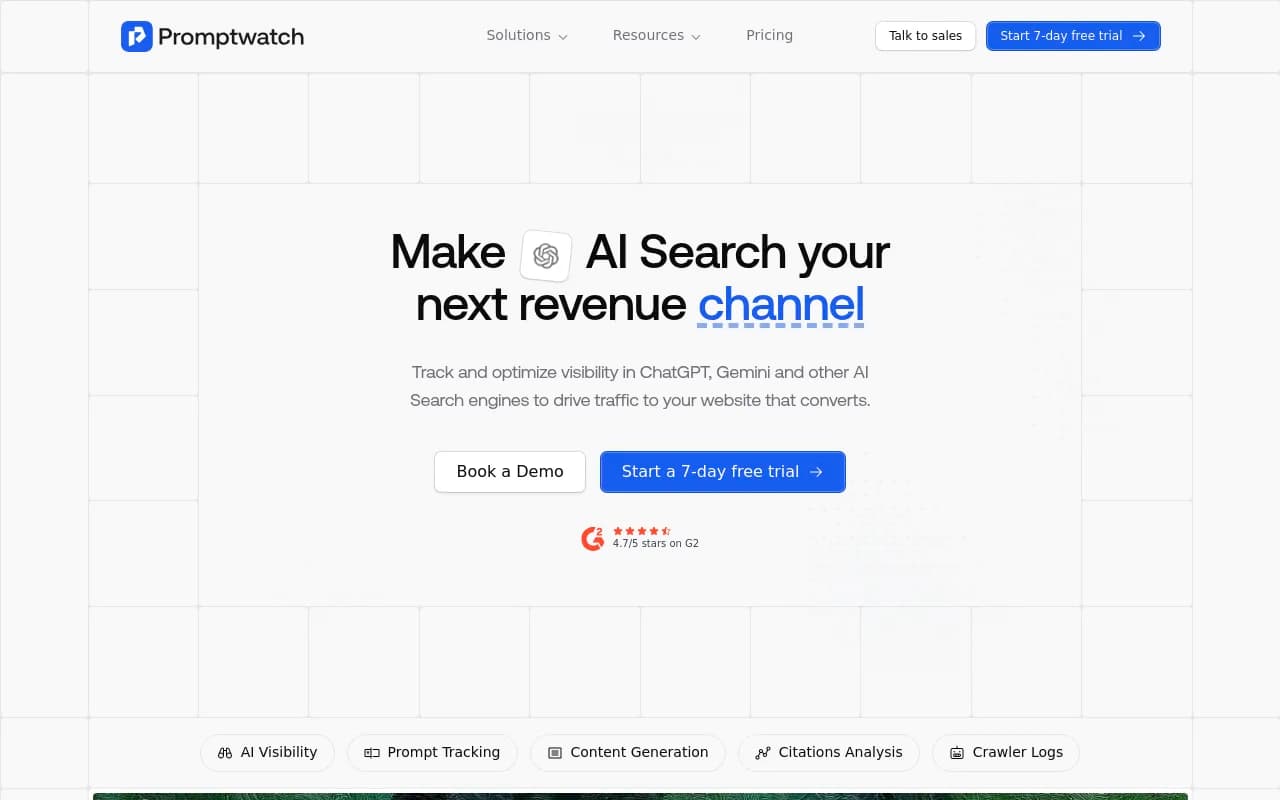
The workflow fit shows up in a few specific places. Agent Chat lets a non-technical marketer ask plain-language questions about visibility data and get a chart back, instead of waiting on an analyst. The Brand Book keeps every AI-generated draft on-brand automatically. And because crawler logs (Agent Analytics) show which pages AI bots actually read, content teams get a real explanation for why a page isn't showing up, not just a binary pass/fail.
Pricing starts at $95/mo for Essential (1 site, 50 prompts), $245/mo for Professional (2 sites, 150 prompts, automated content generation, shopping insights), and $579/mo for Business (5 sites, 350 prompts). Agency tiers start at $199/mo with unlimited projects and 10 seats. It's rated 4.7/5 on G2 across 1,840+ customers including Duolingo, Yelp, and Typeform.
Best for: teams who are tired of monitoring tools that generate reports nobody acts on.
2. Peec AI: best for teams that need unlimited seats and fast setup
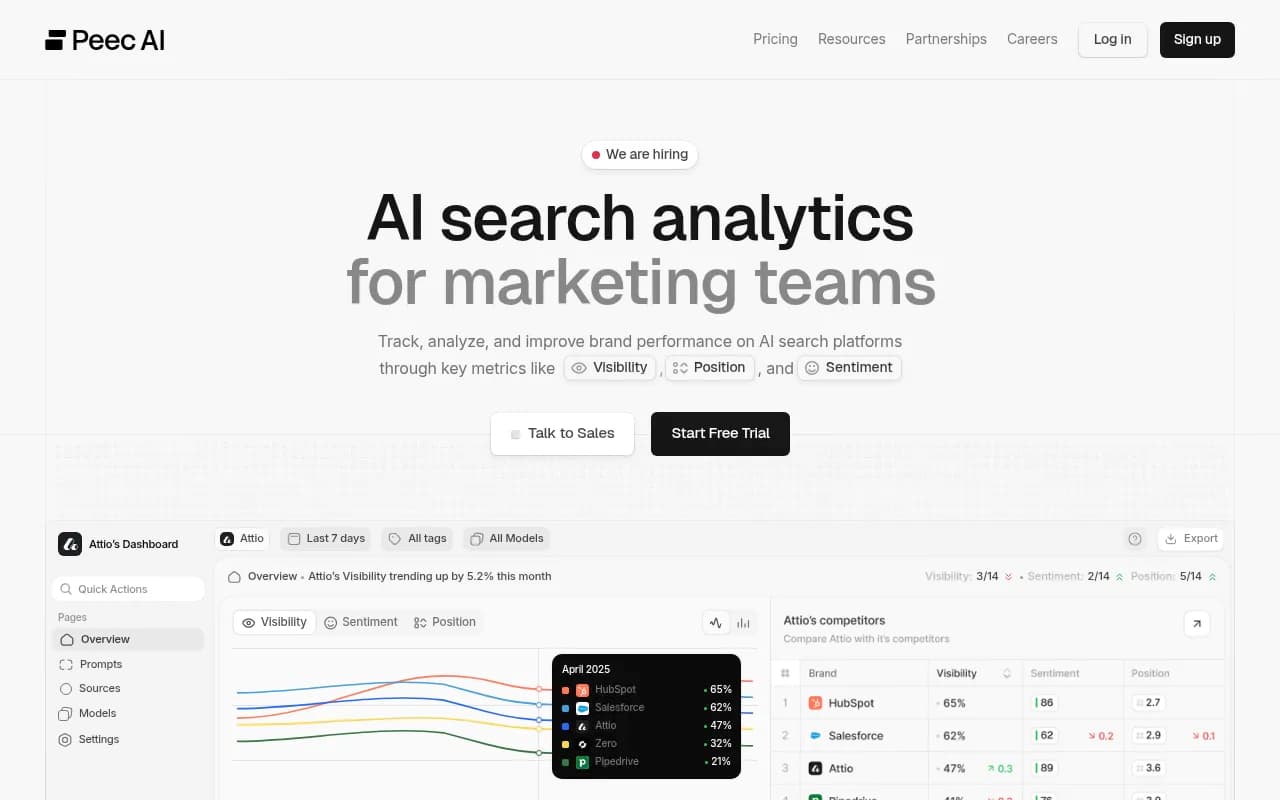
Peec AI's standout workflow feature is its suggested-prompts generator, which builds a starting prompt library straight from a brand's existing website content. That alone can save a content team a day of brainstorming. Every plan, from the $95/mo Starter through the $495/mo Advanced tier, includes unlimited users, which matters a lot for marketing teams where content, SEO, PR, and leadership all want eyes on the same dashboard without a per-seat markup.
Peec also tracks AI Shopping and SKU-level visibility and classifies citation sources into competitor, editorial, reference, and UGC buckets, which helps a marketing team triage where to focus content effort. It's a monitoring-first tool though. There's no CMS publishing or automated content agent, so your team still needs a separate production workflow once Peec tells you where the gaps are.
Best for: lean teams that want broad internal access without stacking per-seat costs.
3. Otterly.AI: best for budget-constrained teams starting small
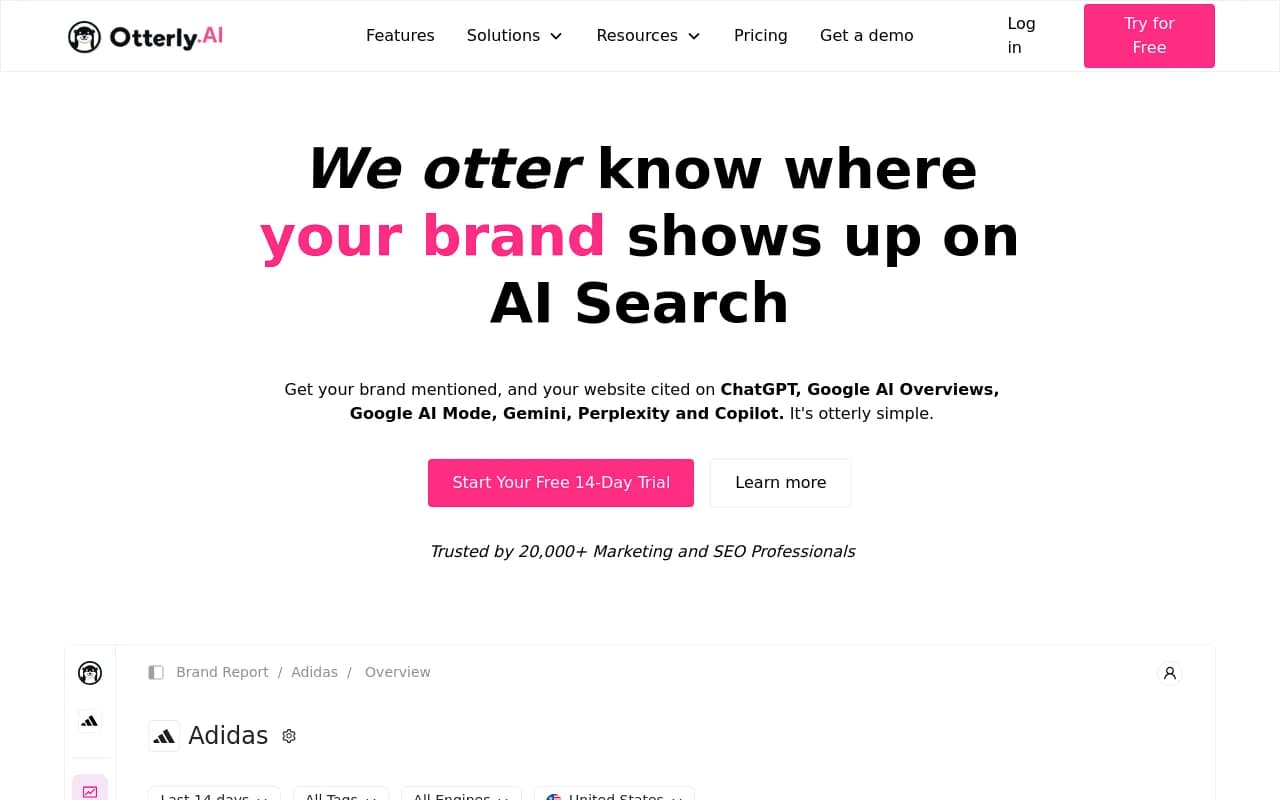
Otterly's Lite plan at $29/mo (or $25/mo annual) is the cheapest meaningful entry point in this category, covering 15 prompts across ChatGPT, Google AI Overviews, Perplexity, and Copilot, with unlimited team members even on that bottom tier. That's a real advantage for a small marketing team testing whether AI visibility tracking is worth budget at all.
The catch is that Gemini, Claude, and Google AI Mode are paid add-ons on every tier, so the real monthly cost for full-engine coverage climbs past the sticker price quickly. Standard ($189/mo) adds API/MCP access and a Looker Studio connector, which helps if your reporting already lives in Looker. Otterly also bundles a surprisingly detailed crawlability audit even at the Lite tier, checking your site against 40+ known AI bots.
Best for: small teams or solo marketers who want to try AI visibility tracking before committing budget.
4. Semrush AI Visibility Toolkit: best for teams already living in Semrush
If your SEO team already runs keyword tracking, site audits, and backlink monitoring through Semrush, the AI Visibility Toolkit add-on ($99/mo per domain) slots into an existing login and existing reporting cadence, which is a real workflow win. You get 25 custom prompts and AI-specific Site Audit checks without asking your team to learn a new interface.
The workflow friction is the per-seat pricing: every additional team member costs another $99/mo, which gets expensive once more than one or two people need access. Semrush One, the bundled suite, offers tiered pricing from roughly $165/mo to $455/mo annually with more prompts included, but it's still built around an SEO toolkit's structure rather than a content-production workflow.
Best for: SEO teams that want AI tracking inside their existing Semrush subscription, not a separate login.
5. Ahrefs Brand Radar: best for teams deep in the Ahrefs ecosystem, willing to pay per engine
Ahrefs Brand Radar has one of the largest prompt databases in this category, drawing on 239M+ tracked prompts, and it ties AI visibility data to Ahrefs' existing SEO and web traffic data, which is genuinely useful if your team already lives in that platform for backlink and keyword work.
The workflow problem is cost structure: each individual AI platform index costs $199/mo, and the all-platforms bundle is $699/mo on top of a base Ahrefs plan starting at $129/mo. A team that wants full coverage can end up paying $800+/mo before adding seats. It also leans more heavily toward Google's AI ecosystem than ChatGPT or Claude, so check that against where your buyers spend time before committing.
Best for: Ahrefs power users who want AI visibility folded into existing SEO reporting, and have budget for it.
6. Profound: best for enterprise teams who can commit to a contract
Profound's Conversation Explorer covers 400M+ real user conversations rather than a fixed list of hand-picked prompts, which gives a large marketing org a much broader signal of actual AI search demand. Prompt Volumes adds double opt-in consumer panel data on top, which is a genuinely different data source than anything scraped from search results.
The workflow catch as of September 2026: Profound retired its self-serve $99 and $399 tiers entirely. The only options left are a 7-day free trial (capped at 3 engines, 50 fixed prompts, no export or history) or an Enterprise contract with custom pricing. For a mid-size marketing team, that means either a short trial that can't inform an ongoing workflow, or a sales conversation and contract commitment before you know if it fits your team.
Best for: large enterprise teams ready to negotiate a contract, not teams that want to self-serve and iterate.
7. Scrunch AI: best for agencies managing a handful of brand workspaces
Scrunch's Agent Experience Platform (AXP) and enterprise SSO support (SAML/OIDC) point this tool toward agencies and larger orgs managing multiple brand workspaces under one roof. Pricing sits around $250/mo for the core tier covering four engines, with custom enterprise pricing for nine models plus API access.
For a single in-house marketing team, Scrunch doesn't offer much workflow advantage over Peec or Otterly at a similar price point. Where it earns its spot is multi-brand management, where the workspace structure and SSO matter more than raw feature depth.
Best for: agencies or holding companies managing several distinct brand accounts.
8. AthenaHQ: best for agencies that want a credit-based pitch workflow
AthenaHQ's credit system (1 credit = analyzing one prompt response for one model, or drafting one piece of content) gives agencies a way to budget AI visibility work per client rather than per seat. Its "Pitch Workspace" feature is built specifically to automate GEO audits for prospective clients, which is a workflow most of this list doesn't address at all. AthenaHQ also offers a free Essential tier with initial credits, useful for testing before a paid Starter plan at $295/mo (3,600 monthly credits, 11-model visibility, unlimited members).
For an internal marketing team rather than an agency, the credit model adds a layer of budgeting complexity that unlimited-prompt competitors don't require.
Best for: agencies that pitch GEO audits as part of new business development.
9. LLM Pulse: best as a lightweight check-in tool, not a full workflow
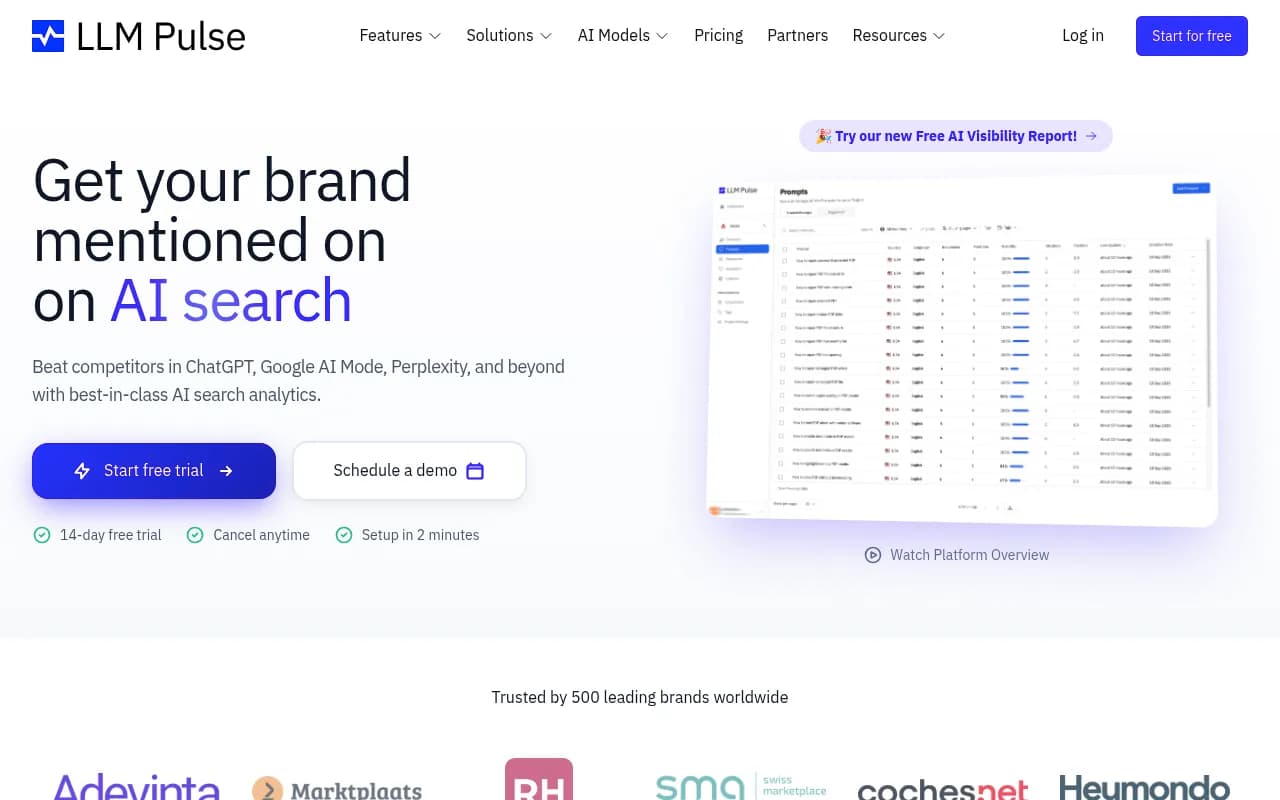
LLM Pulse covers the basics of brand visibility tracking across ChatGPT, Perplexity, and other major models without the workspace, credit, or content-generation complexity of the tools above it. That simplicity is the appeal for a very small team or a solo marketer who just wants a periodic check rather than a daily operating dashboard.
It won't replace a content workflow tool, and it lacks the crawler log analysis, Reddit/YouTube citation tracking, or CMS publishing that the higher-ranked platforms on this list offer. Treat it as a starting point, not an endpoint.
Best for: teams that want the cheapest possible way to glance at AI visibility without building a workflow around it.
Comparison table
| Platform | Starting price | Unlimited seats | Content generation / publishing | Best team fit |
|---|---|---|---|---|
| Promptwatch | $95/mo | No (seat tiers) | Yes, CMS publishing + Content Agents | Teams that want monitoring and execution together |
| Peec AI | $95/mo | Yes, every plan | No | Lean teams wanting broad internal access |
| Otterly.AI | $29/mo | Yes, every plan | No | Budget-constrained teams starting small |
| Semrush AI Visibility | $99/mo per domain | No, $99/mo per seat | No | Teams already in the Semrush ecosystem |
| Ahrefs Brand Radar | $199/mo per engine | Depends on base plan | No | Ahrefs power users with budget |
| Profound | Trial only / custom | Custom (Enterprise) | No | Large enterprise, contract-ready |
| Scrunch AI | ~$250/mo | Custom (Enterprise) | No | Agencies managing several brands |
| AthenaHQ | Free / $295/mo | Yes, Starter tier | Credit-based drafting | Agencies pitching GEO audits |
| LLM Pulse | Entry-level | Varies | No | Lightweight periodic check-ins |
What to actually track once you pick a tool
Picking a tracker is step one. The data only matters if your team knows what to do with it. A few patterns worth building into your workflow, regardless of which tool you choose:
Content types matter more than they used to. Product and landing pages together make up close to 40% of ChatGPT's classified citations, while editorial formats (listicles, how-tos, comparisons, news) make up a similar share overall, according to Promptwatch's citation share by content type data. That split shifts by intent: commercial prompts lean heavily on product and landing pages, informational prompts favor how-to and documentation content. If your tracker reports a citation type breakdown, use it to decide what your content calendar actually needs more of.
Don't assume social monitoring matters equally across engines. ChatGPT has nearly stopped citing social platforms, down to about 0.46% combined share, while Google AI Overviews cites social content roughly 26 times more often, led by YouTube, per Promptwatch's social media citation data by AI model. If your team's prompt tracker only covers ChatGPT, a heavy Reddit or YouTube strategy may be solving a problem that doesn't exist for that engine.
Expect company, not isolation. Most ChatGPT answers cite 8 or more unique domains, per Promptwatch's unique domains per response research, so your real job is improving your position inside a crowded answer, not chasing a binary "cited or not cited" metric.
Final recommendation
If your team wants a single tool that tracks visibility and also does something with the gaps it finds, Promptwatch is the strongest fit on this list for an in-house marketing team, mostly because of the Content Agents, Unified Actions, and crawler log analysis that turn data into assigned work. If your priority is getting the whole team access without paying per seat, Peec AI or Otterly.AI are the more budget-conscious starting points. Agencies managing several client brands should look harder at Scrunch or AthenaHQ's workspace and credit models before anything else on this list.
For a broader look at adjacent categories, including rank tracking tools and GEO software more generally, the directories at bestgeosoftware.com and ai-rank-tools.com are worth a browse before you lock in a contract.