Key takeaways
- Ads now show up inside, above, and below Google's AI Overviews in 12 countries, and above/below in all 200+ markets where AI Overviews appear. You can't target the placement directly, and it's folded into your existing Search, Shopping, and Performance Max campaigns automatically.
- ChatGPT didn't show a single ad until May 27, 2026. By mid-August, ads appeared in roughly 32% of search-enabled responses, with spikes as high as 44% on some days (Promptwatch's ChatGPT ads data).
- The click math is brutal: Pew Research found organic CTR drops about 47% when an AI Overview appears, and Ahrefs puts the position-1 CTR drop at 58%. SparkToro's 2026 numbers show 68% of Google searches now end without any click at all.
- Branded queries are the exception, not the rule. Amsive found an 18% CTR increase for branded queries inside AI Overviews, while generic queries dropped 34-46%. Being known beats being findable.
- This is a creative, structural, and brand problem, not just a bidding problem. The checklist below covers campaign eligibility, content formats AI actually cites, and the brand-building work that none of this replaces.
What actually changed in 2026
I want to get the sequence of events straight first, because half the panic out there is about features that have been live for months and half of it is about things that haven't shipped yet.
Google's AI Overviews have been running for roughly a year. What's new in 2026 is that Google started putting ads inside the box, not just around it. According to Google's own Ads Help documentation, ads trigger only on "no one right answer" queries where Google detects commercial intent, and the ad has to be relevant to both the original query and the AI-generated content around it (support.google.com). You don't set this up as a new campaign. If you're already running Search, Shopping, or Performance Max, you're automatically eligible. You also can't opt out, can't bid separately for the placement, and right now there's no reporting that breaks AI Overview impressions out from regular "Top Ads." It all gets lumped together.
As of January 2026, ads can appear within the AI Overview box itself in 12 countries: the US, Australia, Canada, India, Indonesia, Kenya, Malaysia, New Zealand, Nigeria, Pakistan, Philippines, and Singapore. Everywhere else that has AI Overviews, ads can still show above or below the box, just not woven into the generated text.
Some categories are carved out entirely from the in-box placement: alcohol, gambling, finance, healthcare, adult content, and politics. If you're in one of those verticals, you're stuck competing above and below the fold, same as before.
Then in May, Google Marketing Live announced the next wave: four Gemini-built ad formats. Conversational Discovery ads answer a specific question with tailored creative. Highlighted Answers let ads slot into AI Mode's recommendation lists, labeled "Sponsored." AI-powered Shopping ads have Gemini write a custom explainer for why a given product fits your query, not a generic description. And there's a Business Agent for Leads. Google also expanded its Direct Offers pilot, which now includes native checkout through merchant partners and travel deals, meaning someone can complete a purchase inside AI Mode without ever landing on your site.
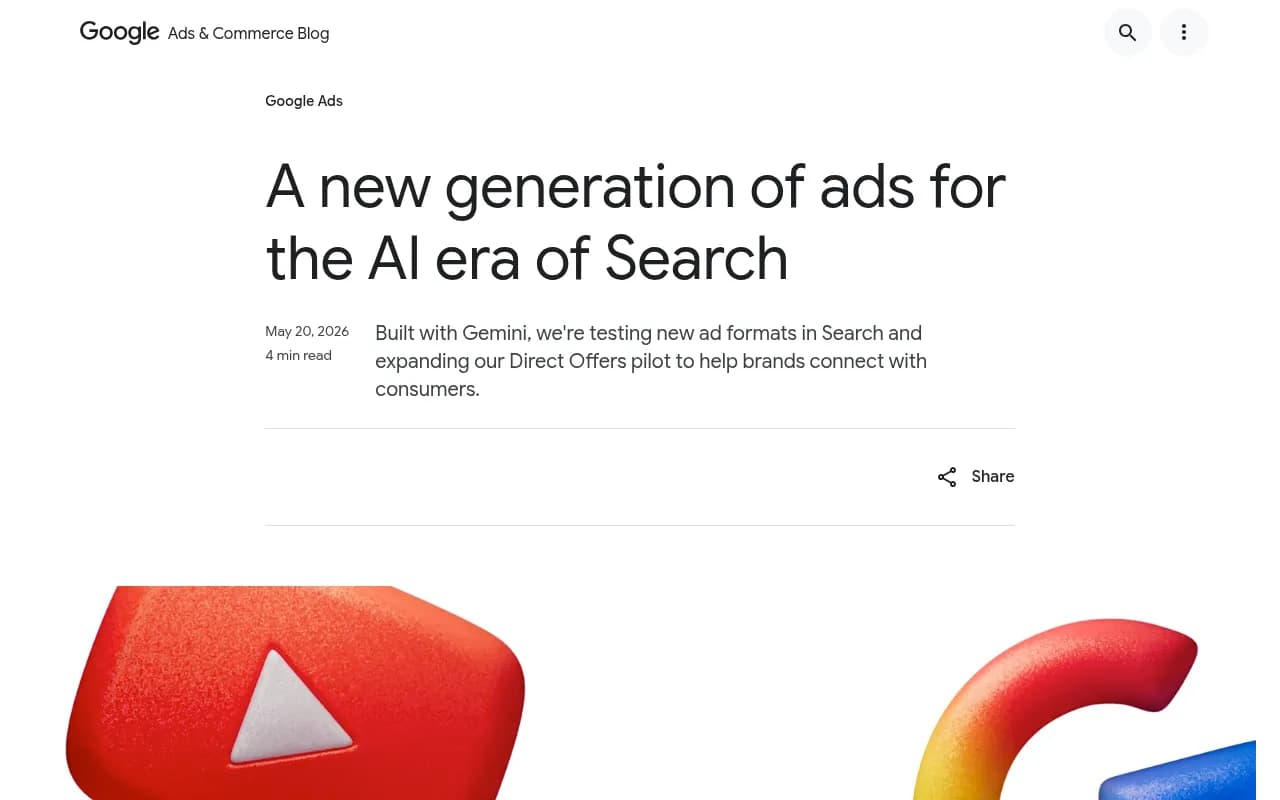
That last part is worth sitting with for a second. Google isn't just inserting ads into AI answers, it's trying to close the loop so the AI answer is the transaction. If that works at scale, the click becomes almost optional for the retailer too, not just the shopper.
AI Mode specifics worth knowing
AI Mode now shows ads in roughly a quarter of its results, with engagement reportedly 18% higher than standard search ads but at a 35% CPC premium, according to Digital Applied's analysis. There are four distinct placement types inside AI Mode: inline sponsored citations embedded in the answer text (highest trust, highest CPC, limited inventory), sidebar recommendation cards, post-response ads below the finished answer (closest to a traditional ad, cheaper, more inventory), and follow-up query sponsorship, which triggers as a conversation narrows toward purchase intent.
The mechanic that trips people up: Google evaluates the whole conversational thread, not a single query, to decide whether an ad shows. Someone might ask a broad, informational first question with no ad in sight, then ask a follow-up that reveals commercial intent, and suddenly an ad appears. Your targeting has to account for multi-turn intent, not just the keyword that started the session.
ChatGPT's ad rollout moved faster than most people noticed
While everyone was watching Google, OpenAI quietly turned ads on inside ChatGPT's search results. Promptwatch Data tracked this closely: ChatGPT showed zero ads until May 27, 2026, when they first appeared in 1.69% of search-enabled responses. From there it climbed in bursts, a spike around June 25-26, then a jump past 30% on July 1 that stuck. In the seven days before August 17, the average ad rate hit 32.4%, up 12.5% from the prior week, with single-day spikes as high as 43.9% (promptwatch.com/data/chatgpt-ads-over-time).
Break that down by prompt type and it gets more interesting. Of ad-bearing responses, 73.3% came from plain organic prompts, 18.0% from brand-specific prompts, and 8.6% from competitor-comparison prompts. So ads aren't only showing up when someone searches a category term, they're showing up even when someone's asking about your brand by name, or comparing you to a competitor.
If you're only watching one platform's ad program, you're missing where the growth actually is right now.
ChatGPT's shopping features (product cards, price comparisons) are still a smaller slice of the pie overall, a low single-digit percentage of search responses, but the rate jumped visibly in late May before settling back, which tells you OpenAI is actively tuning when these show up rather than leaving it static. Shopping features cluster hard on commercial, transactional prompts, where trigger rates run well above the all-prompt average (promptwatch.com/data/chatgpt-shopping-usage). Promptwatch's take on this, and I agree, is that the traffic is modest today but the brands that get Product schema, pricing, and merchant feeds AI-ready now will be the hardest to displace once the feature scales.
The click decline, with numbers that actually hold up
There's a lot of noise in "AI is killing SEO" content, so let's stick to numbers with a clear methodology behind them.
Pew Research Center analyzed 68,879 real Google searches and found that when an AI Overview shows up, users click a traditional organic result only 8% of the time, versus 15% when there's no AI Overview. That's a 47% relative drop in CTR, measured, not modeled.
Ahrefs found the position-1 organic listing loses 58% of its CTR when an AI Overview appears above it. Bain and Dynata put the zero-click rate at 83% when an AI Overview shows. Semrush's number for AI Mode specifically is even higher, a 93% zero-click rate. And SparkToro's early-2026 data shows 68.01% of all Google searches in the first four months of the year ended without a single click, the fastest acceleration of the zero-click trend it has tracked in a decade.
There's one dataset, from Ziptie, claiming both organic and paid CTR compressed by 61% and 68% respectively on the same queries between June 2024 and September 2025. I'd treat that one as directional rather than gospel since it's a single secondary source, but even without it, the Pew and Ahrefs numbers alone make the point.
Here's the part that should change how you plan budget, not just how you feel about it: Amsive found branded queries with AI Overviews present actually saw an 18% CTR increase, while generic queries dropped 34-46%. Seer Interactive's study found brands cited inside AI Overviews earned 35% more organic clicks and 91% more paid clicks than brands that weren't cited. Being the brand someone already has in mind is worth more now than it was two years ago, not less.
The 2026 readiness checklist
1. Audit your current AI Overview and AI Mode exposure
You can't manage what you can't see, and right now Google gives you almost nothing to see it with. There's no segmented reporting for AI Overview ad impressions, it all reports as "Top Ads." So you need to manually check how often your category's queries trigger an AI Overview, whether ads show inside it, and who's winning those slots. Run the same queries across a few days, not once, because the placement is volatile.
Tools built for this exist outside Google's own dashboards. Promptwatch tracks how brands appear across ChatGPT, Gemini, AI Overviews, AI Mode, Perplexity, and more, including a dedicated Ads Radar for tracking which competitors are buying ad placements against your prompts and what their ad copy looks like.
2. Check campaign eligibility, don't assume it
AI Mode ads are currently limited to Performance Max and AI Max for Search campaigns, as of April 2026. Standard Search, Display, and Video campaigns don't qualify yet, though Google has hinted at broader eligibility later this year. If your account is still running classic Search campaigns without AI Max enabled, you are leaving placements on the table that your competitors running Performance Max are already winning.
AI Max for Search isn't a new campaign type, it's an optimization layer inside an existing Search campaign, off by default. Turning it on gives you three things: broader search-term matching beyond your keyword list, AI-generated headlines and descriptions pulled from your existing ads and landing pages, and final URL expansion, where Google can route a click to any page on your site that fits the ad group's theme, not just your chosen landing page. Before flipping it on account-wide, run it as an A/B experiment against your existing structure. Google's own tooling now supports one-click experiments and budget/ROI-target testing for exactly this.
One prerequisite that gets skipped: AI Max needs clean conversion tracking, ideally offline conversion tracking if your conversions are lead-form fills, and enough volume for the automated matching to actually learn. If your account is small and thin on data, don't expect magic.
3. Fix the content formats AI actually cites
Promptwatch's citation data from late September 2026 shows product pages are the single most-cited content type in ChatGPT responses, at 22.4% of all citations, with landing pages at 16.8%. Together that's nearly 40% of citations going to pages that simply describe what a company sells (promptwatch.com/data/chatgpt-citation-share-by-content-type). Listicles come in at 13.6%, how-to guides at 8.7%. Reviews, oddly, are only 1.7% overall, though that jumps to roughly triple on branded prompts specifically.
Split by intent, commercial prompts lean on product pages, landing pages, listicles, and comparisons for about 70% combined of citations. If your product pages are thin, missing pricing, or behind a login wall, you're invisible exactly where the ad dollars and the citation weight both concentrate.
Domain authority matters less than you'd think, by the way. Mid-tier domains in the DR 46-75 range earned about 46% of ChatGPT citations in August 2026, while the very top tier (DR 91-100) actually shrank from around 7% to 4.4% share over the month (promptwatch.com/data/chatgpt-citation-share-by-domain-rank-august-2026). You don't need a decade-old DR 90 site to get cited. You need the right page, formatted the right way, answering the question that's actually being asked.
4. Get product feeds and schema AI-ready before Shopping scales further
ChatGPT's shopping features are still a small slice of total responses, but they're growing in steps, and the brands with clean Product schema, live pricing, and availability data in their feeds now will be much harder to dislodge once this becomes a bigger share of commerce queries. If your Merchant Center feed still relies on a single white-background product shot, that's a visual gap worth closing before AI Overviews lean further into image-heavy shopping cards.
5. Segment campaigns by funnel stage, not just keyword
Informational, top-of-funnel keywords are the ones most likely to get fully answered inside an AI Overview with no click at all. Bottom-funnel, high-intent queries are where the auction pressure is concentrating, and CPC volatility there is rising, especially in margin-thin verticals. E-commerce and local-service brands with strong shopping feeds are seeing more pricing stability than SaaS and B2B lead-gen accounts that still lean on informational traffic to fill the top of the funnel. If your account structure doesn't already separate these, that's the first thing to fix, because bidding the same way on both is how budgets quietly bleed out.
6. Stop treating brand awareness as a soft metric
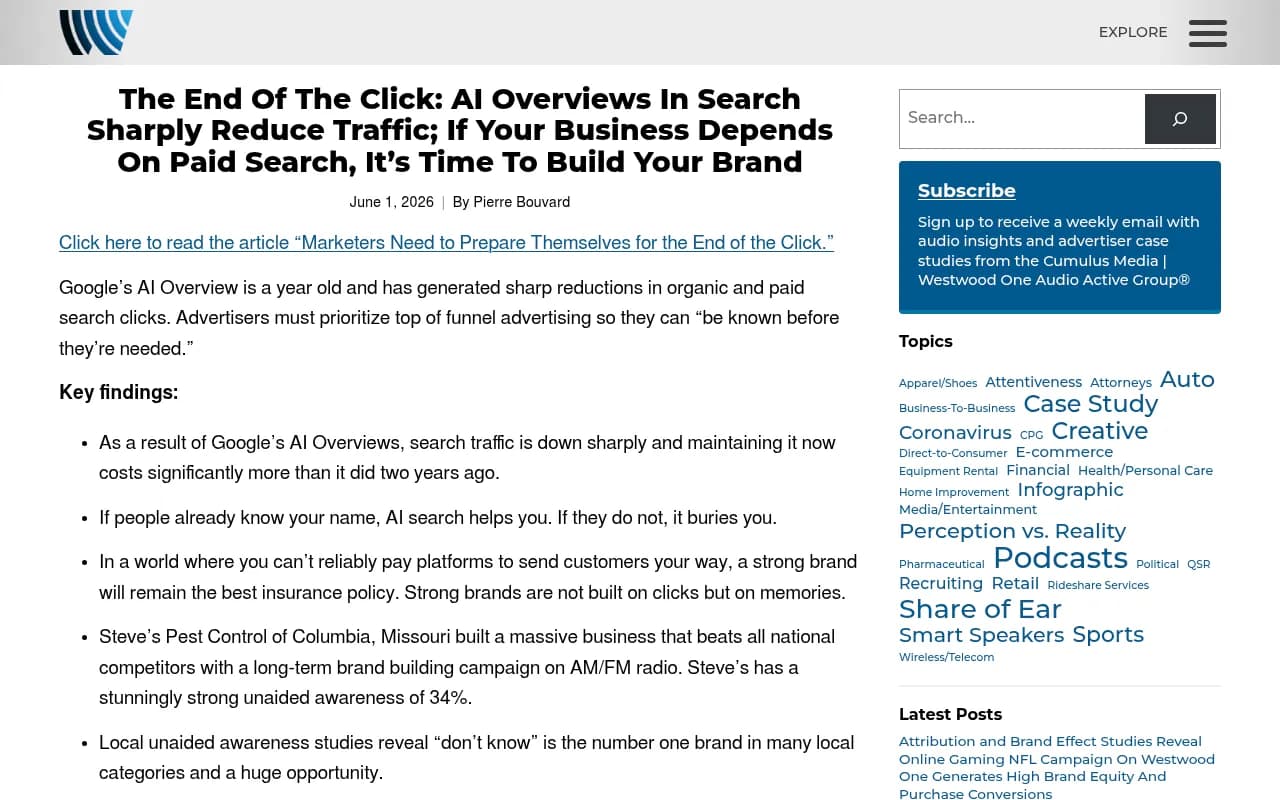
This is the part that gets buried under all the campaign-mechanics talk, and it shouldn't be. Westwood One's research on the "end of the click" makes a case I think is correct: in a world where you can't reliably pay a platform to send someone to you, a strong brand is the best insurance you have left. Their data on local unaided awareness is genuinely striking, "don't know" is the number-one answer across categories like plumbing, roofing, and chiropractic care when people are asked to name a business off the top of their head. Meanwhile Steve's Pest Control in Columbia, Missouri, built 34% unaided awareness in its market through years of consistent radio advertising and now outperforms national competitors locally.
The logic connects directly to the CTR numbers above. If AI search rewards brands people already know, 18% CTR lift on branded queries, 35-91% more clicks when a brand is cited, then brand-building spend isn't a nice-to-have running parallel to your search budget. It's the thing that determines whether your search budget still works at all in two years.
Comparing the ad surfaces
| Platform | Ad model | Where ads appear | Current scale | Key constraint |
|---|---|---|---|---|
| Google AI Overviews | CPC/CPA/ROAS, same auction as standard Search | Inside box (12 countries), above/below (200+ markets) | Over 60% of all Google searches show an AI Overview | No opt-out, no separate bidding, no segmented reporting |
| Google AI Mode | CPC, ~35% premium vs standard search | Inline citations, sidebar cards, post-response, follow-up sponsorship | ~25.5% of AI Mode results carry an ad; 75-100M+ MAU (sources vary) | Limited to Performance Max and AI Max for Search campaigns |
| ChatGPT Search | Unclear/testing, appears alongside citations | Within search-enabled responses | ~32% of search responses as of mid-August 2026, up from 0% in May | No self-serve ad buying platform publicly available yet |
| Perplexity | CPM, reportedly $30-50 range | Sponsored results alongside answers | Over 100M users, ~$200M annualized revenue reported | Ad program status has fluctuated; verify current availability |
A note on verifying claims before you act
A few figures in circulation right now conflict depending on the source and the month, AI Mode's monthly active users range from 75 million to over 100 million depending on whether you're reading Digital Applied or a Forbes/TechCrunch figure, and Perplexity's ad testing has reportedly both expanded and paused at different points this year. Don't build a Q1 budget around a single stat you read once. Check it against a second source, and check it again closer to your actual spend date, because these programs are genuinely moving month to month.
What this means for your 2026 plan, concretely
If I had to compress this into three moves for a brand marketer reading this in October 2026: first, don't panic-cut your search budget, the ad inventory inside AI Overviews and AI Mode is real and growing, and opting out isn't even possible for eligible campaign types, so you might as well make sure you're structurally eligible to compete for it. Second, treat your product pages and landing pages as the primary citation surface for AI search, not an afterthought behind your blog content, because that's measurably where ChatGPT and Google's AI systems are pulling from. Third, and this is the one people skip, put real money behind being a brand someone names unprompted. The data keeps saying the same thing from different angles: branded queries outperform, cited brands get more clicks, and unaided awareness is worth more now than it was when the click was guaranteed.
If you want a tool-level view of how your specific brand shows up across ChatGPT, Gemini, AI Overviews, Perplexity, and the rest, with the ad and shopping placements tracked alongside citations, that's the kind of monitoring Promptwatch was built for, and it's worth a look before you lock in next year's search and GEO budget. For a broader survey of platforms doing this kind of AI visibility tracking, the directory at bestgeosoftware.com is a reasonable place to compare options side by side.