Key takeaways
- Ads in AI Overviews aren't a new campaign type. They're new placements for existing Search, Shopping, and Performance Max campaigns, now rendered above, below, and inside the AI-generated answer.
- Google Ads data confirms in-AI-Overview ads require AI-powered, keywordless targeting (broad match, AI Max, Performance Max, Shopping, or Dynamic Search Ads) because the long, conversational queries that trigger AI Overviews rarely match the exact keywords advertisers bid on.
- AI Mode introduced genuinely new formats in 2026, including Conversational Discovery ads, Highlighted Answers, in-line shopping cards, and a chat-based Business Agent for Leads.
- Shopping inside AI Mode is close to a different marketplace: only 1.28% of products in the standard Google Shopping carousel also show up in AI Mode for the same query, and AI Mode surfaces far fewer products at noticeably higher average prices.
- Sensitive verticals (finance, healthcare, alcohol, gambling, adult, politics) are still largely excluded from ads inside AI Overviews, though Google has quietly begun a small healthcare ad test inside AI Mode, a signal worth watching.
Why this matters right now
If you've been running Google Ads for more than a year, you've probably noticed the SERP looks different than it did in 2024. More queries trigger a generated answer before any blue links show up. Search Engine Land's reporting (cited via Terra's 2026 benchmark analysis) found that paid CTR on queries triggering AI Overviews can drop meaningfully compared to traditional results pages. SparkToro's 2026 numbers back this up from another angle: 68.01% of US Google searches ended without a click this year, up from 60.45% in 2024.
Google's answer to that zero-click pressure isn't to stop selling ads. It's to put ads inside the thing that's replacing the click. That's the entire story of this guide: five-ish distinct ad formats, three different surfaces (above/below the AI Overview, inside the AI Overview, and inside AI Mode), and a set of eligibility rules that quietly rewards advertisers who already run broad match, Performance Max, and well-structured Shopping feeds.
I'll be honest, some of this still feels half-built. Google's own reporting doesn't even separate AI-surface ad performance from regular "Top Ads" yet, according to Ads Liaison Ginny Marvin. You're optimizing for a placement you can't fully measure. That's the reality in late 2026, not a flaw in your setup.
The three places ads can appear around an AI Overview
Google's own Ads Help documentation lays out three distinct zones, and they behave very differently.
1. Above and below the AI Overview
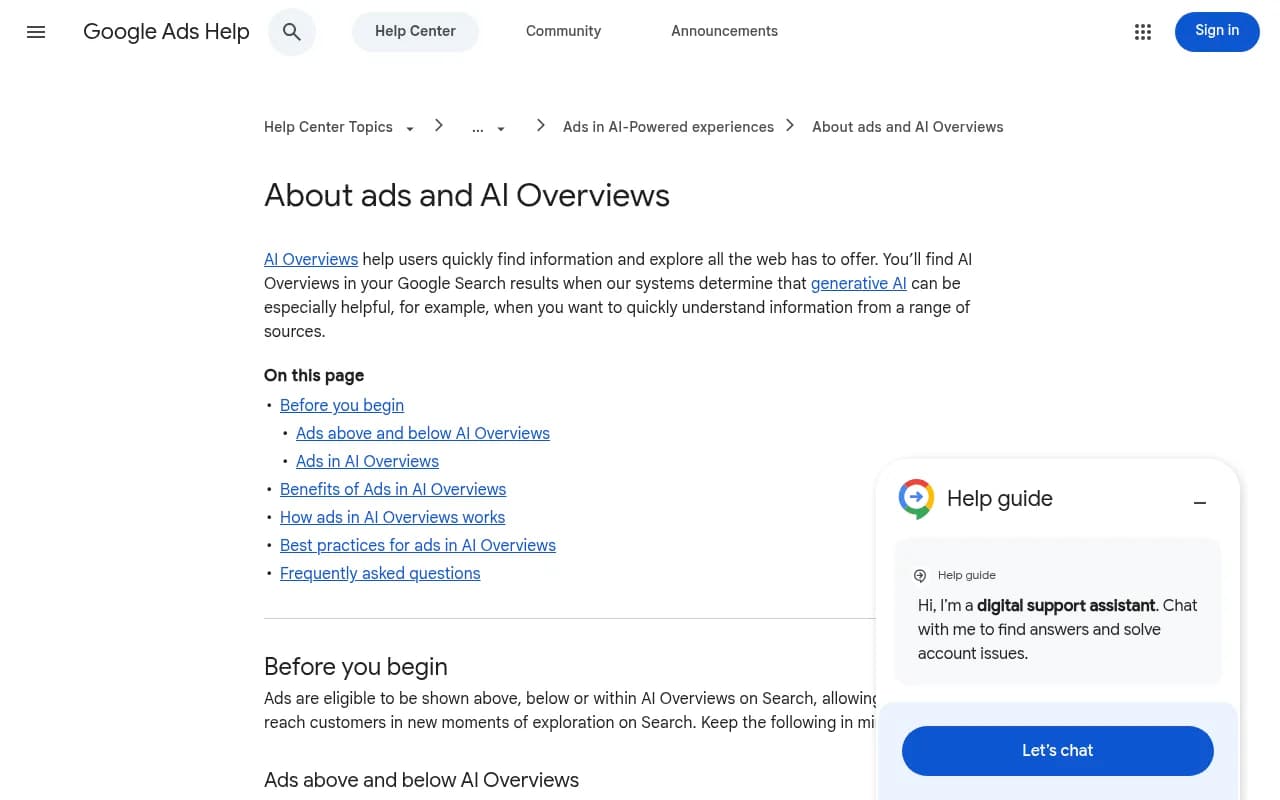
This is the least disruptive placement and the one with the widest reach. Ads here are eligible in all 200+ markets where AI Overviews exist, use the standard auction ranking system, and work with any existing text, shopping, local, or app ad from your Search, Shopping, Performance Max, or App campaigns. Nothing new to build here. If your account is healthy today, you're already eligible.
2. Inside the AI Overview itself
This is the interesting one, and it's far more restricted. According to Google's official documentation, ads rendered inside the AI Overview are currently limited to English, on mobile and desktop, in only 12 markets: Australia, Canada, India, Indonesia, Kenya, Malaysia, New Zealand, Nigeria, Pakistan, Philippines, Singapore, and the US. Only Text and Shopping ads from Search, Shopping, and Performance Max campaigns qualify, not Demand Gen, Display, or Video.
The matching logic is the part most advertisers miss. Google uses both the user's query and the content Gemini generated in the AI Overview as signals. Google's own example: someone searches "why is my pool green and how do I clean it." The query itself has no obvious purchase intent, but the generated answer talks about cleaning steps, so Google infers commercial intent and can slot in Shopping ads for pool vacuum cleaners, even though nobody bid on that exact query. This is why Google requires broad match, AI Max, Performance Max, Shopping, or Dynamic Search Ads for this placement. Tightly scoped exact-match campaigns simply can't catch queries this long and this conversational.
3. Inside AI Mode
AI Mode is where Google has been shipping actual new formats, not just new placements for old ones. Coverage of Google Marketing Live 2026 and a breakdown from Torro Media point to roughly five concrete patterns showing up in AI Mode responses:
| Format | Where it sits | Closest existing analog |
|---|---|---|
| Bottom text ads | Stacked after the AI Mode answer, labeled Sponsored | Standard Search ad |
| Bottom shopping carousel | Horizontal row of products after an explanatory answer | Shopping ad unit |
| In-line single product card | One sponsored product embedded inside the generated text | Native product placement |
| In-line non-rich mention | Brand or product named in the text without a full card | Contextual mention |
| Sponsored product grid | Grid of multiple sponsored products after a buying guide | Shopping comparison grid |
On top of that structural layout, Google announced two genuinely new ad experiences at GML in May 2026.
Conversational Discovery ads are generated in real time by Gemini to respond to the actual phrasing of a query, not a generic keyword match. Google's own example was a search for a home scent that evokes "a luxury spa or a rainy forest" with low-maintenance upkeep, the ad copy and product framing adapt to that specific mood and constraint rather than running a static creative. These are currently in US testing on mobile and desktop.
Highlighted Answers let a product earn a labeled spot directly inside an AI-generated recommendation list, like "best language learning apps," if it's genuinely one of the better options for that query. Both of these formats carry an "independent AI explainer," a Gemini-written note about the product that's separate from the advertiser's own copy, alongside the standard Sponsored label.
Google also previewed AI-powered Shopping ads for big-ticket, considered purchases like espresso machines or TVs, where Gemini writes a custom explainer tying a specific product in your feed to the specific query, and a Business Agent for Leads, which swaps a static lead form inside the ad for a Gemini-powered chat window that answers questions using your own site content. Both were described as rolling out later in 2026, with Business Agent for Leads in open beta for US advertisers.
Campaign types that actually qualify
Across every format above, the eligible campaign types are a short, repeating list: Performance Max, AI Max for Search, AI Max for Shopping, broad match Search, Dynamic Search Ads, and standard Shopping campaigns. Standard exact and phrase match campaigns were historically shut out of AI Overview and AI Mode placements, but that changed in September 2026 when Google confirmed exact and phrase match keywords in standard Search campaigns became eligible to trigger text ads in AI Mode for direct-intent queries specifically. Conversational and exploratory queries still require AI Max or Performance Max.
Google has also been auto-migrating eligible Search campaigns to AI Max for Search since September 1, 2026, and reports a 7% average conversion lift from the full AI Max suite, climbing to 27% for accounts that were previously stuck on exact and phrase match only. If your account hasn't been touched by that migration yet, it's worth checking manually rather than assuming it already happened.
Shopping feeds need a separate strategy for AI Mode
This is the stat that should change how you prioritize your Merchant Center work. Research cited by Common Thread Co in September 2026 found that only 1.28% of products appearing in the standard Google Shopping carousel also show up in AI Mode for the identical query on the same day. AI Mode surfaces an average of 3.9 products per query, against 27.8 in standard Shopping search, and the prices shown in AI Mode average 21.6% higher.
Read that again: your Shopping feed might be performing fine in classic Search while being almost invisible in AI Mode for the exact same products. Google's own testing found that "conversational attributes" in Merchant Center, descriptive, natural-language product attributes rather than bare spec sheets, showed up in half of one retailer's AI Mode product recommendations during a controlled test. If you haven't filled those fields in, that's a concrete, low-effort fix before you touch bids.
Google's newer AI Performance Insights tool, generally available in Australia, Canada, India, New Zealand, and the US as of mid-September 2026, gives a share-of-voice view specifically for AI Mode and AI Overviews. It's worth turning on before you make big structural changes, since it's currently the only native way to see how you're actually doing in these surfaces separately from regular Top Ads reporting.
Sensitive verticals: the rules are shifting
Google's documented policy excludes ads inside AI Overviews for adult content, alcohol, gambling, finance, healthcare, and politics, among other sensitive categories. That's still accurate for AI Overviews specifically. But Google confirmed through Ads Liaison Ginny Marvin that it has begun a small test of ads inside AI Mode for the healthcare vertical, limited to US advertisers running English queries, using the same eligible campaign types (Performance Max, AI Max with search-term matching, Shopping, broad match). The first phase explicitly excludes ads using pinned assets or text disclaimers, which narrows what creative is usable even for advertisers who get into the test.
If you're in a regulated category, don't assume the exclusion is permanent. Watch Google's product announcements specifically for AI Mode, not AI Overviews, since that's where the exceptions are starting to appear.
Disclosure labels for AI-made creative
Since July 9, 2026, Google has required a "How this ad was made" disclosure inside My Ad Center, reachable through the three-dot menu or info icon, covering Search, YouTube, and Discover ads. If you build creative with Google's own generative ad tools, the disclosure gets added automatically. If you use something else, like the Canva and Nano Banana workflows that have become common for static ad production in 2026, you get a self-declare control instead.
The part advertisers tend to miss: depending on local rules, the label can show directly on the ad itself, not just buried in an info panel, which means the same global campaign could display differently market to market. Inconsistent disclosure across regions reads as sloppy, not compliant, so it's worth deciding on one disclosure posture centrally rather than letting it vary by account manager.
How AI Overview ads compare to ads in other AI answer engines
It helps to see Google's multi-format approach against what competitors are doing, because the contrast is sharp.
| Platform | Ad placement | Format variety | Frequency |
|---|---|---|---|
| Google AI Overviews / AI Mode | Above, below, and inside the answer | Text, Shopping, carousel, grid, in-line cards, Conversational Discovery, Highlighted Answers | Varies by market and vertical |
| ChatGPT | Single sponsored card below the response | One format | Rising fast: Promptwatch's data shows ads went from 0% before May 27, 2026 to a 29.6% 30-day average by mid-August, peaking past 43% on individual days |
That ChatGPT trajectory is worth sitting with for a second. OpenAI went from zero ad inventory to showing ads in roughly three out of ten web-search responses in under three months. Promptwatch's breakdown of ChatGPT ads over the past 90 days also shows the ad mix is heavily weighted toward organic, non-branded prompts (around 73% of ad-bearing responses), with brand-specific and competitor-comparison prompts making up smaller shares. If you're used to thinking of AI answer engines as ad-free zones, that assumption is already out of date, and Google's push into AI Overviews and AI Mode is the same dynamic playing out on a platform you've been advertising on for twenty years.
For marketers trying to track where their brand actually shows up across these surfaces, whether that's an ad, a citation, or a product card, tools built specifically for AI search visibility are becoming part of the standard toolkit alongside Google Ads reporting. Promptwatch tracks citation and shopping behavior across ChatGPT, Gemini, Perplexity, and Google's AI surfaces, including its own Ads Radar for tracking sponsored placements and Shopping feature triggers inside ChatGPT specifically.
A practical checklist before you touch anything
- Confirm your eligible campaign types. If you're still running tightly scoped exact-match Search campaigns with no AI Max layer, you're shut out of most AI Overview and AI Mode inventory for conversational queries.
- Audit your Shopping feed for AI Mode separately from classic Shopping performance. Given the 1.28% product overlap finding, don't assume a healthy Shopping feed in regular search means anything for AI Mode.
- Fill in conversational product attributes in Merchant Center if you haven't already. It's a concrete lever tied to real test data, not a vague "optimize your feed" suggestion.
- Decide your AI-disclosure posture centrally if you're running the same creative across multiple markets.
- Turn on AI Performance Insights if you're in one of the five markets where it's live, since it's currently the only native separation of AI-surface performance from standard reporting.
- If you're in a regulated vertical, track Google's AI Mode announcements specifically, since that's where exceptions like the healthcare test are emerging, not in the AI Overviews documentation.
None of this is finished product. Google is still testing formats, still migrating campaigns automatically, and still hasn't given advertisers a clean performance breakout for any of it. The advertisers who'll be ahead of this by the time it stabilizes are the ones adjusting their campaign structure and feed quality now, not waiting for a polished reporting dashboard that doesn't exist yet.